GPVHOSO GeForce GTX 750 Ti 4GB GDDR5

Tarjeta de perfil bajo para cajas delgadas verificado el 28 nov
14/100 puntuación global 4,3 media de 40 valoraciones de propietarios
- GPU
- GeForce GTX 750 Ti
- VRAM
- 4GB GDDR5
- Boost clock
- 1020 MHz
- TDP
- 60 W
- Memory bus
- 128 bit
- Class
- consumer
Compara precios en 1 tienda
De la más barata a la más cara. Las ofertas nuevas, reacondicionadas y en pack se mantienen separadas para que compares lo comparable.
| Tienda | Vendido por | Color y estado | Precio | vs. el más bajo | Última comprobación | Enlace |
|---|---|---|---|---|---|---|
| Nuevo1 ofertaUnidad individual | ||||||
| Agotado en la última comprobación | ||||||
| Amazon | Desconocido | No indicado | Sin precio | Agotado | 8 nov | Ir a la tienda |
 Fuente: PriceZen, comprobado el 8 nov 2026
Un precio se considera vigente si lo comprobamos en los últimos 7 días. «Vendedor externo» significa un vendedor de terceros en esa tienda, no la propia tienda.
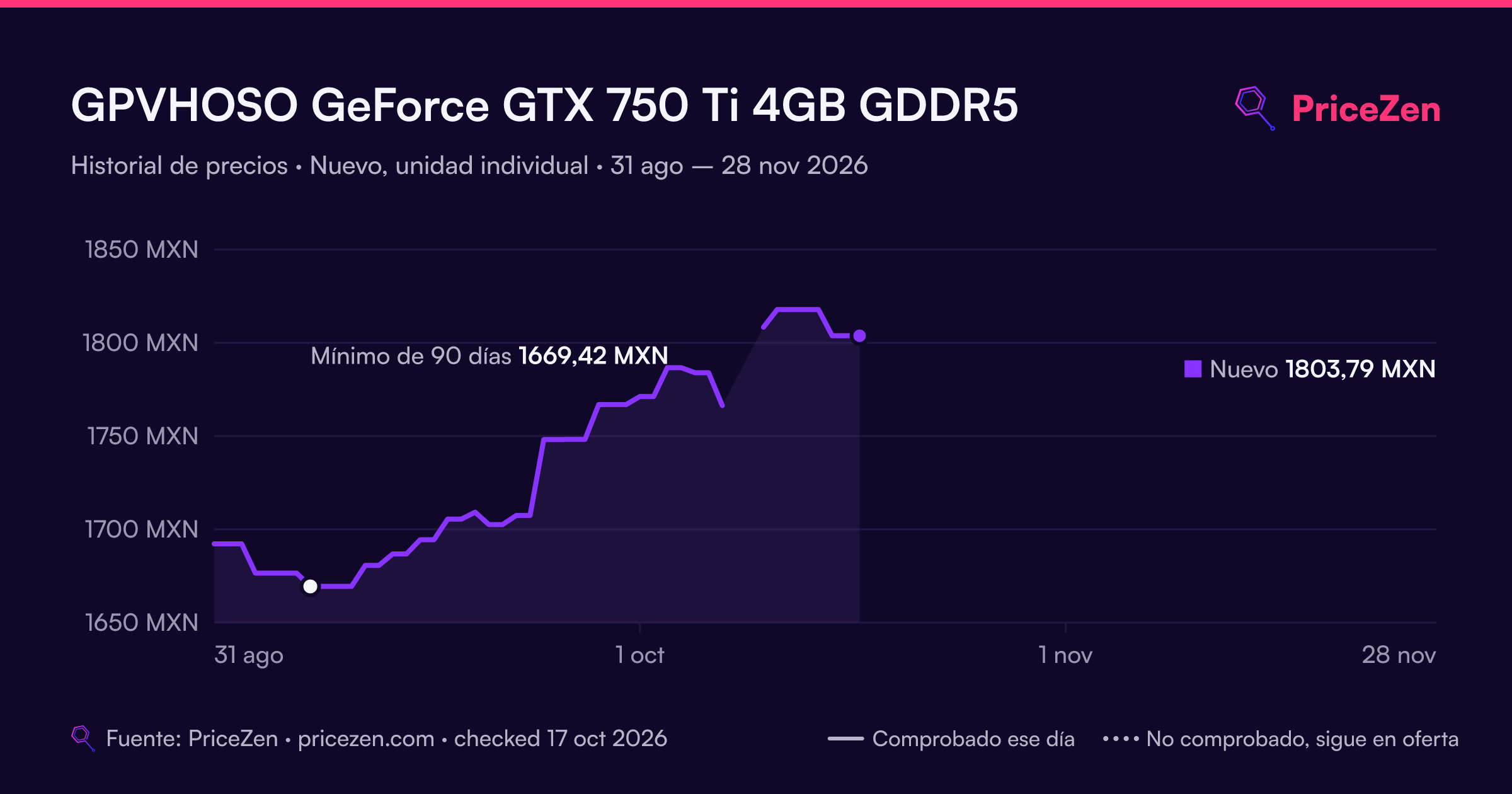
Historial de precios
Comprobado ese díaNo comprobado ese día, sigue en oferta
Fuente: PriceZen, checked 17 oct 2026











Resumen
The 30-Second Version
The GPVHOSO GeForce GTX 750 Ti is a low-power budget graphics card that's quiet, easy to install, and perfect for reviving old PCs or handling basic tasks. It runs older games like League of Legends and Dota 2 fine, but modern AAA titles are completely out of reach. Buy it for the 60W power draw and simplicity, not for gaming performance.
Pros & Cons
Ventajas
- Only 60W TDP, no extra power connector needed 94th
- Very quiet operation, owners consistently praise this
- Easy installation in prebuilts and small form factor PCs
- 4GB VRAM handles older games and basic tasks fine
- Good value for budget builds and office machines
Desventajas
- Bottom 14th percentile for raster performance
- Can't run modern AAA titles at all
- 4GB VRAM is restrictive for anything recent
- Only 1x HDMI output, limited connectivity
- No modern features like ray tracing or DLSS
Opinión de los propietarios
The Word on the Street
- Buyers consistently praise how quiet this card runs, with multiple owners mentioning it's nearly silent even under load.
- The no-power-connector design is a huge selling point, especially for people with weak or proprietary power supplies in prebuilt systems.
- A common complaint is that the card simply can't handle newer games, with several owners noting it struggles with anything released in the last few years.
Cómo cambió la opinión de los propietarios con el tiempo
ExclusivaSegún cuándo escribieron realmente sus opiniones los clientes, para ver si los elogios iniciales se mantuvieron.
8 opiniones escritas, dic 2025 – mar 2026: 8 satisfechos
En las 40 valoraciones de tiendas: 4,3★. La mayoría de los propietarios valora sin escribir una opinión. El gráfico cuenta las 8 opiniones escritas.
Cada punto es una opinión escrita, en el mes en que se escribió. Satisfechos = 4-5★, neutrales = 3★, insatisfechos = 1-2★.
Las pruebas
Performance
The GTX 750 Ti scores 3,899 in PassMark G3D, which puts it in the bottom 14th percentile for raster performance in our database. That's not a typo. This card is genuinely one of the weakest GPUs we've tracked in terms of raw rendering power. The 640 CUDA cores clocked at 1020MHz boost and 4.375 FP32 TFLOPS of compute put it well behind even integrated graphics on modern CPUs in some workloads.
In practice, you're looking at smooth 1080p gameplay in older titles like League of Legends, Dota 2, CS:GO, and Minecraft. Those games will run fine at medium settings. But anything from 2020 onward is going to struggle, and 2024 AAA titles are basically off the table. The 4GB of VRAM helps with texture loading in older games, but the memory bandwidth of 192 GB/s is a hard ceiling. Don't expect to push high refresh rates or crank settings. This is a 60fps-at-low-settings card for esports titles, and that's about it.
Specifications
Full Specifications
Chipset
| GPU Chipset | GeForce GTX 750 Ti |
| Brand | NVIDIA |
| Architecture | Pascal |
| Class | consumer |
| Process | 16 |
Memory
| VRAM | 4 GB |
| Memory Type | GDDR5 |
| Memory Bus | 128 |
| Bandwidth | 192.2 |
Compute
| CUDA Cores | 640 |
| Stream Processors | 640 |
| Base Clock | 1020 |
| Boost Clock | 1020 |
| FP32 TFLOPS | 4.375 |
Performance
| PassMark G3D | 3899 |
| GPU Compute | 4264 |
Power & Cooling
| TDP | 60 |
| Recommended PSU | 300 |
| Power Connectors | None |
Connectivity
| Interface | PCI Express 3.0 x16 |
| DisplayPort | 0 |
| HDMI | 1 |
| Max Displays | 3 |
| Max Resolution | 4K |
Physical
| Weight | 0.5 kg / 1.2 lbs |
Features
| DirectX | 12 |
vs Competition
Stacked against modern budget cards, the GTX 750 Ti looks rough. The ASUS TUF RTX 5090 and Gigabyte RTX 5070 Ti Eagle are in a completely different universe, obviously, but even something like a used GTX 1650 or RX 6400 will run circles around this card while still fitting in low-power builds. The RX 6400 specifically draws about the same power and offers significantly better performance for not much more money.
Where the 750 Ti wins is simplicity. No power connector, no driver headaches on older Windows versions, and it just works. The MSI Ventus RTX 5070 Ti and ZOTAC SOLID OC are powerful cards, but they need serious PSUs and cost many times more. If you're building a retro gaming rig or reviving a Dell OptiPlex, this card makes sense. For anything else, you're better off looking at newer low-profile options or the used market.
| Spec | GPVHOSO GeForce GTX 750 Ti | ASUS GeForce RTX 5090 TUF Gaming | Gigabyte GeForce RTX 5070 Ti Eagle Ice | MSI GeForce RTX 5070 Ti Ventus 3X OC | ZOTAC GeForce RTX 5080 APOCALYPSE | PNY GeForce RTX 5080 ARGB OC |
|---|---|---|---|---|---|---|
| Chipset | GeForce GTX 750 Ti | GeForce RTX 5090 | GeForce RTX 5070 Ti | GeForce RTX 5070 Ti | GeForce RTX 5080 | GeForce RTX 5080 |
| Vram | 4GB GDDR5 | 32GB GDDR7 | 16GB GDDR7 | 16GB GDDR7 | 16GB GDDR7 | 16GB GDDR7 |
| Boost Clock Mhz | 1020 | 2407 | 2542 | 2482 | 2730 | 2620 |
| Tdp W | 60 | 575 | 300 | 300 | 360 | 360 |
| Memory Bus Bits | 128 | 512 | 256 | 256 | 256 | 256 |
| Ray Tracing | - | Yes | Yes | Yes | Yes | Yes |
| GPU Class | consumer | consumer | consumer | consumer | consumer | consumer |
| Compare | Compare | Compare | Compare | Compare |
| Producto | AI | Rt | Vram | Raster | Compute | Feature | Thermal | User Sentiment | Efficiency | Connectivity | Valoración social | Affordability |
|---|---|---|---|---|---|---|---|---|---|---|---|---|
| GPVHOSO GeForce GTX 750 Ti | 14.2 | 13.6 | 14.2 | 13.7 | 8.1 | 10.5 | 6.2 | 33.8 | 20.3 | 17 | 49.1 | 93.7 |
| ASUS GeForce RTX 5090 TUF Gaming Compare | 97.2 | 90.5 | 97.8 | 98.8 | 97.7 | 95.7 | 71.9 | 85 | 23.1 | 99.3 | 98.7 | 2.2 |
| Gigabyte GeForce RTX 5070 Ti Eagle Ice Compare | 78.9 | 88.6 | 86 | 88.9 | 87.9 | 95.7 | 91.8 | 85 | 71.7 | 94.2 | 93.4 | 22.8 |
| MSI GeForce RTX 5070 Ti Ventus 3X OC Compare | 78.9 | 92.4 | 86 | 88.9 | 87.9 | 95.7 | 91.8 | 85 | 71.7 | 94.2 | 83.9 | 21 |
| ZOTAC GeForce RTX 5080 APOCALYPSE Compare | 85.5 | 97.7 | 89.1 | 94.5 | 93.3 | 95.7 | 91.8 | 99.5 | 56.6 | 94.2 | 98.7 | 22.9 |
| PNY GeForce RTX 5080 ARGB OC Compare | 85.5 | 97.7 | 89.1 | 94.5 | 93.3 | 95.7 | 91.8 | 71.1 | 56.6 | 94.2 | 74.9 | 15.7 |
Precio
Value & Pricing
At around 16,097 INR, the GPVHOSO GTX 750 Ti is a weird value proposition. For a brand new card with a warranty, it's not terrible if you specifically need a low-power, no-connector GPU for an old office PC or a media server. But you can often find used GTX 1050 Ti or RX 570 cards for similar money that absolutely demolish this thing in performance. The 4GB of VRAM is nice, but it's like putting a bigger gas tank on a moped. You're still not going anywhere fast. If your budget is tight and your power supply is weak, this works. Otherwise, save up a bit more or shop the used market.
Leer más
Overview
The GPVHOSO GeForce GTX 750 Ti is a budget graphics card that sits firmly in the "get my old PC working again" category. It's a 4GB GDDR5 card based on NVIDIA's ancient Maxwell architecture, and it's aimed at people who need basic display output, light gaming, or a cheap upgrade for an office machine. You won't find ray tracing, DLSS, or any modern features here, but you also won't find a power connector requirement, which is kind of the whole point.
This card draws just 60W from the PCIe slot alone, so it'll drop into almost any prebuilt or small form factor system without a PSU upgrade. That's the main selling point, honestly. If you've got a 180W power supply and a motherboard with an open x16 slot, this thing will work. It's also quiet, which owners consistently mention in reviews.
At around 16,000 INR on Amazon India, it's competing with used cards and other budget options. The 4GB of VRAM sounds decent on paper, but the 128-bit memory bus and 192 GB/s bandwidth tell the real story. This is a card for older games, basic productivity, and multi-monitor setups, not for anything released in the last few years.
Common Questions
Q: Is the GTX 750 Ti good for gaming?
It's fine for older and esports titles like League of Legends, Dota 2, and CS:GO at 1080p medium settings. Don't expect it to run modern AAA games from 2020 onward at playable frame rates.
Q: Does the GTX 750 Ti need a power connector?
No, the GTX 750 Ti draws only 60W from the PCIe slot and doesn't require any additional power cables. This makes it ideal for prebuilt systems with weak power supplies.
Q: Can the GTX 750 Ti run 4K?
It supports 4K display output for desktop use and video playback, but gaming at 4K is completely out of the question. This card is strictly a 1080p or lower gaming solution.
Q: Is 4GB VRAM enough for the GTX 750 Ti?
For older games and basic tasks, 4GB is adequate. But the 128-bit memory bus limits bandwidth to 192 GB/s, so the extra VRAM doesn't help much with modern titles that need both capacity and speed.
Who Should Skip This
Skip this card if you're building a gaming PC for anything released in the last five years. The GTX 750 Ti can't handle modern AAA titles, and even mid-range games from 2020 will struggle. If you need low-power performance, look at the RX 6400 or a used GTX 1650 instead. Content creators and anyone doing video editing or 3D modeling should also look elsewhere, the compute performance is in the bottom 7th percentile of our database. This card is for office machines, retro rigs, and media servers, not for anyone who wants to actually push pixels in modern games.
Verdict
Should you buy the GPVHOSO GTX 750 Ti? Only if you have a very specific use case. If you've got an old prebuilt with a weak power supply and you need basic display output, light gaming, or a cheap multi-monitor setup, this card does the job quietly and reliably. Owners report stable performance and easy installation, which matters when you're working with older hardware.
But if you're hoping to play modern games, do any kind of serious creative work, or future-proof your system even a little bit, this isn't the card for you. The performance numbers are genuinely bad by 2025 standards, and the 4GB of VRAM won't save you. This is a utility card, not a gaming card. Know what you're getting into, and you'll probably be happy with it.
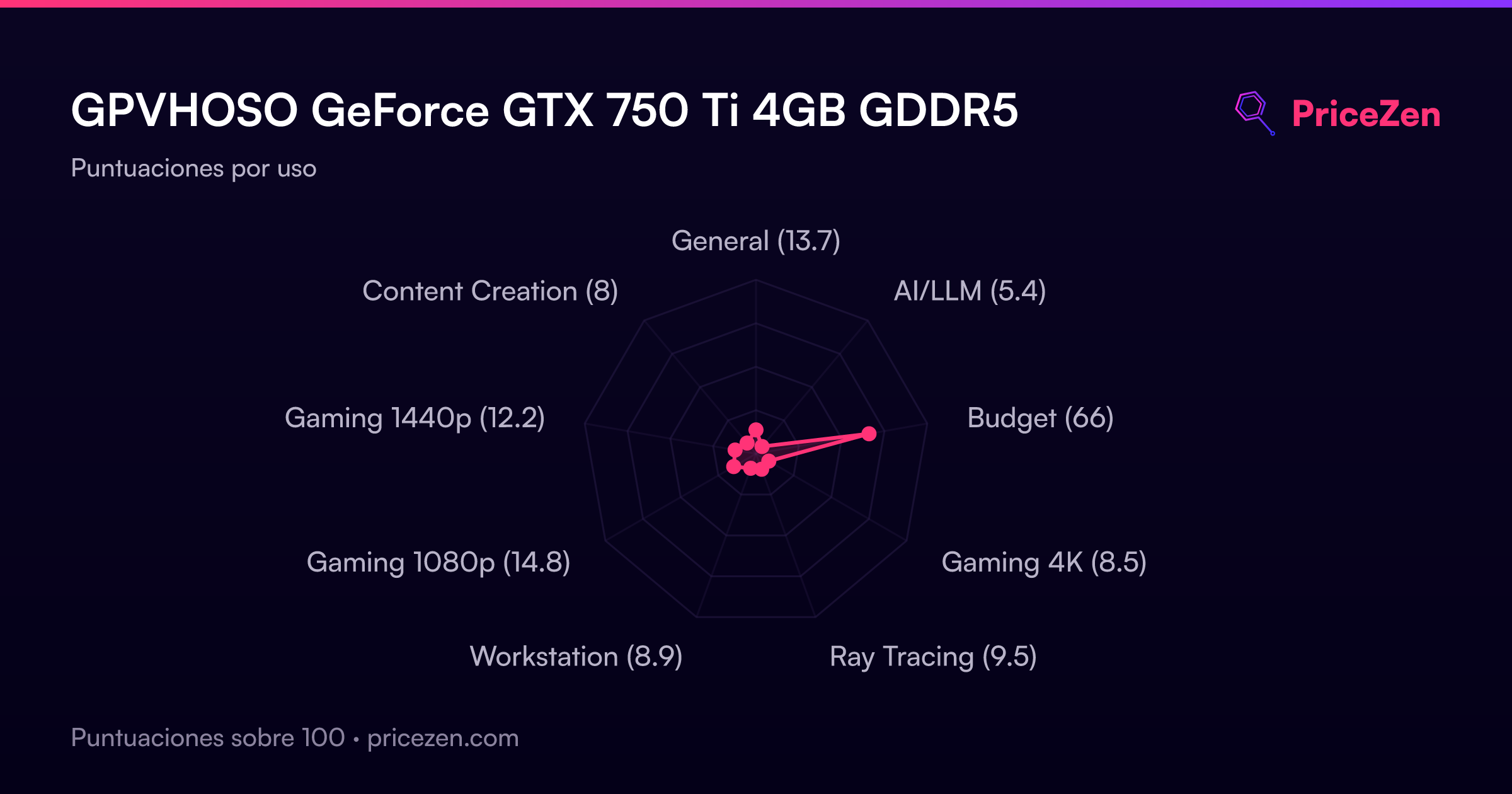
Usage Scores
- General13.7
- AI/LLM5.4
- Budget66
- Gaming 4K8.5
- Ray Tracing9.5
- Workstation8.9
- Gaming 1080p14.8
- Gaming 1440p12.2
- Content Creation8