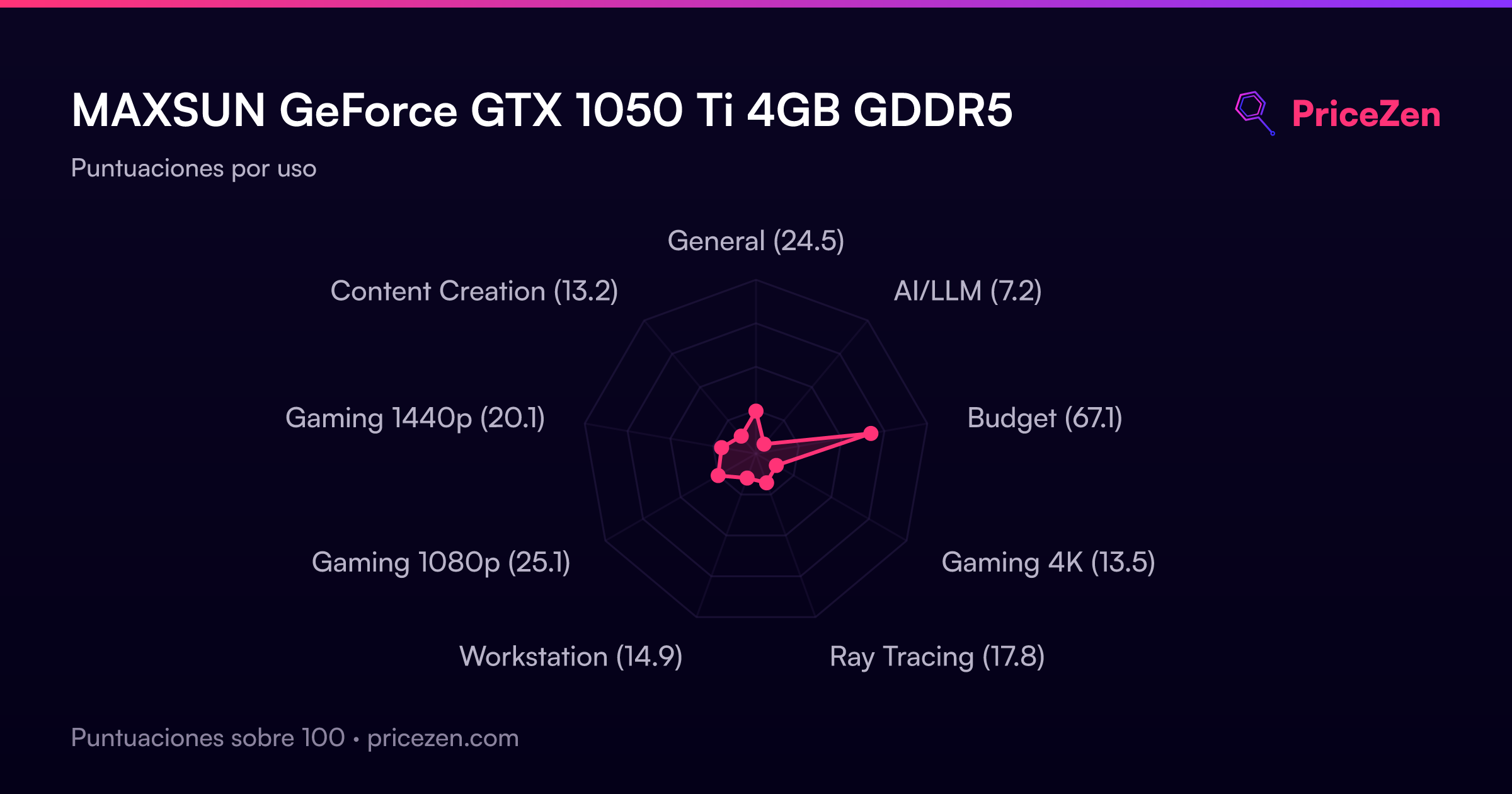
MAXSUN GeForce GTX 1050 Ti 4GB GDDR5
The 167mm low-profile card with a 75W TDP fits small form factor builds without extra power connectors, while the silver plated PCB and solid capacitors improve stability and thermals. Its 4GB GDDR5 memory and 1392MHz boost clock handle 1080p gaming at modest settings, and the single-slot bracket design suits slim cases. This is best for budget builders upgrading an office PC or HTPC for light gaming and media use.












Resumen
The 30-Second Version
The Maxsun GTX 1050 Ti LP is a low profile card for slim SFF builds, and that's its only real trick. Performance is bottom-tier with a 25.4 gaming score and weak compute. At $170 USD, you're paying a premium for the form factor, not the speed.
Pros & Cons
Ventajas
- Low profile design fits slim SFF cases most cards can't 86th
- 75W TDP means no extra power connector needed
- Silver plated PCB and solid caps suggest decent build quality
- Affordability ranks in the top 12% of cards we track
Desventajas
- 1080p gaming score of 25.4 is rough even for budget builds
- 4GB GDDR5 with 112 GB/s bandwidth chokes on modern titles
- DLSS and VR Ready claims are misleading on Pascal hardware
- Thermals and connectivity both rank in the bottom quarter
Opinión de los propietarios
The Word on the Street
Las pruebas
Performance
The numbers tell a rough story. PassMark G3D lands at 6366, which puts raster performance near the bottom of our database. 2.14 TFLOPS of FP32 compute is also one of the weakest results we track. For 1080p gaming, the score is 25.4 out of 100. That's not a typo. You can run older esports titles like CS2 or League at low settings, but anything from the last five years will struggle hard. The 112 GB/s memory bandwidth is a real bottleneck too. And despite the box mentioning DLSS and VR Ready, this Pascal card supports neither in any meaningful way. DLSS requires RTX hardware. VR Ready is a marketing stretch from 2016 that aged poorly.
Specifications
Full Specifications
Chipset
| GPU Chipset | GeForce GTX 1050 Ti |
| Brand | NVIDIA |
| Architecture | Pascal |
| Class | consumer |
| Process | 14 |
Memory
| VRAM | 4 GB |
| Memory Type | GDDR5 |
| Memory Bus | 128 |
| Bandwidth | 112.1 |
Compute
| CUDA Cores | 768 |
| Base Clock | 1291 |
| Boost Clock | 1392 |
| FP32 TFLOPS | 2.138 |
Performance
| PassMark G3D | 6366 |
| GPU Compute | 2668 |
Power & Cooling
| TDP | 75 |
| Recommended PSU | 300 |
| Power Connectors | None |
| Cooler | Fan |
| Fans | 1 |
Connectivity
| Interface | PCI Express X16 3.0 |
| DisplayPort | 1 |
| HDMI | 1 |
| Max Resolution | 7680x4320 |
Physical
| Length | 167 |
| Slot Width | 2 |
| Form Factor | Low Profile |
| Weight | 0.2 kg / 0.5 lbs |
Features
| Ray Tracing | No |
| Upscaling | DLSS |
| AV1 Encode | No |
| VR Ready | Yes |
| DirectX | 12 |
| RGB | No |
vs Competition
Stacked against the competition in our database, this card gets lapped. The MSI Ventus G5060, ASUS Dual RX9060XT, and Gigabyte Vision 3080 are all in a completely different universe performance-wise. Even the Sapphire PULSE and PowerColor Reaper RX9060XT cards make the 1050 Ti look like a relic. The only place this Maxsun card wins is physical size and power draw. Every competitor here needs more wattage and more case room. So if you're building in a shoebox, this might be your only new option. But that's a narrow niche.
| Spec | MAXSUN GeForce GTX 1050 Ti | ASUS GeForce RTX 5090 TUF Gaming | Gigabyte GeForce RTX 5070 Ti Eagle Ice | MSI GeForce RTX 5070 Ti Ventus 3X OC | ZOTAC GeForce RTX 5080 APOCALYPSE | Sapphire Radeon RX 7900 XTX NITRO+ |
|---|---|---|---|---|---|---|
| Chipset | GeForce GTX 1050 Ti | GeForce RTX 5090 | GeForce RTX 5070 Ti | GeForce RTX 5070 Ti | GeForce RTX 5080 | Radeon RX 7900 XTX |
| Vram | 4GB GDDR5 | 32GB GDDR7 | 16GB GDDR7 | 16GB GDDR7 | 16GB GDDR7 | 24GB GDDR6 |
| Boost Clock Mhz | 1392 | 2407 | 2542 | 2482 | 2730 | 2680 |
| Tdp W | 75 | 575 | 300 | 300 | 360 | 339 |
| Memory Bus Bits | 128 | 512 | 256 | 256 | 256 | 384 |
| Ray Tracing | No | Yes | Yes | Yes | Yes | Yes |
| GPU Class | consumer | consumer | consumer | consumer | consumer | consumer |
| Compare | Compare | Compare | Compare | Compare |
| Producto | AI | Rt | Vram | Raster | Compute | Feature | Thermal | Efficiency | Connectivity | Valoración social | Affordability |
|---|---|---|---|---|---|---|---|---|---|---|---|
| MAXSUN GeForce GTX 1050 Ti | 14.2 | 16.9 | 13.6 | 16.6 | 9.6 | 39.9 | 25.2 | 39.6 | 20.3 | 56.3 | 86.3 |
| ASUS GeForce RTX 5090 TUF Gaming Compare | 97.2 | 90.5 | 97.8 | 98.8 | 97.7 | 95.8 | 72.1 | 23.5 | 99.3 | 98.7 | 2.3 |
| Gigabyte GeForce RTX 5070 Ti Eagle Ice Compare | 79.1 | 88.7 | 86 | 89 | 88 | 95.8 | 91.9 | 71.8 | 94.2 | 93.3 | 24.6 |
| MSI GeForce RTX 5070 Ti Ventus 3X OC Compare | 79.1 | 92.4 | 86 | 89 | 88 | 95.8 | 91.9 | 71.8 | 94.2 | 83.8 | 23.9 |
| ZOTAC GeForce RTX 5080 APOCALYPSE Compare | 85.4 | 97.6 | 89.1 | 94.5 | 93.4 | 95.8 | 91.9 | 56.8 | 94.2 | 98.7 | 21.2 |
| Sapphire Radeon RX 7900 XTX NITRO+ Compare | 95.2 | 96.4 | 92 | 83.4 | 95.7 | 95.8 | 91.9 | 51.6 | 98.8 | 69.1 | 19.2 |
Precio
Value & Pricing
At $170 USD or $230 CAD, this is a tough sell. You're paying for the form factor, not the performance. The affordability percentile looks decent at 88th, but that's relative to all GPUs including much pricier ones. For the same money, a used GTX 1650 or even a low profile RTX 3050 will absolutely smoke this card. If you absolutely need low profile and can't find anything else, fine. Otherwise, save your cash or buy used.
Amazon 1 oferta Desde 3446 MXN
Seguimos los precios de este producto desde el 25 nov 2026. El gráfico aparecerá cuando tengamos más datos.
Leer más
Overview
The Maxsun GTX 1050 Ti LP is a low profile card aimed at small form factor builds and office PCs that need a little graphics boost. It sips power at 75W and fits in tight cases, which is genuinely useful if you're working with a slim Dell or HP prebuilt. But this is 2016 silicon, and it feels like it in 2025. 4GB of GDDR5 and 768 CUDA cores won't get you far in modern games.
Maxsun leans hard on the silver plated PCB and solid capacitors as selling points. Fine, sure, stability is nice. But the real story here is the form factor. At 167mm and low profile ready, it's one of the few cards that'll actually fit in those cramped office machines. Just don't expect miracles once it's in there.
Common Questions
Q: Does this card need an external power connector?
No. The 75W TDP is fully supplied through the PCIe slot, so it works in prebuilts with stock 300W power supplies.
Q: Can this run modern games at 1080p?
Not really. With a 25.4 gaming score and 4GB of GDDR5, expect low settings on older titles only. Newer games will be a slideshow.
Q: Will this fit in my small form factor case?
If your case accepts low profile cards, yes. At 167mm long and 2 slots thick, it's designed specifically for slim SFF builds.
Who Should Skip This
Skip this if you have a standard ATX case or any interest in modern gaming. The performance is too weak for the price, and you can find much faster used cards for the same money. Also skip if you need DLSS or ray tracing, because this Pascal card does neither despite what the box says.
Verdict
This card is for one specific person: someone with a slim prebuilt PC who needs basic display output and maybe light esports gaming. If that's you, it'll work. If you have a normal case and a normal power supply, buy literally anything else. The low profile tax is real, and you're paying it hard here.
Usage Scores
- General24.5
- AI/LLM7.2
- Budget67.1
- Gaming 4K13.5
- Ray Tracing17.8
- Workstation14.9
- Gaming 1080p25.1
- Gaming 1440p20.1
- Content Creation13.2