Gigabyte GeForce GTX 1080 Ti Gaming OC 11GB GDDR5X Black
The Pascal-based GTX 1080 Ti chip with 11GB of GDDR5X memory and a 1657MHz boost clock delivers strong 1440p gaming performance. Its all-black design with customizable RGB lighting and a triple-fan cooler offers a clean aesthetic and effective thermal management for overclocking. This card is best for 1440p gamers upgrading older systems who prioritize raw rasterization performance over modern AI features.

Sin precio actual de tiendas








Resumen
The 30-Second Version
The Gigabyte GTX 1080 Ti Gaming OC Black is a solid used card for older games and 1440p gaming, with 11GB of VRAM and great overclocking headroom. But at $395 USD, it's overpriced for what you get in 2025. No ray tracing, no DLSS, and limited connectivity make it a tough sell against modern budget cards. Buy it only if you're building a retro rig or need a cheap card for older titles.
Pros & Cons
Ventajas
- Excellent overclocking headroom thanks to 8+2 power phases and good memory chips 72nd
- Quiet triple-fan Windforce cooler at moderate fan speeds 69th
- 11GB of VRAM is still enough for 1440p gaming
- Stable performance under sustained load
- Clean all-black design with minimal GPU sag
Desventajas
- No ray tracing or DLSS support
- Aorus Graphics Engine software is buggy for some users
- Fans get noisy above 80% speed
- Price inflated by mining demand on the used market
- Connectivity options are extremely limited, 5th percentile
Opinión de los propietarios
The Word on the Street
Cómo cambió la opinión de los propietarios con el tiempo
ExclusivaSegún cuándo escribieron realmente sus opiniones los clientes, para ver si los elogios iniciales se mantuvieron.
7 opiniones escritas, ago 2017 – dic 2020: 7 satisfechos
En las 593 valoraciones de tiendas: 4,4★. La mayoría de los propietarios valora sin escribir una opinión. El gráfico cuenta las 7 opiniones escritas.
Cada punto es una opinión escrita, en el mes en que se escribió. Satisfechos = 4-5★, neutrales = 3★, insatisfechos = 1-2★.
Las pruebas
Performance
The raw numbers tell a mixed story. In our database, this card lands at 18,592 on PassMark G3D, which puts it in the middle of the pack for raster performance. That's solid for 1080p and even 1440p gaming, but it's not going to set any records. The 11.34 TFLOPS of FP32 compute is respectable, but it sits around the 25th percentile for compute overall, meaning modern cards have left it in the dust for anything beyond gaming.
Real-world implications? For 1080p gaming, this card scores 43.5 out of 100 in our rankings, which is honestly underwhelming. You'll get playable framerates in most titles, but you won't be maxing out settings in newer games. The 484 GB/s of memory bandwidth helps with texture-heavy scenes, but the lack of modern features like DLSS means you're relying on raw horsepower alone. If you're playing older titles or esports games, this card will feel great. If you're trying to run Cyberpunk 2077 at ultra, you'll be dialing things back.
Specifications
Full Specifications
Chipset
| GPU Chipset | GeForce GTX 1080 Ti |
| Brand | NVIDIA |
| Architecture | Pascal |
| Class | consumer |
| Process | 16 |
Memory
| VRAM | 11 GB |
| Memory Type | GDDR5X |
| Memory Bus | 352 |
| Bandwidth | 484.4 |
Compute
| Base Clock | 1518 |
| Boost Clock | 1657 |
| FP32 TFLOPS | 11.34 |
Performance
| PassMark G3D | 18592 |
| GPU Compute | 9598 |
Power & Cooling
| TDP | 250 |
| Recommended PSU | 600 |
| Cooler | Triple Fan |
| Fans | 3 |
Connectivity
| Max Resolution | 7680x4320 |
Physical
| Length | 279 |
| Slot Width | 2 |
| Form Factor | ATX |
| Weight | 1.4 kg / 3.1 lbs |
Features
| Ray Tracing | No |
| AV1 Encode | No |
| VR Ready | Yes |
| DirectX | 12 |
| RGB | Yes |
vs Competition
Stacked against modern competitors, the 1080 Ti shows its age. The ASUS TUF Gaming RTX 5070 Ti and MSI Suprim RTX 5080 are in a completely different league, with ray tracing, DLSS, and vastly better efficiency. The ZOTAC SOLID SFF OC RTX 5070 Ti is also a strong alternative if you want modern performance in a compact form factor. These cards cost more, but they're also new with warranties and current driver support.
On the AMD side, the Sapphire NITRO+ and XFX Mercury RX 9070 XT cards offer much better value for modern gaming. They have more VRAM, better compute performance, and actual ray tracing support. The 1080 Ti's only real advantage is price, and even that's debatable when you factor in the used market risks. If you're set on a Pascal card for nostalgia or specific workload reasons, the 1080 Ti is fine, but there's no scenario where it beats a modern mid-range card.
| Spec | Gigabyte GeForce GTX 1080 Ti Gaming OC | MSI GeForce RTX 5090 Gaming Trio | ASUS GeForce RTX 5090 TUF Gaming OC | PNY NVIDIA RTX PRO 6000 Blackwell Max-Q Workstation Edition | ZOTAC GeForce RTX 5090 SOLID OC White Edition | NVIDIA RTX PRO 6000 Blackwell Max-Q Workstation Edition |
|---|---|---|---|---|---|---|
| Chipset | GeForce GTX 1080 Ti | GeForce RTX 5090 | GeForce RTX 5090 | NVIDIA RTX PRO 6000 Blackwell Max-Q Workstation Edition | GeForce RTX 5090 | NVIDIA RTX PRO 6000 Blackwell Max-Q Workstation Edition |
| Vram | 11GB GDDR5X | 32GB GDDR7 | 32GB GDDR7 | 96GB GDDR7 | 32GB GDDR7 | 96GB GDDR7 |
| Boost Clock Mhz | 1657 | 2480 | 2580 | 2280 | 2422 | 2280 |
| Tdp W | 250 | 575 | 575 | 300 | 575 | 300 |
| Memory Bus Bits | 352 | 512 | 512 | 512 | 512 | 512 |
| Ray Tracing | false | true | true | true | true | true |
| GPU Class | consumer | consumer | consumer | workstation | consumer | workstation |
| Compare | Compare | Compare | Compare | Compare |
| Producto | AI | Rt | Vram | Raster | Compute | Feature | Thermal | User Sentiment | Efficiency | Connectivity | Valoración social | Affordability |
|---|---|---|---|---|---|---|---|---|---|---|---|---|
| Gigabyte GeForce GTX 1080 Ti Gaming OC | 49.2 | 32.9 | 43.2 | 40.3 | 25.3 | 28.1 | 72.1 | 64.4 | 26.8 | 5.1 | 69.2 | 62.2 |
| MSI GeForce RTX 5090 Gaming Trio Compare | 97.5 | 90.9 | 97.8 | 98.8 | 98.2 | 95.8 | 91.8 | 0 | 23.6 | 94.1 | 93.4 | 4.1 |
| ASUS GeForce RTX 5090 TUF Gaming OC Compare | 97.9 | 90.6 | 97.8 | 98.8 | 98.9 | 95.8 | 91.8 | 45.5 | 23.6 | 99.8 | 74.9 | 1.8 |
| PNY NVIDIA RTX PRO 6000 Blackwell Max-Q Workstation Edition Compare | 99.7 | 99.6 | 99.8 | 87.3 | 99.3 | 99.8 | 25.2 | 96.1 | 69 | 87.2 | 46.6 | 0.3 |
| ZOTAC GeForce RTX 5090 SOLID OC White Edition Compare | 97.3 | 90.9 | 97.8 | 98.8 | 97.8 | 95.8 | 91.8 | 85.5 | 23.6 | 94.1 | 39.6 | 1.8 |
| NVIDIA RTX PRO 6000 Blackwell Max-Q Workstation Edition Compare | 99.8 | 99.6 | 99.8 | 87.3 | 99.9 | 99.8 | 25.2 | 0 | 69 | 87.2 | 40.7 | 0.5 |
Precio
Value & Pricing
At $395 USD, this card is a tough sell in 2025. You're paying for a piece of history, not a competitive modern GPU. The 61st percentile affordability score suggests it's not outrageously priced compared to other cards in our database, but that's a low bar when you consider what else is out there. For similar money, you can find used RTX 3060 Ti or RX 6700 XT cards that offer better performance and modern features.
The value proposition really depends on your use case. If you're building a retro gaming rig or need a card for older titles at high refresh rates, the 1080 Ti still delivers. But if you want to play anything from the last few years at high settings, you're better off saving a bit more for something with RT cores and DLSS. The mining-era price inflation hasn't fully corrected, and you're still paying a premium for a card that's two generations behind.
Historial de precios
Leer más
Overview
The Gigabyte GTX 1080 Ti Gaming OC Black is a card from a different era, and honestly, that's part of the charm. Back when Pascal ruled the roost, this was the GPU you bought if you wanted flagship 4K gaming without selling a kidney. It packs 11GB of GDDR5X on a 352-bit bus, good for 484 GB/s of memory bandwidth, and a boost clock of 1657MHz in OC mode. The triple-fan Windforce cooler keeps the 250W TDP in check, and the all-black shroud looks clean in almost any build.
Who is this for in 2025? Mostly budget builders and tinkerers. At around $395 USD on the used market, it's a weird middle ground. It'll crush older titles and esports games, but modern AAA games with ray tracing will leave it wheezing. The 11GB of VRAM is still respectable, but the card's lack of RT cores and aging architecture means you're buying raw raster performance and not much else.
What makes it interesting is the overclocking headroom. Owners consistently report that the memory chips and power delivery are solid, and with 8+2 power phases, Gigabyte built this thing to be pushed. If you're comfortable tweaking fan curves and voltages, there's real performance left on the table. Just don't expect modern features like DLSS or AV1 encoding.
Common Questions
Q: Can this card handle 4K gaming?
Yes, but with caveats. The 11GB of VRAM and 484 GB/s of memory bandwidth help with 4K textures, but the card's raster performance sits around the 42nd percentile in our database. You'll get playable framerates in older 4K titles, but modern AAA games will require lowering settings. For smooth 4K gaming in 2025, you'd want something with more compute power and DLSS support.
Q: Is the GTX 1080 Ti still good for 1080p gaming?
It's decent, but not great. Our database scores it at 43.5 out of 100 for 1080p gaming, which is below average for modern cards. You'll get high framerates in esports titles and older games, but newer titles will need settings dialed back. If 1080p is your target, a used RTX 3060 or RX 6600 XT would serve you better for similar money.
Q: How much power does this card need?
The card has a 250W TDP, and Gigabyte recommends a 600W power supply. In practice, a quality 550W unit will work fine for most systems, but 600W gives you headroom for overclocking. Make sure you have two 8-pin PCIe power connectors available, as this card needs both.
Q: Does the RGB lighting work well?
The RGB Fusion lighting supports 16.8 million colors, but several owners note it's wasted unless you have a vertical GPU mount. The lighting is on the side of the card, so in a standard horizontal mount, you won't see much of it. The Aorus Graphics Engine software used to control the lighting is also buggy for some users.
Who Should Skip This
If you're building a new gaming PC in 2025, skip this card. The lack of ray tracing, DLSS, and modern connectivity options makes it a poor foundation for a new build. You'd be better off with a used RTX 3060 Ti, RX 6700 XT, or even a new RTX 4060, all of which offer better performance and features for similar or slightly more money.
Also skip this if you care about quiet operation out of the box. The fans get noisy above 80% speed, and you'll need to manually set a fan curve to keep things quiet. If you want a plug-and-play experience, look elsewhere. And if you're doing any AI or machine learning work, the 26.5 out of 100 AI score makes this card a non-starter. Modern cards with tensor cores will run circles around it.
Verdict
For budget 1080p and 1440p gaming on older titles, the 1080 Ti is still a capable card. The 11GB of VRAM and solid raster performance mean you can play most games from before 2020 at high settings without issue. If you're building a secondary rig or upgrading an older system, this card will breathe new life into it. Just be prepared to tweak fan curves and maybe deal with the buggy Aorus software.
For anyone wanting to play modern AAA games, this card is a pass. The lack of ray tracing, DLSS, and modern connectivity options makes it a poor investment in 2025. You're better off spending a bit more on a used RTX 3060 Ti or RX 6700 XT, which offer better performance and features for similar money. The 1080 Ti was a legend in its day, but its day has passed.
Usage Scores
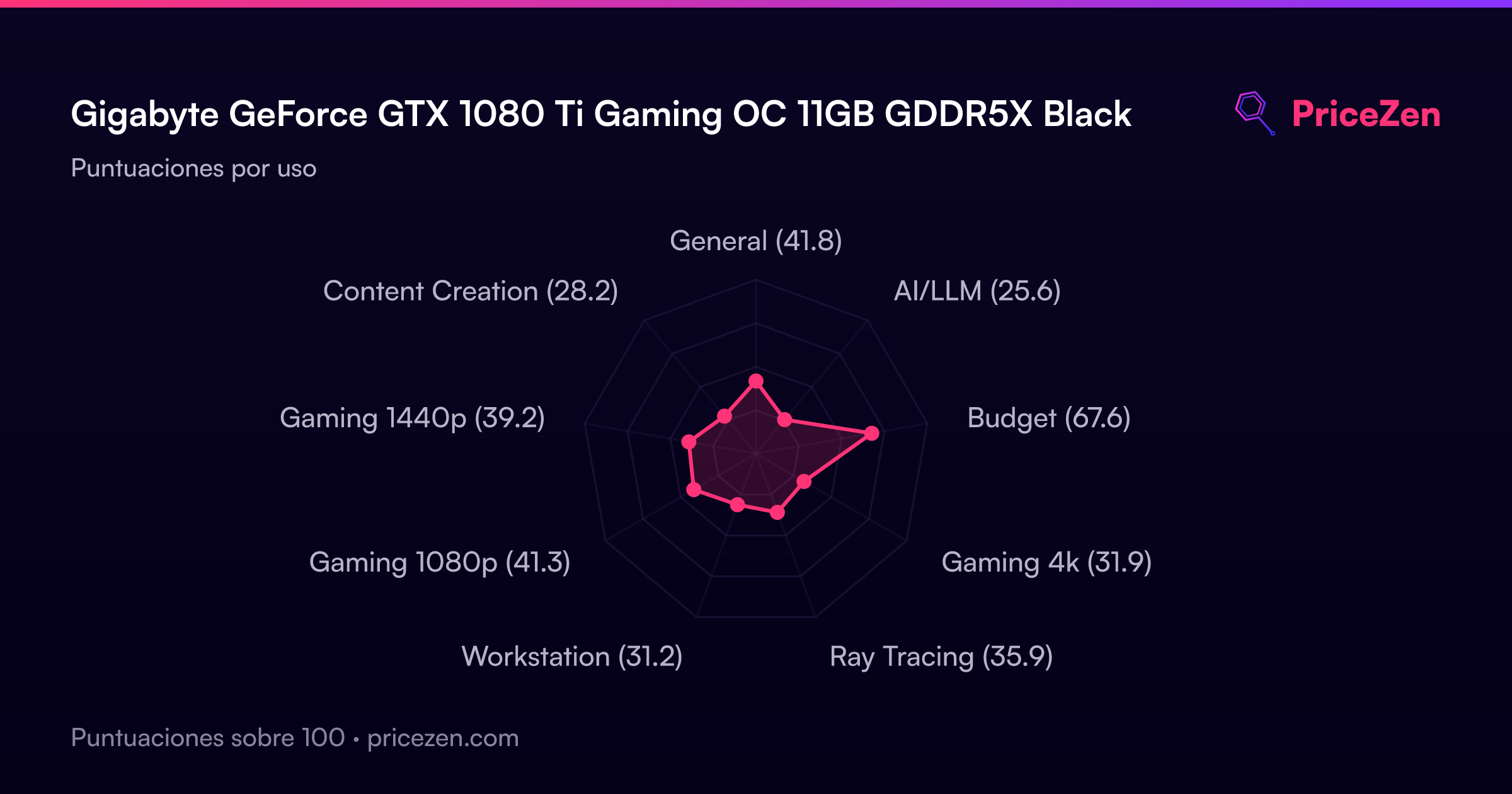
- General41.8
- AI/LLM25.6
- Budget67.6
- Gaming 4k31.9
- Ray Tracing35.9
- Workstation31.2
- Gaming 1080p41.3
- Gaming 1440p39.2
- Content Creation28.2