MSI Claw 8 EX AI+ 512GB Intel Arc G3 Handheld Console

55/100 puntuación global
- Platform
- PC
- Form factor
- Handheld
- Storage
- 512 GB
- Max resolution
- 1080p
- Screen
- 8" LCD
- Optical drive
- None
Compara precios en 1 tienda
De la más barata a la más cara. Las ofertas nuevas, reacondicionadas y en pack se mantienen separadas para que compares lo comparable.
| Tienda | Vendido por | Color y estado | Precio | vs. el más bajo | Última comprobación | Enlace |
|---|---|---|---|---|---|---|
| Nuevo1 ofertaUnidad individual | ||||||
| Agotado en la última comprobación | ||||||
| Amazon | Desconocido | No indicado | Sin precio | Agotado | Hace 3 días | Ir a la tienda |
 Fuente: PriceZen, comprobado el 25 nov 2026
Un precio se considera vigente si lo comprobamos en los últimos 7 días. «Vendedor externo» significa un vendedor de terceros en esa tienda, no la propia tienda.











Resumen
The 30-Second Version
The MSI Claw 8 EX AI+ packs 32GB of LPDDR5x, an 8-inch 120Hz touch display and an 80Wh battery into a genuinely portable Windows handheld, ranking in the top 14% for portability. But performance sits about average, 512GB of storage falls behind most rivals, and at USD 1,499 to 1,500 it's one of the priciest options going. Buy it for the RAM, the battery and the carry-anywhere Windows flexibility, not for raw gaming grunt.
Pros & Cons
Ventajas
- 32GB of LPDDR5x memory, unusually generous for a handheld and great for multitasking 79th
- Portability ranks in the top 14%, a standout for an 8-inch device 75th
- 80Wh battery rated up to 8 hours, a large cell for this form factor
- 120Hz 1920x1200 touch display matched to 1080p/120 fps output target
- WiFi 7 plus full Windows 11 Home, so your PC library and apps just work
Desventajas
- Affordability sits in the bottom 15%, one of the priciest options in the category
- 512GB SSD ranks in the bottom 27% for storage, small for modern game libraries
- Performance lands about average, only middle of the pack
- LCD panel rather than a higher-end display technology, ranking in the upper half
- 785g is portable for its class but still a chunk of hardware to hold for hours
Las pruebas
Performance
Let's talk about what those numbers actually mean. The Arc G3 with 10 Xe cores targets 1080p output at up to 120 fps, and the panel matches that with a 120Hz refresh rate. On paper the pipeline lines up nicely. But our performance ranking puts this about average in its category, which tells you the competition has caught up or passed it. Esports titles and older AAA games should be comfortable here. Demanding new releases at native 1920x1200 with settings cranked? That's where you'll be making compromises, and the 120Hz screen will spend a lot of time waiting for frames it doesn't get.
The 32GB of LPDDR5x is the spec that quietly does the most work. Integrated graphics share system memory, so having that much headroom means the GPU isn't starving while Windows and a launcher sit in the background. Multitasking is where this thing should feel genuinely unbothered. Storage is the weak link: 512GB on a PCIe Gen4x4 NVMe drive in the tiny 2230 form factor is fast but small, and our storage ranking puts it in the bottom 27%, which falls behind most of the field. Modern game installs eat that alive. There's microSD expansion, which helps, but you'll be managing your library rather than ignoring it. The display itself ranks in the upper half, solid but not special, and it's LCD rather than anything fancier. At 785g with an 80Wh cell, the weight-to-battery ratio is reasonable, and that's a big part of why portability scores so well.
Specifications
Full Specifications
Console
| Platform | PC |
| Form Factor | Handheld |
| Operating System | Windows 11 |
Performance
| CPU | Intel Arc G3 |
| GPU | Intel Arc Graphics |
| RAM (GB) | 32 |
| Max Resolution | 1080p |
| Max Frame Rate | 120 |
| HDR | No |
| Ray Tracing | No |
| VRR | No |
Storage & Media
| Storage (GB) | 512 GB |
| Storage Expansion | microSD |
| Optical Drive | None |
| Backward Compatible | No |
| VR Support | No |
Screen & Battery
| Screen Size (in) | 8 |
| Screen Resolution | 1920x1200 |
| Panel | LCD |
| Refresh Rate (Hz) | 120 |
| Touchscreen | Yes |
| Battery (Wh) | 80 |
| Battery Life (h) | 8 |
| Weight (g) | 785 |
Connectivity
| Wi-Fi | Wi-Fi 7 |
| Bluetooth | 5.4 |
| Ethernet | No |
| HDMI | 2.1 |
| USB Ports | 2 |
vs Competition
Our competitor set here is broad, and that matters. The Sony PlayStation 5 Pro and Microsoft Xbox Series X Disc Edition 2TB are home consoles, so they're not competing on portability at all. Against those, the Claw's argument is entirely that it fits in a bag and runs Windows. If you never leave the couch, that argument evaporates fast. The Nintendo Switch 2 is the opposite trade: a handheld built around its own games rather than your PC library. Cross-shop that one if you want simplicity and don't care about Steam.
The real fight is with the Lenovo Legion Go 2 1TB Ryzen Z2 Extreme and the ASUS ROG Xbox Ally X20. Those are the direct rivals, and this is where the Claw's rankings sting a bit. Its storage sits in the bottom 27% and performance about average, so if either of those rivals brings more capacity or more grunt to the table, the Claw is giving ground on the two things handheld gamers care most about. Where it pushes back is memory and portability: 32GB of LPDDR5x and a top-14% portability score are real advantages, and the 80Wh cell is a serious piece of hardware. If you want the lightest-feeling, most RAM-heavy Windows handheld and you can live with 512GB, the Claw makes its case. If you want maximum performance headroom, shop the Legion Go 2 and the Ally X20 hard before deciding.
| Spec | MSI Claw 8 EX AI+ 512GB Intel Arc G3 | Sony PlayStation 5 Pro | Microsoft Xbox Series X Disc Edition 2TB | Lenovo Legion Go 2 1TB Ryzen Z2 | Nintendo Switch 2 | ASUS ROG Xbox Ally X |
|---|---|---|---|---|---|---|
| Platform | PC | PlayStation 5 | Xbox Series | PC | Nintendo Switch 2 | PC |
| Form Factor | Handheld | Home | Home | Handheld | Hybrid | Handheld |
| Edition | - | Digital | Disc | - | - | - |
| Storage | 512 GB | 2 TB | 2 TB | 1 TB | 256 GB | 1 TB |
| Max Resolution | 1080p | 8K | 8K | 1080p | 4K | 1080p |
| Screen | 8" LCD | - | - | 8.8" OLED | 7.9" LCD | 7" LCD |
| Optical Drive | None | Detachable | 4K UHD Blu-ray | None | None | None |
| Compare | Compare | Compare | Compare | Compare |
| Producto | Media | Display | Almacenamiento | Performance | Portability | Affordability |
|---|---|---|---|---|---|---|
| MSI Claw 8 EX AI+ 512GB Intel Arc G3 | 39.4 | 74.5 | 24.5 | 48.9 | 78.7 | 15.3 |
| Sony PlayStation 5 Pro Compare | 92.6 | 31.9 | 97.9 | 98.9 | 18.1 | 9.7 |
| Microsoft Xbox Series X Disc Edition 2TB Compare | 88.3 | 31.9 | 94.7 | 94.7 | 18.1 | 6.9 |
| Lenovo Legion Go 2 1TB Ryzen Z2 Compare | 64.9 | 98.9 | 55.3 | 75.5 | 45.7 | 23.6 |
| Nintendo Switch 2 Compare | 71.3 | 96.8 | 11.7 | 35.1 | 92.6 | 84.7 |
| ASUS ROG Xbox Ally X Compare | 64.9 | 61.7 | 55.3 | 38.3 | 88.3 | 29.2 |
Precio
Value & Pricing
At USD 1,499 to 1,500 across the two US listings we track, this is expensive. Not "expensive for a handheld" expensive, just plain expensive, and our affordability score of 26.5 out of 100 is the weakest area in the whole profile. The spread between listings is a single dollar, so there's no clever store-hopping trick here. You're paying roughly fifteen hundred bucks and that's the price.
What do you get for it? A lot of RAM, a big battery, WiFi 7, and a Windows install that doubles as a real computer. What you don't get is class-leading gaming throughput or roomy storage. If your budget stretches this far and you specifically want the Windows flexibility plus that 32GB, fine. But if you're purely chasing frames per dollar, the numbers say look elsewhere. We'd want to see this closer to the middle of the price pack before calling it good value, and right now it isn't.
Leer más
Overview
The MSI Claw 8 EX AI+ CG3M is MSI's swing at the Windows handheld crowd, and it's a big swing. You get an Intel Arc G3 chip with integrated Arc graphics built on the B390 architecture and 10 Xe cores, 32GB of LPDDR5x memory, and an 8-inch 1920x1200 LCD running at 120Hz with touch input. It ships with Windows 11 Home in Xbox mode, so the front end leans console while the guts stay full PC. That combination is the whole pitch: your existing PC library, in something you can hold.
Who's this for? Someone who wants one device that plays modern PC games on the couch, on a plane, and occasionally does actual computer things. The 32GB of RAM is genuinely generous for a handheld, and WiFi 7 means online play and big downloads aren't fighting your connection. The 80Wh battery is rated up to 8 hours, which on paper is one of the more optimistic claims in this category. Owners will tell you how that holds up under a real game load, and we don't have owner reports on this one yet, so treat that figure as a ceiling rather than a promise.
Here's the interesting tension. Our scoring model puts portability in the top 14% of devices, which makes it a standout for a device this size, but performance lands about average, basically middle of the pack against everything else in handheld gaming. And affordability sits near the bottom, in the bottom 15%. So you're paying near the top of the market for a machine whose strongest measurable trait is that it's easy to carry. That's not automatically a bad deal, but it's a specific one, and it's worth understanding before you click buy.
Common Questions
Q: Is 512GB enough storage for a gaming handheld?
Honestly, it's tight. Our storage ranking puts this in the bottom 27%, which falls behind most of the category, and modern AAA installs will fill 512GB faster than you'd like. The drive itself is quick, a PCIe Gen4x4 NVMe unit in the compact 2230 form factor, and there's microSD expansion for overflow. Plan on actively managing what's installed rather than keeping your whole library local.
Q: Can it really run games at 120 fps?
The output target is 1080p at up to 120 fps and the screen refreshes at 120Hz, so the hardware pipeline supports it. But our performance ranking sits about average, middle of the pack, so expect that ceiling in lighter esports and older titles rather than in demanding new releases. For heavy games you'll be dialing settings down and living well below 120.
Q: How long does the battery actually last?
MSI rates the 80Wh cell at up to 8 hours, which is a large battery for a handheld and part of why portability scores in the top 14%. That figure is a best-case rating, though, and gaming loads pull far more power than idle or video. We don't have owner reports on this model yet, so treat 8 hours as the optimistic end and expect meaningfully less during real gameplay.
Q: Is it worth USD 1,499 over the other Windows handhelds?
Only if you specifically want what it's good at. Affordability ranks in the bottom 15% and our budget score is 26.5 out of 100, the weakest part of its profile, so you're paying near the top of the market. The 32GB of LPDDR5x and strong portability justify it for some buyers, but cross-shop the Lenovo Legion Go 2 1TB Ryzen Z2 Extreme and ASUS ROG Xbox Ally X20 before committing.
Who Should Skip This
Skip this if your main goal is playing the newest, heaviest games at high settings. Performance ranks about average and storage in the bottom 27%, so you're neither getting top-tier throughput nor room to keep a big library installed. At USD 1,499 to 1,500 that's a rough combination, and the Lenovo Legion Go 2 1TB Ryzen Z2 Extreme or ASUS ROG Xbox Ally X20 deserve a serious look instead.
Also skip it if you barely leave the house. The whole reason to accept about-average performance at a premium price is portability, and this thing scores in the top 14% there. If that advantage means nothing to you, a Sony PlayStation 5 Pro or Microsoft Xbox Series X Disc Edition 2TB makes far more sense for couch play. And if you want plug-and-play simplicity with no Windows maintenance, the Nintendo Switch 2 is the calmer life.
Verdict
If you're a PC gamer who travels constantly and wants one device for games and work, the Claw 8 EX AI+ has a genuine pitch. The 32GB of RAM, WiFi 7, full Windows 11 Home with Xbox mode, and that top-14% portability score add up to a machine that's easy to live with on the road. The 80Wh battery gives you room to breathe between outlets, and the 120Hz touch panel is pleasant for both games and general poking around. For that person, USD 1,499 buys something no console can match.
If you're mostly a couch gamer, or you're buying purely to play demanding new releases at high settings, we'd steer you differently. Performance about average and storage in the bottom 27% mean this isn't the muscle pick, and the affordability score of 26.5 means you're paying a premium for traits that don't help you. Look at the Lenovo Legion Go 2 1TB Ryzen Z2 Extreme or the ASUS ROG Xbox Ally X20 for the handheld fight, or a home console if portability isn't actually the point. Good device, narrow audience.
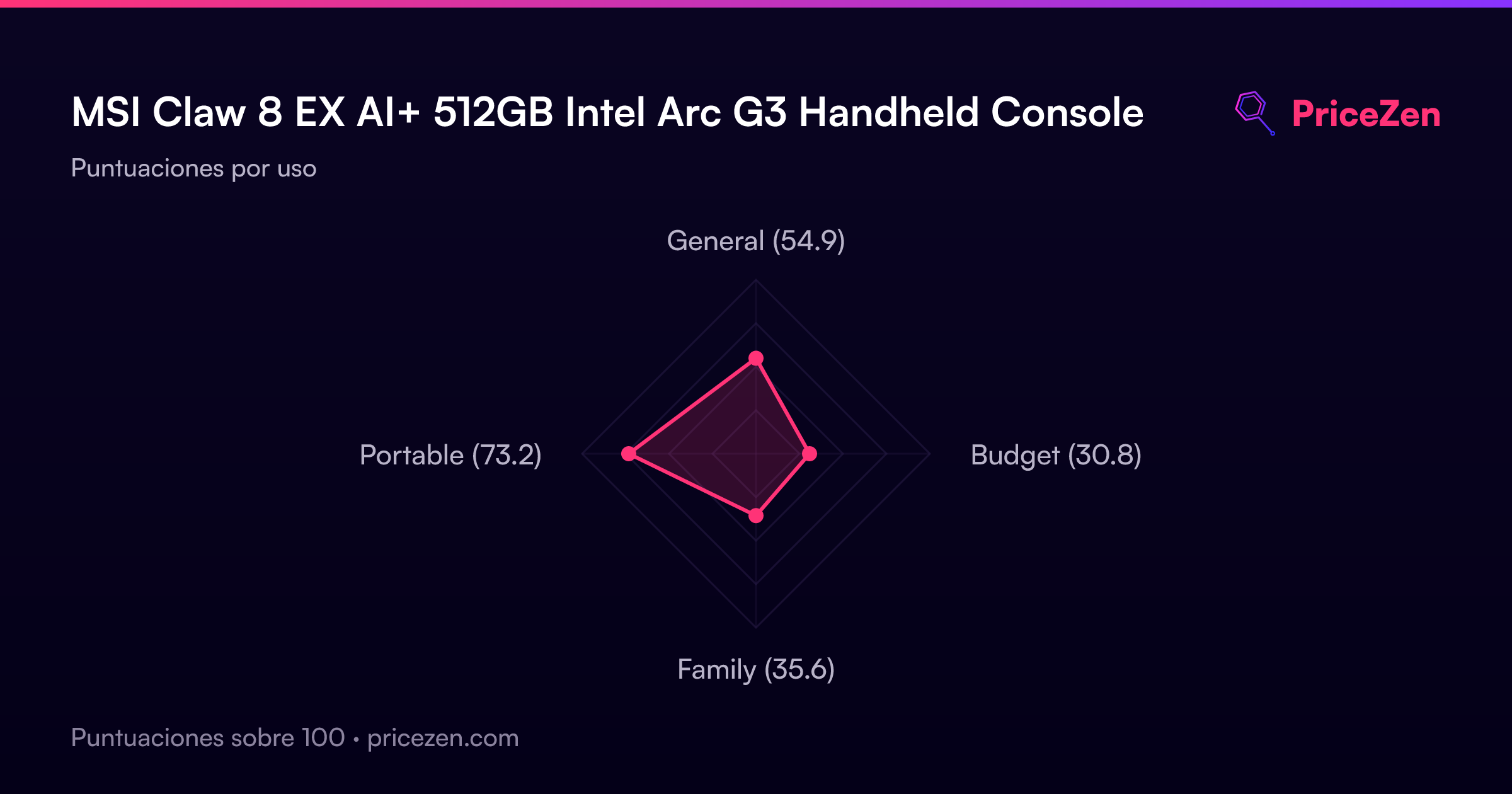
Usage Scores
- General54.9
- Budget30.8
- Family35.6
- Portable73.2