Canon EOS R6052C002 EK
The 25.8MP CMOS sensor delivers high-resolution stills suitable for detailed product photography, though the fixed display and lack of stabilization limit its versatility. Its bundled accessories and low price point make it an accessible entry into the Canon mirrorless system for beginners. This camera is best for budget-conscious still-life photographers who shoot in controlled, tripod-based environments.

Sin precio actual de tiendas
Dónde lo vimos antes. Consulta el precio de hoy en la tienda.











Resumen
The 30-Second Version
The Canon EOS R100 bundle is a decent USD 418 entry into mirrorless photography, with a 24.1MP APS-C sensor that ranks above average and eye-detection AF that's genuinely good for portraits. The catch is everything around the sensor: a fixed screen, no in-body stabilization, 4K limited to 24p and no weather sealing. Buy it for stills on a tight budget, not for video or vlogging, where it scores a dismal 13.1 out of 100.
Pros & Cons
Ventajas
- 24.1MP APS-C sensor with DIGIC 8 ranks above average for the category 67th
- Dual Pixel CMOS AF with 143 zones and eye detection is great for portraits
- USD 418 bundle includes a 64GB UHS-I card, shoulder bag and cleaning kit
- Built-in Wi-Fi and Bluetooth for getting photos off the camera quickly
- RF mount opens up Canon's full lens lineup as you grow
Desventajas
- Fixed 3" LCD with no tilt or flip, near the bottom of the category for displays
- No in-body stabilization, so handheld video needs a stabilized lens
- 4K capped at 24p, no high-frame-rate 4K option
- No weather sealing, so rain and dust are a real risk
- Burst rate and AF tracking both fall behind most mirrorless rivals
Las pruebas
Performance
Let's start with the part that works. A 24.1MP APS-C sensor is a real sensor, not a phone-sized one, and it ranks around the 60th percentile in our data, meaning it's solidly above average for the mirrorless category. Paired with DIGIC 8, that gives you enough resolution to crop hard and still print large, plus the shallow depth of field and low-light headroom that APS-C buys you over a compact or a phone. For portraits specifically, the Dual Pixel CMOS AF with eye detection across 143 zones is the feature that earns its keep: it locks onto eyes rather than guessing at faces, which is exactly what you want when your subject is a squirming toddler or a friend who won't hold still. The trade-off is that our autofocus ranking overall is below average, so while the eye detection is good for static and slow-moving subjects, this isn't the system you want tracking a sprinting dog or a kid mid-cartwheel.
Video is where expectations need adjusting. 4K is limited to 24p, which is fine for a cinematic look but useless for slow motion, and Full HD tops out at 60p. There's no in-body stabilization at all, ranking in the bottom third of the category, so handheld footage will show every micro-jitter unless your lens has optical stabilization doing the work. Burst shooting also lags behind most competitors, which rules out serious action sequences. And the fixed 3" LCD ranks near the bottom, meaning no flip, no tilt, no articulation. Combined with the EVF sitting below average, framing anything at an awkward angle becomes a contortion exercise. Our video score of 29.3 out of 100 reflects all of that stacking up. Battery life lands almost exactly mid-pack, so plan on a spare for long days rather than expecting either heroics or disaster.
Specifications
Full Specifications
Sensor
| Type | CMOS |
| Megapixels | 25.8 MP |
Shooting
| Electronic Shutter | Yes |
Video
| Max Resolution | 4K |
Connectivity
| Wi-Fi | Yes |
| Bluetooth | Yes |
vs Competition
The competitor set here is genuinely tough company: Sony Alpha a6700, Nikon Z 6II, Panasonic Lumix GH5II, Fujifilm X-T30 III and OM System OM-5 Mark II. Against that group, the R100's argument is entirely about cost and simplicity. Its affordability ranking is its second-strongest metric after the sensor, and none of its other numbers crack the top tier. If you're cross-shopping the Fujifilm X-T30 III, you're weighing a similar beginner-friendly proposition, and the R100's case rests on that USD 418 all-in bundle price and Canon's eye-detection AF for portraits. If the X-T30 III fits your budget, it's worth comparing directly, because the R100 gives ground on display quality and burst speed, both of which sit in the bottom third of our rankings.
The Sony Alpha a6700 and OM System OM-5 Mark II are the ones to look at if autofocus tracking or stabilization is your priority, since those are precisely the R100's soft spots, with tracking below average and stabilization in the bottom third. The Panasonic Lumix GH5II is the obvious cross-shop for anyone whose main output is video, given the R100's 4K 24p ceiling and total lack of in-body stabilization. And the Nikon Z 6II is playing in a different weight class entirely; if you're considering it, you've already outgrown what this camera is trying to be. Our advice: pick the R100 if budget is the binding constraint and stills are the goal. Pick something else if you already know you need tracking, stabilization or a flip screen.
| Spec | Canon EOS R6052C002 EK | Sony Alpha a7R VI | Fujifilm X-H2 | Nikon Z8 | Panasonic Lumix G9 II | OM System OM-1 Mark II |
|---|---|---|---|---|---|---|
| Type | mirrorless | mirrorless | mirrorless | mirrorless | mirrorless | mirrorless |
| Sensor | 25.8MP | 66.8MP full-frame | 40.2MP aps-c | 45.7MP full-frame | 25.2MP micro-four-thirds | 20.4MP micro-four-thirds |
| AF Points | - | 759 | 425 | 493 | 779 | 1053 |
| Burst FPS | - | 30 | 15 | 30 | 75 | 120 |
| Video | 4K | 8K @120fps | 8K @60fps | 8K @120fps | 4K @120fps | 4K @60fps |
| IBIS | No | Yes | Yes | Yes | Yes | Yes |
| Weather Sealed | No | Yes | Yes | Yes | Yes | Yes |
| Weight (g) | - | 622 | 579 | 820 | 575 | 511 |
| Compare | Compare | Compare | Compare | Compare |
| Producto | AF | EVF | Build | Burst | Video | Sensor | Battery | Display | Connectivity | Affordability | Stabilization |
|---|---|---|---|---|---|---|---|---|---|---|---|
| Canon EOS R6052C002 EK | 37 | 37.4 | 36.7 | 32.1 | 58.2 | 59.6 | 45.9 | 27.4 | 54.3 | 67.1 | 33.1 |
| Sony Alpha a7R VI Compare | 96.5 | 98.9 | 94.2 | 88 | 98.9 | 81 | 96.4 | 97.3 | 95.5 | 12.6 | 99.6 |
| Fujifilm X-H2 Compare | 91.4 | 96.2 | 93.2 | 79.2 | 94.6 | 98.8 | 97.1 | 94.9 | 95.5 | 24.6 | 95.8 |
| Nikon Z8 Compare | 92.7 | 90.6 | 97.4 | 94.7 | 98.5 | 67.5 | 88.4 | 97.1 | 95.5 | 16 | 87.8 |
| Panasonic Lumix G9 II Compare | 97.6 | 90.4 | 93.1 | 95.8 | 97.3 | 59.4 | 89.8 | 96.4 | 95.5 | 38 | 87.8 |
| OM System OM-1 Mark II Compare | 98.6 | 99.8 | 92.6 | 99.3 | 83.5 | 46.7 | 95.1 | 94.9 | 95.5 | 25.8 | 99.6 |
Precio
Value & Pricing
At USD 418, this sits in the upper half of the affordability rankings for mirrorless cameras, and the bundle math is the reason it's worth a look. A 64GB UHS-I SDXC card, a shoulder bag and a cleaning kit are things you'd otherwise buy separately in your first week of ownership, and having them arrive together removes the guesswork for a first-time buyer. We track prices across stores with our own system, and right now we're seeing a single US listing at USD 418 through Best Buy, which also carries a price match guarantee. That's a useful safety net if you spot it cheaper elsewhere shortly after buying.
The honest caveat: you're paying for a camera whose weakest areas are the ones beginners often discover they care about six months in. Video flexibility, a screen you can flip around, faster burst shooting. If those matter to you later, you'll be shopping again. As a low-cost way into the RF mount with a sensor that punches above its price, though, the value holds up.
Leer más
Overview
The Canon EOS R100 is Canon's entry point into the RF mirrorless world, and this particular listing (6052C002 EK) is a bundle rather than a bare body. You get the camera, neck strap, charger, battery, body cap, a 64GB UHS-I SDXC card, a Slinger Alpine 120 shoulder bag, a cleaning kit and Canon's 1-year limited warranty. At USD 418 from Best Buy, that's a complete starter setup in one box, which matters more than it sounds if you've never bought a camera before and don't want to spend an evening figuring out which memory card won't bottleneck your video.
Under the hood it's a 24.1MP APS-C CMOS sensor paired with the DIGIC 8 processor, Dual Pixel CMOS AF across 143 zones with face and eye detection, 4K at 24p and Full HD at 60p, a 2.36m-dot OLED viewfinder, a fixed 3" LCD, and built-in Wi-Fi and Bluetooth. No in-body stabilization, no weather sealing. That spec sheet reads like a camera designed for someone taking their first serious photos: portraits, family stuff, travel snaps, the occasional bit of video. Our scoring model agrees on the intent, putting beginner use at 45.9 out of 100, which is its strongest category by a wide margin.
What makes it interesting is the gap between what it does well and what it doesn't. The sensor sits comfortably above the middle of the pack in our rankings, and the price lands in the upper half for affordability among mirrorless cameras. But the display ranks near the bottom of the category, autofocus tracking falls behind most rivals, and vlogging scores a genuinely rough 13.1 out of 100. This is a stills-first camera that happens to record video, not a content-creation tool. Buy it knowing that and you'll be happy. Buy it expecting a YouTube rig and you'll be returning it.
Common Questions
Q: Does this bundle include a lens?
The listed contents are the EOS R100 body, neck strap, charger, battery, body cap, a 64GB UHS-I SDXC card, a Slinger Alpine 120 shoulder bag, a cleaning kit and Canon's 1-year limited warranty. No lens appears in that list, so budget for one separately. The camera uses the Canon RF mount, which gives you access to Canon's RF lens range.
Q: Can I use this for YouTube videos or vlogging?
We'd steer you elsewhere. The 3" LCD is fixed with no tilt or flip, so you can't frame yourself, and there's no in-body stabilization to smooth handheld footage. Our scoring puts vlogging at 13.1 out of 100 and video overall at 29.3, which reflects those limits plus 4K being capped at 24p.
Q: Is the image quality good enough compared to a modern phone?
Yes, and it's the camera's strongest argument. The 24.1MP APS-C CMOS sensor ranks around the 60th percentile among mirrorless cameras in our data, which is well above what any phone sensor can deliver in terms of detail, dynamic range and natural background blur. Paired with Dual Pixel eye detection, it's particularly strong for portraits.
Q: Will it hold up outdoors or in bad weather?
Not reliably. There's no weather sealing on this body, and its build quality ranks below the category midpoint. Fine for dry days and careful handling, but if you shoot in rain, dust or cold regularly, look at a sealed body instead.
Who Should Skip This
Vloggers and solo video creators should walk away immediately. A fixed rear screen means you can't see yourself, no in-body stabilization means walking shots look like an earthquake, and 4K at 24p gives you no room to slow anything down. Our vlogging score of 13.1 out of 100 is about as clear as these things get. Look at the Panasonic Lumix GH5II if video is your main output, or the Sony Alpha a6700 if you want stronger autofocus tracking alongside it.
Sports and wildlife shooters should skip too, since burst performance is below average and overall AF tracking is also below average, both behind most of the category. Anyone shooting in rain, on boats, or in dusty conditions needs weather sealing this body doesn't have, and the OM System OM-5 Mark II is the natural cross-shop there. And if you already know you want a tilting screen for low-angle or overhead work, the R100's display ranking near the bottom of the category will frustrate you within a week.
Verdict
If you're buying your first interchangeable-lens camera and you mostly want to shoot photos, this is a sensible place to start. The 24.1MP APS-C sensor gives you image quality that a phone can't fake, the eye-detection AF makes portraits forgiving, and USD 418 with a card and bag included means there's nothing else to buy on day one except a lens. Beginners who shoot family, travel, pets sitting still and casual portraits will get real value here, and the RF mount means your lenses carry forward if you upgrade the body later.
If you're planning to film yourself, shoot sports, or work outdoors in bad weather, skip it. The fixed screen, missing stabilization, 24p-only 4K and absent weather sealing aren't small omissions, they're the whole job description for those use cases. Our vlogging score of 13.1 out of 100 isn't a rounding error, it's a warning label. Spend more on a body with a flip screen and stabilization, or accept that this camera is a stills tool and buy it as one.
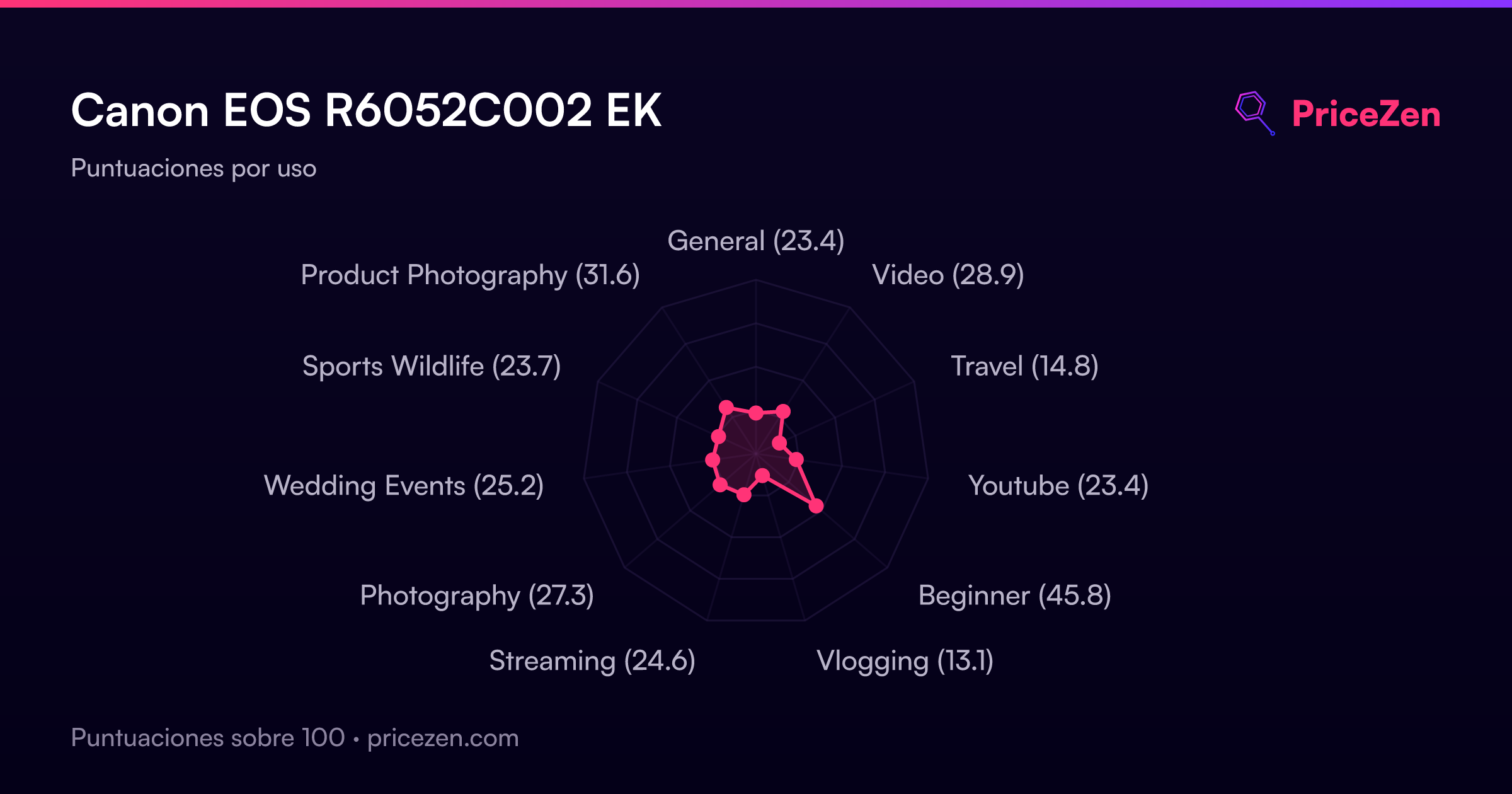
Usage Scores
- General23.4
- Video28.9
- Travel14.8
- Youtube23.4
- Beginner45.8
- Vlogging13.1
- Streaming24.6
- Photography27.3
- Wedding Events25.2
- Sports Wildlife23.7
- Product Photography31.6