Panasonic CX Series AJ-CX4000GJ
The 11.1MP micro-four-thirds MOS sensor delivers 4K 60p 10-bit 4:2:2 output via 12G-SDI, with a B4 lens mount for interchangeable 2/3" lenses. Its direct livestreaming via RTSP/RTMP/RTMPS and NDI-based workflows make it a strong fit for broadcast and live events. Best for professional ENG crews covering news, sports, and documentaries who need reliable streaming and broadcast-standard ergonomics.

Sin precio actual de tiendas
Resumen
The 30-Second Version
A broadcast streaming beast with a B4 mount and top-shelf connectivity, but the sensor is a letdown for the price. If you need live 4K HDR to air without fuss, this is your camera. If you want pretty pictures, buy a mirrorless and save CAD 35,000.
Pros & Cons
Ventajas
- Top-tier connectivity with 12G-SDI, NDI, and direct RTMP streaming 90th
- Excellent 2.8M-dot EVF for long shoulder-mount sessions 87th
- B4 mount opens up a huge ecosystem of broadcast glass
- 4K 60p 10-bit 4:2:2 output is genuinely broadcast-ready
Desventajas
- Sensor ranks near the bottom of our database for this category
- No stabilization at all
- Autofocus is mediocre at best
- Priced like a small car in CAD
Las pruebas
Performance
The streaming and connectivity chops are the standout here, landing near the top of our database. 12G-SDI out, HDMI and BNC I/O, plus native NDI support means this camera slots into existing broadcast infrastructure without a fight. The 2.8M-dot EVF is also excellent, which matters when you're shoulder-mounting this thing for hours at a live event. But the sensor story is rough. An 11.1MP micro-four-thirds chip ranks in the bottom tenth of our database for this category. For 4K that's enough pixels on paper, but low-light performance and dynamic range won't touch what a modern full-frame or even APS-C sensor delivers. The lack of any stabilization is also a choice, though for a shoulder-mount ENG rig with a proper B4 lens, that's less of a dealbreaker than it sounds.
Specifications
Full Specifications
Sensor
| Type | MOS |
| Size | micro-four-thirds |
| Megapixels | 11.14 MP |
Video
| Max Resolution | 4K |
| 4K FPS | 60 |
| 10-bit | Yes |
| Log Profile | Yes |
| Codec | H.264, H.265, AVC-Intra, AVC-LongG |
Display & EVF
| Screen Size | 3.5" |
| Touchscreen | Yes |
| EVF Resolution | 2.76 M dots |
Connectivity
| Wi-Fi | Yes |
| Bluetooth | Yes |
| USB | USB3.0 (DEVICE), USB2.0 (HOST) |
| HDMI | HDMI type A |
vs Competition
Put this next to a Sony FX30 and the contrast is stark. The FX30 costs a fraction of the price, has a larger Super35 sensor, and delivers better image quality for narrative and doc work. But the FX30 can't touch the CX4000's broadcast connectivity, B4 mount, or shoulder-mount ergonomics. The Nikon Z8 and Canon EOS R6 Mark III are both hybrid mirrorless cameras that crush this Panasonic on sensor performance and autofocus, but again, they're not built for live ENG workflows. The real comparison is against other broadcast camcorders, and in that world the CX4000 holds its own on connectivity while lagging on sensor tech. If you need a streaming-first broadcast camera and already own B4 glass, this is a solid choice. If you need the best possible image quality per dollar, look elsewhere.
| Spec | Panasonic CX Series AJ-CX4000GJ | Sony Alpha a7R VI | Fujifilm X-H2 | Nikon Z8 | OM System OM-1 Mark II | Canon EOS R6 Mark III |
|---|---|---|---|---|---|---|
| Type | camcorder | mirrorless | mirrorless | mirrorless | mirrorless | mirrorless |
| Sensor | 11.1MP micro-four-thirds | 66.8MP full-frame | 40.2MP aps-c | 45.7MP full-frame | 20.4MP micro-four-thirds | 32.5MP full-frame |
| AF Points | - | 759 | 425 | 493 | 1053 | 1053 |
| Burst FPS | - | 30 | 15 | 30 | 120 | 40 |
| Video | 4K @60fps | 8K @120fps | 8K @60fps | 8K @120fps | 4K @60fps | 6K @120fps |
| IBIS | No | Yes | Yes | Yes | Yes | Yes |
| Weather Sealed | No | Yes | Yes | Yes | Yes | Yes |
| Weight (g) | - | 622 | 579 | 820 | 511 | 609 |
| Compare | Compare | Compare | Compare | Compare |
| Producto | AF | EVF | Build | Burst | Video | Sensor | Battery | Display | Connectivity | Affordability | Stabilization |
|---|---|---|---|---|---|---|---|---|---|---|---|
| Panasonic CX Series AJ-CX4000GJ | 37 | 89.5 | 36.7 | 32.1 | 52.7 | 8.9 | 45.9 | 58.9 | 87.2 | 3.5 | 33.1 |
| Sony Alpha a7R VI Compare | 96.5 | 98.9 | 94.2 | 87.9 | 98.9 | 81 | 96.4 | 97.3 | 95.5 | 12.6 | 99.6 |
| Fujifilm X-H2 Compare | 91.4 | 96.2 | 93.2 | 79.2 | 94.6 | 98.8 | 97.1 | 94.9 | 95.5 | 24.7 | 95.8 |
| Nikon Z8 Compare | 92.7 | 90.6 | 97.4 | 94.7 | 98.4 | 67.6 | 88.4 | 97.1 | 95.5 | 16 | 87.8 |
| OM System OM-1 Mark II Compare | 98.6 | 99.8 | 92.6 | 99.3 | 83.5 | 46.6 | 95.1 | 94.9 | 95.5 | 25.8 | 99.6 |
| Canon EOS R6 Mark III Compare | 98.6 | 89.8 | 93.8 | 90.8 | 89.5 | 61.9 | 96.7 | 94.9 | 95.5 | 23 | 99.6 |
Precio
Value & Pricing
At CAD 41,949, this is not a casual purchase and it's not trying to be. For a broadcast station or production house that already owns B4 lenses and needs reliable live streaming, the price makes sense as a capital expense. For anyone else, it's a hard pass. The sensor performance simply doesn't justify this price tag if you're not already locked into the broadcast lens ecosystem. You're paying for the workflow and connectivity, not the image quality.
Leer más
Overview
The AJ-CX4000GJ is a broadcast workhorse built for one thing: getting live 4K HDR footage out to the world without drama. It's a shoulder-mount ENG camcorder with a B4 lens mount, which tells you immediately this isn't a vlogging toy or a hybrid mirrorless pretending to be a cinema camera. The headline here is the 4K 60p 10-bit 4:2:2 output over 12G-SDI, paired with direct RTSP/RTMP/RTMPS streaming. That's a serious combo for newsrooms and live event crews who need to go from lens to broadcast feed without a pile of external boxes. But the sensor percentile ranking is a real eyebrow-raiser, and we'll get into why that matters.
Common Questions
Q: Does the AJ-CX4000GJ work with my existing B4 lenses?
Yes, that's the whole point of the B4 mount. If you already own 2/3-inch broadcast lenses, they'll mount directly. The camera uses an optical magnifying system to adapt the lens image circle to the 4/3 sensor, so expect some crop factor compared to a native 2/3-inch camera.
Q: Can I livestream directly from this camera without a computer?
Yes. It supports RTSP, RTMP, and RTMPS streaming protocols natively, plus NDI for network-based production. You'll need a solid network connection, but no external encoder is required for basic streaming setups.
Q: Is this camera good for documentary work?
It can work for docs, especially run-and-gun broadcast style shooting where the shoulder mount and EVF shine. But the sensor's low-light performance and lack of stabilization will frustrate you in uncontrolled environments. A Sony FX30 or Canon R6 Mark III would be a better doc camera for most people.
Who Should Skip This
If you're a solo shooter, YouTuber, or indie filmmaker looking for the best image quality per dollar, this isn't it. Go get a Sony FX30 or a used full-frame mirrorless and spend the savings on lenses and lights. The CX4000 only makes sense if you're already in the broadcast world with B4 glass and a live production workflow.
Verdict
The AJ-CX4000GJ is a purpose-built tool that excels at live production and streaming but falls short on raw image quality. Buy it if you're a broadcaster or production house that needs reliable 4K HDR output with pro connectivity and already has B4 lenses. Skip it if you're shopping for image quality, low-light performance, or anything resembling a hybrid camera. This is a niche tool for a niche audience, and for that audience it does the job well.
Usage Scores
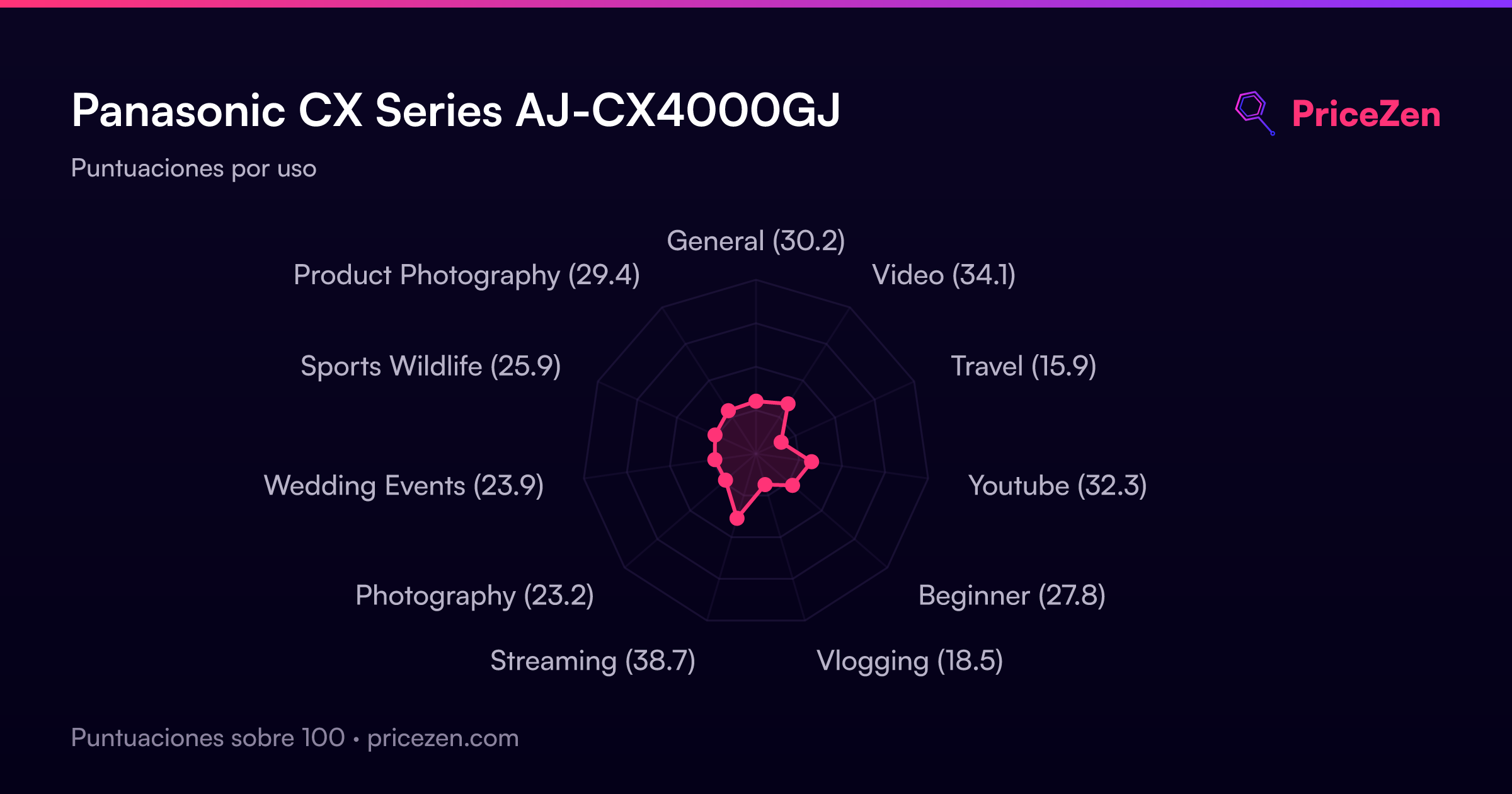
- General30.2
- Video34.1
- Travel15.9
- Youtube32.3
- Beginner27.8
- Vlogging18.5
- Streaming38.7
- Photography23.2
- Wedding Events23.9
- Sports Wildlife25.9
- Product Photography29.4