Sony XDCAM PXW-Z300

Empuñadura de videocámara para grabar largo y estable verificado el 28 nov
39/100 puntuación global
- Type
- camcorder
- Sensor
- 8.3MP 1/2.3-inch
- Video
- 4K @60fps
- IBIS
- Sí
- Weight
- 2600 g
Resumen
The 30-Second Version
The PXW-Z300 is a news-and-docs specialist with best-in-class connectivity, dual XLR inputs and AI subject-tracking AF at 4K60p. The catch is a tiny 1/2-type sensor that ranks near the bottom of the category, plus a CAD 11,399 price at Vistek that lands in the cheapest 9 percent of nothing, it's expensive. Broadcast crews who need fast workflows should take it seriously; creators chasing image quality per dollar should keep looking.
Pros & Cons
Ventajas
- Connectivity in the 95th percentile, top-tier for fast file transfer and streaming workflows 96th
- Three independent rings for focus, zoom and iris give real manual control 82nd
- Dual XLR inputs plus 3.5mm stereo minijack cover pro audio needs 75th
- 4K60p 10-bit recording with full-pixel readout across three sensors 69th
- IBIS ranked well above average at 76, strong for handheld news work
Desventajas
- Sensor ranks in the 6th percentile, tiny 1/2-type chips limit low-light and shallow depth of field
- Affordability sits in the 9th percentile, CAD 11,399 is steep for this sensor class
- No weather sealing, risky for the outdoor news work it targets
- Weakest use-case score is travel at 27.3, and 2600g doesn't help
- EVF (37) and burst (32) both lag behind most of the category
Las pruebas
Performance
Let's talk numbers, because they tell an interesting story. Video capability lands at 47.3 out of 100 in our scoring, basically middle of the pack, which sounds underwhelming for a flagship until you remember what this camera prioritizes. The 4K60p output with full-pixel readout and 10-bit color in H.264, H.265 or MPEG-2 is genuinely solid broadcast-grade material. What drags the score down is that small sensor: an 8.3MP 1/2.3-inch class imager just can't gather light like the larger sensors elsewhere in this category. Expect clean results in daylight and controlled lighting, and expect to work harder when the sun goes down.
Autofocus scores 69, solidly above average, and the AI subject recognition is the reason. Sony's system tracks people based on posture and anatomical structure, even when they turn away from the lens, which is exactly what you want when your interview subject starts walking. Stabilization ranks at 76, well above average, so handheld footage should hold up without a gimbal for most walking shots. The weak spots are burst at 32 and the EVF at 37, both below the midpoint. This is a video-first machine, and if you were hoping to moonlight as a stills photographer, the rankings say look elsewhere. Battery sits at 46, about average, though the V-mount compatibility means swapping power on the fly is part of the design rather than an afterthought.
Specifications
Full Specifications
Sensor
| Type | Exmor R CMOS |
| Size | 1/2.3-inch" |
| Megapixels | 8.3 MP |
| Processor | BIONZ XR |
Autofocus
| Subject Detection | Yes |
Shooting
| Electronic Shutter | Yes |
Video
| Max Resolution | 4K |
| 4K FPS | 60 |
| 1080p FPS | 60 |
| 10-bit | Yes |
| Codec | MPEG-4 AVC/H.264, MPEG-H HEVC/H.265, MPEG-2 |
Display & EVF
| Screen Size | 3.5" |
| Touchscreen | Yes |
| Articulating | Yes |
Build
| Weight | 2.6 kg / 5.7 lbs |
Connectivity
| Wi-Fi | Yes |
| Bluetooth | Yes |
| USB | USB Type-C (SuperSpeed USB 5 Gbps, USB 3.2) |
| HDMI | HDMI Type-A |
| Hot Shoe | Yes |
vs Competition
Our comparison set here is unusual, and it actually clarifies who this camera is for. The Canon EOS R1 and Panasonic Lumix S1H are the names a serious video buyer will cross-shop, and both sit in a different philosophical camp than the Z300. The Sony's argument is integration: three sensors, built-in XLR, broadcast codecs including MPEG-2, and connectivity that outranks nearly everything we track. Where it gives ground is the sensor, full stop. At the 6th percentile, the Z300's imaging foundation is far behind what the category's leaders offer, and if your work lives in dim interiors or demands creamy background separation, the Panasonic Lumix S1H is the direction we'd point you, purely on the strength of where the Sony's own sensor ranking sits.
The Fujifilm GFX100S II shows up in this category's competitor list too, and it's a reminder of how wide the gap in imaging priorities runs. Against something like that, the Z300's counterargument is speed and operability: subject recognition AF at 4K60p, a stabilizer ranked well above average, and a display setup at 83 that beats most rivals for flexible framing. If you shoot events, news, or docs where moments don't wait, the Sony's strengths are the ones that keep footage usable. If you shoot controlled, planned, image-quality-first work, the competitors' side of the ledger looks heavier. Pick based on which failure mode you can't tolerate: missed moments or compromised image quality.
| Spec | Sony XDCAM PXW-Z300 | Fujifilm X-H2 | Nikon Z8 | Panasonic Lumix G9 II | OM System OM-1 Mark II | Canon EOS R6 Mark III |
|---|---|---|---|---|---|---|
| Type | camcorder | mirrorless | mirrorless | mirrorless | mirrorless | mirrorless |
| Sensor | 8.3MP 1/2.3-inch | 40.2MP aps-c | 45.7MP full-frame | 25.2MP micro-four-thirds | 20.4MP micro-four-thirds | 32.5MP full-frame |
| AF Points | - | 425 | 493 | 779 | 1053 | 1053 |
| Burst FPS | - | 15 | 30 | 75 | 120 | 40 |
| Video | 4K @60fps | 8K @60fps | 8K @120fps | 4K @120fps | 4K @60fps | 6K @120fps |
| IBIS | Yes | Yes | Yes | Yes | Yes | Yes |
| Weather Sealed | No | Yes | Yes | Yes | Yes | Yes |
| Weight (g) | 2600 | 579 | 820 | 575 | 511 | 609 |
| Compare | Compare | Compare | Compare | Compare |
| Producto | AF | EVF | Build | Burst | Video | Sensor | Battery | Display | Affordability | Stabilization |
|---|---|---|---|---|---|---|---|---|---|---|
| Sony XDCAM PXW-Z300 | 69.1 | 37.4 | 63.3 | 32.1 | 51.8 | 6.1 | 46 | 82.4 | 9.8 | 75 |
| Fujifilm X-H2 Compare | 91.6 | 96.2 | 93.3 | 79 | 94.6 | 98.8 | 97.1 | 95 | 25.1 | 95.8 |
| Nikon Z8 Compare | 92.9 | 90.7 | 97.5 | 94.6 | 98.5 | 67.9 | 88.4 | 97.1 | 16.2 | 87.9 |
| Panasonic Lumix G9 II Compare | 97.7 | 90.5 | 93.2 | 95.8 | 97.3 | 59.9 | 89.9 | 96.4 | 38.2 | 87.9 |
| OM System OM-1 Mark II Compare | 98.6 | 99.8 | 92.7 | 99.3 | 83.8 | 47.3 | 95.1 | 95 | 26 | 99.6 |
| Canon EOS R6 Mark III Compare | 98.6 | 89.9 | 93.8 | 90.6 | 89.6 | 62.2 | 96.7 | 95 | 23.4 | 99.6 |
Precio
Value & Pricing
At CAD 11,399 from Vistek, currently the only listing we're tracking in Canada, this is not an impulse buy. Our affordability ranking puts it in the 9th percentile, meaning almost everything else in this category costs less relative to what it delivers on paper. And honestly, the spec sheet alone doesn't justify the price. What you're paying for is the workflow: cloud transfer, streaming to OTT and OTA platforms, XLR audio, three-ring control, and a body designed for one-person crews. If those features save your production hours every week, the math changes fast. If they don't, you're overpaying for a small-sensor camcorder.
We track prices over time through our community browser extension, and right now there's no cross-store competition in our Canadian data to shop against. One listing, one price. That's worth knowing if you were hoping to play retailers against each other.
Leer más
Overview
The Sony XDCAM PXW-Z300 is a flagship handheld built for news crews and documentary shooters, and it wears that job description openly. Three 1/2-type Exmor R CMOS sensors feed a BIONZ XR processing engine, with a dedicated AI Processing Unit handling subject recognition autofocus. You get 4K at up to 59.94p in 10-bit, three independent rings for focus, zoom and iris, dual XLR inputs, and cloud transfer baked into the workflow. This isn't a camera trying to be everything to everyone. It's a run-and-gun broadcast tool, and our data backs that up: connectivity sits in the 95th percentile, one of the best we track in this category.
Who's it for? Newsrooms, ENG operators, documentary filmmakers who need to hand footage off fast and can't babysit a rig. The side V-mount, the flexible LCD arm on a 3.5" articulating touch display, the HDMI Type-A and USB Type-C ports, all of it points at someone shooting solo under deadline pressure. If your day involves interviews, press conferences, or chasing a story across town, this thing was designed around your problems.
But here's the trade-off you need to hear before falling in love: those 1/2-type sensors are small. Our sensor ranking puts this near the bottom of the category, in the 6th percentile, and that has real consequences for low light and depth of field. Sony is betting that processing power, autofocus intelligence and workflow speed matter more to its target buyer than sensor size. For a news shooter, that bet probably pays off. For anyone chasing cinematic shallow focus, it doesn't. We'll get into exactly where that line falls.
Common Questions
Q: Is the small sensor a dealbreaker for professional work?
Depends on the work. The 1/2-type sensors rank in the 6th percentile of this category, so low-light performance and shallow depth of field are genuine weak points. For daylight news, interviews and well-lit documentary shooting, the 4K60p 10-bit output with full-pixel readout is broadcast-ready. For moody, cinematic or night-heavy work, you'll feel the limitation.
Q: Can it handle solo run-and-gun shooting?
That's exactly its design brief. Subject recognition AF scores above average at 69 and tracks people even when they face away, IBIS ranks well above average at 76, and the 3.5" articulating touch display sits at 83 for flexible framing. The main caution is the lack of weather sealing, so plan around rain.
Q: How does the audio setup compare to using adapters on other cameras?
You get two 3-pin XLR inputs plus a 3.5mm stereo minijack built into the body, no adapters or external recorders needed. Combined with connectivity in the 95th percentile for fast transfers and streaming, it's a complete interview-to-delivery package in one unit, which is the core reason to pay its price.
Q: Is it good value at CAD 11,399?
Our affordability ranking puts it in the 9th percentile, so on pure specs-per-dollar it's a tough sell. The value lives in the workflow features: cloud transfer, broadcast codecs, three-ring control and pro audio. If those save your production real time, it earns its price. If you just want great-looking 4K, the mid-pack video score of 47.3 says your money goes further elsewhere.
Who Should Skip This
Skip this if image quality is your north star. The sensor ranking in the 6th percentile isn't a footnote, it's the defining compromise, and no amount of processing wizardry fully escapes physics. Filmmakers who want shallow focus, low-light latitude or maximum grading headroom should be looking at the larger-sensor options in this category, like the Panasonic Lumix S1H, rather than paying CAD 11,399 for small chips.
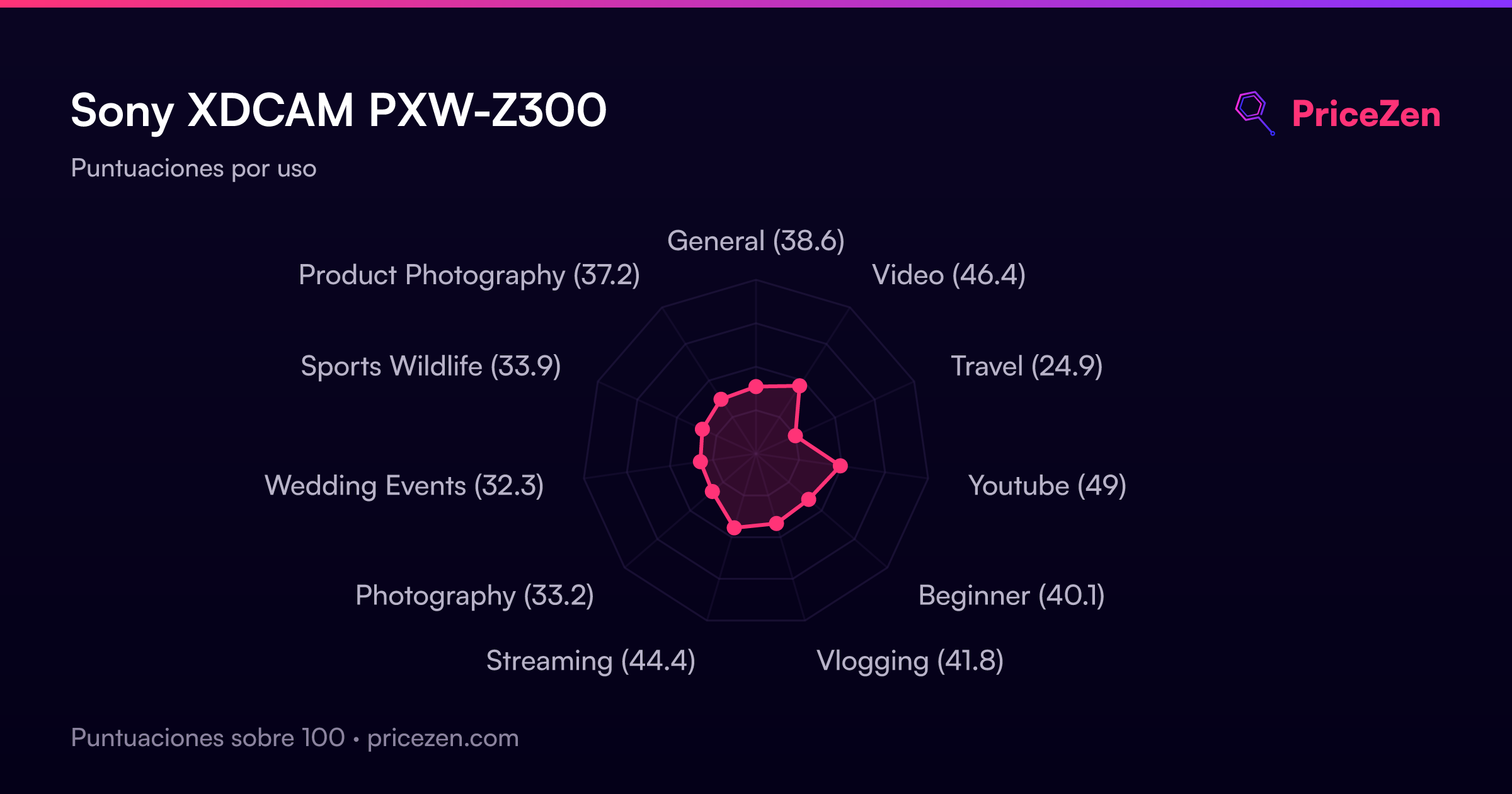
Also skip it if you're a travel shooter or a hybrid stills/video creator. Travel is its weakest use case at 27.3 out of 100, and 2600g with no weather sealing is a rough combination for life on the road. Burst at 32 and EVF at 37 mean the photography side is an afterthought. And YouTube-focused creators should pause hard: a 50 out of 100 use-case score at this price means you're funding a newsroom workflow you'll never use.
Verdict
For working news and documentary shooters, we think the PXW-Z300 makes a strong case. The connectivity is best-in-class, the audio inputs are proper, the three-ring manual control is what pros actually ask for, and the AI autofocus takes real workload off a solo operator. If your footage needs to move from camera to air quickly, this is built for you, and CAD 11,399 is a business expense against hours saved. Our video score of 47.3 undersells it for this specific job because the scoring weighs raw imaging capability that news work simply doesn't need as much.
For YouTube creators and general video makers, we're more cautious. The scores tell the story: 50 for YouTube, 47.3 for video, 45.5 for streaming, all hovering around average, at a price that's anything but. You'd be paying flagship money for mid-pack output quality, carried by workflow features you may never touch. Unless you specifically need XLR audio and broadcast-style operation in one body, your budget likely works harder elsewhere in this category. This is a specialist tool. Buy it for the specialty, not the badge.
Usage Scores
- General38.6
- Video46.4
- Travel24.9
- Youtube49
- Beginner40.1
- Vlogging41.8
- Streaming44.4
- Photography33.2
- Wedding Events32.3
- Sports Wildlife33.9
- Product Photography37.2