Vivitar VECXX140 Black
The 20MP CMOS sensor and 5K video capture set this compact apart, with a 4-inch touchscreen and dual-lens selfie mode for easy framing. Wi-Fi sharing and a 32GB card add convenience, while the f/1.8 aperture helps in low light. Best for beginners who want a simple, feature-packed camera for everyday photos and streaming.

Sin precio actual de tiendas
Resumen
The 30-Second Version
The VECXX140 shoots 10fps bursts and 4K video for CAD 128, which is genuinely cheap. But the build quality is in the 12th percentile, autofocus is unreliable, and the 72MP and 5K claims are marketing fiction. It's a fine toy camera, not a serious tool.
Pros & Cons
Ventajas
- 10fps burst shooting, 72nd percentile, genuinely fast for the price 87th
- f/1.8 aperture lets in decent light for a budget compact 75th
- 4-inch touchscreen is larger than most competitors 75th
- 4K video at 30fps with a 63rd percentile video score 68th
- CAD 128 price point ranks in the 88th percentile for affordability
Desventajas
- Build quality in the 12th percentile, feels cheap and fragile
- No real stabilization, digital only, 36th percentile
- Autofocus is unreliable, 38th percentile
- 20MP sensor is below average, 34th percentile
- Marketing claims of 72MP and 5K are misleading, real resolution is 20MP
Las pruebas
Performance
The 10fps burst is the standout number here. That's the 72nd percentile, which puts it ahead of plenty of pricier compacts. For action shots or fast-moving kids, that's a real advantage. The 20MP sensor is fine for daylight shooting, but it's nothing special, landing in the 34th percentile. You'll get decent detail in good light, but push the ISO and the image quality falls apart quickly. The f/1.8 aperture helps a bit in dimmer conditions, letting in more light than typical budget compacts, but without real stabilization you'll need steady hands or a tripod for anything slower than 1/30s.
Video is a mixed bag. 4K at 30fps sounds impressive, and the video score sits at the 63rd percentile, which is above average for this price bracket. But the stabilization is digital only, and it ranks in the 36th percentile. That means handheld 4K footage will have noticeable shake unless you're standing perfectly still. The autofocus is another weak point at the 38th percentile, so expect some hunting when subjects move. The 4-inch touchscreen is a genuine plus, ranking in the 64th percentile, and it makes navigating menus and framing shots easier than on smaller displays.
Specifications
Full Specifications
Sensor
| Type | CMOS |
| Size | 1/2.3-inch" |
| Megapixels | 20 MP |
| ISO Range | 100 |
Shooting
| Burst (Mechanical) | 10 |
| Electronic Shutter | Yes |
Video
| Max Resolution | 4K |
| 4K FPS | 30 |
| 1080p FPS | 30 |
| Codec | MOV |
Display & EVF
| Screen Size | 4" |
| Touchscreen | Yes |
| Articulating | No |
Build
| Weather Sealed | No |
| Weight | 0.3 kg / 0.7 lbs |
Connectivity
| Wi-Fi | Yes |
| Bluetooth | No |
| USB | USB-C |
vs Competition
Against the Sony ZV-1F, the VECXX140 gets absolutely demolished on autofocus, build quality, and video reliability, but it costs a fraction of the price. The ZV-1F is a purpose-built vlogging camera with excellent AF and a flip screen, while the Vivitar feels like a toy by comparison. The Panasonic Lumix DMC-G7 is a different beast entirely, a mirrorless interchangeable lens camera with far better sensor performance and real stabilization options, but it's also significantly more expensive and heavier. The Canon EOS M5 and Olympus PEN E-PL7 both offer better image quality and build, but again, you're paying for it. The Aboobu DC226 is the closest competitor in spirit, another budget compact with inflated specs, and the Vivitar actually beats it on burst speed and display size. If your budget is strictly under CAD 150, the VECXX140 is a reasonable pick. If you can stretch to CAD 300 or more, skip it entirely.
| Spec | Vivitar VECXX140 | Sony Alpha a7R VI | Fujifilm X-H2 | Nikon Z8 | Panasonic Lumix G9 II | OM System OM-1 Mark II |
|---|---|---|---|---|---|---|
| Type | compact | mirrorless | mirrorless | mirrorless | mirrorless | mirrorless |
| Sensor | 20MP 1/2.3-inch | 66.8MP full-frame | 40.2MP aps-c | 45.7MP full-frame | 25.2MP micro-four-thirds | 20.4MP micro-four-thirds |
| AF Points | - | 759 | 425 | 493 | 779 | 1053 |
| Burst FPS | 10 | 30 | 15 | 30 | 75 | 120 |
| Video | 4K @30fps | 8K @120fps | 8K @60fps | 8K @120fps | 4K @120fps | 4K @60fps |
| IBIS | true | true | true | true | true | true |
| Weather Sealed | false | true | true | true | true | true |
| Weight (g) | 318 | 622 | 579 | 820 | 575 | 511 |
| Compare | Compare | Compare | Compare | Compare |
| Producto | AF | EVF | Build | Burst | Video | Sensor | Battery | Display | Connectivity | Affordability | Stabilization |
|---|---|---|---|---|---|---|---|---|---|---|---|
| Vivitar VECXX140 | 36.9 | 37.4 | 13.6 | 67.9 | 58 | 31.2 | 46.1 | 58.4 | 75.3 | 86.9 | 74.5 |
| Sony Alpha a7R VI Compare | 96.4 | 98.9 | 94.1 | 88 | 98.9 | 80.5 | 96.5 | 97.4 | 95.3 | 13.1 | 99.5 |
| Fujifilm X-H2 Compare | 91.2 | 96.3 | 93.1 | 79 | 94.8 | 98.8 | 97.3 | 94.8 | 95.3 | 28 | 95.6 |
| Nikon Z8 Compare | 92.6 | 90.5 | 97.3 | 94.7 | 98.4 | 66.8 | 88.7 | 97.1 | 95.3 | 16.4 | 87.5 |
| Panasonic Lumix G9 II Compare | 97.6 | 90.3 | 93 | 95.9 | 97.4 | 58.8 | 90.1 | 96.3 | 95.3 | 38.1 | 87.5 |
| OM System OM-1 Mark II Compare | 98.6 | 99.8 | 92.4 | 99.5 | 83.6 | 45.6 | 95.2 | 94.8 | 95.3 | 26.3 | 99.5 |
Precio
Value & Pricing
At CAD 128, the VECXX140 is one of the most affordable cameras in our database, sitting in the 88th percentile for price. That's the whole pitch. You're getting a 20MP sensor, 4K video, a 4-inch touchscreen, and a 10fps burst for less than the cost of a decent smartphone gimbal. The included 32GB card sweetens the deal slightly. But the value proposition depends entirely on your expectations. If you want a cheap camera that technically does 4K and can fire off bursts, this delivers. If you want reliable autofocus, decent build quality, or footage that doesn't shake like a found-footage horror film, you'll need to spend more.
Leer más
Overview
The Vivitar VECXX140 is a budget compact that swings big on paper and misses in practice. A 20MP CMOS sensor and 10fps burst sound respectable, and the burst rate actually lands in the 72nd percentile, which is genuinely solid for a camera in this class. But the sensor itself sits at the 34th percentile, and there's no real stabilization to speak of, just digital smoothing that doesn't hold up against actual optical or sensor-shift systems. The 4-inch touchscreen is a nice touch, and at 318g it won't weigh down your bag. But the build quality ranks in the 12th percentile, which tells you a lot about where corners got cut.
The marketing copy throws around phrases like 5K Ultra HD and 72MP effective resolution, but those numbers are inflated. The sensor is 20MP, and the 72MP figure is almost certainly interpolation, not real detail. The f/1.8 aperture is the one spec that genuinely helps in low light, and the included 32GB card is a practical bonus. For CAD 128, you're getting a camera that can technically shoot 4K video and fire off 10 frames per second, but the overall experience is held back by weak autofocus and a body that feels cheap.
Common Questions
Q: Does the Vivitar VECXX140 actually shoot 5K video?
No. The sensor is 20MP, and the camera records 4K at 30fps. The 5K and 72MP claims in the marketing are interpolated figures, not native resolution. Real video output tops out at 4K, and stills are 20MP.
Q: Is the VECXX140 good for vlogging?
Not really. The video score is in the 63rd percentile, which is decent, but the stabilization is digital only and ranks in the 36th percentile. Handheld footage will be shaky, and the autofocus at the 38th percentile will hunt when you move. The 4-inch touchscreen helps with framing, but the lack of a flip screen makes selfie vlogging awkward.
Q: How does the burst mode perform?
The 10fps mechanical burst is one of the camera's strongest features, ranking in the 72nd percentile. That's faster than many cameras costing twice as much. Just keep in mind the autofocus may struggle to keep up with fast-moving subjects during bursts.
Who Should Skip This
Skip this if you care about build quality, reliable autofocus, or smooth video. The 12th percentile build ranking means this camera won't survive much rough handling, and the 38th percentile autofocus will frustrate anyone trying to shoot moving subjects. Travel photographers should look elsewhere too, the travel score of 22.7 out of 100 is the weakest area by a wide margin. If you're planning to shoot handheld video, the digital-only stabilization at the 36th percentile will leave you with shaky footage. Anyone who already owns a decent smartphone from the last few years will likely get better photos and video from their phone.
Verdict
The Vivitar VECXX140 is a camera for people who want to say they own a 4K camera without spending real money on one. The 10fps burst is legitimately impressive for the price, and the 4-inch touchscreen is a nice touch. But the 12th percentile build quality, unreliable autofocus, and digital-only stabilization make it hard to recommend for anything beyond casual snapshots in good light. At CAD 128, it's cheap enough that you won't feel burned, but don't expect the 5K marketing claims to translate into real-world image quality. If you're a beginner who wants to learn the basics without risking much cash, it's a low-stakes entry point. Just keep your expectations grounded.
Usage Scores
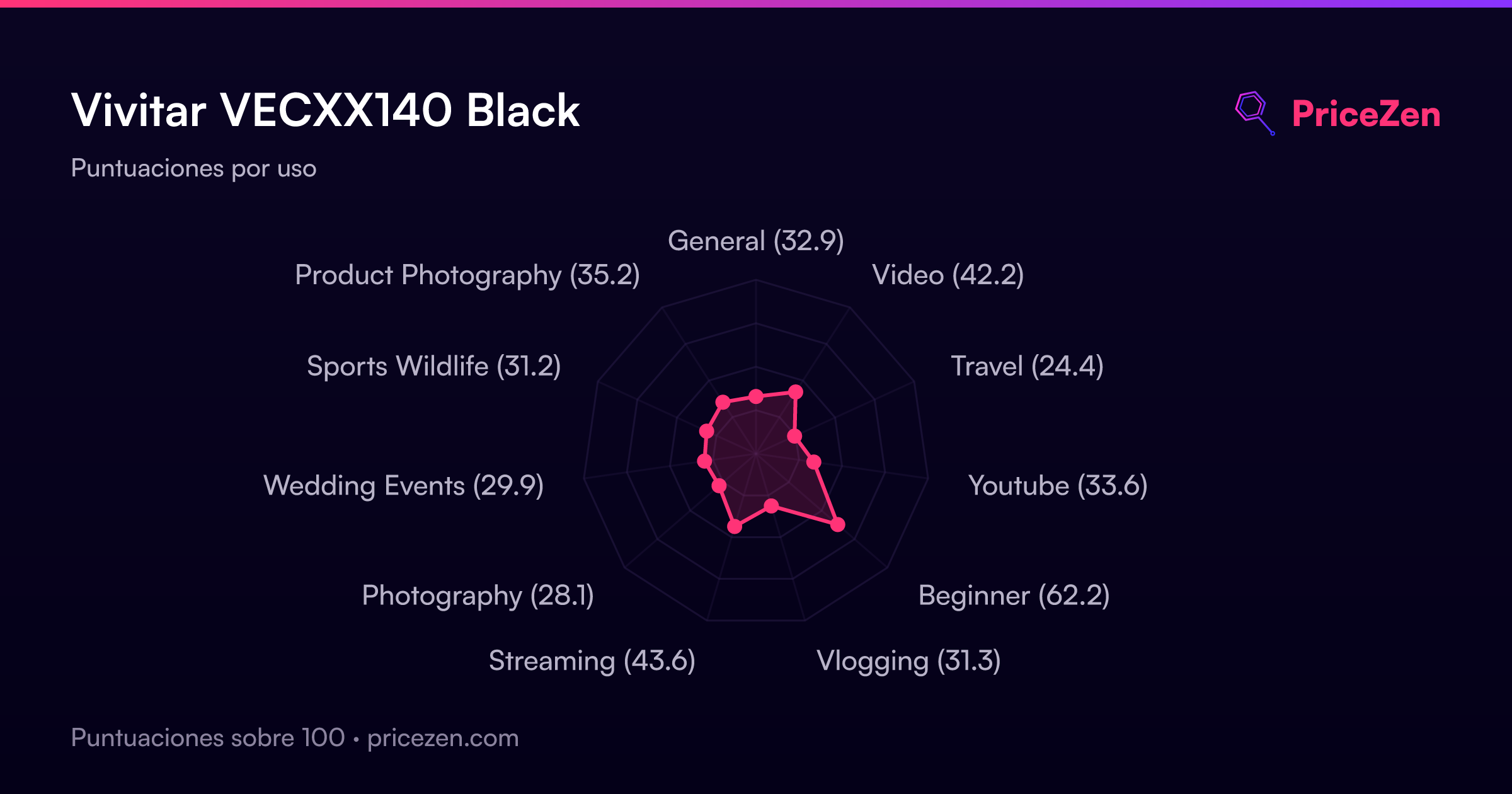
- General32.9
- Video42.2
- Travel24.4
- Youtube33.6
- Beginner62.2
- Vlogging31.3
- Streaming43.6
- Photography28.1
- Wedding Events29.9
- Sports Wildlife31.2
- Product Photography35.2