Fujifilm X-T1 Black

Velocidades de obturación de hasta 1/32000 s verificado el 28 nov
60/100 puntuación global 4,5 media de 379 valoraciones de propietarios
- Type
- mirrorless
- Sensor
- 16.3MP aps-c
- AF points
- 49 pts
- Burst
- 8 fps
- Video
- 1080p
- IBIS
- Sí
- Weather sealed
- Sí
- Weight
- 1179 g
Compara precios en 1 tienda
De la más barata a la más cara. Las ofertas nuevas, reacondicionadas y en pack se mantienen separadas para que compares lo comparable.
| Tienda | Vendido por | Color y estado | Precio | vs. el más bajo | Última comprobación | Enlace |
|---|---|---|---|---|---|---|
| Nuevo1 ofertaUnidad individual | ||||||
| No comprobados en los últimos 7 días, por lo que estos precios pueden haber cambiado | ||||||
| Amazon | Vendedor externo | No indicado | 22.395,79 MXN | 2 nov | Ir a la tienda | |
 Fuente: PriceZen, comprobado el 2 nov 2026
Un precio se considera vigente si lo comprobamos en los últimos 7 días. «Vendedor externo» significa un vendedor de terceros en esa tienda, no la propia tienda.
Historial de precios
Comprobado ese díaNo comprobado ese día, sigue en oferta
Fuente: PriceZen, checked 2 nov 2026










Resumen
The 30-Second Version
The Fujifilm X-T1 is a beautifully built mirrorless camera with a top-tier EVF and excellent image quality, but its autofocus is one of the worst in our rankings. Prices have settled into a tight $899 to $1,000 range, making it a solid value pick for stills shooters. Skip it if you need reliable AF or modern video features.
Pros & Cons
Ventajas
- Best-in-class build quality with weather-sealed magnesium alloy body 99th
- Excellent 2.36M-dot OLED viewfinder with 0.77x magnification 86th
- Sharp, detailed images thanks to the X-Trans sensor design 86th
- Intuitive dial-based manual controls that photographers love 81st
Desventajas
- Autofocus is one of the weakest we've seen, 4th percentile
- Battery life is mediocre and drains fast, especially with the EVF
- No in-body stabilization, so handheld video is shaky
- Menu system is non-intuitive and has a learning curve
Opinión de los propietarios
The Word on the Street
- Owners consistently rave about the image quality and how portable the camera feels for travel
- The electronic viewfinder gets a lot of love, with many saying it's one of the best they've used
- Battery life is a common complaint, with several owners saying they need multiple spares for a day of shooting
- The learning curve is real, especially for people coming from DSLRs or older photographers
Cómo cambió la opinión de los propietarios con el tiempo
ExclusivaSegún cuándo escribieron realmente sus opiniones los clientes, para ver si los elogios iniciales se mantuvieron.
15 opiniones escritas, mar 2014 – dic 2018: 7 satisfechos, 8 sin estrellas
En las 379 valoraciones de tiendas: 4,5★. La mayoría de los propietarios valora sin escribir una opinión. El gráfico cuenta las 15 opiniones escritas.
Cada punto es una opinión escrita, en el mes en que se escribió. Satisfechos = 4-5★, neutrales = 3★, insatisfechos = 1-2★.
Las pruebas
Performance
The X-T1's 16.3MP X-Trans CMOS II sensor is the star here. It lands in the 76th percentile for sensor performance, which is solid for a camera this age. The randomized pixel array eliminates the need for an optical low-pass filter, so fine detail holds up well. Low-light performance is genuinely good, with an expandable ISO range up to 51200. Users consistently praise the image quality, and the 4.5-star rating across 379 reviews backs that up. Burst shooting at 8fps mechanical is respectable, sitting in the 68th percentile. But the autofocus is the weak link. It's in the 4th percentile, which is rough. Single-point AF is fine for static subjects, but tracking moving subjects is a frustrating experience. The EVF is a bright spot, literally. It's in the 87th percentile, with a 0.77x magnification that makes framing feel immersive. Video tops out at 1080p60, which is about average for this class. No stabilization built in, so you'll want lenses with OIS for handheld work.
Specifications
Full Specifications
Sensor
| Type | X-Trans CMOS II |
| Size | aps-c |
| Megapixels | 16.3 MP |
| ISO Range | 100 |
| Processor | EXR Processor II |
Autofocus
| AF Points | 49 |
| AF Type | Contrast Detection: 49 |
Shooting
| Burst (Mechanical) | 8 |
| Max Shutter | 1/32000 |
| Electronic Shutter | Yes |
Video
| Max Resolution | 1080p |
| 1080p FPS | 60 |
| RAW Video | Yes |
| Codec | H.264 |
Display & EVF
| Screen Size | 3" |
| Articulating | Yes |
| EVF Resolution | 2.36 M dots |
Build
| Weather Sealed | Yes |
| Weight | 1.2 kg / 2.6 lbs |
Connectivity
| Wi-Fi | Yes |
| Hot Shoe | Yes |
vs Competition
The current competition is stiff. The Sony FX30 is a video-first camera with modern autofocus that leaves the X-T1's 49-point contrast-detect system in the dust. The Panasonic Lumix G9 II brings far better AF tracking and stabilization, two areas where the X-T1 simply can't compete. The Nikon Z6 III outclasses it on sensor performance, autofocus, and video capability across the board. The OM System OM-1 Mark II is the closest philosophical match, both weather-sealed bodies aimed at outdoor shooters, but the OM-1 Mark II has vastly superior autofocus and in-body stabilization. The Canon EOS R6 Mark III rounds out the group with modern AF and video features that make the X-T1's 1080p ceiling look dated. The X-T1's advantages haven't changed: that 99th-percentile build quality, the excellent EVF, and the dial-driven shooting experience that some photographers genuinely prefer over menu-diving. If you're buying for specs, every camera on this list beats it. If you're buying for feel and you shoot deliberate, static subjects, the X-T1 still earns its spot.
| Spec | Fujifilm X-T1 | Canon EOS R1 | Leica Q3 Monochrom | Hasselblad X2D II 100C | Panasonic LUMIX G97 | Sony BURANO |
|---|---|---|---|---|---|---|
| Type | mirrorless | mirrorless | compact | mirrorless | mirrorless | cinema |
| Sensor | 16.3MP aps-c | 24.2MP full-frame | 60MP full-frame | 100MP medium-format | 20.3MP micro-four-thirds | 41.9MP full-frame |
| AF Points | 49 | 4897 | 315 | 425 | 49 | 627 |
| Burst FPS | 8 | 40 | 15 | 3 | 9 | 60 |
| Video | 1080p | 6K @120fps | 8K @60fps | 1080p | 4K @30fps | 8K @120fps |
| IBIS | Yes | Yes | Yes | Yes | Yes | Yes |
| Weather Sealed | Yes | Yes | Yes | No | Yes | Yes |
| Weight (g) | 1179 | 920 | 746 | 730 | 478 | 2400 |
| Compare | Compare | Compare | Compare | Compare |
| Producto | AF | EVF | Build | Burst | Video | Sensor | Battery | Display | User Sentiment | Connectivity | Valoración social | Affordability | Stabilization |
|---|---|---|---|---|---|---|---|---|---|---|---|---|---|
| Fujifilm X-T1 | 6.4 | 85.6 | 99.3 | 64.2 | 51.9 | 75.7 | 45.9 | 68 | 86 | 57.2 | 80.7 | 47.2 | 75 |
| Canon EOS R1 Compare | 99.8 | 99.2 | 98.3 | 90.6 | 95.8 | 53.6 | 45.9 | 97.9 | 56.4 | 95.6 | 80.7 | 9.4 | 87.8 |
| Leica Q3 Monochrom Compare | 89.1 | 97.7 | 97 | 77.3 | 94.6 | 74.8 | 86.9 | 82.3 | 86 | 90 | 40.8 | 8.2 | 75 |
| Hasselblad X2D II 100C Compare | 91.6 | 97.7 | 71.4 | 1.8 | 22.1 | 96.9 | 93.5 | 99.2 | 86 | 69.5 | 59.3 | 8.4 | 99.9 |
| Panasonic LUMIX G97 Compare | 75.5 | 79.8 | 91.8 | 65.9 | 75.7 | 46.3 | 4.8 | 96.4 | 86 | 95.6 | 56.3 | 54.4 | 87.8 |
| Sony BURANO Compare | 93.4 | 89.6 | 99.3 | 90.6 | 95 | 65.2 | 45.9 | 82.3 | 0 | 83.2 | 0 | 5.5 | 87.8 |
Precio
Value & Pricing
Pricing has tightened up considerably. In the US, listings now run from $899 to $1,000, which is a much narrower spread than we were seeing before. That's good news: you no longer have to hunt through wildly inflated listings to find a fair deal. At $899, the X-T1 is a genuinely compelling budget option for stills shooters who want Fujifilm's color science and that tactile dial experience. Even at the top of the range, $1,000 is reasonable for what you get, though you're still buying into an older AF system. The days of accidentally overpaying nearly two grand for this body are behind us, and that makes it easier to recommend on value alone.
Leer más
Overview
The Fujifilm X-T1 is a camera that refuses to feel old. It's a 16.3MP APS-C mirrorless body with a gorgeous 2.36M-dot OLED viewfinder, weather sealing, and a dial-based control scheme that makes you feel like you're actually operating a camera, not navigating a spreadsheet. The X-Trans CMOS II sensor skips the optical low-pass filter, so images come out sharp and detailed, especially for a sensor this size. It's not a spec monster by today's standards, but it nails the fundamentals.
What really stands out is the build. This thing sits in the 99th percentile for build quality in our database, and it shows. Magnesium alloy body, weather-resistant construction, and a weight that feels substantial without being a brick. The 18-135mm kit lens is also weather-sealed, which is a nice touch for a travel setup. The autofocus, though, is a different story. 49 AF points and contrast-detect only means it's one of the weakest AF systems we've tracked. More on that below.
Common Questions
Q: What lenses fit the X-T1?
The X-T1 uses Fujifilm's X-mount, so any Fujinon XF or XC lens will fit natively. With an adapter, you can mount a wide range of other lens brands, though autofocus performance will vary.
Q: Can I use the X-T1 for video?
It shoots 1080p at up to 60fps, which is fine for casual clips but not competitive with modern 4K cameras. There's no in-body stabilization, so you'll want a lens with OIS or a tripod for smooth footage.
Q: Is the X-T1 good for beginners?
It depends on your patience. The dial-based controls are intuitive once you learn them, but the menu system is clunky and the autofocus can be frustrating. If you're willing to learn, it's a rewarding camera. If you want point-and-shoot simplicity, look elsewhere.
Who Should Skip This
Skip the X-T1 if you shoot anything that moves. The autofocus is genuinely bad, and you'll miss shots that even budget modern cameras would nail. Also skip it if video is a priority, since there's no stabilization and 1080p is the ceiling. And if you're not willing to carry spare batteries, the mediocre battery life will annoy you. This is a camera for deliberate, stills-focused photographers who value build quality and the shooting experience over raw performance.
Verdict
The X-T1 is for photographers who care more about the experience of shooting than raw specs. If you want a weather-sealed body with a fantastic viewfinder, dial-based controls, and that Fujifilm image quality, this is a joy to use. It's a great travel camera for stills, especially paired with the weather-resistant 18-135mm kit lens. With prices now sitting between $899 and $1,000, the value case is stronger than it's been in a while. But if you need reliable autofocus for action, wildlife, or kids running around, this camera will frustrate you. The AF is genuinely bad by modern standards. And if video matters at all, the lack of stabilization and 1080p ceiling make it a poor choice. Buy it for the feel, not the performance.
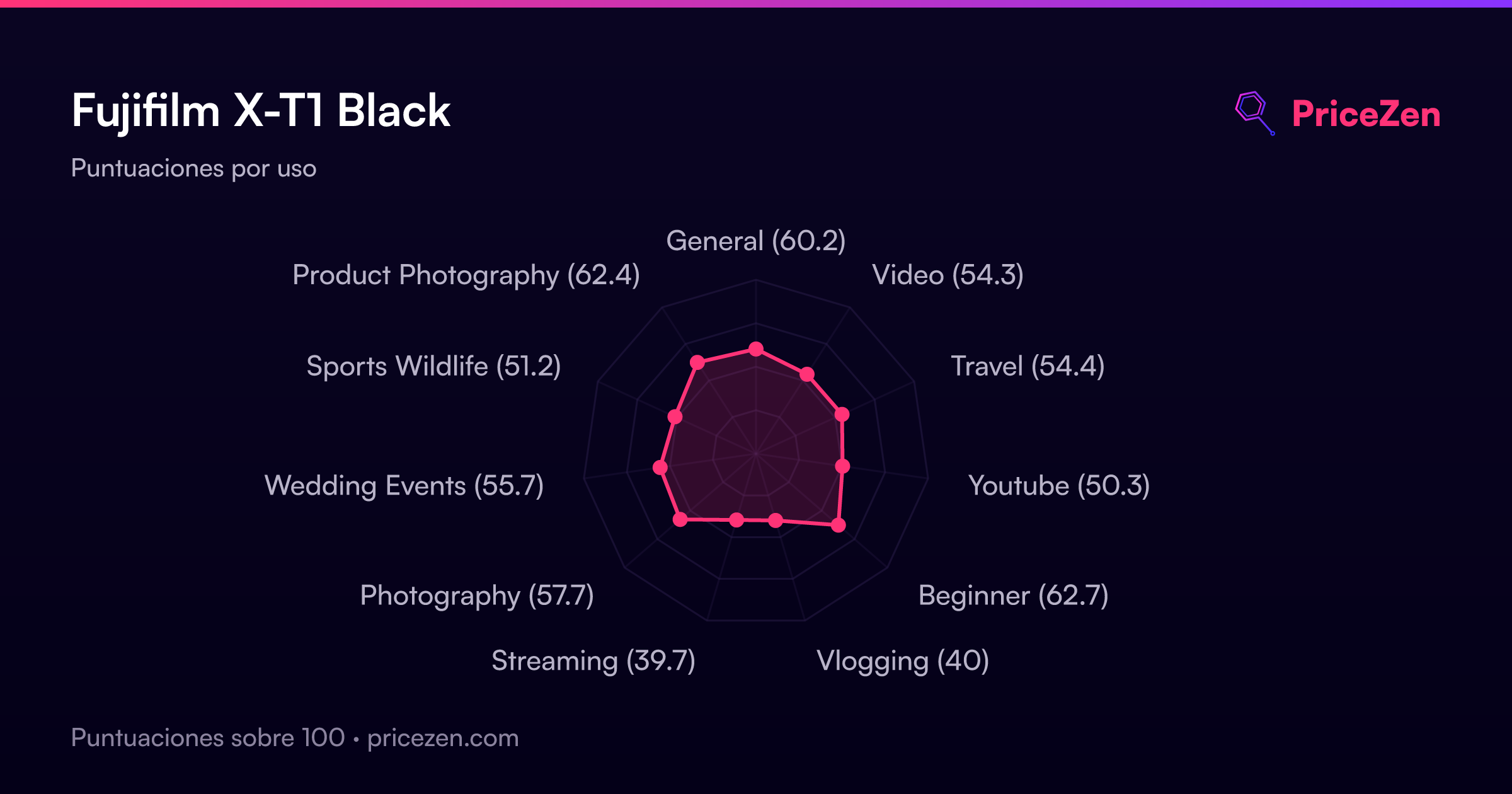
Usage Scores
- General60.2
- Video54.3
- Travel54.4
- Youtube50.3
- Beginner62.7
- Vlogging40
- Streaming39.7
- Photography57.7
- Wedding Events55.7
- Sports Wildlife51.2
- Product Photography62.4