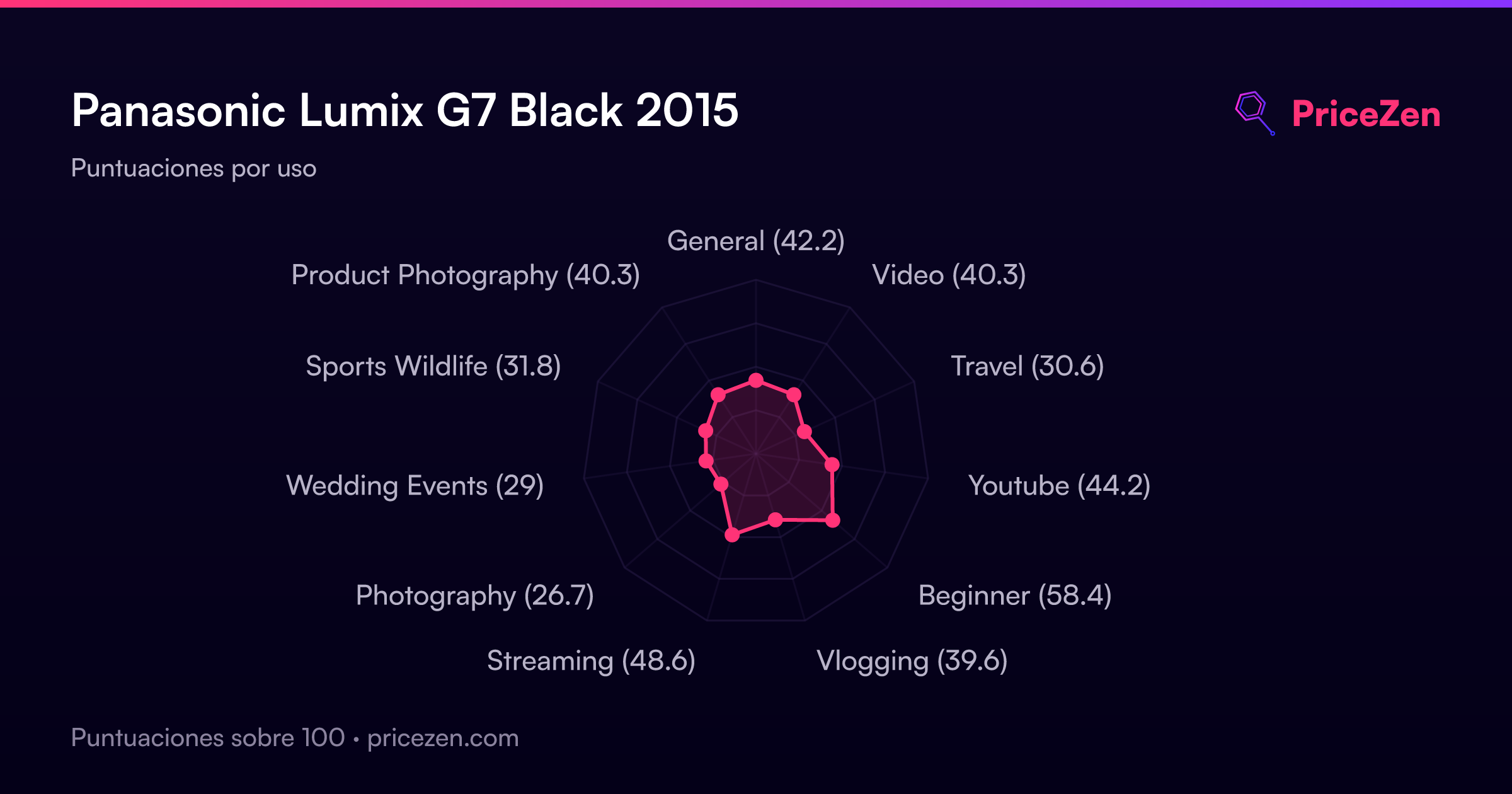
Panasonic Lumix G7 Black 2015
The 4K UHD video at 30fps and 40fps electronic burst shooting, driven by the Venus Engine 9, make this a capable hybrid for its class. The lightweight 265g body, paired with a fully articulating touchscreen and high-resolution 2.36m-dot OLED viewfinder, offers flexible composition for both stills and video. This camera is best for beginner streamers and YouTubers who need a compact, affordable entry point into 4K content creation.

Sin precio actual de tiendas











Resumen
The 30-Second Version
The G7's autofocus ranks in the 5th percentile, one of the worst we've seen, and its 16MP sensor sits at 11th. But it still delivers 4K video, a standout EVF, and a great articulating screen for as little as $659. Owners love it, rating it 4.6 out of 5, but that love is mostly from video shooters who got a deal.
Pros & Cons
Ventajas
- 4K video at 30fps with external mic input, a rare combo at this price 86th
- 40fps electronic burst mode, well above average for the category 85th
- 2.36M-dot OLED EVF, a standout in the 85th percentile 82nd
- Articulating touchscreen LCD, great for vlogging and odd angles 80th
- Lightweight 265g body with strong ergonomics and customization
Desventajas
- Autofocus ranks in the 5th percentile, one of the worst we've seen
- No in-body stabilization, a recurring owner complaint
- 16MP sensor sits at 11th percentile, limiting for stills
- Build quality ranks in the 8th percentile, not weather-sealed
- Battery life is middle of the pack at 47th percentile
Opinión de los propietarios
The Word on the Street
Cómo cambió la opinión de los propietarios con el tiempo
ExclusivaSegún cuándo escribieron realmente sus opiniones los clientes, para ver si los elogios iniciales se mantuvieron.
15 opiniones escritas, jun 2015 – nov 2024: 15 satisfechos
En las 2025 valoraciones de tiendas: 4,6★. La mayoría de los propietarios valora sin escribir una opinión. El gráfico cuenta las 15 opiniones escritas.
Cada punto es una opinión escrita, en el mes en que se escribió. Satisfechos = 4-5★, neutrales = 3★, insatisfechos = 1-2★.
Las pruebas
Performance
Let's start with the good stuff. The burst shooting is genuinely impressive for a camera this old. You get 8fps with mechanical shutter and single-shot AF, plus a wild 40fps electronic mode that leverages the 4K video pipeline. That puts it in the 83rd percentile for burst, which is well above average. The 2.36M-dot OLED EVF is a standout too, landing in the 85th percentile. It's bright, sharp, and honestly better than what you'd expect at this price point. The 3-inch articulating touchscreen is also strong, sitting in the 86th percentile.
The problem is the autofocus. The 49-point DFD system ranks in the 5th percentile, which is one of the worst we've seen. DFD was Panasonic's contrast-detect workaround before they moved to phase-detect, and it shows its age. It's fine in good light and for static subjects, but tracking anything moving quickly is a frustrating experience. The sensor is also a weak spot at 11th percentile. 16MP is fine for 4K video, but for stills it's limiting, especially when you need to crop. Low-light performance is mediocre at best, and the lack of in-body stabilization means you're relying entirely on lens OIS. The 14-140mm kit lens has Power O.I.S., which helps, but it's not a substitute for IBIS.
Specifications
Full Specifications
Sensor
| Type | MOS |
| Size | micro-four-thirds |
| Megapixels | 16 MP |
| ISO Range | 200 |
| Processor | Venus Engine 9 |
Autofocus
| AF Points | 49 |
| AF Type | Contrast Detection: 49 |
Shooting
| Burst (Mechanical) | 8 |
| Burst (Electronic) | 40 |
| Max Shutter | 1/16000 |
| Electronic Shutter | Yes |
Video
| Max Resolution | 4K |
| 4K FPS | 30 |
| 1080p FPS | 60 |
| Codec | AVCHD, MP4 |
Display & EVF
| Screen Size | 3" |
| Touchscreen | Yes |
| Articulating | Yes |
| EVF Resolution | 2.36 M dots |
Build
| Weight | 0.3 kg / 0.6 lbs |
Connectivity
| Wi-Fi | Yes |
| Bluetooth | No |
| USB | Mini-USB 8-Pin (USB 2.0) |
| HDMI | Micro HDMI |
| Hot Shoe | Yes |
vs Competition
Against modern competitors, the G7 shows its age fast. The Fujifilm X-H2 and OM System OM-1 Mark II both have stacked sensors, phase-detect autofocus, and in-body stabilization. The Sony a7R IIIA has a full-frame 42MP sensor that makes the G7's 16MP look like a toy. Even the Nikon Z5 II and Canon EOS R7, both mid-range options, offer weather sealing and far better AF systems. The G7's one advantage is price. You can buy two or three used G7 bodies for the cost of one new X-H2. But you're trading away autofocus performance, sensor resolution, stabilization, and build quality. For video-only shooters on a tight budget, the G7 still holds up. For anyone shooting stills or hybrid work, the modern options are worth the extra money.
| Spec | Panasonic Lumix G7 | Sony CineAlta BURANO | Blackmagic Design URSA Cine17K 65 | ARRI ALEXA 35 XTREME | Fujifilm X-T10 | OM System OM V210072SU000_AG9_1 |
|---|---|---|---|---|---|---|
| Type | mirrorless | cinema | cinema | cinema | mirrorless | mirrorless |
| Sensor | 16MP micro-four-thirds | 41.9MP full-frame | 140.8MP full-frame | 14.6MP aps-c | 16.3MP aps-c | 20.4MP micro-four-thirds |
| AF Points | 49 | 627 | - | - | 77 | 121 |
| Burst FPS | 8 | - | 60 | 35 | 8 | 6.5 |
| Video | 4K @30fps | 8K @120fps | 8K @60fps | 4K @240fps | 1080p | 4K |
| IBIS | false | true | false | false | true | true |
| Weather Sealed | false | false | false | false | false | true |
| Weight (g) | 265 | 2400 | - | 2900 | 381 | 1424 |
| Compare | Compare | Compare | Compare | Compare |
| Producto | AF | EVF | Build | Burst | Video | Sensor | Display | User Sentiment | Connectivity | Valoración social | Affordability | Stabilization |
|---|---|---|---|---|---|---|---|---|---|---|---|---|
| Panasonic Lumix G7 | 6.6 | 85.4 | 9.8 | 80.1 | 57.8 | 15.8 | 82.1 | 55.6 | 75.3 | 86.4 | 53.3 | 32.8 |
| Sony CineAlta BURANO Compare | 93.1 | 89.5 | 85.4 | 31.6 | 98 | 64.1 | 82.1 | 0 | 82.8 | 0 | 2.8 | 87.7 |
| Blackmagic Design URSA Cine17K 65 Compare | 36.9 | 98.7 | 73.6 | 98.5 | 99.7 | 98.1 | 82.1 | 0 | 80.5 | 7.8 | 2.7 | 32.8 |
| ARRI ALEXA 35 XTREME Compare | 36.9 | 80.9 | 78.2 | 96.1 | 97.7 | 71.8 | 27.2 | 0 | 82.8 | 0 | 1.3 | 32.8 |
| Fujifilm X-T10 Compare | 80.8 | 85.4 | 71 | 63.4 | 47.9 | 74.7 | 67.5 | 18.3 | 64.7 | 63.4 | 52.9 | 74.6 |
| OM System OM V210072SU000_AG9_1 Compare | 82.6 | 37.3 | 88.2 | 61.1 | 42.7 | 45.7 | 82.1 | 0 | 67 | 29.3 | 38.1 | 94.3 |
Precio
Value & Pricing
Here's where things get interesting. The G7's value proposition depends entirely on what you pay. In the US, prices range from $659 to $725 across two listings. That $66 spread is worth paying attention to, and the lower end is where this camera makes sense. At $659, you're getting 4K video, a great EVF, and a solid articulating screen for less than most entry-level mirrorless bodies cost new. But in Canada, the spread is wild: CAD 905 to CAD 2,488. That's a CAD 1,583 gap between listings. If you're paying anywhere near the top of that range, you're getting fleeced. The G7 is a value play, and it only works if you buy it at the low end. The 14-140mm kit lens adds real utility, but it's not worth overpaying for.
Historial de precios
Leer más
Overview
The Panasonic Lumix G7 is a weird one in our database. It lands in the 90th percentile for social proof and the 86th for its display, but the sensor sits at a rough 11th percentile and autofocus is dead last at 5th. That's a strange mix, and it tells you exactly what this camera is: a beloved budget workhorse with some serious age showing. Owners rate it 4.6 out of 5 across 2,025 reviews, and the sentiment score of 87/100 backs that up. People genuinely love this thing.
But love doesn't fix a 16MP Micro Four Thirds sensor in 2025. The G7 was a killer deal when it launched, and it still has charm, but the numbers don't lie. It's a 4K video machine with a stills sensor that lags behind most modern options. If you're buying it for video or streaming, you're in decent shape. If you're buying it for photography, well, keep reading.
Common Questions
Q: Is the Panasonic G7 good for 4K video?
Yes, 4K video is the G7's strongest feature. It shoots 4K at 30fps and 24fps, and the video quality ranks in the 60th percentile overall. The external microphone input is a big plus for video work. Just note that you'll need a fast SD card to handle 4K recording, and there's no headphone jack for monitoring audio.
Q: How does the autofocus perform on the G7?
The autofocus is the G7's biggest weakness. The 49-point DFD system ranks in the 5th percentile, which is one of the worst in our database. It's contrast-detect based, so it works okay for static subjects in good light but struggles with fast-moving subjects and low-light tracking. If you shoot sports or wildlife, this is not the camera for you.
Q: Does the G7 have image stabilization?
No, the G7 has no in-body image stabilization. It ranks in the 34th percentile for stabilization, which is below average. You'll need to rely on lens-based stabilization, like the Power O.I.S. in the 14-140mm kit lens. For handheld video without a stabilized lens, expect shaky footage.
Who Should Skip This
If you shoot stills, skip this. The 16MP sensor ranks in the 11th percentile, and the autofocus is in the 5th. That combination makes action photography, wildlife, and even casual family shots more frustrating than they need to be. The build quality is also rough, sitting at the 8th percentile with no weather sealing. If you shoot outdoors in anything but perfect conditions, or if you need reliable subject tracking, spend a bit more on a modern body. The G7 is a video bargain, not a photography workhorse.
Verdict
The Panasonic Lumix G7 is a camera that time has passed by, but not completely. Its 4K video, excellent EVF, and articulating screen still make it a viable budget option for streamers and video-first shooters. The 87/100 sentiment score and 4.6-star rating show that owners who bought it at the right price are genuinely happy. But the 5th percentile autofocus and 11th percentile sensor are hard to ignore. If you can find one at the low end of the US price range, around $659, and you mainly shoot video, it's a decent buy. For photography, look elsewhere.
Usage Scores
- General42.9
- Video40.6
- Travel31.3
- Youtube44.5
- Beginner58.2
- Vlogging39.7
- Streaming48.4
- Photography26.9
- Wedding Events29.2
- Sports Wildlife31.8
- Product Photography40.5