Exascend PE3 Series 3.84TB PCIe 3.0 x4 M.2

Hardware encryption guards your files verified Nov 28
57/100 overall score
Prices checked on 1 days so far, too few to say what is usual.
- Capacity
- 3.84TB
- Form factor
- M.2
- Interface
- PCIe 3.0 x4
- Read speed
- 3,100 MB/s
- NAND
- TLC
Compare prices at 1 store
Cheapest first. New, refurbished and bundled offers are kept apart, so you compare like with like.
| Store | Sold by | Colour and condition | Price | vs lowest | Last checked | Link |
|---|---|---|---|---|---|---|
| New1 offerSingle unit | ||||||
| Amazon | Not known | Not listed | MX$15,144.44 | Lowest price | 5 days ago | Go to store |
 Source: PriceZen, checked Nov 23, 2026
A price counts as current when we checked it in the last 7 days. “Marketplace seller” means a third-party seller on that store, not the store itself.


Snapshot
The 30-Second Version
USD 401 separates Amazon's USD 498 from Best Buy's USD 899 for the same drive, which is the wildest number here. You get 3.84TB and hardware encryption, but PCIe 3.0 speeds of 3100/2000 MB/s are only average, endurance trails the field, and the warranty is one year. Buy it for capacity, not for pace.
Pros & Cons
Pros
- 3.84TB of TLC NAND, one of the biggest capacities in our internal SSD rankings 87th
- Hardware encryption on board, pushing features well above average 79th
- 3100 MB/s sustained reads and 2000 MB/s writes, tuned for steady load rather than burst bragging rights
- Enterprise-focused flash management with configurable capacities and QoS tuning
- Amazon's USD 498 listing is far cheaper than the USD 899 alternative
Cons
- Affordability ranks in the bottom tenth of internal SSDs we track
- PCIe 3.0 x4 keeps speed at roughly the category average
- Endurance falls behind most of the field
- Only a 1-year warranty on a drive sold as enterprise grade
- Portable use score of 16.2/100 is a genuine weak spot
The proof
Performance
Start with the interface, because it explains everything else. PCIe 3.0 x4 caps what this thing can do, and the rated 3100 MB/s read / 2000 MB/s write figures land it at the 58th percentile for speed in our data, basically average for an internal SSD right now. Random performance scores 62, so it's solid rather than special there. The marketing leans hard on sustained throughput, low I/O latency and quality of service, which is exactly what enterprise buyers care about: steady numbers under constant load instead of a big burst figure that falls off a cliff. That's a real design goal, but it isn't the same thing as being fast compared to the consumer drives it's shelved next to.
Capacity is where it actually shines. 3.84TB of TLC puts it among the roomiest internal SSDs we compare, and hardware encryption pushes the feature score to 78, well above average. Our use-case scores tell the rest of the story: 62.3 for laptops and 61.7 for gaming are middling results, and portable use bottoms out at 16.2. If your workload is bulk storage with consistent writes, the spec sheet makes sense. If you want the quickest drive in the machine, this isn't it.
Specifications
Full Specifications
Drive
| Capacity | 3840 |
| Form Factor | M.2 |
| Interface | PCIe 3.0 x4 |
| Protocol | SATA |
| PCIe Generation | 3 |
| External | No |
Performance
| Sequential Read (MB/s) | 3100 |
| Sequential Write (MB/s) | 2000 |
Hardware
| NAND | TLC |
Reliability
| Warranty (years) | 1 |
Features
| Hardware Encryption | Yes |
vs Competition
Against the Samsung 9100 PRO, Kingston FURY Renegade, WD_BLACK SN850X, Crucial T700 and Seagate FireCuda 530R, the PE3's argument is capacity and consistency, not speed. Its 3100/2000 MB/s figures sit at the 58th percentile, so mid-pack, while its 3.84TB puts it near the top for room. Cross-shop the Samsung 9100 PRO or Crucial T700 if raw throughput is the priority, since our speed ranking says this drive isn't leading there. Look at the Kingston FURY Renegade or WD_BLACK SN850X for gaming builds, where the PE3's 61.7 score is unremarkable. The FireCuda 530R is worth a look if endurance matters, given the PE3's below-average endurance ranking and one-year warranty. The PE3 only really wins if you want lots of encrypted, steady-state storage in one M.2 slot.
| Spec | Exascend PE3 Series | Inland Performance Plus | Gigabyte AORUS AG4731TB N | XPG SPECTRIX S65G | Solidigm D7-P5520 | HP NVMe Mainstream Performance Mixed Use |
|---|---|---|---|---|---|---|
| Capacity | 3.84TB | 8TB | 1TB | 1TB | 7.68TB | 3.2TB |
| Form Factor | M.2 | M.2 2280 | M.2 2280 | M.2 2280 | U.2 | 2.5" |
| Interface | PCIe 3.0 x4 | PCIe 4.0 | PCIe 4.0 x4 | PCIe 4.0 x4 | PCIe 4.0 x4 | PCIe 4.0 x4 |
| Seq Read | 3,100 MB/s | 7,100 MB/s | 7,300 MB/s | 6,000 MB/s | - | - |
| Nand Type | TLC | TLC | TLC | TLC | TLC | - |
| Dram Cache | - | Yes | Yes | Yes | - | - |
| Endurance | - | 6000 TBW | 700 TBW | 320 TBW | - | 17520 TBW |
| Compare | Compare | Compare | Compare | Compare |
| Product | Speed | Random | Feature | Capacity | Endurance | Affordability |
|---|---|---|---|---|---|---|
| Exascend PE3 Series | 59 | 62.3 | 79.4 | 87.2 | 36.3 | 10 |
| Inland Performance Plus Compare | 87.8 | 81.7 | 89.7 | 97.1 | 93.3 | 5.3 |
| Gigabyte AORUS AG4731TB N Compare | 84.4 | 92.6 | 94.3 | 56.5 | 91.5 | 46.5 |
| XPG SPECTRIX S65G Compare | 78.1 | 81.7 | 99 | 56.5 | 76.8 | 58.7 |
| Solidigm D7-P5520 Compare | 69.3 | 62.3 | 79.4 | 96 | 58.4 | 1 |
| HP NVMe Mainstream Performance Mixed Use Compare | 69.3 | 89.4 | 15.6 | 86.5 | 99.3 | 0.1 |
Price
Value & Pricing
USD 401 separates the two US listings we're tracking: Amazon has it at USD 498, Best Buy at USD 899. That's not a rounding error, that's a different product decision. At USD 498 the 3.84TB capacity and hardware encryption start to look reasonable if you specifically need sustained-write behaviour. At USD 899 we'd walk away, because our affordability ranking already puts this drive in the bottom tenth of the category and paying the higher listing only deepens that hole. We track prices over time, partly through our community browser extension, and this is a drive where the store you pick matters more than usual.
We started tracking prices for this product on Nov 25, 2026. The chart appears once we have more data.
Read more
Overview
3.84TB of TLC NAND, 3100 MB/s sustained reads and 2000 MB/s writes over PCIe 3.0 x4, and a price that swings from USD 498 at Amazon to USD 899 at Best Buy. Those are the numbers that decide whether this drive makes sense for you, because the Exascend PE3 is an enterprise part sitting in a consumer category, and it shows. Our scoring model puts capacity in the top tier of internal SSDs (88th percentile), features well above average thanks to hardware encryption, and speed right around the middle of the pack (58th percentile).
The catch is affordability: it lands in the bottom tenth of every internal SSD we track. Endurance sits below average too, and the warranty is just one year, which is short for something marketed as enterprise hardware. Add it up and our overall score comes out at 58.5/100, with laptop fit at 62.3 and gaming at 61.7. This is a niche drive being asked to compete with mainstream flagships, and it doesn't win that fight on paper.
Common Questions
Q: Is PCIe 3.0 going to hold this drive back?
For peak speed, yes. The 3100 MB/s read and 2000 MB/s write ratings put it at the 58th percentile for speed in our data, which is about average for internal SSDs right now. Random performance scores 62, so it's solid there. The design aim is sustained throughput and low I/O latency under constant load rather than headline burst numbers.
Q: Is 3.84TB overkill for a laptop or gaming PC?
It's a lot of space, and capacity is this drive's strongest card, ranking near the top of the category. But our fit scores are 62.3 for laptops and 61.7 for gaming, both middling. If you mainly need room for large libraries and you can get it at USD 498, fine. If you want faster load times, our speed ranking says look elsewhere.
Q: Does the one-year warranty matter on an enterprise drive?
We think it does. Endurance ranks below average in our comparison set (34th percentile), and a 1-year warranty is short coverage for something billed as enterprise hardware. Combined with an affordability score in the bottom tenth, that's a lot of risk to take on at USD 899.
Who Should Skip This
Gamers and everyday upgraders should skip this one. A 61.7 gaming score and mid-pack speed ranking mean you're paying enterprise money for average quickness, and the bottom-tenth affordability score backs that up. Anyone who needs long-term write stamina should also look elsewhere, since endurance falls behind most of the field and the warranty runs just one year. And if you're planning to carry it around, the 16.2/100 portable score is about as clear a no as our model gives.
Verdict
We'd only recommend this at Amazon's USD 498, and only for a specific job: bulk capacity with hardware encryption and predictable sustained writes. The 88th-percentile capacity and above-average feature score are real. But a 58.5/100 overall score, mid-pack speed, below-average endurance and a one-year warranty make it a hard sell as a general-purpose upgrade, and at USD 899 it's an easy pass. Nobody pays us to say that, we just run the specs and benchmarks through our model and report where things land.
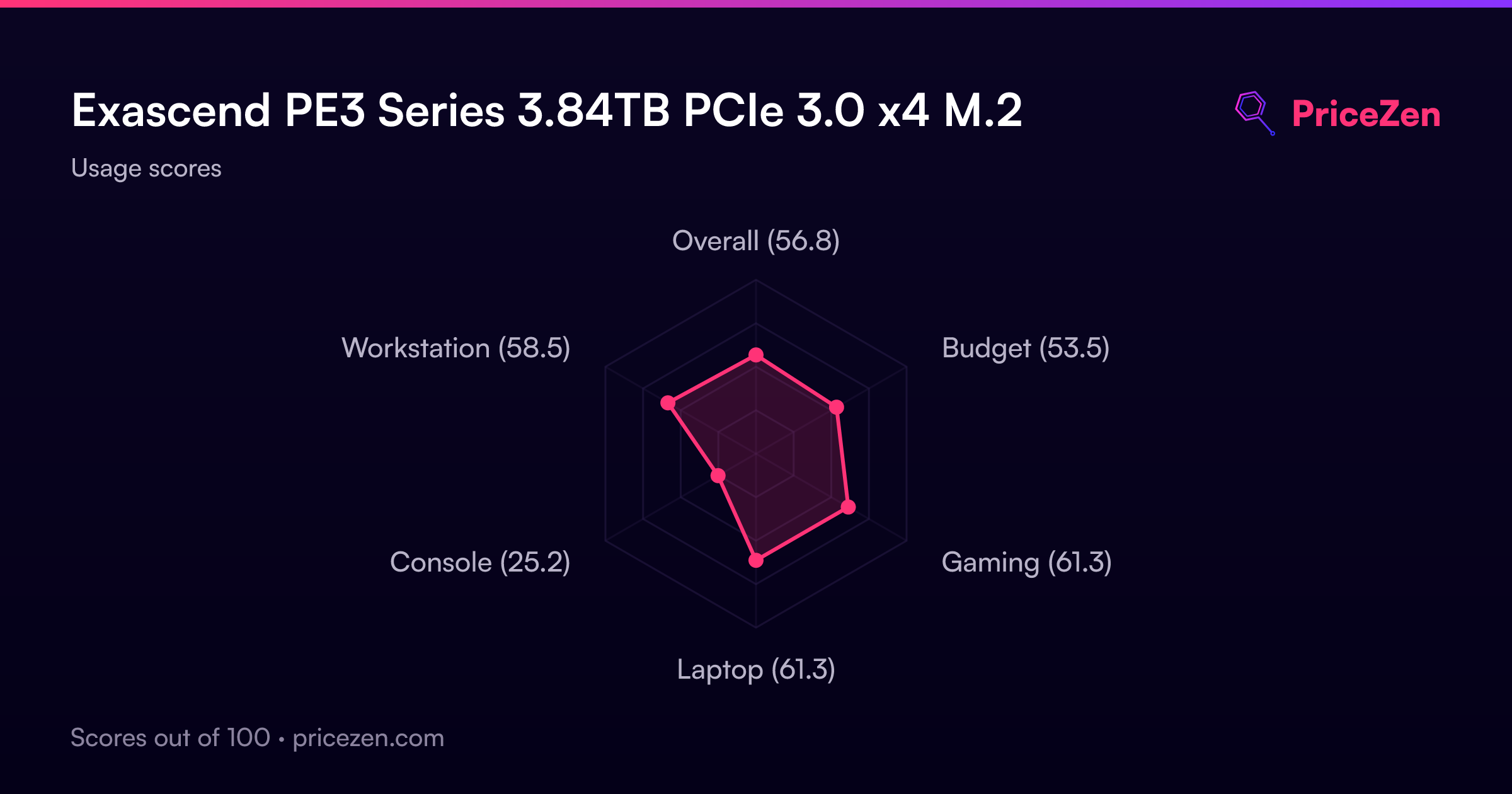
Usage Scores
- Overall56.8
- Budget53.5
- Gaming61.3
- Laptop61.3
- Console25.2
- Workstation58.5