Intel SSD DC 4600 Series 1.9TB SATA III 2.5"
The 1.9TB capacity with TLC NAND and a 2,000,000-hour MTBF targets enterprise endurance, though SATA III caps sequential speeds at 500 MB/s read and 480 MB/s write. Its 2.5-inch form factor and SATA interface make it a drop-in upgrade for older servers or workstations without NVMe support. Best for IT managers refreshing legacy storage arrays where capacity and reliability outweigh raw performance, not for portable or high-IOPS workloads.












Snapshot
The 30-Second Version
The Intel SSD DC 4600 Series 1.9TB SATA SSD is an enterprise drive with dated performance and inconsistent pricing. It hits 500 MB/s read and 480 MB/s write, which is slow by modern standards. With a 1-star customer rating and reports of used drives sold as new, this one is hard to recommend.
Pros & Cons
Pros
- 1.9TB capacity is decent for a SATA drive 68th
- SATA III interface works with almost any system
- Enterprise-grade MTBF rating of 2,000,000 hours
- 2.5-inch form factor fits most server bays
- TLC NAND is more durable than QLC
Cons
- Speed is in the bottom 20% of all drives we've tested
- Customer rating is 1 out of 5 stars
- Pricing is wildly inconsistent across listings
- Random performance is below average
- Likely to be sold as used or refurbished without disclosure
What owners think
The Word on the Street
How owner sentiment changed over time
ExclusiveBased on when customers actually wrote their reviews - so you can see whether early praise held up.
1 written review, Oct 2025: 1 unhappy
Across all 1 store ratings: 1.0★. The chart counts the 1 written review.
Each dot is one written review, in the month it was written. Happy = 4-5★, mixed = 3★, unhappy = 1-2★.
The proof
Performance
Let's talk numbers. The Intel DC S4600 hits 500 MB/s sequential read and 480 MB/s sequential write. That's about as fast as SATA III gets, so no complaints there if you're comparing it to other SATA drives. But here's the thing, SATA III has been a bottleneck for years. Any half-decent NVMe drive will do 3,500 MB/s or more, and the top drives in our database are pushing 7,000 MB/s plus. So in the grand scheme of storage, this drive is slow. Our database puts its speed at the 18th percentile, which means over 80% of the drives we've tested are faster. That's not a typo.
Random performance is a bit better but still nothing to write home about. 72K random read IOPS and 65K random write IOPS put it at the 41st percentile for random performance. That's below average, but for a SATA enterprise drive from this era, it's not embarrassing. The TLC NAND is fine for what it is, but it's not going to blow anyone away. If you're running a database or virtualization workload that needs consistent low-latency random I/O, this drive will do the job, just not quickly. The endurance rating of 2,000,000 hours MTBF sounds impressive, but that's a statistical measure, not a guarantee your specific drive won't die. And given the customer feedback we've seen about used drives with SMART errors, I'd take that number with a grain of salt.
Specifications
Full Specifications
Drive
| Capacity | 1900 |
| Form Factor | 2.5" |
| Interface | SATA III |
| Protocol | SATA |
| External | No |
Performance
| Sequential Read (MB/s) | 500 |
| Sequential Write (MB/s) | 480 |
| Random Read (IOPS) | 72000 |
| Random Write (IOPS) | 65000 |
Hardware
| NAND | TLC |
Reliability
| MTBF (hours) | 2000000 |
vs Competition
Stacked against the Samsung 9100 PRO, this Intel drive looks like it's from a different decade. The 9100 PRO is a PCIe 5.0 NVMe drive with speeds that make 500 MB/s look like a dial-up modem. The WD_BLACK SN850X is another PCIe 4.0 drive that's dramatically faster and often cheaper per gigabyte. Even the Kingston FURY Renegade and Crucial T700 leave the DC S4600 in the dust. The only reason to pick the Intel drive over any of these is if you specifically need a SATA interface, like for an older server or a system with no M.2 slots. And even then, there are newer SATA drives from Crucial and Samsung that offer better endurance and similar speeds for less money.
The SanDisk WD_BLACK WDS800T1X0M is another interesting comparison. It's an 800GB drive, so less capacity, but it's NVMe and way faster. If you're building a workstation and you're considering the Intel DC S4600, you should really be asking yourself why. The only scenario where this drive makes sense is a legacy enterprise environment where you need a specific part number for warranty or compatibility reasons. For everyone else, there are better options at every price point.
| Spec | Intel SSD DC 4600 Series | SanDisk Ultrastar DC SN655 | Solidigm D5-P5336 | KLEVV CRAS C910 | Synology SAT5200 Series | DATO DP580 |
|---|---|---|---|---|---|---|
| Capacity | 1.9TB | 61.44TB | 30.72TB | 500GB | 7TB | 2TB |
| Form Factor | 2.5" | 2.5" | 2.5" | M.2 | 2.5" | M.2 |
| Interface | SATA III | PCIe 4.0 x4 | PCIe 4.0 x4 | PCIe 4.0 x4 | SATA III | PCIe 5.0 x4 |
| Seq Read | 500 MB/s | - | - | 5,000 MB/s | - | 9,300 MB/s |
| Nand Type | TLC | TLC | QLC | TLC | - | - |
| Dram Cache | - | - | - | false | - | - |
| Endurance | - | - | - | 350 TBW | 10000 TBW | - |
| Compare | Compare | Compare | Compare | Compare |
| Product | Speed | Random | Feature | Capacity | Endurance | Social Proof | Affordability |
|---|---|---|---|---|---|---|---|
| Intel SSD DC 4600 Series | 18.3 | 41.1 | 53.2 | 68.3 | 33.7 | 0.3 | 12.2 |
| SanDisk Ultrastar DC SN655 Compare | 68.6 | 87.5 | 53.2 | 99.8 | 65.6 | 0 | 0 |
| Solidigm D5-P5336 Compare | 68.6 | 61.8 | 33.3 | 99.6 | 57 | 0 | 0.3 |
| KLEVV CRAS C910 Compare | 71.6 | 87.1 | 87.4 | 27.7 | 71.7 | 64.7 | 64 |
| Synology SAT5200 Series Compare | 8.3 | 41.4 | 14.7 | 96.8 | 96.1 | 26.2 | 0.5 |
| DATO DP580 Compare | 94.6 | 61.8 | 29.7 | 78.8 | 14.7 | 13.7 | 22.1 |
Price
Value & Pricing
Value is where this drive gets really tricky. At $689 USD, you're paying a premium for an enterprise label and a SATA interface that's been obsolete for years. For that same money, you could get a 2TB NVMe drive like the Samsung 9100 PRO or WD_BLACK SN850X that will absolutely smoke this thing in every performance metric. The Canadian listing at over $3,000 CAD is frankly absurd, and I can't imagine anyone paying that unless they're trapped in some bizarre procurement contract. The affordability score in our database is 11th percentile, which means this drive is more expensive than 89% of comparable products. That's a hard sell when the performance is also in the bottom fifth. If you find one of these used for under $200, maybe it's worth a look for a low-stakes server or backup target. But at retail prices, you're getting fleeced.
Amazon 1 offer From MX$17,596
We started tracking prices for this product on Nov 20, 2026. The chart appears once we have more data.
Read more
Overview
The Intel SSD DC 4600 Series SSDSC2KG019T701 is a 1.9TB enterprise SATA drive that's been floating around the market for a while now. It's a 2.5-inch form factor with a SATA III interface, which puts it firmly in the legacy camp when you look at what modern NVMe drives are doing. The listed price is all over the place, around $689 USD on Amazon, but a Canadian listing shows over $3,000 CAD, so pricing is clearly not stable or sane. This is a drive aimed at data centers and servers, not your average gaming rig, and that context matters a lot when you're trying to figure out if it's worth your time.
People searching for this drive are usually asking the same questions. Is the Intel DC S4600 good for a workstation? Is it reliable enough for a NAS or server? How does it compare to newer SATA SSDs? The short answer is that it's a mixed bag. The endurance story is decent on paper with a 2,000,000 hour MTBF, but the actual customer feedback we've seen is rough. One buyer reported getting used drives that were 3-4 years old with SMART errors right out of the box. That's not a great sign for a product that's supposed to be an enterprise workhorse.
For a 1.9TB SATA SSD, the specs are pretty dated. 500 MB/s read and 480 MB/s write are basically the ceiling for SATA III, but that ceiling was hit years ago. The random performance of 72K read IOPS and 65K write IOPS puts it in the bottom half of our database for random performance. If you're looking at this drive in 2024 or 2025, you're probably doing it because you found a cheap listing or you need a specific enterprise part number for a legacy server. Either way, you should know what you're getting into.
Common Questions
Q: Is the Intel DC S4600 good for gaming?
No, the Intel DC S4600 is not good for gaming. Its 500 MB/s read speed is far below what modern NVMe drives offer, and you'll see longer load times compared to drives like the WD_BLACK SN850X or Samsung 9100 PRO.
Q: How does the Intel DC S4600 compare to NVMe drives?
The Intel DC S4600 is significantly slower than NVMe drives. While it maxes out at 500 MB/s read, most NVMe drives easily exceed 3,500 MB/s, and top-tier PCIe 5.0 drives hit 7,000 MB/s or more.
Q: Is the Intel DC S4600 reliable for a server or NAS?
The Intel DC S4600 has a 2,000,000 hour MTBF rating, which suggests good reliability on paper. However, customer feedback indicates some buyers received used drives with SMART errors, so you should verify the drive's condition before deploying it in a server or NAS.
Q: Why is the Intel DC S4600 so expensive?
The Intel DC S4600 is priced as an enterprise drive, which typically carries a premium. But at around $689 USD, it's more expensive than 89% of comparable drives in our database while offering bottom-tier performance, making it a poor value for most buyers.
Who Should Skip This
Skip this drive if you're building a gaming PC, a workstation, or anything where speed matters. The SATA III interface caps you at 500 MB/s, and modern NVMe drives are 7 to 14 times faster for the same or less money. Also skip it if you're buying from a marketplace seller without a solid return policy, given the reports of used drives sold as new. If you need a SATA drive for an older system, look at newer options from Crucial or Samsung that offer better endurance and actual new-in-box condition. And if you're just looking for bulk storage, a 2TB NVMe drive like the Kingston FURY Renegade or Crucial T700 will serve you far better.
Verdict
Should you buy the Intel SSD DC 4600 Series SSDSC2KG019T701? Probably not. The performance is dated, the pricing is inconsistent and often absurd, and the one customer review we have is a 1-star warning about used drives being sold as new. That's a triple threat of red flags. The 1.9TB capacity is nice, and the SATA interface means it'll work in almost anything, but those are the only real selling points. For the money, you can get a modern NVMe drive that's 10 times faster and actually new.
If you absolutely need a SATA enterprise drive for a legacy server and you can find one of these at a steep discount from a reputable seller, it might be worth considering. But even then, I'd want to see SMART data before I handed over any money. The customer feedback about 3-4 year old drives with errors is a serious concern. This drive feels like a trap for people who don't know what they're buying.
Usage Scores
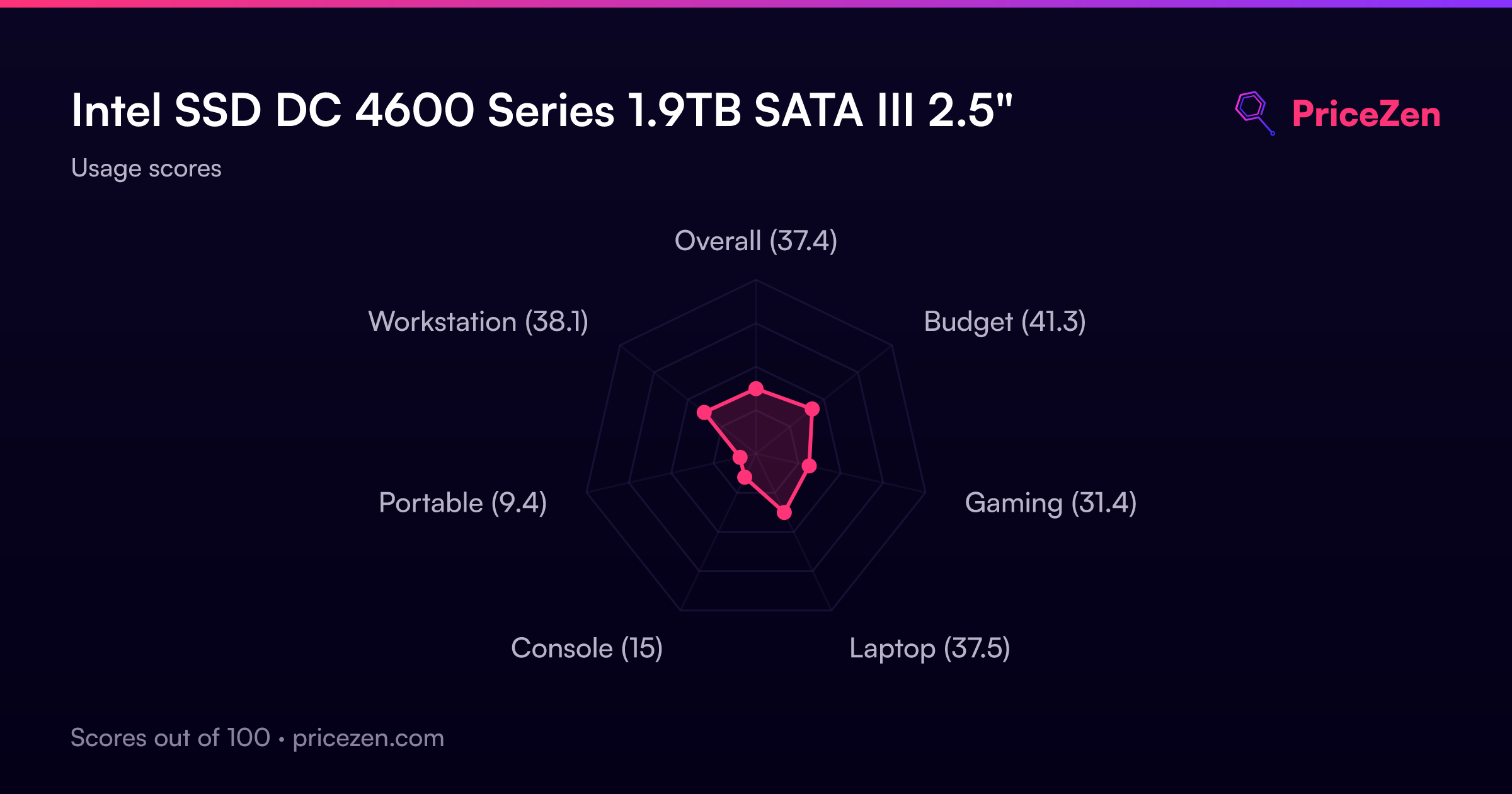
- Overall37.4
- Budget41.3
- Gaming31.4
- Laptop37.5
- Console15
- Portable9.4
- Workstation38.1