Rokinon Cine XEEN 135mm T2.2 Pro

Cine telephoto with creamy backgrounds verified Nov 19
38/100 overall score 4.2 average from 45 owner ratings
- Focal length
- 135mm
- Aperture
- T2.2
- Mount
- Canon EF
- Format coverage
- full-frame
- Weight
- 176 g
- Af type
- manual focus only
- Lens type
- telephoto
Compare prices at 1 store
Cheapest first. New, refurbished and bundled offers are kept apart, so you compare like with like.
| Store | Sold by | Colour and condition | Price | vs lowest | Last checked | Link |
|---|---|---|---|---|---|---|
| New1 offerSingle unit | ||||||
| Not checked in the last 7 days, so these prices may have changed | ||||||
| Amazon | Marketplace seller | Not listed | MX$9,864.17 | Oct 30 | Go to store | |
 Source: PriceZen, checked Oct 30, 2026
A price counts as current when we checked it in the last 7 days. “Marketplace seller” means a third-party seller on that store, not the store itself.
Price history
Checked that dayNot checked that day, still on offer
Source: PriceZen, checked Nov 2, 2026











Snapshot
The 30-Second Version
The Rokinon Cine DS 135mm T2.2 is a fast manual focus telephoto built for video work, not casual stills. The de-clicked aperture and standardized gear positions make it a practical choice for follow focus rigs, and the T2.2 aperture is genuinely fast for the price. At $439 in the US, it's a budget-friendly entry into cine lenses. Just know you're giving up autofocus, stabilization, and some build quality to get there.
Pros & Cons
Pros
- Fast T2.2 aperture for real subject separation 94th
- De-clicked aperture for smooth exposure changes while filming 91st
- Standardized gear positions across the Cine DS line 90th
- Full-frame coverage with a classic 135mm portrait focal length 78th
- 77mm filter thread is common and easy to find
Cons
- Manual focus only, no autofocus at all
- No image stabilization, which hurts at 135mm handheld
- Build quality ranking in the bottom quarter of lenses we track
- Bokeh quality scores below average despite the 9-blade diaphragm
- Minimum focus distance of 800mm limits close-up work
What owners think
The Word on the Street
- Several owners who use this lens for portrait work report being impressed with the sharpness when viewed on high-resolution displays, especially given the price.
- A recurring theme is that the lens performs well in real-world shooting conditions, with users noting it handles lively portrait situations without issues.
- Build quality is a concern for at least one buyer, who reported the lens coming loose and the glass becoming misaligned after only a few hours of use.
- Some users acknowledge the manual focus and lack of modern features are trade-offs, but feel the optical performance and price make it worthwhile for their specific needs.
How owner sentiment changed over time
ExclusiveBased on when customers actually wrote their reviews - so you can see whether early praise held up.
11 written reviews, Mar 2015 – Jun 2024: 10 happy, 1 unhappy
Across all 45 store ratings: 4.2★. Most owners rate without writing a review. The chart counts the 11 written reviews.
Each dot is one written review, in the month it was written. Happy = 4-5★, mixed = 3★, unhappy = 1-2★.
The proof
Performance
Optically, this lens sits right around the middle of the pack in our database, at the 57th percentile. That's not a headline-grabbing score, but it's also not a disaster. The 11 elements in 7 groups include one ED element, which helps control chromatic aberration, and the Ultra Multi-Coating does a decent job keeping flare and ghosting in check. For a lens at this price point, that's a reasonable showing.
The aperture performance is where things get a little more complicated. The T2.2 maximum aperture is genuinely fast for a 135mm, and it gives you real subject separation when you're close to your subject. But the aperture ranking lands in the bottom quarter of lenses we track. That's not because T2.2 is slow, it's because the lens is manual focus only and lacks any electronic communication with the camera body on most mounts. You're giving up a lot of modern conveniences to get that fast glass, and the numbers reflect that trade-off.
Specifications
Full Specifications
Optics
| Type | Telephoto |
| Focal Length Min | 135 |
| Focal Length Max | 135 |
| Elements | 11 |
| Groups | 7 |
| ED Elements | 1 |
| Coating | X-Coating Technology |
Aperture
| Max Aperture | T2.2 |
| Min Aperture | T22 |
| Constant | Yes |
| Diaphragm Blades | 11 |
Build
| Mount | Canon EF |
| Format | full-frame |
| Weather Sealed | No |
| Weight | 0.2 kg / 0.4 lbs |
| Filter Thread | 77 |
AF & Stabilization
| AF Type | manual focus only |
| Stabilization | No |
Focus
| Min Focus Distance | 600 |
vs Competition
The competitors in our database are mostly zoom lenses, which makes for an interesting comparison. The Tamron 28-300mm f/4-7.1 and Sigma 16-300mm f/3.5-6.7 are both superzooms with autofocus and image stabilization. They're way more versatile, but they're also much slower at the long end. At 135mm, the Tamron is probably around f/6.3, which is more than two stops slower than this Rokinon's T2.2. That's the difference between a clean shot and a noisy mess in low light.
The Sony E 18-135mm f/3.5-5.6 OSS is another autofocus zoom with stabilization, and it's a solid all-rounder. But again, it can't touch the Rokinon for light gathering or shallow depth of field. The trade-off is clear: the Rokinon gives you speed and cine-specific features, while the zooms give you flexibility and modern conveniences. If you need one lens that does everything, the Rokinon isn't it. If you need a fast telephoto for interviews and portraits on a video rig, the zooms can't compete.
| Spec | Rokinon Cine XEEN 135mm T2.2 Pro | Canon RF 24-105mm f/2.8L IS USM Z | Nikon NIKKOR Z 70-200mm f/2.8 VR S II | Sony FE 400mm f/2.8 GM OSS | Sigma 200mm f/2 DG OS Sports | Fujifilm Fujinon XF 200mm f/2 R LM OIS WR |
|---|---|---|---|---|---|---|
| Focal Length | 135mm | 24-105mm | 70-200mm | 400mm | 200mm | 200mm |
| Max Aperture | T2.2 | f/2.8 | f/2.8 | f/2.8 | f/2 | f/2 |
| Mount | Canon EF | Canon RF | Nikon Z | Sony E | Sony E | Fujifilm X |
| Format Coverage | full-frame | full-frame | full-frame | full-frame | full-frame | APS-C |
| Stabilization | No | Yes | Yes | Yes | Yes | Yes |
| Weather Sealed | No | Yes | Yes | Yes | Yes | Yes |
| Weight (g) | 176 | 1300 | 998 | 2895 | 1800 | 2265 |
| AF Type | manual focus only | Nano USM | Silky Swift Voice Coil Motors (SSVCM) | XD Linear Motor | HLA (High-response Linear Actuator) | Linear motor |
| Lens Type | telephoto | zoom | telephoto | super-telephoto | prime | prime |
| Compare | Compare | Compare | Compare | Compare |
| Product | AF | Bokeh | Build | Macro | Reach | Video | Optical | Aperture | Wide Angle | Portability | Versatility | Social Proof | Affordability | Stabilization |
|---|---|---|---|---|---|---|---|---|---|---|---|---|---|---|
| Rokinon Cine XEEN 135mm T2.2 Pro | 21.9 | 94.4 | 30.4 | 76.1 | 78.4 | 91.4 | 28.8 | 57.5 | 9.3 | 89.5 | 32.5 | 42.6 | 63 | 41.4 |
| Canon RF 24-105mm f/2.8L IS USM Z Compare | 90 | 78.1 | 98.9 | 76.1 | 73.6 | 85.1 | 97.8 | 43.3 | 73.8 | 13.3 | 91.4 | 86.1 | 10.9 | 95.9 |
| Nikon NIKKOR Z 70-200mm f/2.8 VR S II Compare | 95.4 | 88.6 | 98.9 | 77.2 | 83.6 | 85.1 | 78.1 | 43.3 | 28.9 | 20.3 | 78.5 | 55.5 | 14.7 | 99.3 |
| Sony FE 400mm f/2.8 GM OSS Compare | 95.4 | 99.7 | 90.8 | 89 | 91.6 | 69.7 | 70.7 | 43.3 | 4.4 | 2.6 | 32.5 | 93.8 | 4.6 | 97.2 |
| Sigma 200mm f/2 DG OS Sports Compare | 95.4 | 98.8 | 90.8 | 33.9 | 83.6 | 69.7 | 75 | 64.4 | 6.4 | 6.9 | 32.5 | 29.7 | 14.3 | 99.5 |
| Fujifilm Fujinon XF 200mm f/2 R LM OIS WR Compare | 95.4 | 98.5 | 90.8 | 27.4 | 88.1 | 69.7 | 77.3 | 64.4 | 5.2 | 4.1 | 32.5 | 31.2 | 9.2 | 97.2 |
Price
Value & Pricing
Pricing is all over the map depending on where you live. In the US, you're looking at $439, while UK buyers pay £369 and Canadian shoppers see $657 CAD. The Brazilian listing at R$4,459 is a different beast entirely, but that's import taxes and local market weirdness for you. At the US and UK prices, this is a genuinely affordable way to get a fast 135mm cine lens.
For comparison, most dedicated cine lenses from brands like Zeiss or Canon's CN-E line cost several times more. You're giving up autofocus, weather sealing, and some build quality, but you're also paying a fraction of the price. If you're a solo shooter or small crew on a budget, that math works out. Just don't expect the same level of mechanical refinement you'd get from a lens costing three or four times as much.
Read more
Overview
The Rokinon Cine DS 135mm T2.2 is a bit of a niche tool, and that's exactly why it's interesting. This is a manual focus, de-clicked aperture telephoto prime built for video work first. If you're a stills shooter who relies on autofocus, this lens will feel like a step back in time. But if you're pulling focus on a follow focus rig or want that smooth, clickless aperture adjustment mid-shot, it starts to make a lot of sense.
At its core, you're getting a 135mm focal length with full-frame coverage and a fast T2.2 maximum aperture. That's a classic portrait and interview focal length, and the T-stop rating means the light transmission is actually measured, not just calculated. The 9-blade circular diaphragm is designed to keep out-of-focus highlights looking round and pleasing, which matters a lot when you're shooting people against busy backgrounds.
Rokinon's whole Cine DS line is built around consistency. The focus and aperture gears sit in the same position across every lens in the series, so swapping from a 35mm to this 135mm doesn't mean re-rigging your follow focus. That's a practical detail that saves real time on set, and it's one of the main reasons someone would buy into this system rather than adapting stills lenses.
Common Questions
Q: Does this lens have autofocus?
No, this is a manual focus only lens. That's intentional for cine work, where focus is typically pulled manually with a follow focus system. If you need autofocus, you'll want to look at a stills-oriented 135mm lens instead.
Q: Will this lens work on my APS-C camera?
Yes, it will work on APS-C cameras with the appropriate mount adapter. On APS-C, the angle of view narrows to 12.4 degrees, which gives you an effective field of view similar to a longer focal length. The lens is designed for full-frame coverage, so you won't have any vignetting issues on smaller sensors.
Q: Is this lens weather sealed?
No, there's no weather sealing on this lens. If you shoot in dusty or wet conditions, you'll need to take extra precautions. This is one of the areas where the lower price point shows, and it's worth considering if you shoot outdoors frequently.
Q: Can I use this lens for photography, or is it only for video?
You can absolutely use it for stills, but it's designed with video in mind. The de-clicked aperture is great for smooth exposure changes while filming, but it means you won't get the tactile clicks that stills photographers often prefer. The manual focus also requires more deliberate shooting. For portraits on a tripod, it works well. For fast-moving subjects, it's frustrating.
Who Should Skip This
If you shoot handheld video or stills without a tripod, skip this lens. The lack of image stabilization at 135mm means camera shake will be a constant battle, and the manual focus makes it even harder to keep moving subjects sharp. You'd be better off with something like the Sony E 18-135mm f/3.5-5.6 OSS or the Tamron 28-300mm, both of which offer stabilization and autofocus.
Also skip it if you need to shoot close-up detail work. The 800mm minimum focus distance is pretty limiting, and the macro score of 34.6 out of 100 reflects that. If you want to get close to small subjects, look at a dedicated macro lens or a zoom with a shorter minimum focus distance. This lens is built for people at a distance, not flowers and insects.
Verdict
For video shooters who already work with manual focus and follow focus systems, this lens makes a lot of sense. The de-clicked aperture, standardized gear positions, and T-stop calibration are exactly what you want on a film set. The fast T2.2 aperture gives you real control over depth of field, and the 135mm focal length is a workhorse for interviews and tight shots. At $439, it's hard to argue with the value.
For stills photographers, especially anyone shooting handheld or moving subjects, this lens is a harder sell. No autofocus, no stabilization, and a minimum focus distance of 800mm means you'll be working hard for every shot. If you're shooting portraits on a tripod with time to focus carefully, it can work. But most stills shooters would be better served by an autofocus 135mm or a fast 85mm with stabilization.
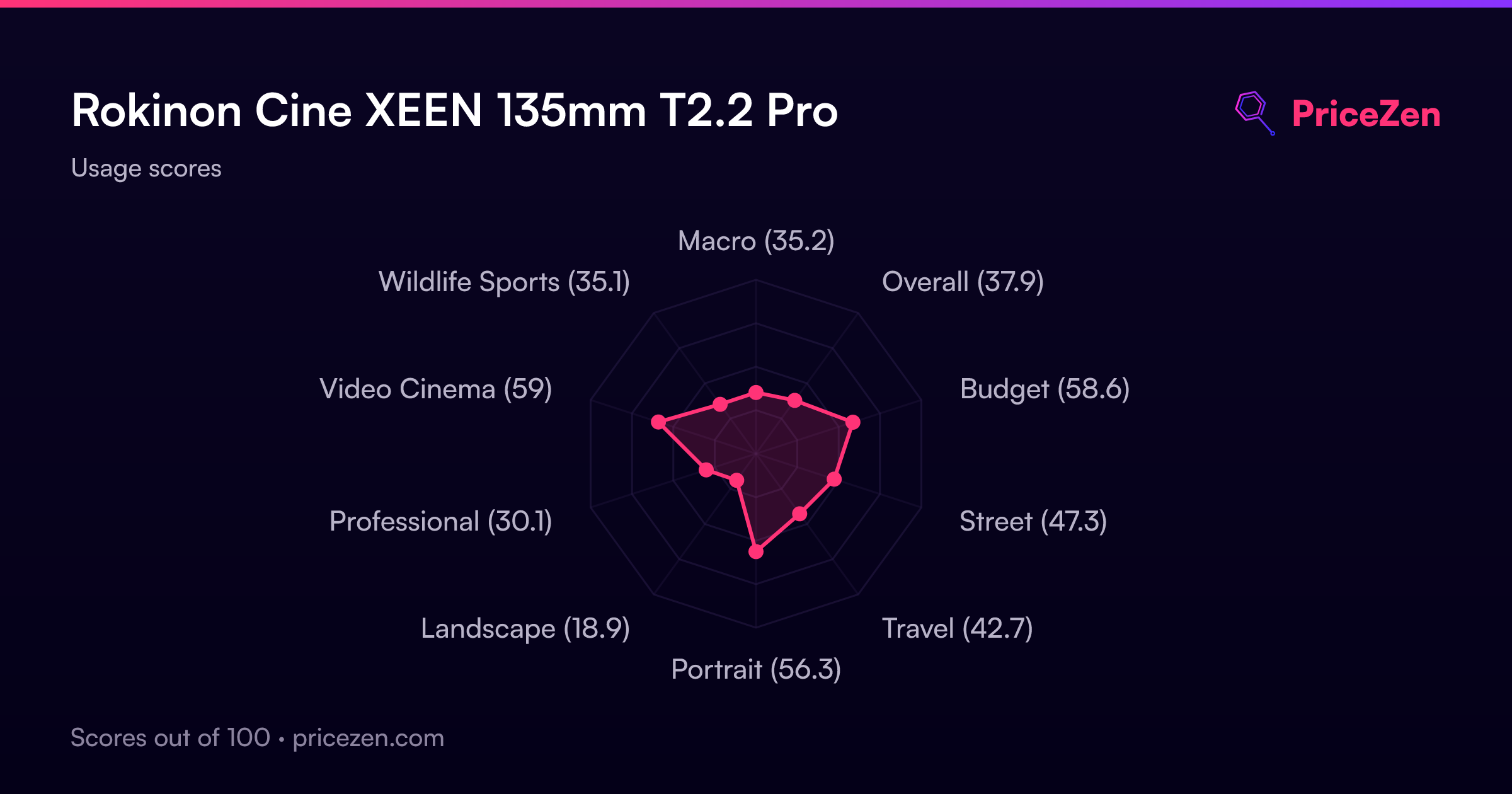
Usage Scores
- Macro35.2
- Overall37.9
- Budget58.6
- Street47.3
- Travel42.7
- Portrait56.3
- Landscape18.9
- Professional30.1
- Video Cinema59
- Wildlife Sports35.1