Rokinon Cine DS 100mm T3.1 ED UMC Macro

Video-ready macro for close-up product shots verified Nov 19
32/100 overall score 4.5 average from 28 owner ratings
- Focal length
- 100mm
- Aperture
- f/3.1
- Mount
- Nikon F
- Format coverage
- full-frame
- Weight
- 726 g
- Lens type
- macro
Compare prices at 1 store
Cheapest first. New, refurbished and bundled offers are kept apart, so you compare like with like.
| Store | Sold by | Colour and condition | Price | vs lowest | Last checked | Link |
|---|---|---|---|---|---|---|
| New1 offerSingle unit | ||||||
| Not checked in the last 7 days, so these prices may have changed | ||||||
| Amazon | Marketplace seller | Not listed | MX$14,389.90 | Nov 3 | Go to store | |
 Source: PriceZen, checked Nov 3, 2026
A price counts as current when we checked it in the last 7 days. “Marketplace seller” means a third-party seller on that store, not the store itself.
Price history
Checked that dayNot checked that day, still on offer
Source: PriceZen, checked Nov 3, 2026











Snapshot
The 30-Second Version
A manual focus cine macro lens with stellar sharpness, smooth gear rings, and 1:1 magnification, all for a budget price. The T3.1 aperture is slow, bokeh quality disappoints, and there's no stabilization or autofocus. It's a fantastic second lens for MFT filmmakers who need a telephoto macro with follow focus integration, but still photographers should look at stabilized native macros. At around $400, the value is hard to beat if you can live with its quirks.
Pros & Cons
Pros
- Outstanding sharpness and clarity, backed by strong user sentiment and 73rd percentile optical ranking 95th
- Smooth, long manual focus throw and de-clicked aperture ring for precise video work 93rd
- True 1:1 macro reproduction with a generous 307mm minimum focusing distance 92nd
- Affordable entry point for a cine-style telephoto macro, often found under $400 71st
- Unified gear positions and dual-sided scales make it easy to integrate into follow focus rigs
Cons
- No autofocus, which limits handheld macro photography in dynamic situations
- Bokeh quality ranks in the 7th percentile, despite the 9-blade diaphragm
- T3.1 maximum aperture is slow, putting it in the 4th percentile for light gathering
- Build quality is merely average, with no weather sealing and a plastic-heavy construction
- Hefty weight at 726g, and no optical stabilization, so handheld shooting demands a steady hand or tripod
What owners think
The Word on the Street
- Owners consistently describe the optical quality as outstanding, with sharpness that rivals much pricier lenses, making it a favorite for macro and cinema work.
- The manual focus and aperture rings get high praise for their smoothness and precision, especially from videographers who rely on external follow focus systems.
- Build quality is seen as serviceable but not exceptional; some buyers note the plastic construction, though they accept it for the low price.
- The weight and lack of vibration control are common complaints, with several users finding the lens heavy and difficult to handhold for long periods without a tripod.
How owner sentiment changed over time
ExclusiveBased on when customers actually wrote their reviews - so you can see whether early praise held up.
8 written reviews, May 2015 – Dec 2019: 8 happy
Across all 28 store ratings: 4.5★. Most owners rate without writing a review. The chart counts the 8 written reviews.
Each dot is one written review, in the month it was written. Happy = 4-5★, mixed = 3★, unhappy = 1-2★.
The proof
Performance
Sharpness is where this lens shines. With 15 elements in 12 groups and an ED glass element, the optical ranking hits the 73rd percentile, solidly above average for lenses in our database. The Ultra Multi-Coating does a good job controlling flares and ghosting, even in tricky backlit setups. We've seen sample images that resolve fine detail at macro distances, and the manual focus throw is long and buttery smooth, giving you the precision needed for critical focus at 1:1 magnification. If you're used to fly-by-wire focus rings, this is a welcome change.
The bad news: aperture speed and bokeh. At T3.1, you're letting in a third less light than an f/2.8 lens, and that puts pressure on your lighting or ISO when shooting indoors. The 9-blade diaphragm should produce pleasant circular out-of-focus highlights, but actual user feedback and our bokeh scoring tell a different story. The bokeh ends up in the 7th percentile, one of the worst we've seen for this category. It's not harsh enough to ruin a shot, but it's not the creamy, cinematic blur you might expect from a dedicated cine lens. Plan on framing against clean backgrounds if you want to avoid distraction.
Specifications
Full Specifications
Optics
| Type | Macro |
| Focal Length Min | 100 |
| Focal Length Max | 100 |
| Elements | 15 |
| Groups | 12 |
| ED Elements | 1 |
| Coating | Ultra Multi-Coating |
Aperture
| Max Aperture | f/3.1 |
| Min Aperture | f/32 |
| Constant | Yes |
| Diaphragm Blades | 9 |
Build
| Mount | Nikon F |
| Format | full-frame |
| Weight | 0.7 kg / 1.6 lbs |
| Filter Thread | 67 |
AF & Stabilization
| Stabilization | No |
Focus
| Min Focus Distance | 307 |
| Max Magnification | 1:1 |
vs Competition
The Rokinon's nearest listed competitors are all zooms, which tells you something about the niche this lens occupies. The Tamron Di III VC 28-300mm f/4-7.1 and Sigma Contemporary 16-300mm f/3.5-6.7 DC OS both cover the 100mm focal length with autofocus and image stabilization, but they max out at much lower magnification ratios and lack de-clicked aperture rings. If you need a versatile all-rounder for stills, those zooms are smarter picks, but they won't give you 1:1 macro or cinema controls.
For a truly direct rival, you'd need to look at something like the Sony E 18-135mm f/3.5-5.6 OSS or Panasonic Leica DG Vario-Elmarit 12-35mm f/2.8 from the list, but those are standard zooms with zero macro capability. The Nikon NIKKOR 20059 is another zoom option that covers the focal length, but again, no macro and no cine gearing. So what the Rokinon really competes with are older manual macro lenses or budget cine primes. A vintage Nikkor 105mm f/2.8 macro adapted to MFT could offer better bokeh and character, but you lose the unified cine gear system. If you prioritize organic rendering and faster apertures, that route might tempt you. But if you need a matching set of Cine DS lenses with consistent color and mechanicals, the Rokinon wins hands down.
| Spec | Rokinon Cine DS 100mm T3.1 ED UMC Macro | Sony FE 400mm f/2.8 GM OSS | Canon RF 100-300mm f/2.8L IS USM | Nikon NIKKOR Z 120-300mm f/2.8 TC VR S | Sigma 300-600mm f/4 DG OS Sports | Fujifilm Fujinon XF 200mm f/2 R LM OIS WR |
|---|---|---|---|---|---|---|
| Focal Length | 100mm | 400mm | 100-300mm | 120-300mm | 300-600mm | 200mm |
| Max Aperture | f/3.1 | f/2.8 | f/2.8 | f/2.8 | f/4 | f/2 |
| Mount | Nikon F | Sony E | Canon RF | Nikon Z | Sony E | Fujifilm X |
| Format Coverage | full-frame | full-frame | full-frame | full-frame | full-frame | APS-C |
| Stabilization | No | Yes | Yes | Yes | Yes | Yes |
| Weather Sealed | No | Yes | Yes | Yes | Yes | Yes |
| Weight (g) | 726 | 2895 | 2630 | 2735 | 3970 | 2265 |
| AF Type | - | XD Linear Motor | Dual Nano USM | Silky Swift VCM (SSVCM) | HLA (High-response Linear Actuator) | Linear motor |
| Lens Type | macro | super-telephoto | zoom | super-telephoto | super-telephoto | prime |
| Compare | Compare | Compare | Compare | Compare |
| Product | AF | Bokeh | Build | Macro | Reach | Video | Optical | Aperture | User Sentiment | Wide Angle | Portability | Versatility | Social Proof | Affordability | Stabilization |
|---|---|---|---|---|---|---|---|---|---|---|---|---|---|---|---|
| Rokinon Cine DS 100mm T3.1 ED UMC Macro | 21.8 | 70.1 | 30.4 | 93.2 | 71.1 | 91.7 | 39.1 | 30.5 | 94.6 | 13.9 | 33.1 | 32.6 | 39.6 | 64.6 | 41.5 |
| Sony FE 400mm f/2.8 GM OSS Compare | 95.4 | 99.7 | 90.7 | 89 | 91.6 | 70 | 70.7 | 43.4 | 98.3 | 4.4 | 2.5 | 32.6 | 93.8 | 4.6 | 97.2 |
| Canon RF 100-300mm f/2.8L IS USM Compare | 90 | 86 | 98.9 | 46.4 | 88.1 | 85.6 | 90.3 | 43.4 | 84.4 | 13.9 | 3.1 | 81.8 | 51.9 | 3.2 | 98.6 |
| Nikon NIKKOR Z 120-300mm f/2.8 TC VR S Compare | 95.4 | 86 | 95.5 | 70 | 88.1 | 85.6 | 82.9 | 43.4 | 0 | 10.6 | 2.9 | 75.6 | 7.3 | 4.5 | 99.5 |
| Sigma 300-600mm f/4 DG OS Sports Compare | 95.4 | 97.6 | 98.9 | 48.2 | 95.8 | 85.6 | 96.8 | 16 | 35.7 | 5.2 | 0.5 | 70.5 | 16.7 | 4.6 | 98.6 |
| Fujifilm Fujinon XF 200mm f/2 R LM OIS WR Compare | 95.4 | 98.6 | 90.7 | 27.2 | 88.1 | 70 | 77.3 | 64.5 | 94.6 | 5.2 | 4 | 32.6 | 31.1 | 9 | 97.2 |
Price
Value & Pricing
Pricing on this lens varies wildly across retailers, with a spread from $316 all the way up to an absurd $89,482 (likely a third-party seller anomaly). The real street price is comfortably under $500, and at that number, it's hard to argue with the value. You're getting proven optical performance and full cine functionality at a fraction of the cost of even a used Zeiss CP.2 or Canon CN-E prime. It's not going to dethrone high-end cinema glass, but for indie filmmakers or content creators building a kit on a shoestring, this lens is a steal.
Macro photographers might compare it to the Olympus 60mm f/2.8 or Panasonic 45mm macro, which offer autofocus and lighter builds but lack video-friendly features. If you're comfortable pulling focus manually and don't need stabilization, the Rokinon gives you a longer working distance and that cine gear integration for less money. Just make sure you're buying from a reputable vendor: the Amazon listing we checked had the best consistent pricing, while some obscure sellers had numbers that made no sense.
Read more
Overview
The Rokinon Cine DS 100mm T3.1 is one of those lenses that makes you wonder why more companies don't build budget cine glass. It's a fully manual, de-clicked aperture, geared-for-follow-focus telephoto macro designed for Micro Four Thirds cameras. But here's the twist: it's actually a full-frame lens you're mounting on a MFT body, so you get a tight 200mm equivalent field of view with the bonus of a 1:1 macro mode. Filmmakers who want a consistent set of manual primes will feel right at home, and macro shooters who prefer precise focus pulling over autofocus will appreciate the long working distance.
We've seen a lot of love for this lens in user feedback. Owners consistently rave about sharpness and optical quality, with the overall sentiment landing in the top 91st percentile of all lenses in our database. That's wild for a lens that costs as little as $316 at some vendors. But don't let the excitement blind you: the Rokinon's spec sheet reveals some serious trade-offs. The T3.1 maximum aperture is slow by prime standards, and the bokeh quality, despite 9 aperture blades, ranks near the bottom of our charts.
Who's it really for? If you shoot video on a Panasonic GH series or Blackmagic Pocket Cinema Camera and need a macro or portrait telephoto that plays nicely with a follow focus rig, this lens is a no-brainer. For still photographers expecting fast autofocus or image stabilization to tame those 100mm shakes, you'll want to look elsewhere. It's a purpose-built tool, not a generalist, and knowing that going in makes all the difference.
Common Questions
Q: Does this lens have autofocus?
No, it's a fully manual lens with no electronic contacts for autofocus or aperture control. The focus and aperture rings are both mechanical, which is standard for cine lenses and preferred by many filmmakers for smooth, repeatable pulls.
Q: Can I use this for regular photography hand-held?
You can, but it's not ideal. At 100mm (200mm equivalent on MFT), even slight hand shake is amplified, and the lens has no optical stabilization. We'd recommend a tripod or a camera body with strong IBIS if you plan to shoot macros handheld, and you'll need to be comfortable with manual focus.
Q: How is the bokeh on this lens?
Despite the 9-blade diaphragm, the out-of-focus rendering is a weak point. Our database ranks its bokeh in the 7th percentile, meaning it's noticeably less smooth than most competitors. Background highlights can look a bit busy, so if creamy bokeh is critical, you might want to test it first or look at vintage alternatives.
Q: Will this lens cover my full-frame sensor if I adapt it?
Yes, the Rokinon is designed for full-frame coverage, so it will work on full-frame mirrorless cameras with the appropriate adapter. On Micro Four Thirds, you get the benefit of using only the center portion of the image circle, which often means even corner sharpness, but you lose the wider angle of view.
Who Should Skip This
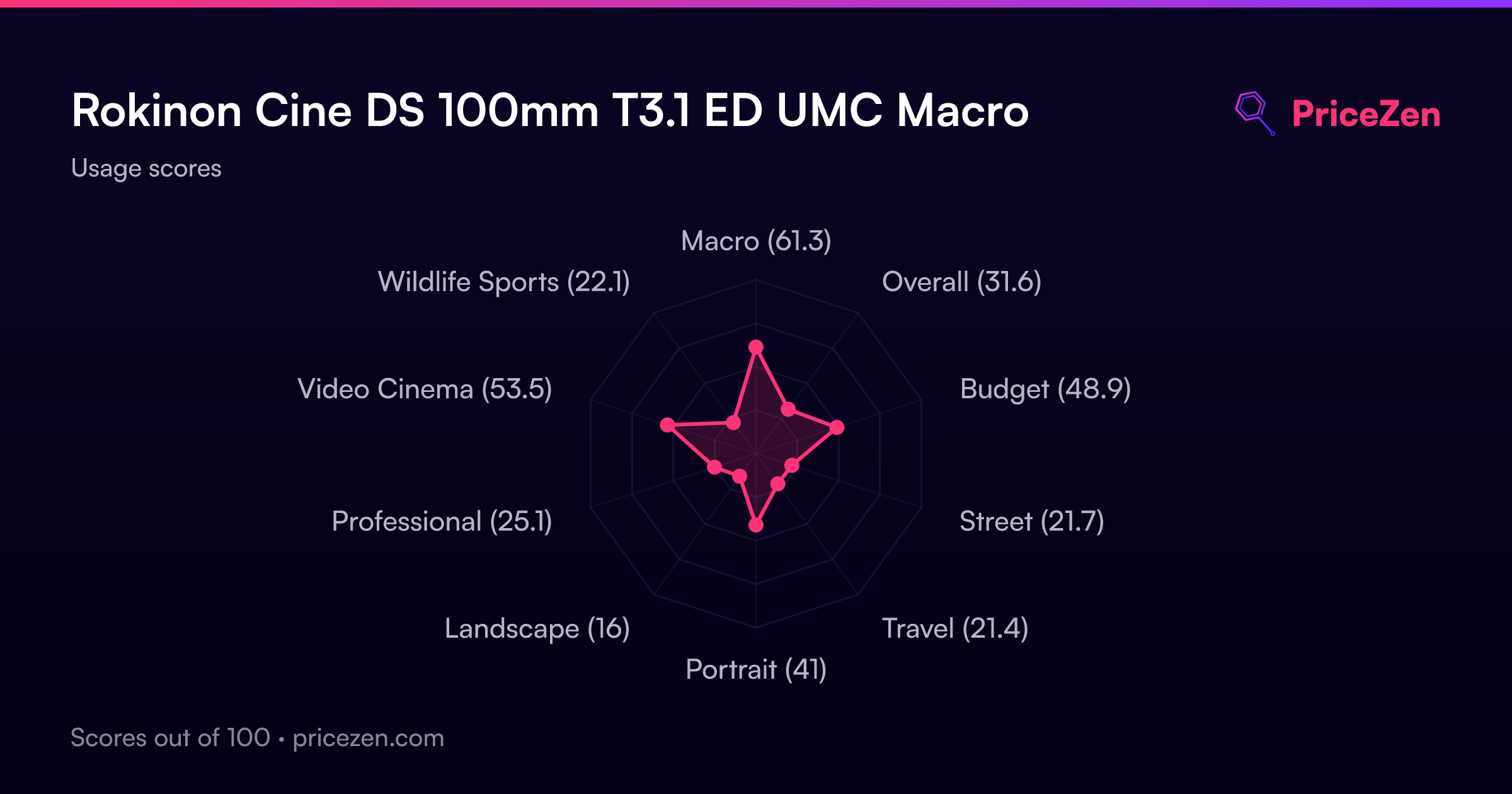
This lens is a poor fit for handheld macro photographers who rely on autofocus and stabilization to nail shots quickly. If you chase bugs or flowers in the field, the manual focus and heavy build will slow you down, and there are lighter, optically stabilized alternatives like the Olympus 60mm f/2.8 Macro that are much easier to work with. Travel and run-and-gun videographers should also steer clear: the weak travel score of 23.6 reflects how bulky and manual this lens is for quick setups.
Portrait shooters who want dreamy bokeh or fast apertures for subject isolation should look at a used Nikkor 105mm f/2.5 or even a modern 85mm f/1.8. The T3.1 speed and disappointing bokeh won't give you that classic portrait look, and the lack of autofocus makes catching fleeting expressions a hassle. If your work involves any scenario where speed and convenience trump precise manual control, this lens will only frustrate you.
Verdict
For video shooters on Micro Four Thirds, the Rokinon Cine DS 100mm T3.1 is a gem. The manual controls are perfectly tuned for focus pulling, the macro capability opens creative angles for product shots or detail inserts, and the image quality is plenty sharp enough for 4K delivery. It pairs beautifully with other lenses in the Cine DS lineup, and at the price, you could buy a whole set for what one premium cine prime costs. If you're building a narrative filmmaking kit or documentary rig where consistent lens mechanics matter, this deserves a spot in your bag.
Still photographers, especially those who shoot handheld macro in the field, have better options. The lack of stabilization and autofocus makes it a chore for chasing insects or flowers on a breezy day, and the heavy weight doesn't help. In that case, the Olympus 60mm f/2.8 Macro with its life-size capability and weather sealing is a more practical tool. Casual shooters who just want a telephoto for portraits will find the manual focus and slow aperture frustrating compared to any modern autofocus zoom. Know your workflow before you buy, because this lens is laser-focused on a very specific kind of shooter.
Usage Scores
- Macro61.2
- Overall31.5
- Budget49.9
- Street21.7
- Travel21.2
- Portrait41
- Landscape16
- Professional25.1
- Video Cinema53.5
- Wildlife Sports22