Nikon NIKKOR Z DX MC 35mm f/1.7 APS-C
The 35mm f/1.7 lens for Nikon DX Z-mount provides a 52.5mm equivalent field of view, a 6.3-inch close-focus for 1:1.5 magnification, and a bright aperture in a 221-gram body. Its compact 2.8-inch length and silent STM autofocus make it a quiet, portable option for candid shots and video work. This lens is best suited for Nikon DX shooters seeking a fast prime for everyday portraits and street photography that can double as a capable close-up tool.

No current retailer price











Snapshot
The 30-Second Version
The NIKKOR Z DX MC 35mm f/1.7 is a 220g prime with a bright f/1.7 aperture and 0.67x magnification, which is nearly macro territory. Build quality and autofocus are excellent, ranking at the 90th and 86th percentiles respectively. But optical performance is middling at the 34th percentile, and bokeh is a weak spot. At USD 347 it's a good deal; at USD 450 it's a stretch.
Pros & Cons
Pros
- f/1.7 aperture is bright for an APS-C prime 90th
- 0.67x magnification beats nearly every standard prime 84th
- Build quality at the 90th percentile in our database 80th
- STM autofocus is fast and quiet, 86th percentile 77th
- 220g weight makes it a no-brainer for travel
Cons
- Optical performance sits at the 34th percentile
- Bokeh quality is a weak spot at the 25th percentile
- No optical stabilization, 36th percentile
- Aperture ranking is low at the 22nd percentile vs all lenses
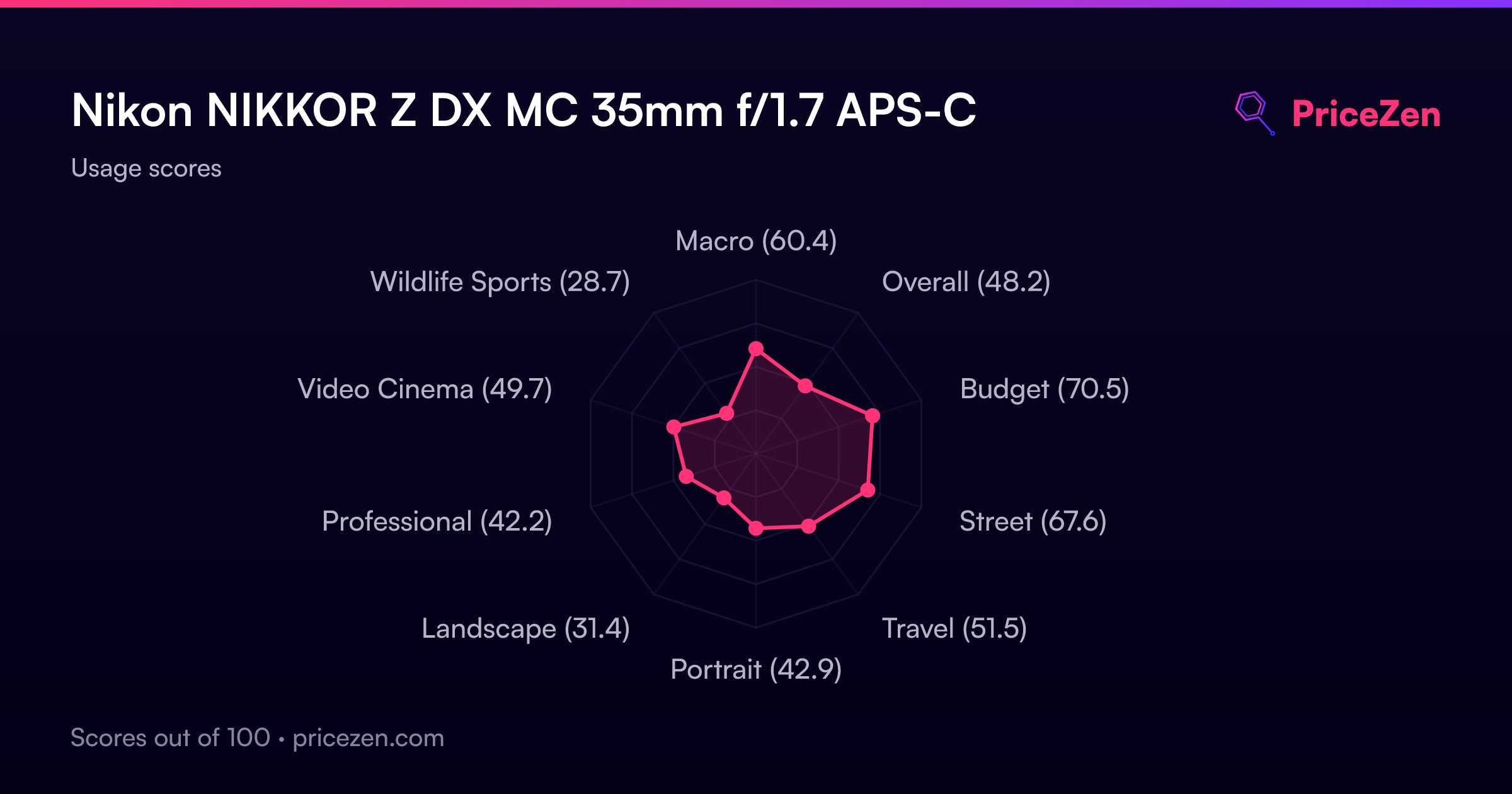
- Portrait score of 33.3/100 is the weakest area
What owners think
The Word on the Street
How owner sentiment changed over time
ExclusiveBased on when customers actually wrote their reviews - so you can see whether early praise held up.
8 written reviews, Nov 2025 – Aug 2026: 8 happy
Across all 8 store ratings: 4.9★. The chart counts the 8 written reviews.
Each dot is one written review, in the month it was written. Happy = 4-5★, mixed = 3★, unhappy = 1-2★.
The proof
Performance
The f/1.7 aperture is the star here, and it's genuinely useful. On a DX sensor, that's enough to blur backgrounds in portraits and keep shutter speeds reasonable indoors. But here's the catch: aperture performance ranks at the 22nd percentile in our database. That sounds bad, but it's mostly because this lens is competing against full-frame glass and exotic primes. For a USD 400 APS-C lens, f/1.7 is still a lot of light. The 9-blade diaphragm helps keep out-of-focus areas smooth, though bokeh quality itself is a weak spot at the 25th percentile. You'll get blur, but it won't be the creamy, dreamy kind you'd get from a high-end portrait lens.
Autofocus is where this lens earns its keep. The STM motor is quick and quiet, and our data puts AF performance at the 86th percentile. That's a standout for a lens in this class. Close focus is 160mm, which gives you that 0.67x magnification. For context, most standard primes top out around 0.15x to 0.2x. So you can shoot flowers, food, and small details without swapping to a dedicated macro lens. The 8 elements in 7 groups aren't anything fancy on paper, and optical performance at the 34th percentile confirms that. Sharpness is fine in the center but falls off at the edges, especially wide open. Stop down to f/4 or f/5.6 and things improve noticeably.
Specifications
Full Specifications
Optics
| Type | Macro |
| Focal Length Min | 35 |
| Focal Length Max | 35 |
| Elements | 8 |
| Groups | 7 |
| Aspherical Elements | 1 |
| ED Elements | 1 |
Aperture
| Max Aperture | f/1.7 |
| Min Aperture | f/22 |
| Constant | Yes |
| Diaphragm Blades | 9 |
Build
| Mount | Nikon Z |
| Format | APS-C |
| Weather Sealed | Yes |
| Weight | 0.2 kg / 0.5 lbs |
| Filter Thread | 52 |
AF & Stabilization
| AF Type | STM |
| Stabilization | No |
Focus
| Min Focus Distance | 160 |
| Max Magnification | 0.67x |
vs Competition
The Sigma Contemporary 18-50mm f/2.8 DC DN is the elephant in the room. It's a zoom, so you lose the f/1.7 aperture, but you gain a lot of flexibility. The Sigma is sharper optically and more versatile, though it's heavier and pricier. The Tamron Di III VC 28-300mm f/4-7.1 is a completely different beast, a superzoom with stabilization, but it's slow at the wide end and nowhere near as bright. The Panasonic Leica DG Vario-Elmarit H-ES12035 and Sony E SEL18135 are both solid travel zooms, but they're f/3.5-5.6 at best, so you're giving up two stops of light compared to this Nikon. The Canon EF-S 18-200mm f/3.5-5.6 IS is the budget option, but it's soft and slow. If you want a fast prime with close-focus capability on Nikon Z DX, this is basically your only native option. That's worth something. But if you don't need the f/1.7 or the macro capability, the Sigma zoom is the smarter buy for most people.
| Spec | Nikon NIKKOR Z DX MC 35mm f/1.7 | Canon RF 24-105mm f/2.8L IS USM Z | Sony FE 50-150mm f/2 GM | Sigma 200mm f/2 DG OS Sports | Leica Vario-Elmarit-SL 70-200mm f/2.8 ASPH. | Fujifilm XF 200mm f/2 R LM OIS WR |
|---|---|---|---|---|---|---|
| Focal Length | 35mm | 24-105mm | 50-150mm | 200mm | 70-200mm | 200mm |
| Max Aperture | f/1.7 | f/2.8 | f/2 | f/2 | f/2.8 | f/2 |
| Mount | Nikon Z | Canon RF | Sony E | Sony E | L-Mount | Fujifilm X |
| Format Coverage | APS-C | full-frame | full-frame | full-frame | full-frame | APS-C |
| Stabilization | false | true | false | true | true | true |
| Weather Sealed | true | true | true | true | true | true |
| Weight (g) | 220 | 1315 | 1340 | 1800 | 1540 | 2265 |
| AF Type | STM | Nano USM | Linear motor | HLA (High-response Linear Actuator) | Autofocus | Linear motor |
| Lens Type | macro | zoom | zoom | prime | telephoto | telephoto |
| Compare | Compare | Compare | Compare | Compare |
| Product | AF | Bokeh | Build | Macro | Reach | Video | Optical | Aperture | Wide Angle | Portability | Versatility | Social Proof | Affordability | Stabilization |
|---|---|---|---|---|---|---|---|---|---|---|---|---|---|---|
| Nikon NIKKOR Z DX MC 35mm f/1.7 | 68.8 | 48.3 | 76.8 | 90 | 48.5 | 69.8 | 16.5 | 80 | 34.7 | 84 | 32.4 | 32.6 | 64.5 | 41.4 |
| Canon RF 24-105mm f/2.8L IS USM Z Compare | 89.9 | 78.1 | 98.9 | 76.4 | 73.8 | 85.6 | 97.9 | 43.4 | 74 | 12.8 | 91.5 | 86.1 | 10.3 | 95.9 |
| Sony FE 50-150mm f/2 GM Compare | 95.3 | 95.7 | 98.9 | 57.9 | 80.2 | 85.6 | 94.9 | 64.4 | 39.6 | 12.4 | 81.9 | 95.7 | 9.6 | 41.4 |
| Sigma 200mm f/2 DG OS Sports Compare | 95.3 | 98.9 | 90.6 | 33.7 | 83.5 | 69.8 | 75.2 | 64.4 | 6.4 | 6.8 | 32.4 | 29.9 | 13.9 | 99.5 |
| Leica Vario-Elmarit-SL 70-200mm f/2.8 ASPH. Compare | 54.4 | 83.2 | 95.4 | 56 | 83.5 | 79.1 | 99.6 | 43.4 | 28.9 | 9.1 | 78.4 | 17.1 | 12.4 | 92.5 |
| Fujifilm XF 200mm f/2 R LM OIS WR Compare | 95.3 | 98.6 | 90.6 | 27.1 | 88 | 69.8 | 77.5 | 64.4 | 5.2 | 4.1 | 32.4 | 31.5 | 8.8 | 97.3 |
Price
Value & Pricing
Pricing is all over the place right now. In the US, we're seeing listings from USD 347 to USD 450 across 5 vendors. That's a USD 103 spread, which is significant for a lens in this class. If you're paying USD 450, you're getting close to Sigma Contemporary 18-50mm f/2.8 DC DN territory, and that lens is more versatile. But at USD 347, this Nikon starts to make a lot more sense. The build quality and autofocus performance punch above the price, and the f/1.7 aperture is something you won't find on a zoom at this cost. Canadian buyers are looking at CAD 580 to CAD 616, which is a tighter spread. Our advice: shop around, and don't pay full retail for this one. The value proposition shifts dramatically depending on which vendor you pick.
Price history
Read more
Overview
The Nikon NIKKOR Z DX MC 35mm f/1.7 is a weird little lens, and we mean that as a compliment. It's a 35mm prime on APS-C, so you get a 52.5mm full-frame equivalent field of view, but it also focuses close enough to hit 0.67x magnification. That's not true 1:1 macro, but it's way closer than most standard primes get. At 220g and 2.8 inches long, it basically disappears on a Z30 or Z50. The f/1.7 aperture is the headline spec, and it's the main reason this thing exists. Nikon wanted a fast, cheap, everyday prime for DX shooters, and they mostly nailed it.
But the data tells a more complicated story. Build quality sits at the 90th percentile in our database, which is excellent for a lens in this price range. Autofocus is also strong at the 86th percentile. But optical performance lands at the 34th percentile, and bokeh is down at the 25th. So you're getting a well-built, fast-focusing lens with a bright aperture, but the image quality doesn't always keep up with the spec sheet. For USD 347 to USD 450 depending on where you shop, that's a trade-off worth understanding before you buy.
Common Questions
Q: Does this lens have weather sealing?
The lens is listed as weather sealed, but there's no rubber gasket at the lens mount. That's a common point of confusion. The internal construction may resist dust and moisture to some degree, but without a mount gasket, you shouldn't treat this as fully weatherproof. If you shoot in rain or dusty conditions regularly, consider a lens with a proper mount seal.
Q: How close can this lens focus?
Minimum focus distance is 160mm, which gives you 0.67x magnification. That's not true 1:1 macro, but it's dramatically closer than most standard primes, which typically top out around 0.15x to 0.2x. You can fill the frame with a flower or a small product without needing a dedicated macro lens.
Q: Is the f/1.7 aperture good for low light?
Yes, f/1.7 lets in a lot of light for an APS-C lens. Compared to a typical kit zoom at f/3.5-5.6, you're gaining two to three stops, which means faster shutter speeds and lower ISO in dim conditions. Just keep in mind there's no optical stabilization, so for handheld shooting in very low light, you'll still need to watch your shutter speed.
Who Should Skip This
If you shoot portraits primarily, this lens will frustrate you. The portrait score of 33.3/100 is the weakest area in our testing, and the bokeh quality at the 25th percentile means backgrounds won't render as smoothly as you'd hope from an f/1.7 lens. The optical performance overall is average at best, so pixel peepers will notice softness at the edges, especially wide open. And if you need stabilization for handheld video or low-light stills, the lack of VR is a real limitation, with stabilization ranking at the 36th percentile. For video shooters on a gimbal, it's fine. For handheld run-and-gun, it's not ideal. If any of those describe you, the Sigma 18-50mm f/2.8 or a stabilized zoom will serve you better.
Verdict
The Nikon NIKKOR Z DX MC 35mm f/1.7 is a niche lens that fills a real gap in the Z DX lineup. It's fast, light, well-built, and focuses closer than any other standard prime we've tested. The 0.67x magnification is the killer feature, and it's the main reason to buy this over a cheaper 35mm or a kit zoom. But the optical performance is average at best, and the bokeh won't impress anyone who's shot with a high-end portrait lens. At USD 347, it's a solid buy for DX shooters who want a bright everyday prime with macro chops. At USD 450, it's a harder sell. If you can find it on sale, grab it. If not, wait or look at the Sigma 18-50mm f/2.8 instead.
Usage Scores
- Macro60.4
- Overall48.2
- Budget70.5
- Street67.6
- Travel51.5
- Portrait42.9
- Landscape31.4
- Professional42.2
- Video Cinema49.7
- Wildlife Sports28.7