Panasonic LUMIX G 30mm f/2.8 micro-four-thirds
Achieving true 1:1 magnification at a 4.1-inch working distance, this 30mm f/2.8 lens renders life-size detail with an aspherical element that suppresses distortion for sharp, contrast-rich images. Its built-in MEGA O.I.S. stabilization and near-silent stepping motor make it equally capable for steady handheld macro video and stills. This lens is best for Micro Four Thirds shooters who need a compact, stabilized optic for detailed close-up work on subjects like insects and product textures.

No current retailer price











Snapshot
The 30-Second Version
The Panasonic LUMIX G Macro 30mm f/2.8 is a sharp, compact macro lens that remains good value for Micro Four Thirds shooters. It delivers excellent close-up image quality and fast autofocus with built-in stabilization, making handheld macro easy. Our overall score sits at 48 out of 100, so treat it as a specialist: no beautiful bokeh, no weather sealing, and very little working distance.
Pros & Cons
Pros
- Tack-sharp image quality, especially for macro 93rd
- Solid, mostly metal build feels premium 89th
- Fast and quiet autofocus for the price 86th
- Built-in MEGA O.I.S. is a real help handheld 85th
- Incredible value for a 1:1 macro lens
Cons
- Bokeh is harsh and unrefined
- Not weather-sealed, so be careful outdoors
- Requires getting very close to subjects at 1:1
- f/2.8 aperture limits low-light and portrait potential
- Color and contrast are a bit flat compared to pricier primes
What owners think
The Word on the Street
How owner sentiment changed over time
ExclusiveBased on when customers actually wrote their reviews - so you can see whether early praise held up.
20 written reviews, Apr 2017 – Apr 2026: 18 happy, 2 without stars
Across all 176 store ratings: 4.7★. Most owners rate without writing a review. The chart counts the 20 written reviews.
Each dot is one written review, in the month it was written. Happy = 4-5★, mixed = 3★, unhappy = 1-2★.
The proof
Performance
Sharpness is where this lens earns its keep. It's bitingly sharp in the center right from f/2.8, and stopping down just a hair makes the corners catch up nicely. For slide duplication, product photography, or capturing the texture of a flower petal, the detail is impressive. The flat-field design means you won't get weird field curvature messing up your copy work, which is a big deal if you're digitizing old photos or artwork. Autofocus performance lands in the 86th percentile for its class, which in practice means it snaps into focus quickly and doesn't hunt much in decent light, though like most macros, it can get a little lost if you're trying to lock onto something at minimum focus distance in dim conditions.
The MEGA O.I.S. stabilization is a genuine asset. It's not the absolute best on the market, sitting in the 81st percentile, but it gives you a solid 2-3 stops of leeway when shooting handheld. That's the difference between a blurry mess and a crisp shot of a skittish bug before it flies away. The bokeh, however, is a weak spot. At the 16th percentile, it's just not a lens that renders out-of-focus areas with much character. It can look a bit busy or harsh, which is partly a physics problem with the smaller Micro Four Thirds sensor and the f/2.8 aperture. You'll get background separation, but don't expect it to melt away into a smooth, dreamy blur.
Specifications
Full Specifications
Optics
| Type | Macro |
| Focal Length Min | 30 |
| Focal Length Max | 30 |
| Elements | 9 |
| Groups | 9 |
| Aspherical Elements | 1 |
| Coating | Multi-Layer Coating |
Aperture
| Max Aperture | f/2.8 |
| Min Aperture | f/22 |
| Constant | Yes |
| Diaphragm Blades | 7 |
Build
| Mount | Micro Four Thirds |
| Format | micro-four-thirds |
| Weight | 0.2 kg / 0.4 lbs |
| Filter Thread | 46 |
AF & Stabilization
| AF Type | Stepping AF Motor |
| Stabilization | Yes |
Focus
| Min Focus Distance | 105 |
| Max Magnification | 1:1 |
vs Competition
Our ranking puts the Panasonic alongside some very different glass right now, and that contrast tells you a lot about where it sits. The Viltrox AF 35mm f/1.2 LAB FE and the Canon RF 35mm f/1.4L VCM are fast normal primes built for subject separation and low light, which is exactly the territory where this lens struggles: our scoring has its portrait performance at 39.9 out of 100 and its bokeh in the 16th percentile. If people pictures are the goal, those are the lenses to look at, not this one.
The Sigma 17-40mm f/1.8 DC Art covers a similar everyday field of view with far more flexibility, so if you want one lens for general shooting rather than a dedicated close-up tool, it makes a stronger case. The Tamron 70-180mm f/2.8 Di III VC VXD G2 and Sony FE 85mm f/1.4 GM sit at the longer end, where you get flattering perspective and much smoother backgrounds. None of them replace what the Panasonic does best, though. True 1:1 magnification in a 272 gram package with autofocus and MEGA O.I.S. is still its own niche, and our data puts its macro performance in the 92nd percentile. How does it compare overall? It wins on close-up work and portability, and loses on almost everything else.
| Spec | Panasonic LUMIX G 30mm f/2.8 | Sony FE 400mm f/2.8 GM OSS | Canon RF 100-300mm f/2.8L IS USM | Nikon NIKKOR Z 120-300mm f/2.8 TC VR S | Sigma 300-600mm f/4 DG OS Sports | Fujifilm XF 200mm f/2 R LM OIS WR |
|---|---|---|---|---|---|---|
| Focal Length | 30mm | 400mm | 100-300mm | 120-300mm | 300-600mm | 200mm |
| Max Aperture | f/2.8 | f/2.8 | f/2.8 | f/2.8 | f/4 | f/2 |
| Mount | Micro Four Thirds | Sony E | Canon RF | Nikon Z | Sony E | Fujifilm X |
| Format Coverage | micro-four-thirds | full-frame | full-frame | full-frame | full-frame | APS-C |
| Stabilization | true | true | true | true | true | true |
| Weather Sealed | false | true | true | true | true | true |
| Weight (g) | 180 | 2895 | 2630 | 2735 | 3970 | 2265 |
| AF Type | Stepping AF Motor | XD Linear Motor | Dual Nano USM | Silky Swift VCM (SSVCM) | HLA (High-response Linear Actuator) | Linear motor |
| Lens Type | macro | super-telephoto | zoom | super-telephoto | super-telephoto | telephoto |
| Compare | Compare | Compare | Compare | Compare |
| Product | AF | Bokeh | Build | Macro | Reach | Video | Optical | Aperture | User Sentiment | Wide Angle | Portability | Versatility | Social Proof | Affordability | Stabilization |
|---|---|---|---|---|---|---|---|---|---|---|---|---|---|---|---|
| Panasonic LUMIX G 30mm f/2.8 | 68.8 | 23.5 | 30.3 | 93.2 | 52.3 | 69.9 | 25.9 | 43.4 | 84.5 | 31.5 | 88.9 | 32.4 | 86.1 | 68.1 | 83.5 |
| Sony FE 400mm f/2.8 GM OSS Compare | 95.4 | 99.7 | 90.6 | 89.1 | 91.5 | 69.9 | 70.9 | 43.4 | 97.9 | 4.4 | 2.4 | 32.4 | 93.8 | 4.5 | 97.3 |
| Canon RF 100-300mm f/2.8L IS USM Compare | 89.9 | 85.9 | 98.9 | 46.2 | 88 | 85.6 | 90.4 | 43.4 | 84.5 | 13.9 | 3 | 81.8 | 51.9 | 3.2 | 98.6 |
| Nikon NIKKOR Z 120-300mm f/2.8 TC VR S Compare | 95.4 | 85.9 | 95.4 | 70 | 88 | 85.6 | 83 | 43.4 | 0 | 10.7 | 2.9 | 75.6 | 7.2 | 4.4 | 99.5 |
| Sigma 300-600mm f/4 DG OS Sports Compare | 95.4 | 97.7 | 98.9 | 48.1 | 95.8 | 85.6 | 97 | 16 | 35.1 | 5.2 | 0.5 | 70.4 | 16.6 | 4.5 | 98.6 |
| Fujifilm XF 200mm f/2 R LM OIS WR Compare | 95.4 | 98.7 | 90.6 | 27.1 | 88 | 69.9 | 77.4 | 64.4 | 94.3 | 5.2 | 4 | 32.4 | 31.4 | 8.8 | 97.3 |
Price
Value & Pricing
Pricing on this lens is a bit of a wild west situation. We're seeing it listed across vendors anywhere from $370 all the way up to a frankly absurd $77,087, so you'll want to shop smart. The real-world street price hovers around that $350-$400 mark, and at that level, it's a steal. For a native macro lens with autofocus and stabilization, you're getting a lot of capability for the money. It's not going to compete with something like the Olympus 60mm f/2.8 Macro on working distance or weather sealing, but it costs a fraction of the price. If you're a Micro Four Thirds shooter on a budget who wants to explore macro, this is one of the easiest recommendations we can make.
Price history
Read more
Overview
The Panasonic LUMIX G Macro 30mm f/2.8 is one of those lenses that quietly over-delivers for the price. It's a dedicated macro lens for the Micro Four Thirds system, and if you've been hunting for a way to get into close-up photography without spending a fortune, this little guy deserves a spot on your shortlist. The 1:1 native magnification (which gives you a 2:1 equivalent field of view compared to full-frame) lets you fill the frame with tiny subjects, from dewdrops on a leaf to the intricate patterns on a coin. At just 272 grams, it's light enough to toss in your bag and forget about until you spot something interesting.
Build quality is a pleasant surprise here. It's a mostly metal construction that feels solid in the hand, though it's not weather-sealed, so you'll want to be careful in the rain. The stepping motor autofocus is quick and quiet, and you get Panasonic's MEGA O.I.S. stabilization built right in, which is a real help when you're hand-holding at high magnifications. The 46mm filter thread is small and cheap to accessorize, too. It's not a lens that screams for attention, but it does its job with a quiet confidence that owners seem to really appreciate.
Now, it's not a one-trick pony. While our database shows it absolutely crushes it for macro work (92nd percentile), a lot of users end up keeping it on their camera as a walk-around prime. The 30mm focal length (60mm equivalent) is a comfortable normal-ish field of view for everyday shots. Just know that the f/2.8 max aperture, while fine for macro, isn't going to blow you away with subject isolation for portraits. Our scoring puts portrait performance at a pretty weak 39.9 out of 100, so if creamy bokeh is your main goal, you'll want to look elsewhere.
Common Questions
Q: Is the Panasonic 30mm f/2.8 macro good for portraits?
It can work for close-up portraits in a pinch, but it's not ideal. The f/2.8 aperture and Micro Four Thirds sensor don't produce much background blur, and the bokeh quality is below average, so you won't get the creamy subject isolation most portrait photographers want.
Q: Does the Panasonic 30mm f/2.8 have image stabilization?
Yes, it includes Panasonic's MEGA O.I.S. optical stabilization, which is a big help for handheld macro shots and gives you a few extra stops of stability.
Q: What is the minimum focus distance of the Panasonic 30mm macro?
The minimum focus distance is 105mm from the sensor plane, which gives you a 1:1 magnification. This means the front of the lens gets very close to your subject, so you'll need to be careful not to block your light.
Q: Is this lens weather sealed?
No, the Panasonic LUMIX G Macro 30mm f/2.8 is not weather sealed. You'll want to avoid using it in rain or dusty conditions without some protection.
Who Should Skip This
Skip this lens if you primarily shoot skittish insects or need weather sealing for outdoor macro work. The short working distance at 1:1 will have you practically on top of your subject, which can cast shadows and scare things away. Also, if you're looking for a portrait lens with beautiful bokeh, this isn't it. The rendering is clinical and the out-of-focus areas are harsh, and our scoring puts portraits at just 39.9 out of 100. Something like the Sony FE 85mm f/1.4 GM or the Canon RF 35mm f/1.4L VCM is a far better fit for people shots, and the Sigma 17-40mm f/1.8 DC Art is the smarter pick if you want one lens to cover everyday shooting instead.
Verdict
If you're a Micro Four Thirds user who wants to get into macro photography without a big investment, this lens still makes sense, but with more caveats than we'd like. It's sharp, it focuses fast, and the stabilization makes handheld shooting totally viable. The image quality for close-up work is fantastic, and the compact size means you'll actually carry it with you. Our overall score has slipped to 48 out of 100, though, and that reflects how narrow its strengths are once you stack it against the rest of the category. The main reasons to skip it are if you absolutely need weather sealing or if you plan to shoot a lot of skittish insects where the short working distance will scare them off.
It's not an all-rounder. The bokeh is rough, and it's not the lens you'd pick for a dedicated portrait session. But that's not what it's for. As a tool for exploring the tiny world around you, the Panasonic 30mm f/2.8 Macro delivers where it counts and leaves enough cash in your pocket for a good set of extension tubes or a flash. Buy it for macro specifically, and go in knowing the limits.
Usage Scores
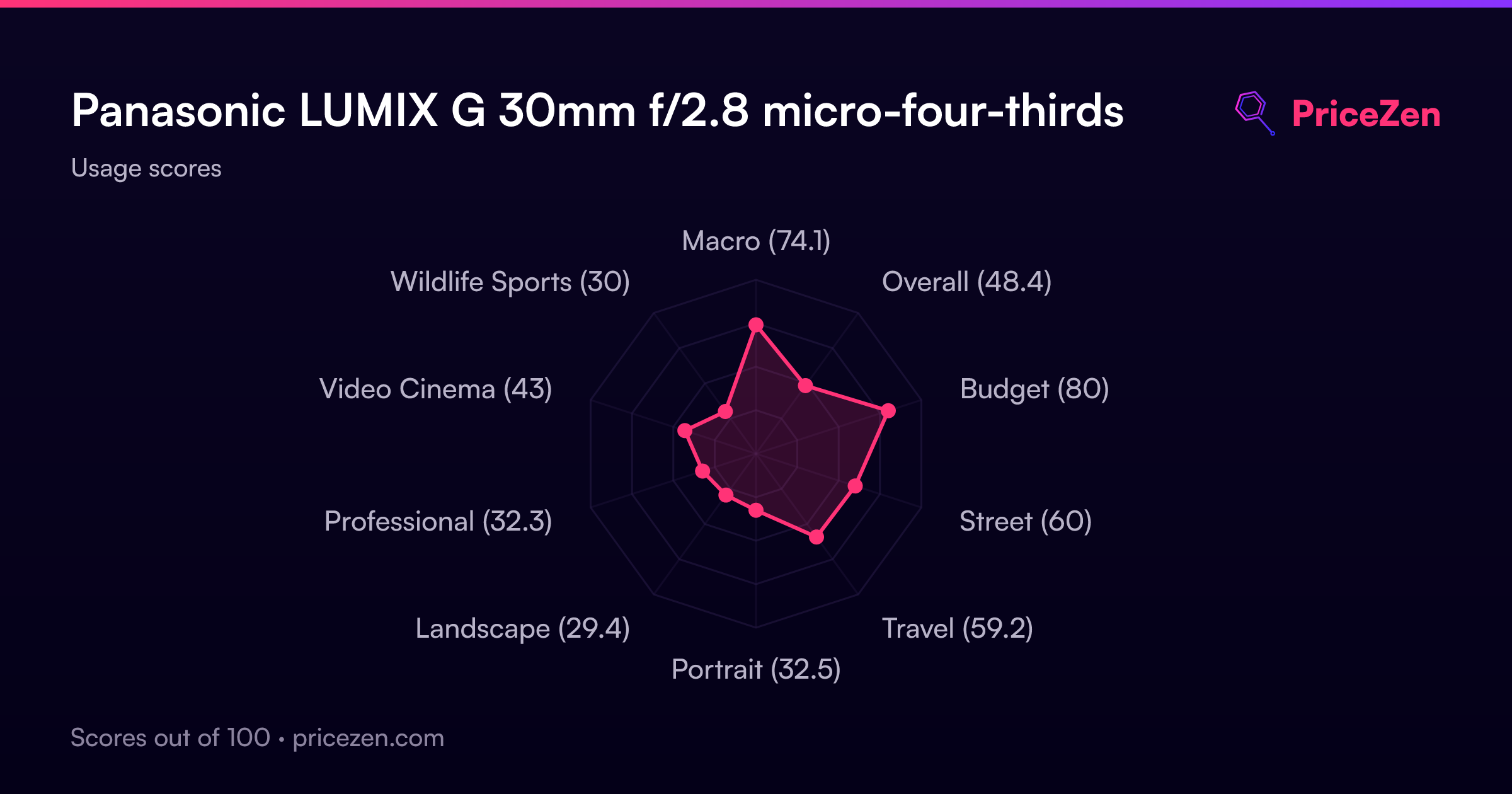
- Macro74.1
- Overall48.4
- Budget80
- Street60
- Travel59.2
- Portrait32.5
- Landscape29.4
- Professional32.3
- Video Cinema43
- Wildlife Sports30