Sigma Cine 20mm T1.5 FF
The 20mm T1.5 full-frame cine lens features a 100% metal body and 0.8M gear pitch, with a 180-degree focus throw and weather sealing for professional use. Its standardized gear positions and 95mm front diameter ensure compatibility with existing matte boxes and follow focus systems, while the 1360g weight makes it lighter than many peers. This lens suits cinematographers shooting 8K-resolution projects who need a durable, consistent prime set for full-frame cameras.

No current retailer price


Snapshot
The 30-Second Version
The Sigma Cine 20mm T1.5 FF is a purpose-built cinema lens with top-tier video performance and a bright T1.5 aperture. The 180 degree focus throw and consistent gear positions make it a dream for focus pullers. At CAD 5,500, it's expensive compared to stills glass but a bargain in the cine world. Buy it if you shoot on sets or rent gear professionally, skip it if you need autofocus or portability.
Pros & Cons
Pros
- 92nd percentile video performance, top-tier sharpness for 8K workflows 92nd
- T1.5 aperture is a standout, 83rd percentile for light gathering 83rd
- 180 degree focus throw gives focus pullers precise control 81st
- Full-frame coverage in a relatively compact cine housing 77th
- 95mm front diameter and consistent gear positions work with standard cine accessories
Cons
- No weather sealing, risky for outdoor shoots in rough conditions
- 1380g weight makes handheld work tiring fast
- No autofocus, manual focus only by design
- Travel score of 5.5 out of 100, completely impractical for casual use
- Bokeh quality is average at 30th percentile, not a character lens
The proof
Performance
The optical performance here is the main event. Sigma claims resolution matching up to 8K, and while we don't have lab charts in front of us, the video score of 66.5 out of 100 puts this lens in the 92nd percentile among all products of this type. That's top of the charts territory. For a 20mm prime at T1.5, maintaining sharpness across the frame wide open is genuinely difficult, and the fact that this lens is rated this highly suggests Sigma nailed the optical formula. The 9-blade diaphragm helps keep out-of-focus highlights looking round and natural, though the bokeh score lands at a middling 30th percentile, which makes sense for a wide angle. You're not buying a 20mm for creamy background blur.
The aperture ranking is another standout, sitting in the 83rd percentile. T1.5 on a full-frame 20mm is a lot of glass, and it shows in the weight. The minimum focus distance of 276mm is actually quite close for a cine lens this wide, which opens up some creative close-up work with dramatic perspective distortion. The 180 degree focus throw is the spec that matters most for focus pullers. That long rotation gives you fine control, especially when paired with a wireless follow focus. It's not a lens you'll be pulling focus on by hand while shooting handheld, but that's not the point. The lack of stabilization is a non-issue for most cine work since you'll be on sticks, a dolly, or a gimbal anyway.
Specifications
Full Specifications
Optics
| Type | Prime |
| Focal Length Min | 20 |
| Focal Length Max | 20 |
Aperture
| Max Aperture | f/1.5 |
| Min Aperture | f/16 |
| Diaphragm Blades | 9 |
Build
| Mount | Canon EF |
| Format | full-frame |
| Weather Sealed | Yes |
| Weight | 1.3 kg / 2.9 lbs |
AF & Stabilization
| AF Type | manual focus only |
| Stabilization | No |
Focus
| Min Focus Distance | 276 |
vs Competition
The competitors in our database are mostly stills-oriented zooms and primes, which tells you how niche this lens really is. The Sony G Master 70-200mm f/2.8 II and Tamron 70-180mm f/2.8 G2 are both zooms with autofocus and stabilization, aimed at event and sports shooters. They're more versatile in the traditional sense, but they can't touch the T1.5 aperture or the mechanical focus precision of the Sigma. The Canon RF 24-105mm f/2.8 Z is an interesting hybrid option with a power zoom, but again, it's a different tool for a different job.
The Viltrox LAB AF 35mm f/1.2 is probably the closest philosophical competitor, a fast prime with serious optical ambitions. But it has autofocus and costs far less, making it a better fit for hybrid shooters who bounce between photo and video. The Nikon Z 50mm f/1.2 S is a beautiful stills lens, but it's not a cine lens and doesn't pretend to be. None of these competitors offer the 180 degree focus throw, the geared aperture ring, or the consistent housing design that makes the Sigma a true cinema tool. If you need a cine lens, the Sigma is in a class of its own at this price point. If you don't, every one of those competitors will serve you better for general use.
| Spec | Sigma Cine 20mm T1.5 FF | Sony FE 70-200mm f/2.8 GM OSS II | Canon RF 24-105mm f/2.8L IS USM Z | Tamron 70-180mm f/2.8 Di III VC VXD G2 | Viltrox AF 35mm f/1.2 LAB FE | Nikon NIKKOR Z 70-200mm f/2.8 VR S II |
|---|---|---|---|---|---|---|
| Focal Length | 20mm | 70-200mm | 24-105mm | 70-180mm | 35mm | 70-200mm |
| Max Aperture | f/1.5 | f/2.8 | f/2.8 | f/2.8 | f/1.2 | f/2.8 |
| Mount | Canon EF | Sony E | Canon RF | Sony E | Sony E | Nikon Z |
| Format Coverage | full-frame | full-frame | full-frame | full-frame | full-frame | full-frame |
| Stabilization | false | true | true | true | false | true |
| Weather Sealed | true | true | true | true | true | true |
| Weight (g) | 1330 | 1045 | 1315 | 855 | 910 | 998 |
| AF Type | manual focus only | XD Linear Motors | Nano USM | VXD | VCM | VCM Multi-Focus AF System |
| Lens Type | prime | zoom | zoom | zoom | prime | telephoto |
| Compare | Compare | Compare | Compare | Compare |
| Product | AF | Bokeh | Build | Macro | Reach | Video | Aperture | Wide Angle | Portability | Versatility | Affordability | Stabilization |
|---|---|---|---|---|---|---|---|---|---|---|---|---|
| Sigma Cine 20mm T1.5 FF | 21.8 | 29.3 | 76.9 | 9.6 | 10.8 | 91.7 | 82.8 | 81 | 12.3 | 32.5 | 8.4 | 41.4 |
| Sony FE 70-200mm f/2.8 GM OSS II Compare | 95.3 | 88.7 | 99.9 | 77.4 | 83.6 | 85.6 | 43.4 | 28.9 | 18.9 | 78.5 | 12.5 | 97.3 |
| Canon RF 24-105mm f/2.8L IS USM Z Compare | 89.9 | 78.2 | 98.9 | 76.4 | 73.8 | 85.6 | 43.4 | 73.9 | 12.7 | 91.5 | 10.4 | 96 |
| Tamron 70-180mm f/2.8 Di III VC VXD G2 Compare | 95.3 | 85.9 | 90.7 | 82.9 | 81.6 | 81.8 | 43.4 | 28.9 | 24.7 | 76.6 | 29.7 | 97.3 |
| Viltrox AF 35mm f/1.2 LAB FE Compare | 95.3 | 67.9 | 90.7 | 50 | 28.9 | 69.9 | 96.4 | 52.7 | 23.3 | 32.5 | 33.7 | 41.4 |
| Nikon NIKKOR Z 70-200mm f/2.8 VR S II Compare | 95.3 | 88.7 | 98.9 | 77.4 | 83.6 | 85.6 | 43.4 | 28.9 | 19.8 | 78.5 | 14.2 | 99.3 |
Price
Value & Pricing
Pricing is where things get interesting. The only listing we're tracking is CAD 5,500 from Henry's in Canada. That's a serious chunk of change, but context matters. Cine lenses live in a different pricing universe than stills glass. A comparable focal length from ARRI or Zeiss would run you significantly more, often two to three times this price. Sigma has carved out a reputation for delivering 90 percent of the high-end cine experience at a fraction of the cost, and this lens continues that pattern.
That said, the affordability score in our database is a rough 11th percentile. Compared to the broader lens market, this is expensive. But you're not comparing it to a nifty fifty. You're comparing it to other cine primes with full-frame coverage and T1.5 speed. In that context, CAD 5,500 is actually competitive. If you're building a full Sigma Cine prime set, the consistency across focal lengths means you buy once and rent out for years. Rental houses will see this as a smart investment, not an extravagance.
Read more
Overview
The Sigma Cine 20mm T1.5 FF is not a lens you casually toss in a bag for a weekend trip. At 1380 grams with a 95mm front diameter, this thing means business. It's built for cinema rigs, follow focus systems, and matte boxes, not for strolling through a farmer's market. And honestly, that's exactly what makes it interesting. Sigma took their high-end prime optical formula and wrapped it in a housing that actually works on set, with a 180 degree focus throw and gear positions that line up across the whole Cine line.
Who is this for? Working cinematographers, rental houses, and serious video shooters who need consistent color, sharpness, and mechanics across a lens set. The 20mm focal length on full-frame gives you that wide, immersive look without going full fisheye. At T1.5, you're getting serious light gathering, which matters when you're shooting in dim practical locations or want shallow depth of field on a wide shot. The fact that it covers full-frame sensors while staying relatively compact for a cine lens is a real selling point.
But let's be clear about what this is not. It's not a hybrid lens. No autofocus to speak of, no stabilization, no weather sealing. The travel score in our database sits at a brutal 5.5 out of 100, which should tell you everything about its intentions. This is a tool for controlled environments and planned shoots. If that's your world, keep reading. If you want something to vlog with, this review will save you some money.
Common Questions
Q: Does this lens have autofocus?
No, and that's by design. Cine lenses are built for manual focus with a follow focus system. The 180 degree focus throw gives you much finer control than a stills lens, which typically has a much shorter rotation. If you need autofocus, this is not the lens for you.
Q: Will this work on my full-frame Sony camera?
Yes, it's designed for full-frame coverage on Sony E-mount. The 20mm focal length will give you a true wide-angle field of view on full-frame sensors. On APS-C bodies it would behave more like a 30mm equivalent, but this lens is really meant for full-frame cinema cameras.
Q: Is the T1.5 aperture the same as f/1.5?
T-stops and f-stops are related but not identical. T-stops measure actual light transmission, while f-stops are a mathematical ratio of focal length to aperture diameter. T1.5 means the lens transmits the same amount of light as a theoretical perfect f/1.5 lens. In practice, T1.5 is very bright and excellent for low-light work.
Q: Can I use this lens for photography?
You can mount it and take photos, but you'll be fighting the design. No autofocus, no stabilization, heavy at 1380g, and the long focus throw makes quick manual focusing slower. The image quality will be excellent, but the shooting experience is optimized for cinema workflows, not stills.
Who Should Skip This
If you shoot weddings, events, or documentary work where you need to move fast and adapt on the fly, this lens will slow you down. The manual focus, lack of stabilization, and 1380g weight make handheld work exhausting, and the absence of weather sealing means you're gambling every time the forecast looks iffy. You'd be much better served by the Sony G Master 70-200mm f/2.8 II or the Tamron 70-180mm f/2.8 G2, both of which offer autofocus, stabilization, and far more practical handling for run-and-gun shooting.
Travel photographers and landscape shooters should also look elsewhere. The travel score of 5.5 out of 100 is not a typo. This lens is heavy, wide, and completely impractical for hiking or casual carry. A lightweight wide prime or a versatile zoom will serve you far better on the road. And if you're a hobbyist who just wants a fast wide lens for astrophotography or environmental portraits, there are far cheaper options that will get you 90 percent of the image quality without the cine tax.
Verdict
For working cinematographers and rental houses, this lens is an easy recommendation. The optical performance is genuinely excellent, the T1.5 aperture opens up shooting scenarios that slower zooms simply can't handle, and the mechanical design is built for professional workflows. The 180 degree focus throw alone will make your focus puller happy, and the consistent gear positions across the Sigma Cine line mean swapping focal lengths on set doesn't require re-rigging your follow focus. At CAD 5,500, it's a bargain by cine lens standards.
For hybrid shooters, event videographers, or anyone who needs autofocus and portability, this lens will frustrate you. The weight, the manual focus, the lack of stabilization, and the complete absence of weather sealing all point in one direction: this is a studio and set lens. If you're shooting weddings or run-and-gun documentary work, look at the Sony G Master or Tamron zooms instead. They'll give you flexibility and speed of operation that this Sigma simply doesn't offer. But if you're building a cine kit and want full-frame coverage with real low-light capability, the Sigma Cine 20mm T1.5 FF deserves a serious look.
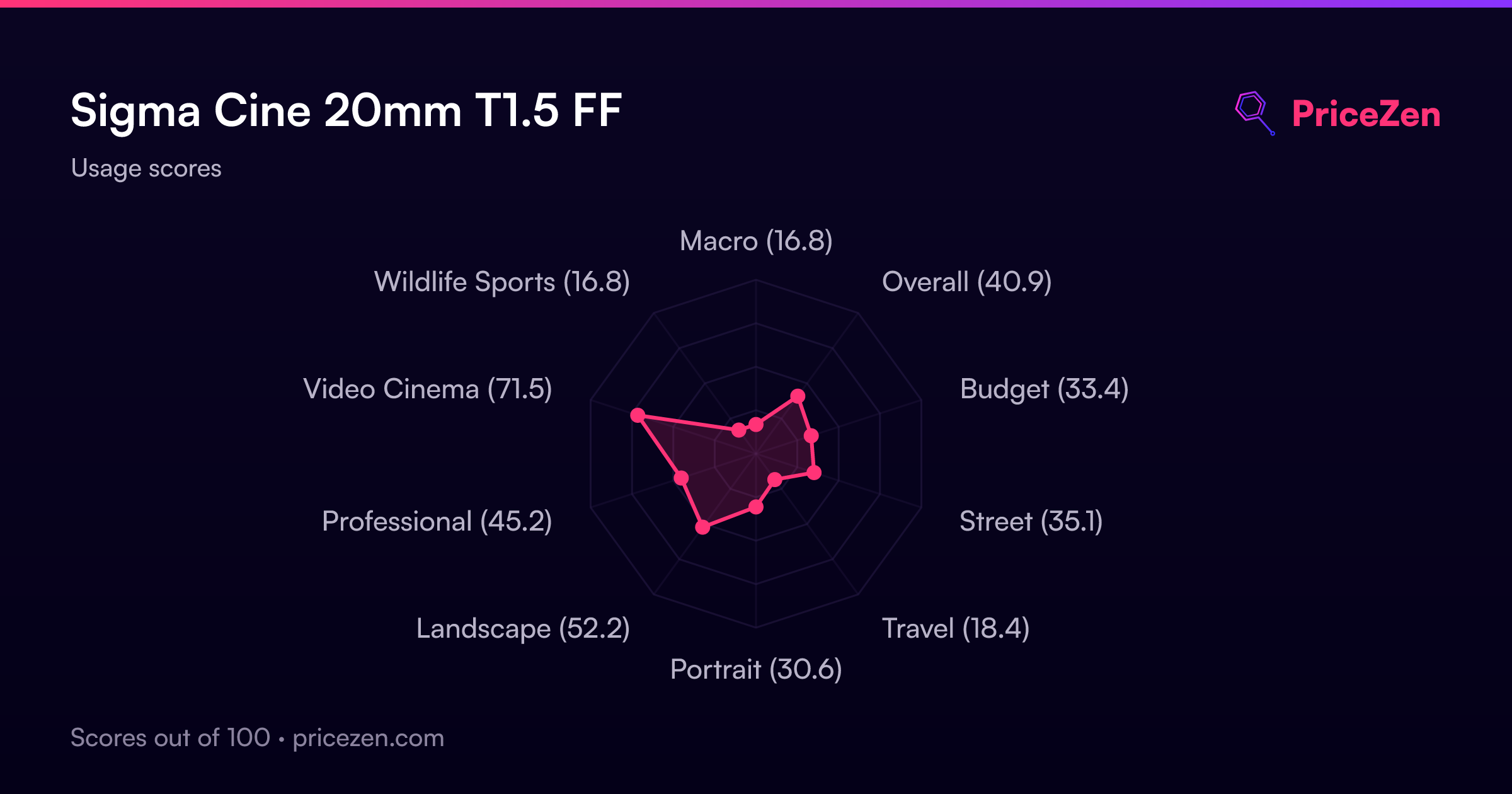
Usage Scores
- Macro16.4
- Overall40.3
- Budget33.1
- Street34.4
- Travel17.4
- Portrait30.5
- Landscape52
- Professional44.7
- Video Cinema71.1
- Wildlife Sports16.4