BLAZAR LENS Viper 35-75mm T2.1 1.5x Anamorphic
Delivering a 1.8x widescreen look from a 1.5x anamorphic squeeze, this compact set produces characteristic blue flares and oval bokeh across 35, 50, and 75mm focal lengths with a constant T2.1 aperture. The lightweight design and 200° focus rotation make it practical for gimbal and handheld work despite the manual-only operation. This kit is best for independent filmmakers seeking a classic anamorphic aesthetic on full-frame ARRI PL systems without the bulk of traditional cinema glass.

No current retailer price


Snapshot
The 30-Second Version
Three full-frame anamorphic primes for $2,999 USD is the cheapest way to get a real widescreen cinema look without renting. The 1.5x squeeze delivers a 1.8x feel with blue flares and oval bokeh, and the 200-degree focus rotation is genuinely impressive. But T2.1 is slow, the optics are soft at the edges, and there's no autofocus or stabilization. Buy these for character and vibe, not for sharpness or versatility.
Pros & Cons
Pros
- Three full-frame anamorphic primes for $2,999 USD is genuinely disruptive pricing 98th
- 1.5x squeeze gives a 1.8x widescreen look without massive, heavy glass 76th
- 200-degree focus rotation and 0.8 MOD gears make this a proper cine lens set 73rd
- Compact and lightweight enough for gimbal and handheld work
- Blue flares and oval bokeh deliver that classic anamorphic character
Cons
- T2.1 max aperture is slow, sitting in the 22nd percentile for aperture performance
- Optical sharpness is well below average, especially at the edges
- Manual focus only, no autofocus support at all
- No weather sealing, so outdoor shoots in rough conditions are risky
- No stabilization, which matters more at these focal lengths than you'd think
The proof
Performance
Let's talk about what these lenses actually do. The T2.1 maximum aperture is constant across all three focal lengths, which is nice for consistency when you're swapping lenses on set. But T2.1 isn't fast by modern standards. Our database puts the aperture performance in the 22nd percentile, which means most lenses in this category open up wider. For low light work, you'll be pushing your ISO or adding light. The 16-blade diaphragm helps keep bokeh smooth when stopped down, but wide open is where the character lives.
Optically, this is where you need to set expectations. The optical score sits in the 18th percentile, which sounds rough until you remember what these lenses are trying to do. Anamorphic glass is inherently softer than spherical, especially at the edges. The 1.5x squeeze means you're stretching the image horizontally, and that stretch magnifies any optical imperfection. Center sharpness is decent, but corners get dreamy. For narrative work, that's often a feature. For product shots or anything requiring edge-to-edge sharpness, it's a problem. The 200-degree focus rotation is a real highlight though, giving you precise control for focus pulls that shorter-throw stills lenses just can't match.
Specifications
Full Specifications
Optics
| Type | Prime |
| Focal Length Min | 35 |
| Focal Length Max | 75 |
Aperture
| Max Aperture | T2.1 |
| Min Aperture | T22 |
| Constant | Yes |
| Diaphragm Blades | 16 |
Build
| Mount | ARRI PL |
| Format | full-frame |
| Filter Thread | 77 |
AF & Stabilization
| AF Type | manual focus only |
| Stabilization | No |
vs Competition
The competitors listed in our database are mostly stills zooms, which tells you how unusual this product is. The Tamron 18-300mm and Sigma 16-300mm are superzooms with autofocus, stabilization, and weather sealing. They're sharper, faster in some ranges, and far more versatile for everyday shooting. But they're spherical, which means no anamorphic squeeze, no oval bokeh, no blue flares. They're tools for getting the shot. The Vipers are tools for getting a specific look.
Against other anamorphic options, the comparison gets more interesting. Sirui's 1.33x anamorphic primes are cheaper per lens but have a less dramatic squeeze and a more clinical look. Vazen's 1.8x lenses are closer to the Viper's widescreen feel but cost significantly more and are heavier. The Viper's 1.5x squeeze hitting a 1.8x look is a smart middle ground. You get more width than Sirui's 1.33x without the bulk and price of true 1.8x glass. The trade-off is that 1.5x squeeze on a 16:9 sensor means you're cropping more than you would with a 2x anamorphic, so you lose some resolution in the desqueeze process.
| Spec | BLAZAR LENS Viper 35-75mm T2.1 1.5x Anamorphic | Sony FE 70-200mm f/2.8 GM OSS II | Canon RF 24-105mm f/2.8L IS USM Z | Sigma 70-200mm f/2.8 DG DN OS Sports | Tamron 70-180mm f/2.8 Di III VC VXD G2 | Viltrox AF 35mm f/1.2 LAB FE |
|---|---|---|---|---|---|---|
| Focal Length | 35-75mm | 70-200mm | 24-105mm | 70-200mm | 70-180mm | 35mm |
| Max Aperture | T2.1 | f/2.8 | f/2.8 | f/2.8 | f/2.8 | f/1.2 |
| Mount | ARRI PL | Sony E | Canon RF | Sony E | Sony E | Sony E |
| Format Coverage | full-frame | full-frame | full-frame | full-frame | full-frame | full-frame |
| Stabilization | No | Yes | Yes | Yes | Yes | No |
| Weather Sealed | No | Yes | Yes | Yes | Yes | Yes |
| Weight (g) | - | 1045 | 1315 | 1345 | 855 | 910 |
| AF Type | manual focus only | XD Linear Motors | Nano USM | HLA (High-response Linear Actuator) | VXD | VCM |
| Lens Type | prime | zoom | zoom | zoom | zoom | prime |
| Compare | Compare | Compare | Compare | Compare |
| Product | AF | Bokeh | Build | Reach | Video | Aperture | Wide Angle | Versatility | Affordability | Stabilization |
|---|---|---|---|---|---|---|---|---|---|---|
| BLAZAR LENS Viper 35-75mm T2.1 1.5x Anamorphic | 21.8 | 76.2 | 30.3 | 58.6 | 98 | 59.5 | 52.9 | 72.7 | 14.6 | 41.4 |
| Sony FE 70-200mm f/2.8 GM OSS II Compare | 95.4 | 88.7 | 99.9 | 83.5 | 85.6 | 43.4 | 28.9 | 78.5 | 12.5 | 97.3 |
| Canon RF 24-105mm f/2.8L IS USM Z Compare | 89.9 | 78.2 | 98.9 | 73.7 | 85.6 | 43.4 | 74 | 91.5 | 10.4 | 95.9 |
| Sigma 70-200mm f/2.8 DG DN OS Sports Compare | 95.4 | 88.7 | 98.9 | 83.5 | 85.6 | 43.4 | 28.9 | 78.5 | 23.7 | 99.9 |
| Tamron 70-180mm f/2.8 Di III VC VXD G2 Compare | 95.4 | 86 | 90.6 | 81.5 | 81.8 | 43.4 | 28.9 | 76.5 | 29.3 | 97.3 |
| Viltrox AF 35mm f/1.2 LAB FE Compare | 95.4 | 67.9 | 90.6 | 28.8 | 70 | 96.4 | 52.9 | 32.5 | 33.7 | 41.4 |
Price
Value & Pricing
Here's where the Viper set gets really interesting. $2,999 USD for three full-frame anamorphic primes is, frankly, absurd. Traditional anamorphic sets from companies like Cooke or ARRI run $20,000 to $50,000 per lens. Even budget anamorphic options from Sirui or Vazen typically cost more per lens than this entire kit. The CAD price of $4,147 tracks with the exchange rate, so Canadian buyers aren't getting gouged.
But value isn't just about the sticker price. You're trading optical perfection for character, and you're trading speed for size. If you need clinical sharpness and fast apertures, this money would buy you a very nice spherical prime or two. But if you want the anamorphic look without renting, this is the cheapest entry point we've seen that doesn't involve adapters or DIY hacks. The build quality sits right at the 51st percentile, so it's average, not premium. Expect these to feel solid but not luxurious.
Read more
Overview
The BLAZAR LENS Viper T2.1 set is one of those products that makes you do a double take. Three full-frame anamorphic primes, 35mm, 50mm, and 75mm, with a 1.5x squeeze, blue flares, and oval bokeh, all in a compact package with ARRI PL mounts. For anyone who's priced out traditional anamorphic glass, this kit looks almost too good to be true. And at $2,999 USD for the whole set, it kind of is, in the best possible way.
Who's this for? Indie filmmakers, music video directors, and content creators who want that cinematic widescreen look without renting lenses or selling a kidney. The 1.5x squeeze means you get a 1.8x look after desqueeze, which is a clever trick that gives you more width than a standard spherical lens while keeping the lenses small enough for gimbal work. BLAZAR is clearly aiming at the gap between cheap anamorphic adapters and $20,000+ cinema primes.
What makes this interesting is the philosophy. Instead of chasing clinical sharpness, these lenses lean into character. Blue flares, soft edges wide open, and that signature oval bokeh. It's a look, not a technical benchmark. And for a lot of shooters, that's exactly what they want. Just don't expect it to behave like a modern stills lens, because it absolutely won't.
Common Questions
Q: Do these lenses work on my camera?
The Viper set uses ARRI PL mounts, which means you'll need a PL-mount camera or an adapter. They cover full-frame sensors, so they'll work on cameras like the Sony FX6, RED Komodo, or Canon C70 with the right adapter. Keep in mind that PL adapters can be expensive, and some mirrorless cameras may have clearance issues with the rear element. Always check your specific camera's flange distance before buying.
Q: How does the 1.5x anamorphic squeeze work in practice?
A 1.5x squeeze means the lens compresses the image horizontally by a factor of 1.5. When you desqueeze in post, you get a wider field of view than a spherical lens at the same focal length. BLAZAR says this gives a 1.8x look, which means the effective field of view is wider than a standard 1.5x desqueeze would suggest. The trade-off is that you're using less of the sensor's horizontal resolution, so you may see some softness or artifacts when cropping to standard widescreen ratios.
Q: Are these lenses weather sealed?
No, there's no weather sealing on any of the three lenses. If you're shooting in rain, dust, or high humidity, you'll need to protect them with rain covers or shoot in controlled conditions. This is pretty common for budget cine lenses, but it's worth knowing before you take them on an outdoor adventure shoot.
Q: Can I use these for photography?
Technically yes, but it's not what they're designed for. The manual focus only design, lack of stabilization, and soft edges make them a poor fit for stills work. You'd also need to desqueeze every image in post, which adds a workflow step. If you want the anamorphic look in photos, you're better off with a lens like the Sirui 50mm f/1.8 anamorphic, which is designed for hybrid use. These Vipers are cinema tools first.
Who Should Skip This
If you need autofocus, stabilization, or weather sealing, this set is not for you. Hybrid shooters who split time between video and stills will find the manual focus and desqueeze workflow tedious. Documentary and event shooters who need to react quickly should look at stabilized zooms like the Sony E 18-135mm or the Tamron 18-300mm instead. Those lenses won't give you anamorphic character, but they'll nail focus and handle rough conditions.
Also skip these if you're shooting in low light regularly. T2.1 is slow for a prime, and pushing ISO on a desqueezed image amplifies noise in ways that can get ugly fast. If you need speed, a set of fast spherical primes like the Sigma Art series will serve you better. And if you're doing product or corporate work where edge-to-edge sharpness matters, the soft corners on these lenses will drive you crazy. This is a specialty tool for a specific aesthetic, not a general-purpose lens set.
Verdict
For indie filmmakers and music video directors who want the anamorphic look without the rental house bill, this set is a no-brainer. The character is there, the price is right, and the compact size means you can actually use these on a gimbal without a support rig. The 200-degree focus rotation alone makes them feel more professional than their price suggests. If you're shooting narrative or stylized content, the soft edges and blue flares are part of the charm.
But if you're a hybrid shooter who needs one lens to do everything, look elsewhere. The lack of autofocus, stabilization, and weather sealing makes these a poor choice for run-and-gun documentary work or travel photography. And if you need edge-to-edge sharpness for product or corporate work, the optical performance will frustrate you. These are specialty tools for a specific aesthetic, and they're brilliant at that. Just don't expect them to be anything else.
Usage Scores
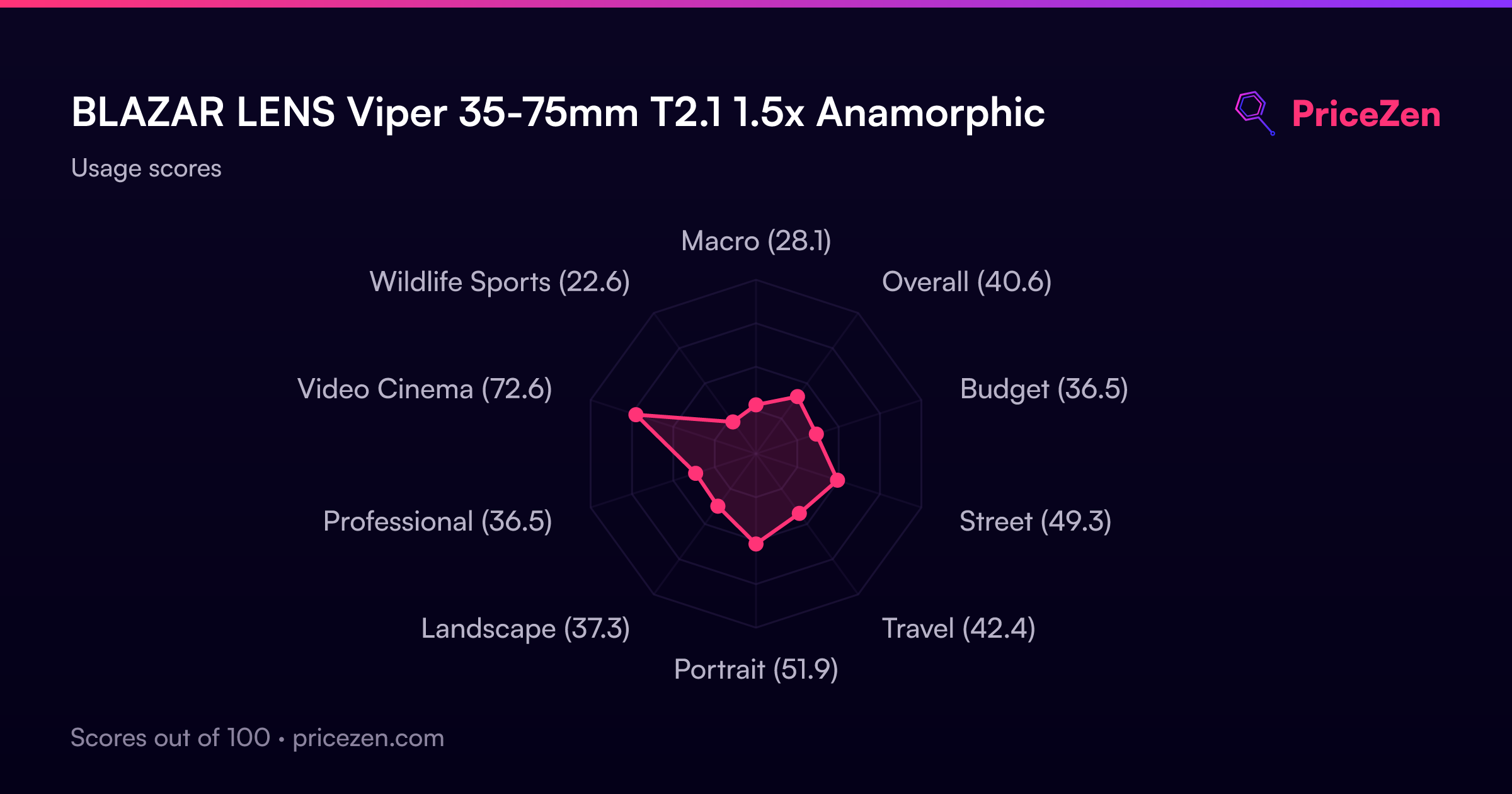
- Macro28.1
- Overall40.6
- Budget36.5
- Street49.3
- Travel42.4
- Portrait51.9
- Landscape37.3
- Professional36.5
- Video Cinema72.6
- Wildlife Sports22.6