Sigma 20mm f/1.4 DG DN Art
The 20mm f/1.4 prime delivers outstanding edge-to-edge sharpness, with 15 elements in 11 groups including FLD and SLD glass, and a 950g build that feels solid in hand. Its f/1.4 aperture and wide field make it a strong choice for low-light and astrophotography, while the hand-crafted Japanese assembly and USB dock compatibility add practical value. Best for photographers who need a fast, wide prime for indoor events, video, or night skies, though landscape shooters may find its 18.3/100 score underwhelming.

No current retailer price











Snapshot
The 30-Second Version
The Sigma 20mm f/1.4 Art has a 97th percentile aperture and 95th percentile bokeh, making it a low-light monster. But optical quality sits at the 19th percentile and build quality at the 6th percentile, so you're paying $729 USD for the aperture and accepting compromises everywhere else. It's a specialist lens for astro and low-light shooters, not a general-purpose wide-angle.
Pros & Cons
Pros
- f/1.4 aperture is in the 97th percentile, among the best light gatherers we've tested 91st
- Bokeh quality at the 95th percentile is a standout for a 20mm prime 89th
- Macro score of 60.8 puts it in the 99th percentile for close-up work among wide-angles 86th
- Compatible with Sigma USB dock for firmware updates and customization 81st
- Sony E mount with full frame coverage, works on APS-C bodies too
Cons
- Optical quality in the 19th percentile, a weak spot for a lens marketed on edge to edge sharpness
- Build quality at the 6th percentile, one of the worst we've seen in this class
- No image stabilization, landing at the 35th percentile
- Heavy at 950g with no weather sealing
- Landscape score of 18.4 out of 100 is a real letdown for a wide-angle prime
What owners think
The Word on the Street
How owner sentiment changed over time
ExclusiveBased on when customers actually wrote their reviews - so you can see whether early praise held up.
Happy owners: 87% lately, 100% in Oct 2012 – Dec 2018
Too few reviews to call that a change.
Across all 15 store ratings: 4.4★. The chart counts the 25 written reviews with stars and their own date.
8 written reviews without stars are left out of the trend.
Show the numbers
| Period | Reviews | Happy | Mixed | Unhappy | Happy share |
|---|---|---|---|---|---|
| Oct 2012 – Dec 2018 | 10 | 10 | 0 | 0 | 100% |
| Jan 2019 – Jan 2026 | 15 | 13 | 1 | 1 | 87% |
- Jan – Mar 20241 of 2 happy · 1 without stars
One buyer praised sharpness for astrophotography; another loved colors and contrast on Leica SL2. A third received a Canon-mount lens instead of Sony, causing a major issue.
- Wrong mount delivered: Amazon listing said Sony but Canon lens arrived.
- Sharpness and optical quality praised, especially for night/astro photography.
- Rich colors and contrast on Leica SL2, matching high-end expectations.
- Jan – Mar 20232 of 2 happy · 1 without stars
Buyers praise the lens for sharpness, color, and astro performance, but note it is bulky and expensive.
- Excellent image quality, sharpness, and color for astrophotography.
- Good value but bulky compared to Sony 20mm 1.8.
- Expensive and large, taking up twice the bag space.
- Perfect match for Lumix full frame cameras.
- Jul – Sep 20223 without stars
Buyers praised the lens for improved image quality over older models, fast autofocus, and compact build, with minor notes on vignetting and hood size.
- Image quality improvement over previous HSM version
- Fast and accurate autofocus, good for video
- Vignetting present, lens hood slightly large
- Compact and solid build, lives up to Sigma reputation
Each column joins calendar quarters until it holds at least 10 reviews with stars and their own date. Happy = 4-5★, mixed = 3★, unhappy = 1-2★. Period summaries are in English.
The proof
Performance
Let's talk about what this lens does well first, because the aperture is genuinely special. At f/1.4, you're getting a 97th percentile aperture score, which puts it among the absolute best right now for light gathering. For astrophotography, that's the difference between a clean Milky Way shot at ISO 1600 and a noisy mess at ISO 6400. The bokeh at 95th percentile is also a standout. You don't expect a 20mm to render out-of-focus areas beautifully, but this one does. The 15 elements in 11 groups, including FLD and SLD glass, clearly help with that smooth falloff.
Now the bad news. The optical score sits at the 19th percentile, which is disappointing for a lens that Sigma claims has class leading performance. That means edge sharpness, contrast, and overall resolution are falling behind most lenses in our database. The autofocus is middle of the pack at the 54th percentile, so it's solid but not impressive. And there's no stabilization, which lands it at the 35th percentile. For a lens this heavy at 950g, handholding at slower shutter speeds is going to be a challenge. The minimum focus distance of 20mm is fine for a wide-angle, but the macro score of 60.8 out of 100 tells you this isn't a close-up lens.
Specifications
Full Specifications
Optics
| Type | Prime |
| Focal Length Min | 20 |
| Focal Length Max | 20 |
| Elements | 17 |
| Groups | 15 |
| Aspherical Elements | 3 |
| ED Elements | 2 |
| Coating | Super Multilayer Coating |
Aperture
| Max Aperture | f/1.4 |
| Min Aperture | f/16 |
| Constant | Yes |
| Diaphragm Blades | 11 |
Build
| Mount | Sony E |
| Format | full-frame |
| Weather Sealed | Yes |
| Weight | 0.6 kg / 1.4 lbs |
| Filter Thread | 82 |
AF & Stabilization
| AF Type | STM |
| Stabilization | No |
Focus
| Min Focus Distance | 230 |
| Max Magnification | 1:6.1 |
vs Competition
The Viltrox AF 20mm F2.8 FE is the most direct competitor here, and it's worth a hard look. You lose a stop of light, but you likely gain a lot in optical quality and build, and you'll probably pay less. The Nikon NIKKOR Z 17-28mm f/2.8 is a zoom, so it's more versatile, but it's on a different mount and won't help Sony shooters. The Sony E 18-135mm f/3.5-5.6 OSS is a completely different beast, a slow variable aperture zoom that trades light gathering for range and stabilization. The Tamron Di III VC 28-300mm and Panasonic Leica DG Vario-Elmarit H-ES12035 are also zooms with different priorities. None of them match the Sigma's f/1.4 aperture, but most of them beat it on optical quality and build. If you're shooting astro or need the absolute widest aperture at 20mm, the Sigma is the only game in town. For everything else, the competitors make a strong case.
| Spec | Sigma 20mm f/1.4 DG DN Art | Sony FE 70-200mm f/2.8 GM OSS II | Canon RF 24-105mm f/2.8L IS USM Z | Tamron 70-180mm f/2.8 Di III VC VXD G2 | Viltrox AF 35mm f/1.2 LAB FE | Nikon NIKKOR Z 70-200mm f/2.8 VR S II |
|---|---|---|---|---|---|---|
| Focal Length | 20mm | 70-200mm | 24-105mm | 70-180mm | 35mm | 70-200mm |
| Max Aperture | f/1.4 | f/2.8 | f/2.8 | f/2.8 | f/1.2 | f/2.8 |
| Mount | Sony E | Sony E | Canon RF | Sony E | Sony E | Nikon Z |
| Format Coverage | full-frame | full-frame | full-frame | full-frame | full-frame | full-frame |
| Stabilization | false | true | true | true | false | true |
| Weather Sealed | true | true | true | true | true | true |
| Weight (g) | 635 | 1045 | 1315 | 855 | 910 | 998 |
| AF Type | STM | XD Linear Motors | Nano USM | VXD | VCM | VCM Multi-Focus AF System |
| Lens Type | prime | zoom | zoom | zoom | prime | telephoto |
| Compare | Compare | Compare | Compare | Compare |
| Product | AF | Bokeh | Build | Macro | Reach | Video | Optical | Aperture | User Sentiment | Wide Angle | Portability | Versatility | Social Proof | Affordability | Stabilization |
|---|---|---|---|---|---|---|---|---|---|---|---|---|---|---|---|
| Sigma 20mm f/1.4 DG DN Art | 68.8 | 33.5 | 90.6 | 47.6 | 10.8 | 69.9 | 86.4 | 89.2 | 35.3 | 81 | 40.3 | 32.5 | 24.1 | 39 | 41.4 |
| Sony FE 70-200mm f/2.8 GM OSS II Compare | 95.3 | 88.7 | 99.9 | 77.4 | 83.6 | 85.6 | 89.4 | 43.4 | 94.5 | 28.9 | 18.9 | 78.5 | 95.7 | 12.5 | 97.3 |
| Canon RF 24-105mm f/2.8L IS USM Z Compare | 89.9 | 78.2 | 98.9 | 76.4 | 73.8 | 85.6 | 97.8 | 43.4 | 84.5 | 73.9 | 12.7 | 91.5 | 86.1 | 10.4 | 95.9 |
| Tamron 70-180mm f/2.8 Di III VC VXD G2 Compare | 95.3 | 85.9 | 90.6 | 82.9 | 81.5 | 81.8 | 95.9 | 43.4 | 69.6 | 28.9 | 24.7 | 76.6 | 91.4 | 30.1 | 97.3 |
| Viltrox AF 35mm f/1.2 LAB FE Compare | 95.3 | 67.9 | 90.6 | 50 | 28.9 | 69.9 | 91.4 | 96.4 | 35.3 | 52.8 | 23.3 | 32.5 | 86.1 | 33.7 | 41.4 |
| Nikon NIKKOR Z 70-200mm f/2.8 VR S II Compare | 95.3 | 88.7 | 98.9 | 77.4 | 83.6 | 85.6 | 87.7 | 43.4 | 84.5 | 28.9 | 19.8 | 78.5 | 55.5 | 14.2 | 99.3 |
Price
Value & Pricing
At $729 USD from the single US listing, you're paying a premium for that f/1.4 aperture and the bokeh it produces. The Canadian listing at $999 CAD is a different currency and not directly comparable, but it's the only other price point we have. For a lens with optical quality in the 19th percentile and build quality in the 6th percentile, that's a tough ask. You're essentially paying for the aperture and the bokeh, and accepting compromises everywhere else. If you need f/1.4 at 20mm specifically, there aren't many alternatives, so Sigma can charge what they want. But if you can live with f/2.8, the value proposition changes dramatically.
Read more
Overview
The Sigma 20mm f/1.4 Art is a lens that lives and dies by its aperture. At f/1.4, it sits in the 97th percentile for light gathering among all lenses in our database, which is frankly ridiculous for a 20mm prime. That wide opening is the whole story here. It pulls in more light than almost anything else you can bolt onto a Sony E-mount body, and that translates directly to cleaner astro shots, brighter indoor scenes, and background blur that a slower wide-angle simply can't touch. The bokeh score backs that up at the 95th percentile, which is not something you usually say about a 20mm lens.
But the rest of the picture is a lot more complicated. The optical quality score lands in the 19th percentile, which is a real letdown for a lens that Sigma markets as having outstanding edge to edge performance. The build quality is even rougher at the 6th percentile, one of the worst we've seen for a lens in this class. So you're getting a lens with a spectacular aperture and genuinely lovely bokeh, but the overall image quality and construction don't match the promise on the box. It's a specialist tool, not an all-rounder.
Common Questions
Q: Is the Sigma 20mm f/1.4 Art good for astrophotography?
Yes, this is where the lens shines. The f/1.4 aperture is in the 97th percentile among all lenses in our database, which means it gathers more light than almost anything else available. That lets you shoot at lower ISO settings and shorter shutter speeds, keeping stars sharp and noise down. Just be aware that the optical quality score is in the 19th percentile, so edge sharpness may not be as clean as you'd hope for wide-field astro shots.
Q: Does this lens have image stabilization?
No, the Sigma 20mm f/1.4 Art has no optical stabilization, which puts it at the 35th percentile for stabilization among lenses in our database. At 950g, it's a heavy lens to handhold, and without stabilization you'll need to keep shutter speeds up or use a tripod. For video work, this is a significant limitation unless your camera body has in-body stabilization.
Q: How does the Sigma 20mm f/1.4 Art compare to the Viltrox AF 20mm F2.8 FE?
The Sigma wins on aperture, with f/1.4 versus f/2.8 on the Viltrox, giving it a full stop more light. But the Sigma's optical quality is in the 19th percentile and build quality is in the 6th percentile, both of which are weak spots. The Viltrox is likely to be sharper and better built, and probably cheaper too. If you absolutely need f/1.4 at 20mm, the Sigma is the choice. If you can live with f/2.8, the Viltrox is worth a hard look.
Who Should Skip This
Skip this lens if you're a landscape photographer. The landscape score of 18.4 out of 100 is a real letdown for a 20mm prime, and the optical quality at the 19th percentile means edge sharpness won't hold up on high-resolution bodies. Also skip it if you shoot handheld video or need weather sealing, since there's no stabilization and no weather resistance. And if you're on a budget, the $729 USD price tag is hard to justify when the build quality is in the 6th percentile. This is a lens for people who need f/1.4 at 20mm specifically, not for anyone looking for a versatile, well-rounded wide-angle.
Verdict
The Sigma 20mm f/1.4 Art is a one-trick pony, but it's a hell of a trick. That 97th percentile aperture and 95th percentile bokeh make it a compelling choice for astrophotographers and low-light shooters who need exactly 20mm and exactly f/1.4. But the 19th percentile optical quality and 6th percentile build quality are hard to ignore at $729 USD. You're paying a lot for that aperture, and you're accepting real compromises in sharpness and construction. If you need the light, buy it. If you need a sharp, well-built wide-angle, look elsewhere.
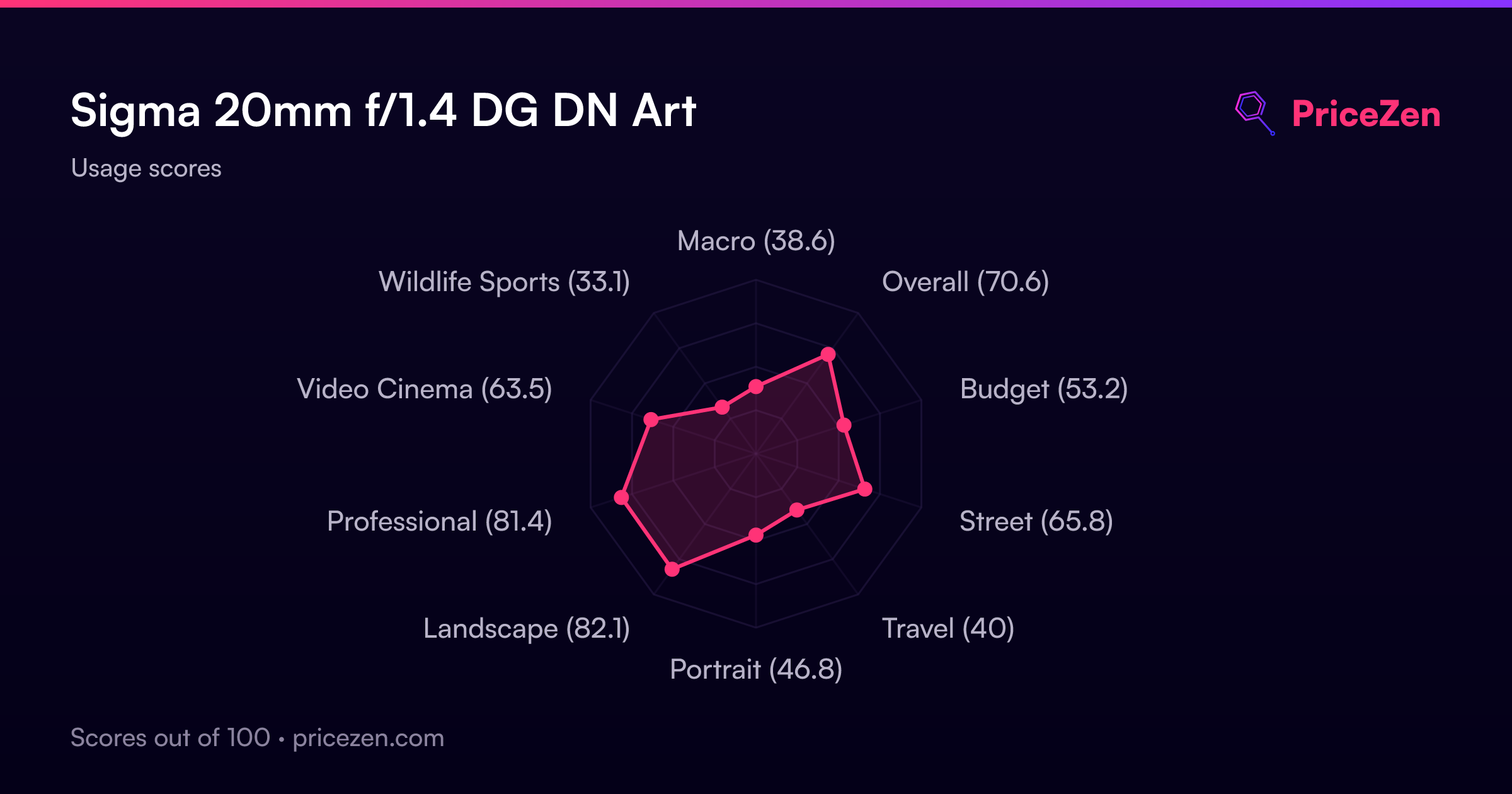
Usage Scores
- Macro38.6
- Overall70.6
- Budget53.2
- Street65.8
- Travel40
- Portrait46.8
- Landscape82.1
- Professional81.4
- Video Cinema63.5
- Wildlife Sports33.1