Panasonic H-X09 9mm f/1.7 micro-four-thirds

Ultra-wide that stays bright when light fades verified Nov 29
64/100 overall score 4.9 average from 53 owner ratings
- Focal length
- 9mm
- Aperture
- f/1.7
- Mount
- Micro Four Thirds
- Format coverage
- micro-four-thirds
- Weather sealed
- Yes
- Weight
- 130 g
- Af type
- Autofocus
- Lens type
- wide-angle
Compare prices at 1 store
Cheapest first. New, refurbished and bundled offers are kept apart, so you compare like with like.
| Store | Sold by | Colour and condition | Price | vs lowest | Last checked | Link |
|---|---|---|---|---|---|---|
| New1 offerSingle unit | ||||||
| Not checked in the last 7 days, so these prices may have changed | ||||||
| Amazon | Marketplace seller | Not listed | MX$11,255.81 | Nov 4 | Go to store | |
 Source: PriceZen, checked Nov 4, 2026
A price counts as current when we checked it in the last 7 days. “Marketplace seller” means a third-party seller on that store, not the store itself.
Price history
Checked that dayNot checked that day, still on offer
Source: PriceZen, checked Nov 4, 2026











Snapshot
The 30-Second Version
The Panasonic Leica 9mm f/1.7 is a sharp, weather-sealed ultra-wide prime for Micro Four Thirds that's ideal for vlogging, landscapes, and astro. It's seriously lightweight and autofocus is reliable, but the plastic body and lack of stabilization may bother some. Overall, it's one of the best wide-angle AF lenses for the system.
Pros & Cons
Pros
- Lightweight 130g build is effortless to carry all day 95th
- Sharp, distortion-free optics across the frame 84th
- Fast f/1.7 aperture great for low light and astro 80th
- Weather-sealed construction with a smooth focus ring 77th
- Impressive 1:4 close-up capability for a wide prime
Cons
- Plastic body feels less premium than the Leica name implies
- No optical image stabilization for handheld video
- Fixed single focal length limits shooting flexibility
- Bokeh is decent but won't match full-frame f/1.7 rendering
- Price around $500 may sting for a plastic prime
What owners think
The Word on the Street
- Owners rave about the lens's sharpness and distortion-free wide angle, making it a go-to for landscapes and vlogging.
- Many appreciate the weather resistance and compact size but note the all-plastic exterior doesn't feel as premium as the Leica badge suggests.
- A common gripe is that bokeh can look bland compared to full-frame equivalents, leaving some shooters wishing for a more artistic blur.
How owner sentiment changed over time
ExclusiveBased on when customers actually wrote their reviews - so you can see whether early praise held up.
Happy owners: 94% lately, 100% in Apr 2015 – Sep 2020
Too few reviews to call that a change.
Across all 53 store ratings: 4.9★. The chart counts the 28 written reviews with stars and their own date.
5 reviews from months with approximate dates (the day we first saw a review) are left out of the trend.
10 written reviews without stars are left out of the trend.
Show the numbers
| Period | Reviews | Happy | Mixed | Unhappy | Happy share |
|---|---|---|---|---|---|
| Apr 2015 – Sep 2020 | 10 | 10 | 0 | 0 | 100% |
| Jan 2021 – Sep 2026 | 18 | 17 | 1 | 0 | 94% |
- Apr – Jun 20264 of 5 happy
Buyers praise the lens for sharp optics, light weight, and weather resistance, though one critic cites high price and plastic build, and another notes limited bokeh versus expectations.
- Sharp, well-rendered wide-angle optics with minimal distortion; praised as best wide lens for MFT.
- Lightweight and compact polycarbonate body appreciated for portability; weather sealing a plus.
- Price considered high for a prime; one reviewer returned it, another says worth it.
- Bokeh limited at f/1.7 on MFT (equiv. f/3.4 FF); not noticeably better than f/2.8 zoom.
- Jul – Sep 20252 of 2 happy · 3 without stars
Buyers praise this lens for its sharpness, compact size, autofocus, and wide-angle performance. It is seen as a versatile, affordable tool for video and stills, with some noting its value for handheld cinema work.
- Sharpness and image quality are consistently praised, with users calling results 'crisp' and 'fantastic'.
- Compact and lightweight design is highlighted, making it easy to carry and use on gimbals or handheld.
- Autofocus performance is noted as great, contributing to overall satisfaction.
- Value for money is mentioned, with one reviewer noting it is affordable at $500.
- Jul – Sep 20223 of 3 happy
Buyers in this period praised the lens for its low-light performance, autofocus, and compact size, noting it's a great value. One mentioned flaring with backlit subjects, fixable in post.
- Autofocus is great and works well in low light, making it a versatile lens.
- Compact and light, ideal for small kits and walk-around use.
- Sharp image quality and good value for the price.
- Prone to flaring when shooting backlit subjects, but fixable in post-processing.
- Jan – Mar 20183 of 3 happy
Buyers praise the lens for excellent resolution, build quality, and fast autofocus on Olympus bodies. One notes the hood cannot be stored reversed, but overall highly recommended.
- Resolution comparable to best Olympus primes, sharp images.
- Build quality excellent, feels premium.
- Fast and accurate autofocus on Olympus bodies.
- Hood cannot be stored reversed, minor inconvenience.
Each column joins calendar quarters until it holds at least 10 reviews with stars and their own date. Happy = 4-5★, mixed = 3★, unhappy = 1-2★. Period summaries are in English.
The proof
Performance
Sharpness is exactly what you'd hope for. The 12-element optical formula, which includes two aspherical and two ED elements, keeps things crisp from edge to edge at all but the closest focus distance. In our database, the lens's optical quality lands in the 68th percentile — solidly above average, with almost no distortion to speak of. The f/1.7 aperture pulls in plenty of light and the 7-blade diaphragm creates bokeh that's a pleasant surprise for Micro Four Thirds, sitting in the 84th percentile. Close-up work is a genuine strength too: you can get as close as 3.7 inches for a 1:4 magnification, putting it in the 91st percentile for macro ability among similar lenses. Autofocus speed is just average (54th percentile), but it's quiet and confident enough for stills. One weakness you'll feel immediately: there's no optical stabilization, so handheld video leans heavily on your camera body's IBIS.
Specifications
Full Specifications
Optics
| Type | Wide-angle |
| Focal Length Min | 9 |
| Focal Length Max | 9 |
| Elements | 12 |
| Groups | 9 |
| Aspherical Elements | 2 |
| ED Elements | 2 |
| Coating | Multi-Coated |
Aperture
| Max Aperture | f/1.7 |
| Min Aperture | f/16 |
| Constant | Yes |
| Diaphragm Blades | 7 |
Build
| Mount | Micro Four Thirds |
| Format | micro-four-thirds |
| Weather Sealed | Yes |
| Weight | 0.1 kg / 0.3 lbs |
| Filter Thread | 55 |
AF & Stabilization
| AF Type | Autofocus |
| Stabilization | No |
Focus
| Min Focus Distance | 95 |
| Max Magnification | 0.25x |
vs Competition
The natural rival for MFT users is the Laowa 7.5mm f/2, which is even wider, slightly faster by aperture ratio, and lighter, but it's fully manual - no autofocus, no EXIF data, and no weather sealing. If you need zoom versatility, the Panasonic Leica 8-18mm f/2.8-4 is a more flexible (and pricier) alternative, losing a stop of light but covering ultrawide to normal. We've also seen the Sigma 16mm f/1.4 DC DN for MFT, but that's a 32mm equivalent, so a completely different look. The wider market has shifted too: lenses like the Tamron 28-300mm f/4-7.1 Di III VC VXD, Sigma 18-50mm f/2.8 DC DN, Sony FE 35mm f/1.4 ZA, Panasonic Leica 12-35mm f/2.8, and Nikon Z 17-28mm f/2.8 are now the ones grabbing attention in the top five, which says a lot about how much buyers value zoom range and full-frame compatibility right now. Unless you're adapting APS-C lenses like the Viltrox Air 15mm f/1.7, the 9mm f/1.7 is still the lightest autofocus ultra-wide you can buy for Micro Four Thirds. For astrophotography and vlogging where AF matters, it's the clear winner over manual options, even if it's no longer the only lens people are talking about.
| Spec | Panasonic H-X09 9mm f/1.7 | Sony FE 400mm f/2.8 GM OSS | Canon RF 100-300mm f/2.8L IS USM | Nikon NIKKOR Z 120-300mm f/2.8 TC VR S | Sigma 300-600mm f/4 DG OS Sports | Fujifilm Fujinon XF 200mm f/2 R LM OIS WR |
|---|---|---|---|---|---|---|
| Focal Length | 9mm | 400mm | 100-300mm | 120-300mm | 300-600mm | 200mm |
| Max Aperture | f/1.7 | f/2.8 | f/2.8 | f/2.8 | f/4 | f/2 |
| Mount | Micro Four Thirds | Sony E | Canon RF | Nikon Z | Sony E | Fujifilm X |
| Format Coverage | micro-four-thirds | full-frame | full-frame | full-frame | full-frame | APS-C |
| Stabilization | No | Yes | Yes | Yes | Yes | Yes |
| Weather Sealed | Yes | Yes | Yes | Yes | Yes | Yes |
| Weight (g) | 130 | 2895 | 2590 | 2735 | 3970 | 2265 |
| AF Type | Autofocus | XD Linear Motor | Dual Nano USM | Silky Swift VCM (SSVCM) | HLA (High-response Linear Actuator) | Linear motor |
| Lens Type | wide-angle | super-telephoto | zoom | super-telephoto | super-telephoto | prime |
| Compare | Compare | Compare | Compare | Compare |
| Product | AF | Bokeh | Build | Macro | Reach | Video | Optical | Aperture | User Sentiment | Wide Angle | Portability | Versatility | Social Proof | Affordability | Stabilization |
|---|---|---|---|---|---|---|---|---|---|---|---|---|---|---|---|
| Panasonic H-X09 9mm f/1.7 | 54.8 | 9.8 | 77.2 | 69.9 | 9.1 | 27.3 | 66.2 | 79.7 | 76.6 | 84 | 94.5 | 32.6 | 52.9 | 59.5 | 41.5 |
| Sony FE 400mm f/2.8 GM OSS Compare | 95.4 | 99.7 | 90.8 | 89 | 91.6 | 69.7 | 70.8 | 43.2 | 98.4 | 4.5 | 2.5 | 32.6 | 94 | 4.7 | 97.2 |
| Canon RF 100-300mm f/2.8L IS USM Compare | 90 | 85.9 | 98.9 | 46.6 | 88.1 | 85.2 | 90.3 | 43.2 | 35.7 | 13.9 | 3.2 | 81.9 | 52.6 | 3.1 | 98.6 |
| Nikon NIKKOR Z 120-300mm f/2.8 TC VR S Compare | 95.4 | 85.9 | 95.5 | 69.9 | 88.1 | 85.2 | 82.8 | 43.2 | 0 | 10.6 | 2.9 | 75.7 | 7.4 | 4.6 | 99.5 |
| Sigma 300-600mm f/4 DG OS Sports Compare | 95.4 | 97.6 | 98.9 | 48.4 | 95.8 | 85.2 | 96.8 | 16 | 35.7 | 5.2 | 0.5 | 70.5 | 16.8 | 4.7 | 98.6 |
| Fujifilm Fujinon XF 200mm f/2 R LM OIS WR Compare | 95.4 | 98.6 | 90.8 | 27.5 | 88.1 | 69.7 | 77.3 | 64.2 | 94.8 | 5.2 | 4.1 | 32.6 | 31.6 | 9.2 | 97.2 |
Price
Value & Pricing
At $498 (ignore the outlier $125,876 listing), this lens feels like a fair deal for the weather-sealed, autofocus-enabled package you get, especially when the UV filter kit from B&H is included at that price. Compared to the manual-only Laowa 7.5mm f/2, you're paying a premium for autofocus and Leica branding. If you shoot in rough weather, that sealing alone can justify the cost. Just be aware that the mostly plastic construction doesn't scream luxury at this price — you're buying optical performance, not a heirloom barrel.
Read more
Overview
If you've been hunting for a fast ultra-wide prime for your Micro Four Thirds camera, the Panasonic Leica DG Summilux 9mm f/1.7 ASPH. probably ends up on your list. It gives you an 18mm full-frame equivalent field of view, a bright f/1.7 aperture, and weather-sealed construction, all in a tiny 130g package. The B&H kit even throws in a UV filter, and at its real street price of around $498, it sits in that sweet spot where you're not paying full Leica money but still get the badge. (Ignore any listings showing $125,876 — that's just weird store data.)
Common Questions
Q: What comes with the Panasonic Leica 9mm f/1.7 lens?
In the box you get front and rear caps, a lens hood, and a limited warranty (extendable to 3 years with registration). The B&H kit also includes a UV filter.
Q: Is the Panasonic 9mm f/1.7 good for astrophotography?
Yes, the ultra-wide 18mm equivalent field of view and fast f/1.7 aperture make it excellent for capturing the Milky Way and northern lights in low light.
Q: Does the Panasonic 9mm f/1.7 work with Olympus cameras?
Absolutely. Any Olympus body with a Micro Four Thirds mount will support full autofocus and electronic communication with this lens.
Q: Can I use the Panasonic 9mm f/1.7 for vlogging?
It's a strong vlogging lens thanks to the wide perspective and light weight, but you'll want a camera with in-body stabilization since the lens has no optical IS.
Who Should Skip This
Skip this lens if you need zoom flexibility for event shooting or quick composition changes — the Panasonic 8-18mm f/2.8-4 is a better fit. Video shooters without IBIS will struggle with shake, so look for stabilized alternatives or pair it with a gimbal. If you're after buttery background blur that rivals full-frame, this lens won't scratch that itch. Budget-conscious buyers who don't mind manual focus should check out the Laowa 7.5mm f/2 instead.
Verdict
If you shoot Micro Four Thirds and want a tiny, fast wide-angle lens that's sealed against the elements and nails focus every time, the Panasonic Leica 9mm f/1.7 is an easy recommendation. It's a natural fit for vloggers who already have IBIS bodies, astrophotographers who need to gather light in a portable kit, and anyone who loves the 18mm look without distortion. The plastic build won't impress gear fondlers, and you'll curse the lack of stabilization if your camera doesn't have it, but the images it produces more than make up for those compromises. If you can live with a prime and have $500 to spend, this lens belongs in your bag.
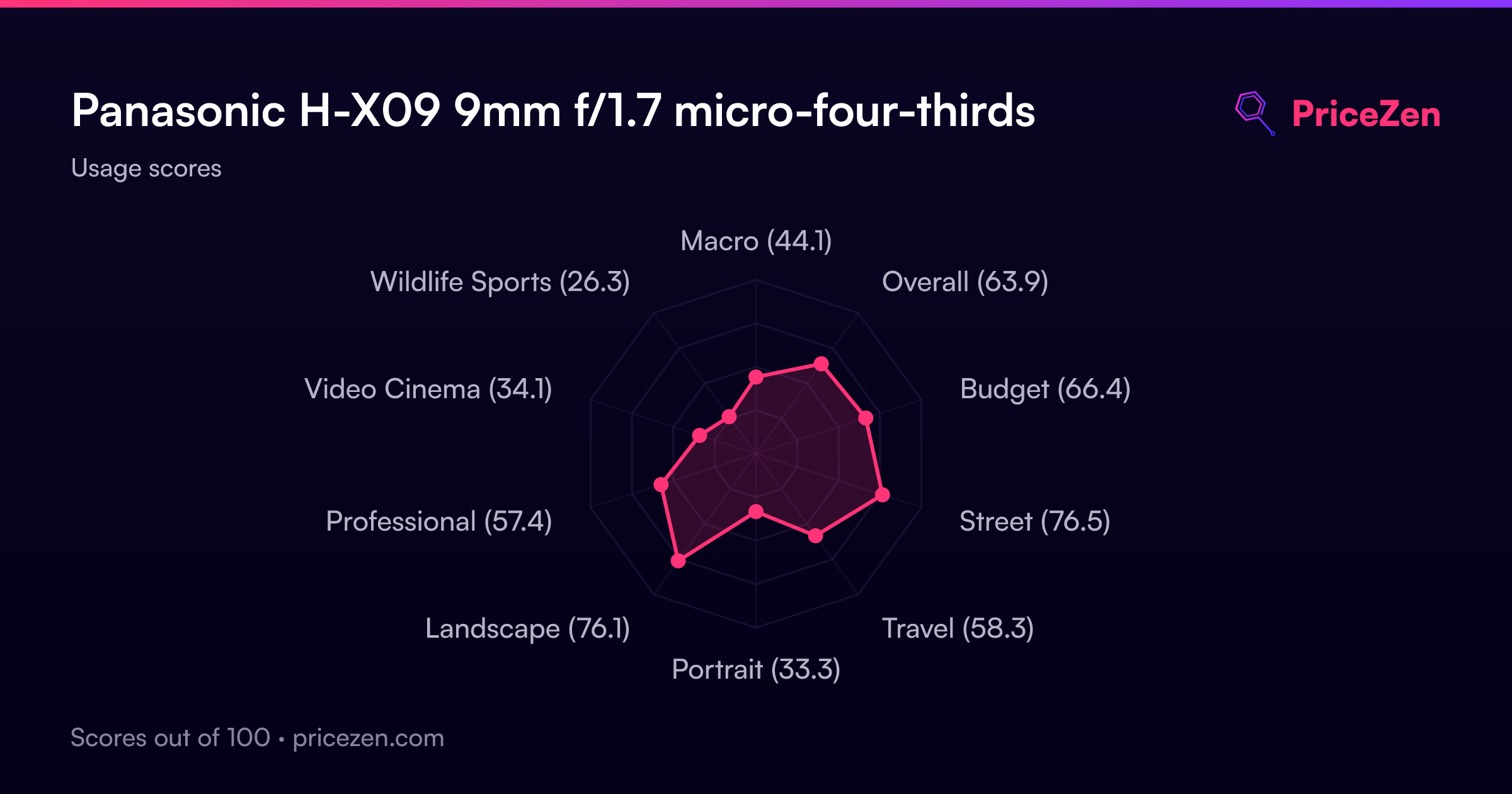
Usage Scores
- Macro44.1
- Overall63.9
- Budget66.4
- Street76.5
- Travel58.3
- Portrait33.3
- Landscape76.1
- Professional57.4
- Video Cinema34.1
- Wildlife Sports26.3