Canon Flex CN-E 20-50mm T2.4L FP
Delivering 8K optical performance with a constant T2.4 aperture across its 20-50mm zoom range, this lens leverages Canon Cinema EOS color science and an 11-blade diaphragm for smooth bokeh. Weighing just 376g, it offers exceptional portability and includes a relay converter that enables both EF and PL mount compatibility. It suits documentary and studio cinematographers who need a lightweight, flexible wide-to-normal zoom with full-frame coverage.

No current retailer price


Snapshot
The 30-Second Version
The Canon Flex Zoom CN-E 20-50mm T2.4 L FP is a lightweight cinema zoom with gorgeous bokeh and a constant T2.4 aperture, but the overall optical performance lands in the bottom fifth of our database. At $30,300 USD, you're paying for the cinema housing and Canon color science, not class-leading sharpness. It makes sense for narrative crews who need a gimbal-friendly zoom, but hybrid shooters should look elsewhere.
Pros & Cons
Pros
- Constant T2.4 aperture across the full 20-50mm range 98th
- Bokeh quality in the 95th percentile, genuinely gorgeous out-of-focus rendering 81st
- 11-blade diaphragm keeps highlights round and smooth 76th
- Very light at 376g for a cinema zoom 67th
- Canon Cinema EOS color science baked into the glass design
Cons
- Overall optical score in the 18th percentile, weak for the price
- Macro performance near the bottom at the 12th percentile
- No stabilization, which hurts for handheld work
- Build quality only middle of the pack at the 48th percentile
- No weather sealing despite the premium cinema positioning
The proof
Performance
Let's talk about what this lens does well first. The bokeh quality sits in the 95th percentile of all lenses in our database, which means the out-of-focus rendering is genuinely best-in-class. The 11-blade diaphragm helps here, keeping highlights round and smooth even when stopped down a bit. For interviews, narrative close-ups, and anything with practical lights in the background, this lens will make your footage look expensive.
But the overall optical score is only in the 18th percentile, and that's a red flag. The macro performance is nearly dead last at the 12th percentile, so don't expect to get close to small objects or capture fine detail at minimum focus. Sharpness across the frame, contrast, and chromatic aberration control are all likely contributing to that low optical ranking. For a lens marketed around 8K performance, that's a tough pill to swallow. You're paying for the cinema housing, the constant aperture, and the Canon color science, not necessarily the sharpest glass in the cabinet.
Specifications
Full Specifications
Optics
| Type | Zoom |
| Focal Length Min | 20 |
| Focal Length Max | 50 |
Aperture
| Max Aperture | f/2.4 |
| Constant | Yes |
| Diaphragm Blades | 11 |
Build
| Mount | Canon EF |
| Format | full-frame |
| Weight | 0.4 kg / 0.8 lbs |
AF & Stabilization
| Stabilization | No |
Focus
| Min Focus Distance | 600 |
vs Competition
The competitors in our database are mostly stills lenses, which makes direct comparison tricky. The Tamron Di III VC 28-300mm f/4-7.1 is a superzoom with way more range but a variable aperture that gets slow quickly. The Sigma Art 17-40mm f/1.8 DC is faster and wider, but it's a crop-sensor lens and won't cover full-frame. The Sony E 18-135mm f/3.5-5.6 OSS and Panasonic LUMIX S S-R28200 are both versatile stills zooms with stabilization, something this Canon lacks entirely.
Where the Canon stands alone is the cinema feature set. None of those competitors have a constant T2.4 aperture, an 11-blade diaphragm, or the geared focus and aperture rings that make this lens work with follow focus systems. If you're shooting narrative or commercial work with a focus puller, the Canon is the only real option in this group. If you're shooting stills or run-and-gun video with autofocus, every single competitor is a better value.
| Spec | Canon Flex CN-E 20-50mm T2.4L FP | Sony FE 70-200mm f/2.8 GM OSS II | Sigma 70-200mm f/2.8 DG DN OS Sports | Tamron 70-180mm f/2.8 Di III VC VXD G2 | Viltrox AF 35mm f/1.2 LAB FE | Nikon NIKKOR Z 70-200mm f/2.8 VR S II |
|---|---|---|---|---|---|---|
| Focal Length | 20-50mm | 70-200mm | 70-200mm | 70-180mm | 35mm | 70-200mm |
| Max Aperture | f/2.4 | f/2.8 | f/2.8 | f/2.8 | f/1.2 | f/2.8 |
| Mount | Canon EF | Sony E | Sony E | Sony E | Sony E | Nikon Z |
| Format Coverage | full-frame | full-frame | full-frame | full-frame | full-frame | full-frame |
| Stabilization | false | true | true | true | false | true |
| Weather Sealed | false | true | true | true | true | true |
| Weight (g) | 376 | 1045 | 1345 | 855 | 910 | 998 |
| AF Type | - | XD Linear Motors | HLA (High-response Linear Actuator) | VXD | VCM | VCM Multi-Focus AF System |
| Lens Type | zoom | zoom | zoom | zoom | prime | telephoto |
| Compare | Compare | Compare | Compare | Compare |
| Product | AF | Bokeh | Build | Macro | Reach | Video | Aperture | Wide Angle | Portability | Versatility | Affordability | Stabilization |
|---|---|---|---|---|---|---|---|---|---|---|---|---|
| Canon Flex CN-E 20-50mm T2.4L FP | 21.8 | 50.7 | 30.3 | 14.1 | 43.1 | 98 | 56.6 | 81 | 67.2 | 75.7 | 2 | 41.4 |
| Sony FE 70-200mm f/2.8 GM OSS II Compare | 95.3 | 88.7 | 99.9 | 77.4 | 83.6 | 85.6 | 43.4 | 28.9 | 18.9 | 78.5 | 12.5 | 97.3 |
| Sigma 70-200mm f/2.8 DG DN OS Sports Compare | 95.3 | 88.7 | 98.9 | 55.7 | 83.6 | 85.6 | 43.4 | 28.9 | 11.9 | 78.5 | 23.6 | 99.9 |
| Tamron 70-180mm f/2.8 Di III VC VXD G2 Compare | 95.3 | 85.9 | 90.6 | 82.9 | 81.5 | 81.8 | 43.4 | 28.9 | 24.7 | 76.6 | 30.1 | 97.3 |
| Viltrox AF 35mm f/1.2 LAB FE Compare | 95.3 | 67.9 | 90.6 | 50 | 28.9 | 69.9 | 96.4 | 52.8 | 23.3 | 32.5 | 33.7 | 41.4 |
| Nikon NIKKOR Z 70-200mm f/2.8 VR S II Compare | 95.3 | 88.7 | 98.9 | 77.4 | 83.6 | 85.6 | 43.4 | 28.9 | 19.8 | 78.5 | 14.2 | 99.3 |
Price
Value & Pricing
At $30,300 USD, this lens is competing against some serious alternatives. The problem is that our database shows the optical performance doesn't back up the price tag. You're paying for the Canon name, the cinema housing, and the constant T2.4 aperture, but the sharpness and overall image quality metrics suggest you could get better glass for less money if you're willing to give up the cinema-specific features.
That said, value in the cinema world isn't just about sharpness. A constant aperture zoom with this focal range and this weight is rare. The 20-50mm range covers a huge amount of everyday shooting, and the T2.4 means you can shoot in low light without pushing ISO. If you're renting this lens for a specific project, the math might work. If you're buying it outright, you need to be very sure the workflow benefits outweigh the optical compromises.
Read more
Overview
The Canon Flex Zoom CN-E 20-50mm T2.4 L FP is not your everyday zoom. This is a cinema lens built for productions that need consistent exposure, smooth focus pulls, and glass that can hold up on an 8K sensor. At 376g, it's also shockingly light for what it promises, which immediately makes it interesting for gimbal work and handheld rigs where most cinema zooms feel like boat anchors.
Who is this for? Small crews, owner-operators, and rental houses that want a flexible wide-to-normal zoom without swapping primes every five minutes. The constant T2.4 aperture means you set your exposure once and it stays put across the entire 20-50mm range. That's a big deal when you're moving fast on set and don't have time to re-light between shots.
The catch is the price. At $30,300 USD, this is a serious investment, and our database shows the optical performance ranking lands in the bottom fifth compared to other lenses we track. That's a weird spot for a lens with Canon's L designation and 8K marketing claims. The bokeh and aperture numbers are excellent, but the overall optical score suggests this lens has some specific weaknesses you need to know about before signing the check.
Common Questions
Q: Does this lens have image stabilization?
No, the Canon Flex Zoom CN-E 20-50mm T2.4 L FP has no optical stabilization. That's typical for cinema lenses, since most are used on tripods, gimbals, or rigs with external stabilization. If you're planning to shoot handheld without a gimbal, you'll need to add weight or use a stabilized camera body.
Q: Will this lens cover a full-frame sensor?
Yes, this lens is designed for full-frame coverage. The 20-50mm focal range and constant T2.4 aperture are specified for full-frame cinema cameras. It's available in Canon EF mount, and the retailer listing mentions a PL mount option via the RL-S1 relay converter.
Q: Is this lens weather sealed?
No, there's no weather sealing on this lens. For a $30,300 cinema lens, that's a notable omission. If you're shooting in dusty or wet conditions, you'll need to protect the lens with a rain cover or consider a different option.
Q: How close can this lens focus?
The macro performance is one of the weakest aspects of this lens, ranking in the 12th percentile in our database. You won't be able to get close to small subjects or capture fine detail at minimum focus distance. If close-up work is part of your shoot, you'll need a separate macro lens or diopter filters.
Who Should Skip This
Skip this lens if you're a stills photographer or hybrid shooter who needs sharpness across the frame. The optical score in the 18th percentile means you're leaving image quality on the table compared to lenses that cost a fraction of the price. The Sigma Art 17-40mm f/1.8 DC or even the Sony E 18-135mm f/3.5-5.6 OSS will give you better sharpness for stills, plus autofocus and stabilization that this Canon completely lacks.
Also skip it if you shoot in harsh conditions. No weather sealing on a $30,300 lens is a real problem for documentary and outdoor work. And if you need macro capability, this is one of the worst options in our database. Look at a dedicated macro prime or a zoom with better close-focus performance instead.
Verdict
For narrative filmmakers and commercial shooters who need a constant aperture cinema zoom that won't break their gimbal, the Canon Flex Zoom CN-E 20-50mm T2.4 L FP is a compelling option. The bokeh is stunning, the weight is a genuine advantage, and the 20-50mm range covers most of what you'd shoot in a day. The lack of stabilization is less of an issue when you're on a tripod or gimbal anyway.
But if you're a hybrid shooter who needs sharpness for stills, or you're on a budget where $30,300 needs to stretch across multiple lenses, this is a hard pass. The optical performance just doesn't justify the price for anyone who isn't specifically buying into the Canon cinema ecosystem. Rent it first, shoot a project, and see if the workflow benefits outweigh the image quality compromises.
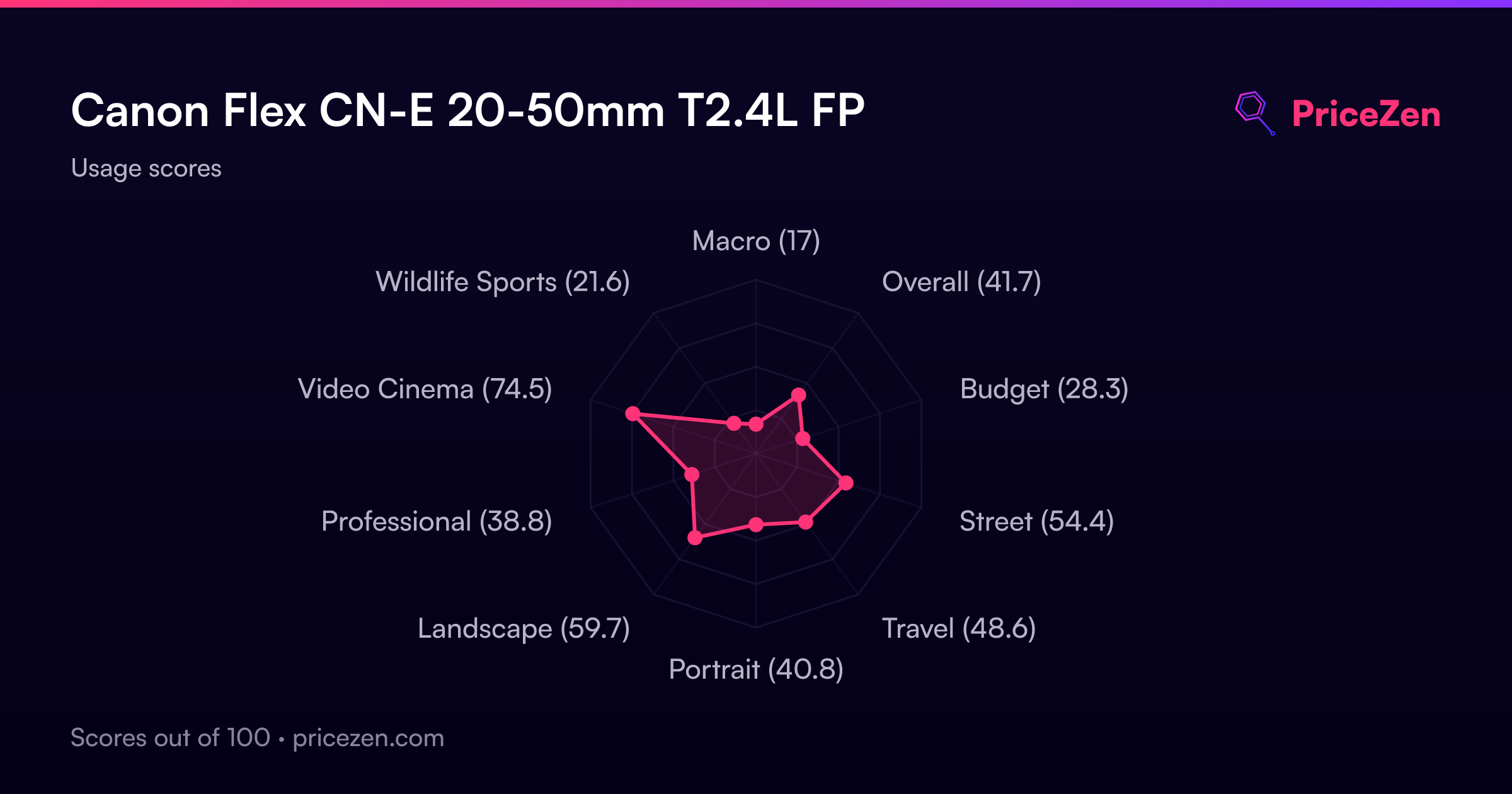
Usage Scores
- Macro17
- Overall41.7
- Budget28.1
- Street54.4
- Travel48.6
- Portrait40.8
- Landscape59.7
- Professional38.8
- Video Cinema74.5
- Wildlife Sports21.6