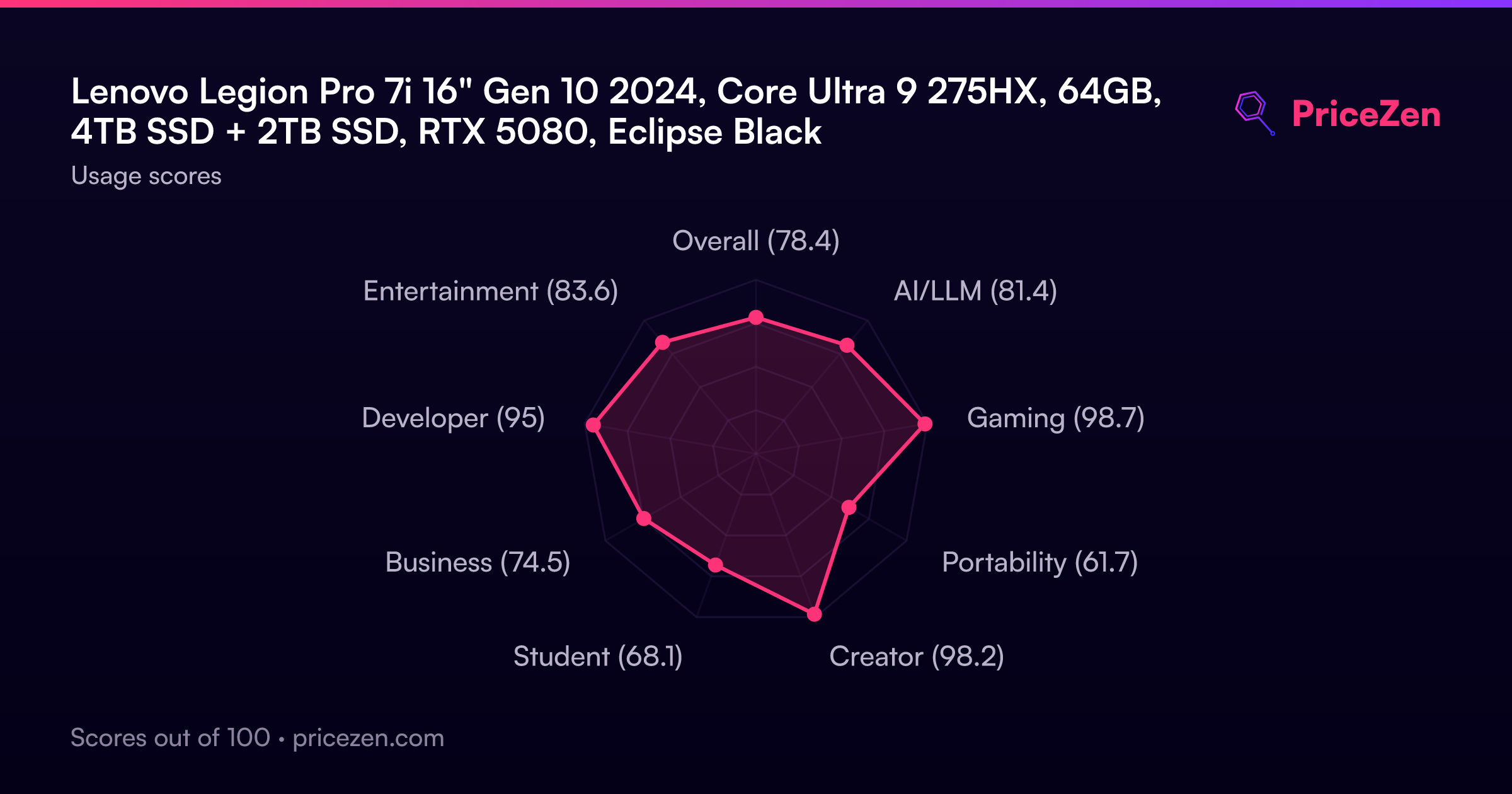
Lenovo Legion Pro 7i 16" Gen 10 2024, Core Ultra 9 275HX, 64GB, 4TB SSD + 2TB SSD, RTX 5080, Eclipse Black
The Intel Core Ultra 9 275HX and NVIDIA GeForce RTX 5080 deliver desktop-class gaming performance in a 1.84kg chassis. The 16-inch 2560x1600 OLED panel at 240Hz and 500 nits offers vibrant colors with 100% DCI-P3 coverage, while 64GB DDR5 and 6TB of NVMe storage handle heavy workloads. Best for gamers and content creators who need a portable yet powerful machine for AAA titles and 4K video editing.

No current retailer price
Snapshot
The 30-Second Version
The Lenovo Legion Pro 7i Gen 10 is a top-tier gaming laptop with a 97th percentile CPU and GPU, 64GB of RAM, and 6TB of storage. The 16-inch OLED display with 240Hz refresh rate is one of the best screens we've seen. Prices range from USD 4,299 to USD 5,599, so shop around for the best deal. If you want maximum gaming performance in a laptop and don't mind the weight or the price, this is a fantastic choice.
Pros & Cons
Pros
- Top-tier CPU and GPU performance, both in the 97th percentile 100th
- 64GB of DDR5 RAM, more than most desktops 99th
- 6TB of total NVMe storage across two drives 99th
- Gorgeous 16-inch OLED display with 240Hz refresh rate 98th
- Excellent port selection including Thunderbolt 5 and four USB-A ports
Cons
- Extremely expensive, 2nd percentile for affordability
- Heavy at 1.84kg, not great for travel
- 8GB of VRAM may limit future games at max settings
- Only 3 customer reviews so far, limited real-world feedback
- Battery life likely suffers with this much power under the hood
What owners think
The Word on the Street
How owner sentiment changed over time
ExclusiveBased on when customers actually wrote their reviews - so you can see whether early praise held up.
1 written review, Feb 2026: 1 happy
Across all 3 store ratings: 5.0★. Most owners rate without writing a review. The chart counts the 1 written review.
Each dot is one written review, in the month it was written. Happy = 4-5★, mixed = 3★, unhappy = 1-2★.
The proof
Performance
The Core Ultra 9 275HX sits in the 97th percentile for CPUs in our database, which means it's one of the best laptop processors you can buy right now. With 16 cores split across performance, efficiency, and low-power efficiency clusters, it handles multitasking like it's nothing. You can run a game, stream it, and have a dozen browser tabs open without the fans sounding like a jet engine. The 64GB of DDR5 is also in the 99th percentile, so memory is never going to be your bottleneck.
The RTX 5080 lands in the 97th percentile for GPUs, and that translates to real-world gaming performance that's hard to beat. At 2560x1600, you'll push high frame rates in demanding titles, and the 240Hz OLED display actually lets you see those frames. The 8GB of VRAM is adequate for most current games, though it's worth noting that some newer titles at max settings are starting to push past that. For creators, the GPU handles rendering and AI workloads without breaking a sweat. The dual SSD setup with 6TB total storage is in the 99th percentile, so load times are fast and you won't be uninstalling games to make room for new ones.
Specifications
Full Specifications
Processor
| CPU | Intel Core Ultra 9 275HX |
| Cores | 24 |
| Frequency | 4.6 GHz |
| L3 Cache | 36 MB |
Graphics
| GPU | NVIDIA GeForce RTX 5080 |
| Type | Discrete |
| VRAM | 16 GB |
| VRAM Type | GDDR7 |
Memory & Storage
| RAM | 64 GB |
| RAM Generation | DDR5 |
| Storage 1 | 4 TB |
| Storage 1 Type | NVMe SSD |
| Storage 2 | 2 TB |
| Storage 2 Type | NVMe SSD |
Display
| Size | 16" |
| Resolution | 2560x1600 (QHD) |
| Panel | OLED |
| Refresh Rate | 240 Hz |
| Brightness | 500 nits |
| Color Gamut | 100% DCI-P3 |
Connectivity
| USB-C Ports | 2 |
| USB Ports | 4 |
| Thunderbolt | Thunderbolt 5 x 2, Thunderbolt 4 |
| HDMI | HDMI 2.1 |
| Wi-Fi | Wi-Fi 7 |
| Bluetooth | BT5.4 |
| Ethernet | Gigabit Ethernet |
Physical
| Weight | 1.8 kg / 4.1 lbs |
| Battery | 80 Wh |
| OS | Windows 11 Home |
vs Competition
The Apple MacBook Pro M4 Max is the obvious alternative for creators who don't need Windows. It's got better battery life, a more polished operating system, and Apple's silicon is incredibly efficient. But it can't match the Legion's gaming performance, and the port selection is more limited. If you're a gamer first and a creator second, the Legion is the better choice. If you're a creator who occasionally games, the MacBook might win you over.
The ASUS ROG Zephyrus GA403WW is a smaller, more portable option with a 14-inch display. It's easier to carry around, but you give up screen real estate and some performance. The MSI Raider is a more direct competitor, with similar specs and a similar price tag. The HP OMEN Transcend 14 is another compact option that trades performance for portability. And the Dell Premium is a wildcard with different strengths. The Legion's standout feature is that OLED display combined with the 240Hz refresh rate. Most competitors either have OLED at lower refresh rates or high refresh rates on IPS panels. Getting both in one package is rare.
| Spec | Lenovo Legion Pro 7i 16" Gen 10 | Apple MacBook Pro 14.2" M4 Max | ASUS ROG Zephyrus 14" GA403WW-G14.R95080 | HP OMEN Transcend | Samsung Galaxy Book5 Pro 14" NP944XHA-KG3US | Dell Premium 14.5" LDA14250-7667SLV-PUS |
|---|---|---|---|---|---|---|
| CPU | Intel Core Ultra 9 275HX | Apple M4 Max | AMD Ryzen AI 9 HX 370 | Intel Core Ultra 9 285H | Intel Core Ultra 7 258V | Intel Core Ultra 7 255H |
| RAM (GB) | 64 | 64 | 32 | 32 | 32 | 32 |
| Storage (GB) | 4096 | 4096 | 2048 | 1024 | 1024 | 1024 |
| Screen | 16" 2560x1600 | 14.2" 3024x1964 | 14" 2880x1800 | 14" 2880x1800 | 14" 2880x1800 | 14.5" 3200x2000 |
| GPU | NVIDIA GeForce RTX 5080 | Apple (40-Core) | NVIDIA GeForce RTX 5080 | NVIDIA GeForce RTX 5070 | Intel Arc Graphics 140V | Intel Arc Graphics |
| OS | Windows 11 Home | macOS | Windows 11 Home | Windows 11 Home | Windows 11 Pro | Windows 11 Home |
| Weight (kg) | 1.8 | 1.6 | 1.6 | 1.6 | 1.2 | 1.7 |
| Battery (Wh) | 80 | 72 | - | 71 | 63 | 62 |
| Compare | Compare | Compare | Compare | Compare |
| Product | CPU | GPU | RAM | Ports | Screen | Portability | Storage | Reliability | Social Proof | Affordability |
|---|---|---|---|---|---|---|---|---|---|---|
| Lenovo Legion Pro 7i 16" Gen 10 | 97.2 | 98.3 | 98.6 | 99.8 | 95.6 | 25.1 | 99.3 | 82.1 | 54.8 | 2.4 |
| Apple MacBook Pro 14.2" M4 Max Compare | 93.7 | 91.6 | 95.7 | 73.2 | 99.3 | 68.9 | 98.5 | 98.3 | 73.3 | 1.7 |
| ASUS ROG Zephyrus 14" GA403WW-G14.R95080 Compare | 91.2 | 98.3 | 90.9 | 89.2 | 96.5 | 73.6 | 89.7 | 60.6 | 96.5 | 5.7 |
| HP OMEN Transcend Compare | 90.1 | 93.6 | 89.7 | 89.2 | 96.5 | 72.3 | 65.1 | 33.6 | 94.1 | 8.3 |
| Samsung Galaxy Book5 Pro 14" NP944XHA-KG3US Compare | 65.7 | 69.6 | 79.4 | 83.1 | 91.5 | 89.5 | 79.2 | 82.1 | 96.5 | 20.1 |
| Dell Premium 14.5" LDA14250-7667SLV-PUS Compare | 87 | 69.6 | 89 | 65.9 | 97.2 | 61.2 | 65.1 | 33.6 | 96.5 | 14 |
Price
Value & Pricing
Let's talk about the elephant in the room. This laptop costs between USD 4,299 and USD 5,599 depending on where you buy it. That's a spread of USD 1,300 across just three listings, which is wild. The best deal we found is at the lower end of that range, so it pays to shop around before you commit. At USD 4,299, you're getting a lot of hardware for the money, but at USD 5,599, you're paying a premium for the same specs.
Compared to the competition, the Legion Pro 7i Gen 10 is priced similarly to other high-end gaming laptops with RTX 5080 GPUs. The Apple MacBook Pro M4 Max costs more for comparable performance in creative workloads, but it has better battery life and a more refined build. The ASUS ROG Zephyrus and MSI Raider offer similar specs at slightly different price points. The Legion's value proposition is strongest if you can find it at the lower end of that price range. At the higher end, you're paying for the Lenovo name and the OLED display, which is genuinely excellent but not cheap.
Read more
Overview
Lenovo's Legion Pro 7i Gen 10 is the kind of laptop that makes you double-check the spec sheet because it seems almost too loaded. You're getting an Intel Core Ultra 9 275HX with 16 cores, 64GB of DDR5, a 4TB SSD plus a 2TB SSD, and an RTX 5080 with 8GB of VRAM. That's a desktop replacement pretending to be a laptop, and honestly, it's not pretending very hard. The 16-inch OLED panel runs at 2560x1600 with a 240Hz refresh rate and 500 nits of brightness, which puts it near the top of our screen rankings.
Who is this for? Gamers who want maxed-out settings without compromise, creators who need serious GPU muscle for rendering or video work, and developers who'll actually use all 64GB of RAM. It's not for someone who just wants to browse the web and check email. This is a machine built for heavy lifting, and the price tag reflects that. Our database puts it in the 2nd percentile for affordability, which is a polite way of saying it costs a lot.
The interesting wrinkle here is the mix of components. The RTX 5080 with 8GB of VRAM is a strong GPU, but the spec sheet also mentions configurations with an RTX 5090 and RTX 5070. The version we're looking at splits the difference. You get excellent gaming performance without stepping all the way up to the most expensive option. And with Thunderbolt 5, Wi-Fi 7, and a port selection that includes four USB-A ports, this thing is built to connect to everything.
Common Questions
Q: Is the RTX 5080 with 8GB of VRAM enough for modern games?
For most current games at 2560x1600, 8GB of VRAM is sufficient. You'll be able to run demanding titles at high settings with good frame rates. However, some newer games at maximum settings are starting to exceed 8GB of VRAM usage, so you may need to dial back texture quality in a few titles. If you're worried about future-proofing, the RTX 5090 configuration with more VRAM might be worth the extra cost.
Q: How does the battery life hold up with this much power?
The 80Wh battery is decent for a gaming laptop, but with a 16-core CPU and RTX 5080 GPU, you shouldn't expect all-day battery life. For gaming, you'll want to keep it plugged in to get full performance. For lighter tasks like web browsing or document editing, you can expect several hours of use, but this is not a laptop designed for all-day unplugged productivity.
Q: Can I upgrade the RAM and storage later?
The RAM uses LPCAMM2 modules, which are upgradable up to 64GB. The storage has two M.2 2280 slots that support PCIe 5.0 drives, with up to 8TB total capacity. The current configuration already maxes out the RAM at 64GB and includes 6TB of storage, so you likely won't need to upgrade anything for a while.
Q: Is the OLED display good for creative work?
Yes, the 16-inch OLED panel with 100% DCI-P3 coverage and 500 nits of brightness is excellent for color-critical work. The 2560x1600 resolution provides sharp text and detailed images. The 240Hz refresh rate is a bonus for gaming and smooth scrolling. For photo and video editing, this display is one of the best you'll find on a gaming laptop.
Who Should Skip This
If you travel frequently or need something light, this is not your laptop. At 1.84kg, it's in the 25th percentile for compactness, which means it's heavier than most laptops in our database. You'll feel it in your bag, and the power brick adds even more weight. Look at the ASUS ROG Zephyrus or HP OMEN Transcend 14 if portability matters more than raw performance.
Budget-conscious buyers should also steer clear. The 2nd percentile affordability ranking tells you everything you need to know. If you don't need the absolute best performance, you can get a laptop with an RTX 4070 or 4060 for significantly less money and still play most games at high settings. The Legion Pro 7i Gen 10 is for people who want the best and are willing to pay for it.
Verdict
If you're a serious gamer who wants a laptop that can handle anything you throw at it, the Legion Pro 7i Gen 10 is one of the best options on the market. The combination of a 97th percentile CPU, 97th percentile GPU, and that stunning OLED display makes it a top-tier gaming machine. You'll be able to play current titles at high settings with smooth frame rates, and the 240Hz refresh rate means competitive gamers will appreciate the responsiveness.
For creators and developers, this laptop is also a strong choice. The 64GB of RAM and 6TB of storage mean you can work with large files and complex projects without worrying about running out of resources. The 4K display option mentioned in the specs is interesting, though the 2560x1600 OLED panel on this model is already excellent. If you need a portable workstation that can also game, this is a solid pick. Just be prepared to pay for it.
Usage Scores
- Overall78.4
- AI/LLM81.4
- Gaming98.7
- Portability61.7
- Creator98.2
- Student68.1
- Business74.5
- Developer95
- Entertainment83.6