ASUS Zenbook S 16 OLED UM5606WA 2024, Ryzen AI 9 365, 24GB, 1TB SSD, White
The AMD Ryzen AI 9 365 10-core processor with Radeon 880M graphics powers a 16-inch 3K OLED 120Hz touchscreen, delivering smooth visuals for productivity and media. The 24GB LPDDR5X RAM and 1TB PCIe 4.0 SSD ensure fast multitasking and quick load times, while the 78Wh battery supports all-day use. Best for developers and students who need a lightweight, high-resolution display for coding and entertainment, though gaming performance is limited.

No current retailer price
Snapshot
The 30-Second Version
A top-tier 16-inch 120Hz OLED paired with a 7th-percentile GPU. The Zenbook S 16 is a fantastic screen with a strong ten-core Ryzen attached and integrated Radeon 880M graphics that score 14.7/100 for gaming. At USD 1,649 it's a creator and coder's laptop miscast as a gaming machine.
Pros & Cons
Pros
- 16-inch 2880x1800 120Hz OLED touch panel with 100% DCI-P3, one of the best screens on the market 94th
- Ryzen AI 9 365 with 10 cores and 20 threads up to 5.0GHz, a standout CPU in this category 86th
- 1TB PCIe 4.0 x4 NVMe SSD, well above average for storage speed 79th
- 1.50kg with a 78Wh battery, genuinely portable for a 16-incher
- Owners like the port mix: 2x USB4 with display and power delivery plus HDMI 2.1
Cons
- Radeon 880M integrated graphics rank near the bottom of the field, gaming scores just 14.7/100
- 24GB of RAM is soldered, no upgrades ever, and owners complain about it
- USD 1,649 puts affordability in the bottom quarter of this category
- Owner sentiment ranks below average despite a 4.2/5 rating, with battery drain under load a recurring gripe
- Port and compactness scores sit around the middle of the pack at 46 and 42
What owners think
The Word on the Street
How owner sentiment changed over time
ExclusiveBased on when customers actually wrote their reviews - so you can see whether early praise held up.
The proof
Performance
The CPU is the engine here, and it's a good one: 86th percentile in our rankings, one of the stronger processors in this field. Ten cores, twenty threads, 2.0GHz base and 5.0GHz turbo with 34MB of smart cache means compiling, container work and heavy browser-tab hoarding are all comfortably within scope. Our developer score of 63.2/100 is the highest of its use-case ratings, which tracks. Storage helps too: the 1TB PCIe 4.0 x4 NVMe SSD ranks well above average, so boots and project loads shouldn't be your bottleneck. The 24GB of LPDDR5X is more middling, solid rather than generous, and it's soldered, so 24GB is what you live with forever.
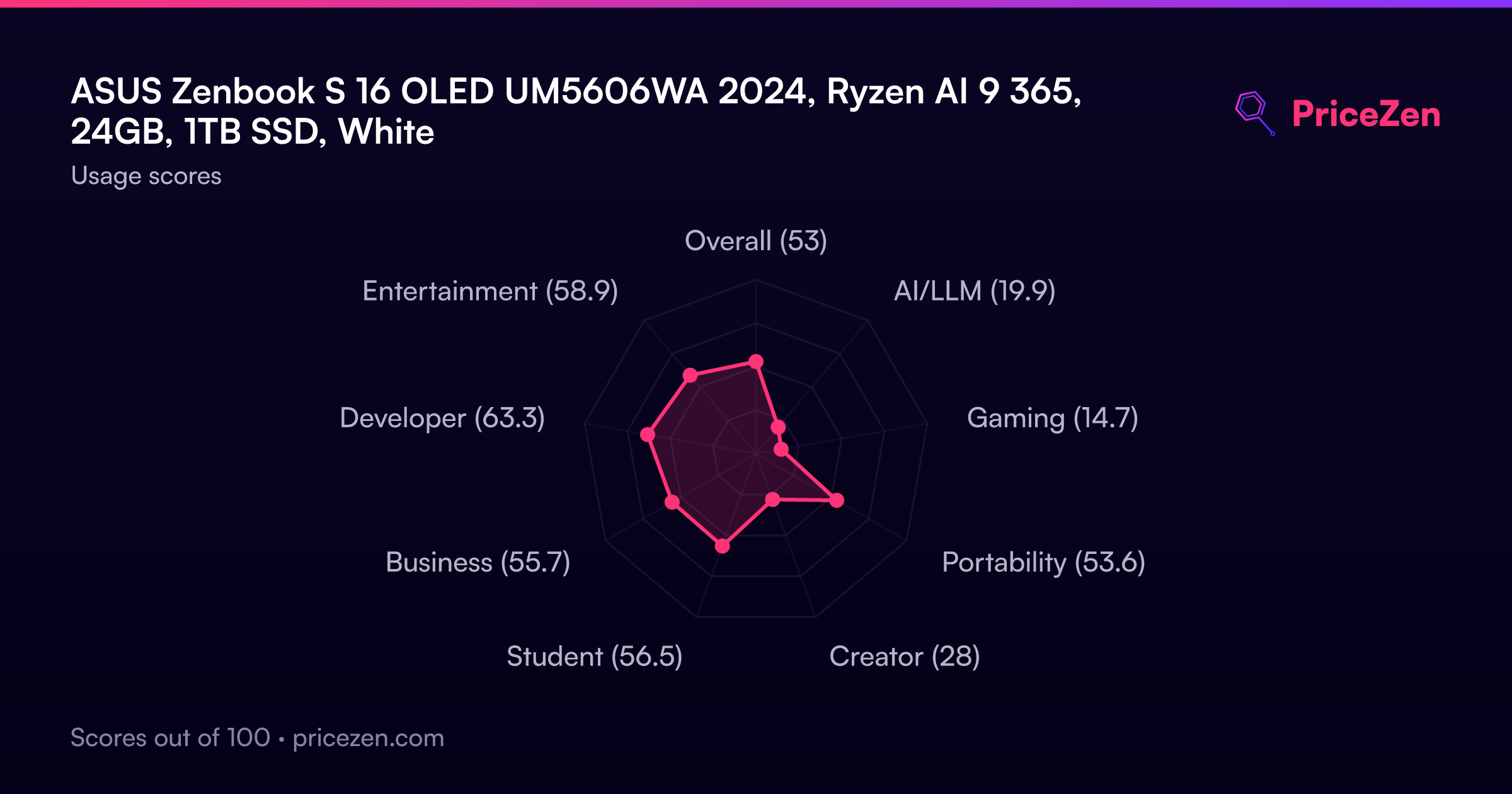
Graphics is where the spreadsheet turns red. The Radeon 880M is integrated, sharing memory with the CPU, and it lands at the 7th percentile, one of the weakest GPU results we've seen in this category. Entertainment scores 58.9/100 and student use 58/100, both fine, but gaming's 14.7/100 is a flat no. One thing worth flagging: this HIDevolution configuration adds Thermal Grizzly Conductonaut on the CPU and Gelid GC Extreme on the GPU, which is a genuine effort at thermals, but paste doesn't turn an iGPU into a discrete card. And a correction to something floating around the Q&A: the 880M is not a dedicated graphics card. It's built into the Ryzen chip. Ports are a bright spot in daily use, with 2x USB4 Type-C carrying display and power delivery, 1x USB 3.2 Gen 2 Type-A, HDMI 2.1 and Wi-Fi 7, even if our port score of 46 is only about average for the class.
Specifications
Full Specifications
Processor
| CPU | AMD Ryzen AI 9 365 |
| Cores | 10 |
| Frequency | 2.0 GHz |
| L3 Cache | 16 MB |
Graphics
| GPU | AMD Radeon 880M |
| Type | Integrated |
| VRAM Type | System Shared |
Memory & Storage
| RAM | 24 GB |
| RAM Generation | LPDDR5X |
| Storage | 1 TB |
| Storage Type | NVMe SSD |
Display
| Size | 16" |
| Resolution | 2880x1800 |
| Panel | OLED |
| Refresh Rate | 120 Hz |
| Color Gamut | DCI-P3:100% |
Connectivity
| USB-C Ports | 2 |
| USB Ports | 1 |
| HDMI | HDMI 2.1 |
| Wi-Fi | Wi-Fi 7 |
| Bluetooth | Bluetooth 5.4 |
Physical
| Weight | 1.5 kg / 3.3 lbs |
| Battery | 78 Wh |
| OS | Windows 11 Home |
vs Competition
Against the Apple MacBook Pro 14.2" M4 Pro, the Zenbook's argument is its top-tier 16-inch 120Hz OLED touch panel and its strong ten-core Ryzen, wrapped in 1.50kg. Cross-shop it if you want Windows 11 Home, touch input and HDMI 2.1 without a dongle. The Lenovo Legion Pro 7i Gen 10 16" and HP OMEN Transcend 14-fb1023dx are the ones to look at if gaming actually matters to you, because our GPU ranking for this ASUS sits at the 7th percentile and its gaming score is 14.7/100, and no amount of Conductonaut fixes that. The Samsung Galaxy Book5 Pro 14" and Dell Premium 14.5" are the closer rivals for thin-and-light work, and here the Zenbook counters with 24GB of LPDDR5X, a well-above-average 1TB PCIe 4.0 SSD and a 78Wh battery. Its own weak spots in that fight are price in the bottom quarter and owner sentiment below average, so it wins on panel and processor, not on value or goodwill.
| Spec | ASUS Zenbook S 16 OLED UM5606WA | Apple MacBook Pro 14.2" M4 Max | Lenovo Legion Pro 7i Gen 10 16" | HP OMEN Transcend | Samsung Galaxy Book5 Pro 14" NP944XHA-KG3US | Dell Premium 14.5" LDA14250-7667SLV-PUS |
|---|---|---|---|---|---|---|
| CPU | AMD Ryzen AI 9 365 | Apple M4 Max | Intel Core Ultra 9 275HX | Intel Core Ultra 9 285H | Intel Core Ultra 7 258V | Intel Core Ultra 7 255H |
| RAM (GB) | 24 | 64 | 32 | 32 | 32 | 32 |
| Storage (GB) | 1024 | 4096 | 1024 | 1024 | 1024 | 1024 |
| Screen | 16" 2880x1800 | 14.2" 3024x1964 | 16" 2560x1600 | 14" 2880x1800 | 14" 2880x1800 | 14.5" 3200x2000 |
| GPU | AMD Radeon 880M | Apple (40-Core) | NVIDIA GeForce RTX 5070 Ti | NVIDIA GeForce RTX 5070 | Intel Arc Graphics 140V | Intel Arc Graphics |
| OS | Windows 11 Home | macOS | Windows 11 Home | Windows 11 Home | Windows 11 Pro | Windows 11 Home |
| Weight (kg) | 1.5 | 1.6 | 2.7 | 1.6 | 1.2 | 1.7 |
| Battery (Wh) | 78 | 72 | 99 | 71 | 63 | 62 |
| Compare | Compare | Compare | Compare | Compare |
| Product | CPU | GPU | RAM | Ports | Screen | Portability | Storage | User Sentiment | Reliability | Affordability |
|---|---|---|---|---|---|---|---|---|---|---|
| ASUS Zenbook S 16 OLED UM5606WA | 86.2 | 6.5 | 64.9 | 45.6 | 94.1 | 42.2 | 79.2 | 37.7 | 60.6 | 23.9 |
| Apple MacBook Pro 14.2" M4 Max Compare | 93.7 | 91.5 | 95.6 | 73.9 | 99.1 | 68.8 | 98.4 | 99 | 98.2 | 1.8 |
| Lenovo Legion Pro 7i Gen 10 16" Compare | 97.2 | 96.7 | 89 | 97.3 | 95 | 9.5 | 79.2 | 90.9 | 81.9 | 5.8 |
| HP OMEN Transcend Compare | 90.1 | 93.5 | 89.6 | 89.4 | 96 | 72.3 | 65.2 | 81.3 | 33.6 | 8.9 |
| Samsung Galaxy Book5 Pro 14" NP944XHA-KG3US Compare | 65.8 | 69.6 | 79.4 | 83.4 | 90.4 | 89.5 | 79.2 | 0 | 81.9 | 21 |
| Dell Premium 14.5" LDA14250-7667SLV-PUS Compare | 87 | 69.6 | 89 | 66.7 | 96.8 | 61.2 | 65.2 | 90.9 | 33.6 | 14.6 |
Price
Value & Pricing
USD 1,649 at Newegg is the only listing we're tracking right now, so there's no store-to-store arbitrage to chase here. What that buys is a top-tier OLED touch panel, a leading CPU, 24GB of fast memory and a 1TB PCIe 4.0 drive in a 1.50kg body, plus HIDevolution's thermal paste upgrade and a 1-year warranty. Against the rest of the category, though, our affordability ranking puts it in the bottom quarter, a weak spot. If your work is code, documents and media, the screen and CPU justify a chunk of that. If any part of your plan involves gaming, you're paying a premium for hardware that scores 14.7/100 at the thing you bought it for.
Read more
Overview
94th percentile for screen, 7th for graphics. That's the ASUS Zenbook S 16 OLED in two numbers, and honestly it tells you most of what you need to know. The panel is a 16-inch 2880x1800 OLED running at 120Hz with 100% DCI-P3 coverage and touch input, which puts it among the best displays we track in this category. Behind it sits a Ryzen AI 9 365 with 10 cores and 20 threads, boosting to 5.0GHz with 34MB of cache, plus 24GB of LPDDR5X and a 1TB PCIe 4.0 x4 NVMe drive. All of that in a 1.50kg chassis with a 78Wh battery.
Here's the wrinkle: our system files this under gaming laptops, and the Radeon 880M is integrated graphics scoring 14.7/100 for gaming. This is a gorgeous productivity machine wearing a badge it didn't earn. Owners give it 4.2/5 across 16 reviews, but our sentiment ranking is below average, so the enthusiasm isn't universal. At USD 1,649 from Newegg, affordability is in the bottom quarter. You're paying for the screen and the CPU, not for frames per second.
Common Questions
Q: Can it actually game?
Not seriously. The Radeon 880M is integrated graphics built into the Ryzen AI 9 365, and it ranks at the 7th percentile in our GPU standings, one of the weakest results in this category. Our gaming score for this machine is 14.7/100. Light or older titles are the ceiling; anything demanding needs a different laptop.
Q: Is 24GB of RAM enough, and can I add more later?
You can't add more. The 24GB of LPDDR5X is soldered to the board, which owners flag as a real annoyance. In our rankings that capacity is solid, above average, good for development work, IDEs and heavy multitasking, but if you routinely run large VMs or huge datasets, buy the capacity you'll need up front.
Q: What can I plug into it?
Two USB4 Type-C ports that carry display output and power delivery, one USB 3.2 Gen 2 Type-A, HDMI 2.1 and Wi-Fi 7. That covers an external monitor and legacy peripherals without adapters, and it's the feature owners praise most, even though our overall port score of 46 is only about average for the class.
Who Should Skip This
Gamers, first and foremost. A 14.7/100 gaming score and a 7th-percentile GPU ranking mean this is the wrong tool, full stop, and the Legion Pro 7i Gen 10 or OMEN Transcend 14 exist for exactly that job. Skip it too if you upgrade RAM as a habit, since 24GB is soldered and permanent. Budget-focused buyers should look elsewhere given the bottom-quarter affordability ranking at USD 1,649. And if you need long unplugged sessions under heavy load, note that battery drain during graphics-heavy work is the gripe owners raise most, despite the 78Wh cell.
Verdict
Buy it for the screen and the silicon, not the badge. A top-tier OLED, a strong CPU and a well-above-average SSD add up to a genuinely strong machine for developers and students who mostly write, read and watch, and the 63.2/100 developer score is the best of its use-case ratings. But we can't ignore that owner sentiment ranks below average even with a 4.2/5 average from 16 reviews, that the RAM is soldered at 24GB, and that USD 1,649 lands in the bottom quarter for affordability. Our recommendation: shortlist it if display quality is your top priority and gaming isn't on the list at all. Otherwise the Legion or the OMEN are the smarter spend.
Usage Scores
- Overall53
- AI/LLM19.9
- Gaming14.7
- Portability53.6
- Creator28
- Student56.5
- Business55.7
- Developer63.3
- Entertainment58.9