PNY GeForce RTX 5060 Ti EPIC-X 16GB GDDR7 Black
The Blackwell architecture and 16GB of GDDR7 memory on a 128-bit bus stand out for handling high-resolution textures, while DLSS 4 and a 2692 MHz boost clock push frame rates at 1080p and 1440p. Its 85W TDP and triple-fan cooler deliver efficient thermal performance in a compact 2-slot design, with RGB lighting adding visual flair. This card is best for 1080p and 1440p gamers who want 16GB of VRAM for texture-heavy titles without a high power draw.

No current retailer price


Snapshot
The 30-Second Version
The PNY GeForce RTX 5060 Ti EPIC-X RGB OC is a 16GB GDDR7 graphics card that pairs mid-pack gaming performance with standout efficiency at 180W. At USD 850 it's a smart pick for 1080p and 1440p builds with modest power supplies, less so for 4K or workstation work.
Pros & Cons
Pros
- 16GB of GDDR7, well above average VRAM for this tier 86th
- 180W TDP and a single 8-pin connector, one of the most efficient cards around 83rd
- Three DisplayPort 2.1b ports plus HDMI 2.1b 81st
- Two-slot design despite the triple-fan cooler 72nd
- PCIe 5.0 x8 and DLSS 5 support
Cons
- Raster and ray tracing performance sit only mid-pack
- Affordability ranks below average at USD 850
- Workstation score of 58.2/100 is its weakest area
- 128-bit memory bus limits headroom at higher resolutions
- 299mm length won't fit every compact case
The proof
Performance
The PassMark G3D benchmark score is 22099, which puts raw raster throughput right around the middle of the pack for graphics cards in our data. Translation: this thing is quick at 1080p and perfectly happy at 1440p, but it isn't going to muscle through 4K with everything maxed. Ray tracing ranks about the same, dead average, so heavy RT titles will lean on DLSS 5 upscaling rather than brute force. Compute sits at 19.18 FP32 TFLOPS and lands exactly mid-pack too, which lines up with that soft 58.2/100 workstation score.
Where it punches above its weight is memory and efficiency. 16GB of GDDR7 is well above average for this class, and 448 GB/s of bandwidth means texture-heavy games and modded installs have room to breathe. The 180W TDP is one of the best figures on the market for a card at this performance level, and a single 8-pin connector means you're not rewiring your case. Thermals rank solid rather than spectacular, so the triple-fan setup does its job without setting records. AI capability comes in at 68/100, decent for local tinkering thanks to that VRAM, but the 120 Tensor cores aren't a substitute for a bigger GPU.
Specifications
Full Specifications
Chipset
| GPU Chipset | GeForce RTX 5060 Ti |
| Brand | NVIDIA |
| Architecture | Blackwell |
| Class | consumer |
| Process | 5 |
Memory
| VRAM | 16 GB |
| Memory Type | GDDR7 |
| Memory Bus | 128 |
| Bandwidth | 448 |
| ECC | No |
Compute
| CUDA Cores | 4608 |
| Tensor Cores | 120 |
| RT Cores | 30 |
| Base Clock | 2407 |
| Boost Clock | 2692 |
| FP16 TFLOPS | 19.18 |
| FP32 TFLOPS | 19.18 |
Performance
| PassMark G3D | 22099 |
| GPU Compute | 10484 |
Power & Cooling
| TDP | 180 |
| Recommended PSU | 600 |
| Power Connectors | 1 x 8-pin |
| Cooler | Triple Fan |
| Fans | 3 |
Connectivity
| Interface | PCI Express 5.0 x8 |
| DisplayPort | 3 |
| HDMI | 1 |
| Max Displays | 4 |
| Max Resolution | 8K (4320p) |
Physical
| Length | 299 |
| Slot Width | 2 |
| Form Factor | Full Height |
| Weight | 0.9 kg / 2.0 lbs |
Features
| Ray Tracing | Yes |
| Upscaling | DLSS 5 |
| DirectX | 12 |
| RGB | Yes |
vs Competition
Against the RTX 5070 Ti crowd, specifically the Gigabyte GeForce RTX 5070 Ti Eagle Ice and the MSI GeForce RTX 5070 Ti Ventus 3X OC, the PNY's argument is efficiency and VRAM per dollar rather than outright speed. Its 22099 PassMark G3D score is mid-pack, and its 180W draw with one 8-pin plug is genuinely one of the lowest-stress installs in the category. If you're building in a small case with a modest PSU, that counts for a lot. If you just want the highest frame rate you can afford, those two are where we'd look next.
The ASUS GeForce RTX 5080 PRIME EVO OC and ZOTAC GeForce RTX 5080 APOCALYPSE are a different weight class entirely, and the Sapphire Radeon RX 7900 XTX NITRO+ is the AMD alternative worth a look if you're not tied to DLSS 5. The PNY can't match that tier on raw raster or ray tracing, both of which land about average in our rankings. What it does offer is 16GB of GDDR7, DisplayPort 2.1b outputs and a power budget those cards would envy. Is the RTX 5060 Ti good for 1440p gaming? Yes, with sensible settings. Is it a 4K card? Not really.
| Spec | PNY GeForce RTX 5060 Ti EPIC-X | ASUS GeForce RTX 5090 TUF Gaming | Gigabyte GeForce RTX 5070 Ti Eagle Ice | MSI GeForce RTX 5070 Ti Ventus 3X OC | ZOTAC GeForce RTX 5080 APOCALYPSE | Sapphire Radeon RX 7900 XTX NITRO+ |
|---|---|---|---|---|---|---|
| Chipset | GeForce RTX 5060 Ti | GeForce RTX 5090 | GeForce RTX 5070 Ti | GeForce RTX 5070 Ti | GeForce RTX 5080 | Radeon RX 7900 XTX |
| Vram | 16GB GDDR7 | 32GB GDDR7 | 16GB GDDR7 | 16GB GDDR7 | 16GB GDDR7 | 24GB GDDR6 |
| Boost Clock Mhz | 2692 | 2407 | 2542 | 2482 | 2730 | 2680 |
| Tdp W | 180 | 575 | 300 | 300 | 360 | 339 |
| Memory Bus Bits | 128 | 512 | 256 | 256 | 256 | 384 |
| Ray Tracing | Yes | Yes | Yes | Yes | Yes | Yes |
| GPU Class | consumer | consumer | consumer | consumer | consumer | consumer |
| Compare | Compare | Compare | Compare | Compare |
| Product | AI | Rt | Vram | Raster | Compute | Feature | Thermal | Efficiency | Connectivity | Affordability |
|---|---|---|---|---|---|---|---|---|---|---|
| PNY GeForce RTX 5060 Ti EPIC-X | 68 | 54.4 | 83 | 55.4 | 49.8 | 59.7 | 71.9 | 85.7 | 81.3 | 41.5 |
| ASUS GeForce RTX 5090 TUF Gaming Compare | 97.2 | 90.5 | 97.8 | 98.8 | 97.7 | 95.7 | 71.9 | 23.2 | 99.3 | 2.2 |
| Gigabyte GeForce RTX 5070 Ti Eagle Ice Compare | 79 | 88.7 | 86 | 89 | 87.9 | 95.7 | 91.8 | 71.7 | 94.2 | 22.8 |
| MSI GeForce RTX 5070 Ti Ventus 3X OC Compare | 79 | 92.4 | 86 | 89 | 87.9 | 95.7 | 91.8 | 71.7 | 94.2 | 22.6 |
| ZOTAC GeForce RTX 5080 APOCALYPSE Compare | 85.5 | 97.7 | 89.1 | 94.5 | 93.3 | 95.7 | 91.8 | 56.7 | 94.2 | 23.1 |
| Sapphire Radeon RX 7900 XTX NITRO+ Compare | 95.3 | 96.4 | 92.1 | 83.4 | 95.6 | 95.7 | 91.8 | 51.4 | 98.8 | 13.5 |
Price
Value & Pricing
At USD 850 it's the same price at Amazon, B&H Photo and Best Buy, so there's no clever shopping trick to unlock here. Canada is messier: we track listings from CAD 850 all the way to CAD 1,216, a CAD 366 spread that's worth watching before you click buy. Our affordability ranking is 41st percentile, meaning below average for the category, and that's the honest sticking point. You're paying a premium for 16GB of GDDR7 and excellent efficiency rather than for top-tier frame rates. If your budget stretches further, the Gigabyte GeForce RTX 5070 Ti Eagle Ice and MSI GeForce RTX 5070 Ti Ventus 3X OC are the obvious step-up cross-shops.
Read more
Overview
The PNY GeForce RTX 5060 Ti EPIC-X RGB OC is a mid-range desktop graphics card built on Nvidia's Blackwell architecture, and it's the 16GB version, which matters more than the triple-fan cooler or the RGB. You get 16GB of GDDR7 on a 128-bit bus pushing 448 GB/s, 4608 CUDA cores, and a factory boost clock of 2692 MHz. Right now it sits at USD 850 in the US, with Canadian listings running from CAD 850 to CAD 1,216.
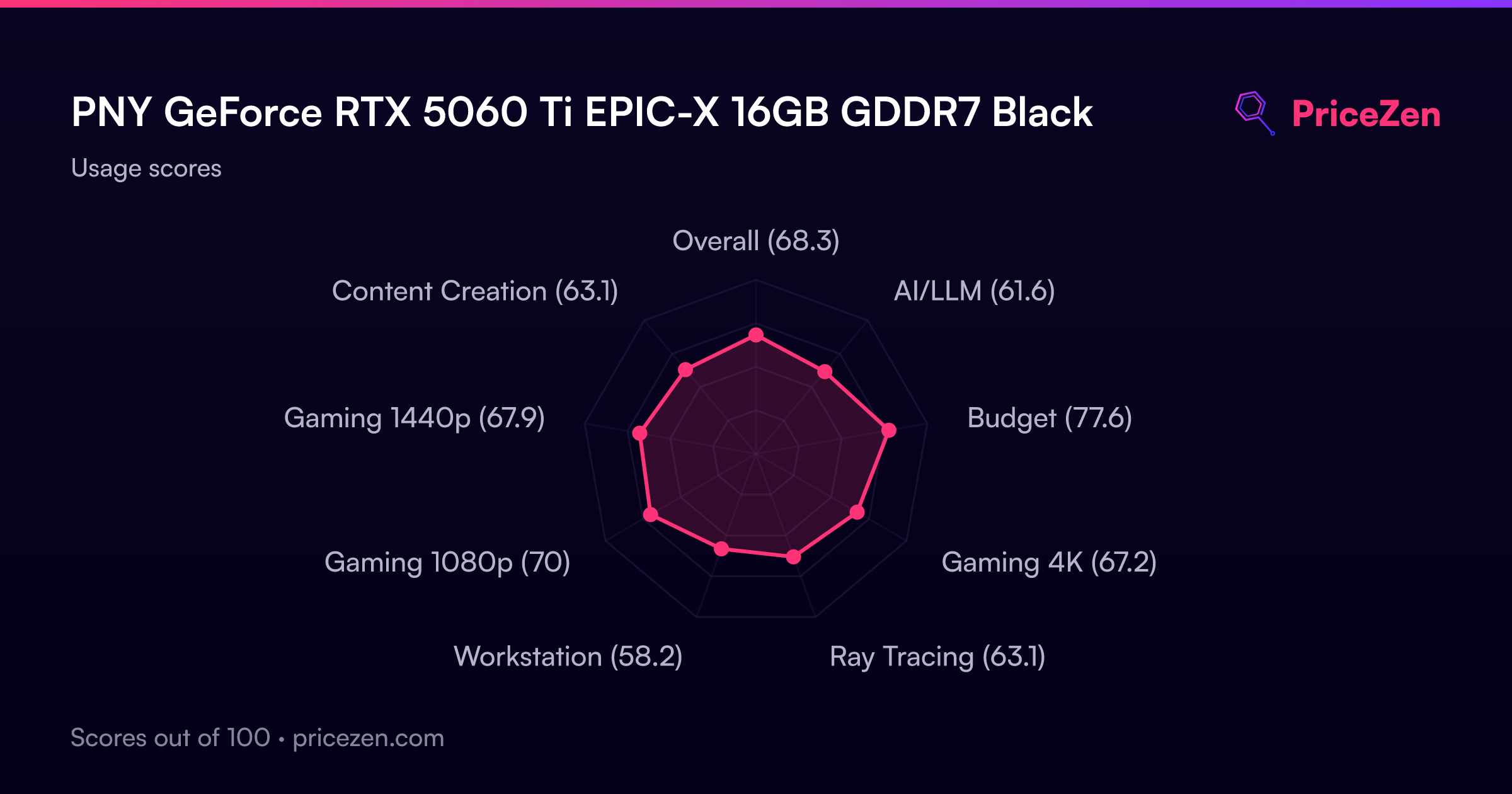
So where does that land it? Our scoring model, which is built from specs and external benchmarks and compares every card against the rest of its category, gives it 70.1/100 for 1080p gaming and 68.3/100 overall. Its best score is budget at 77.5/100, and its weakest is workstation at 58.2/100. That's a card aimed squarely at high-refresh 1080p and comfortable 1440p play, not a compute box.
Physically it's a 299mm, two-slot card with three fans, one 8-pin power connector, a 180W TDP and a 600W recommended PSU. Outputs are three DisplayPort 2.1b plus one HDMI 2.1b, and it uses a PCI Express 5.0 x8 link. Ray tracing and DLSS 5 are both on the menu.
Common Questions
Q: Is the PNY RTX 5060 Ti EPIC-X good for 1440p gaming?
Yes, it handles 1440p comfortably with 16GB of GDDR7 and 448 GB/s of bandwidth behind it. Its raster benchmark ranking is mid-pack, so expect to lean on DLSS 5 in the heaviest titles.
Q: What power supply do I need for the RTX 5060 Ti 16GB EPIC-X?
PNY recommends a 600W PSU, and the card draws 180W through a single 8-pin connector. That's one of the most efficient setups in its class, so most existing builds won't need a new power supply.
Q: Will the PNY RTX 5060 Ti EPIC-X fit in my case?
It's 299mm long and takes up two slots, so measure your clearance before ordering. The triple-fan cooler keeps it to two slots rather than three, which helps in tighter builds.
Q: Is 16GB of VRAM enough for AI and creative work?
16GB is well above average for this tier and gives local AI models room to load, but the card's workstation score of 58.2/100 and mid-pack compute throughput mean it's not a serious rendering or training machine.
Who Should Skip This
If you're targeting 4K, heavy ray tracing or professional rendering, this isn't your card. Its raster and RT rankings sit around average and its workstation score of 58.2/100 is the weakest number on the sheet. Look at the ASUS GeForce RTX 5080 PRIME EVO OC or ZOTAC GeForce RTX 5080 APOCALYPSE instead, or the Sapphire Radeon RX 7900 XTX NITRO+ if you'd rather go AMD. And if you already own a fast card and just want more frames, the Gigabyte GeForce RTX 5070 Ti Eagle Ice is the more logical upgrade path.
Verdict
Buy it if you're a 1080p or 1440p gamer who wants plenty of VRAM, low power draw and an easy install. The 16GB buffer, 180W TDP and single 8-pin connector make it a genuinely painless upgrade, and our budget score of 77.5/100 says the package makes sense even if the sticker price stings a bit.
Skip it if you're chasing maximum frames per dollar. At USD 850 with mid-pack raster performance, the value case rests on efficiency and memory, not speed. Cross-shop the 5070 Ti options before committing.
Usage Scores
- Overall68.3
- AI/LLM61.6
- Budget77.6
- Gaming 4K67.2
- Ray Tracing63.1
- Workstation58.2
- Gaming 1080p70
- Gaming 1440p67.9
- Content Creation63.1