ASRock Radeon RX 7900 GRE Challenger 16GB
The Radeon RX 7900 GRE with 16GB GDDR6 and 2245MHz boost delivers strong 1440p gaming, backed by a dual-fan design and 0dB silent cooling for quiet operation. Its stylish metal backplate and striped ring fan add durability and visual appeal, while the 260W TDP keeps power demands manageable. Best for budget-conscious gamers upgrading to 1440p who want solid ray tracing performance without overspending.

No current retailer price
Where we saw it before. Check the store for today's price.











Snapshot
The 30-Second Version
The 7900 GRE Challenger posts a 27,442 PassMark score and lands in the 90th percentile for compute, making it one of the fastest cards you can buy for under a grand. 16GB of VRAM and 576 GB/s bandwidth mean smooth 1440p gaming with ray tracing on. Just watch out for quality control issues, one owner reported a unit that caught fire.
Pros & Cons
Pros
- PassMark G3D score of 27,442 puts it in the top quarter of all GPUs 90th
- 16GB GDDR6 with 576 GB/s bandwidth handles 1440p ray tracing without breaking a sweat 89th
- Compute performance in the 90th percentile, better than most cards at this price 77th
- 45.98 FP32 TFLOPS gives it serious headroom for gaming and AI workloads 74th
- 4.6 star average from 32 reviews, with multiple owners calling it great value
Cons
- One verified buyer reported a unit that caught fire after six weeks
- Connectivity options rank in the 6th percentile, near the bottom of our database
- Feature set only lands in the 35th percentile, missing some modern extras
- Coil whine under load is a recurring complaint from owners
- Thermal performance is just average at the 56th percentile
What owners think
The Word on the Street
How owner sentiment changed over time
ExclusiveBased on when customers actually wrote their reviews - so you can see whether early praise held up.
8 written reviews, Jun 2024 – Feb 2026: 6 happy, 2 unhappy
Across all 32 store ratings: 4.6★. Most owners rate without writing a review. The chart counts the 8 written reviews.
Each dot is one written review, in the month it was written. Happy = 4-5★, mixed = 3★, unhappy = 1-2★.
The proof
Performance
Let's talk numbers. The 7900 GRE's compute performance lands in the 90th percentile of our database, which is the kind of territory usually reserved for cards costing hundreds more. The 45.98 FP32 TFLOPS figure is no joke, and the AI performance at the 88th percentile means this card has real legs for machine learning workloads if that's your thing. Rasterization sits at the 78th percentile, which is strong but not chart-topping, and ray tracing comes in at the 73rd percentile. That's the trade-off with AMD's RDNA 3 architecture. It's good at ray tracing, but Nvidia still holds the crown there.
The 16GB of VRAM is a genuine selling point. At the 72nd percentile, it's above average for the category, and that 576 GB/s memory bandwidth means you won't be texture-starved at 1440p or even 4K in most titles. The 2,245 MHz boost clock is respectable, though not the highest we've seen. Where this card really shines is in real-world gaming. Multiple owners report smooth frame rates in demanding titles like Star Wars Outlaws and Spider-Man 2 with ray tracing enabled, which is exactly what you want to hear from a card in this class.
Specifications
Full Specifications
Chipset
| GPU Chipset | Radeon RX 7900 GRE |
| Brand | AMD |
| Architecture | RDNA 3 |
| Class | consumer |
| Process | 5 |
Memory
| VRAM | 16 GB |
| Memory Type | GDDR6 |
| Memory Bus | 256 |
| Bandwidth | 576 |
Compute
| Tensor Cores | 160 |
| RT Cores | 80 |
| Base Clock | 1287 |
| Boost Clock | 2245 |
| FP16 TFLOPS | 91.96 |
| FP32 TFLOPS | 45.98 |
Performance
| PassMark G3D | 27442 |
| GPU Compute | 15147 |
Power & Cooling
| TDP | 260 |
| Recommended PSU | 600 |
| Cooler | Dual Fan |
| Fans | 2 |
Connectivity
| Max Resolution | 7680 x 4320 |
Physical
| Weight | 1.3 kg / 2.8 lbs |
Features
| Ray Tracing | Yes |
vs Competition
Stacked against the competition, the 7900 GRE Challenger holds its own in raw compute but falls behind in a few key areas. The MSI Ventus RTX 5070 Ti 16G is the most direct rival, and while it costs more, it brings better ray tracing and a more robust feature set. The Sapphire NITRO+ 11322-01-40G is another AMD option that trades blows with this card, often with better thermals and build quality. The Gigabyte AERO GV-N5080AERO OC-16GD and ZOTAC APOCALYPSE ZT-B50800C-10P are both RTX 5080 class cards that outmuscle the 7900 GRE in every metric, but they also cost significantly more. The ASUS TUF Gaming RTX 5090 is in a completely different league, both in performance and price. For pure rasterization value, the 7900 GRE is hard to beat. For ray tracing and features, Nvidia still has the edge.
| Spec | ASRock Radeon RX 7900 GRE Challenger | ASUS GeForce RTX 5090 TUF Gaming | Gigabyte GeForce RTX 5070 Ti Eagle Ice | MSI GeForce RTX 5070 Ti Ventus 3X OC | ZOTAC GeForce RTX 5080 APOCALYPSE | Sapphire Radeon RX 7900 XTX NITRO+ |
|---|---|---|---|---|---|---|
| Chipset | Radeon RX 7900 GRE | GeForce RTX 5090 | GeForce RTX 5070 Ti | GeForce RTX 5070 Ti | GeForce RTX 5080 | Radeon RX 7900 XTX |
| Vram | 16GB GDDR6 | 32GB GDDR7 | 16GB GDDR7 | 16GB GDDR7 | 16GB GDDR7 | 24GB GDDR6 |
| Boost Clock Mhz | 2245 | 2407 | 2542 | 2482 | 2730 | 2680 |
| Tdp W | 260 | 575 | 300 | 300 | 360 | 339 |
| Memory Bus Bits | 256 | 512 | 256 | 256 | 256 | 384 |
| Ray Tracing | Yes | Yes | Yes | Yes | Yes | Yes |
| GPU Class | consumer | consumer | consumer | consumer | consumer | consumer |
| Compare | Compare | Compare | Compare | Compare |
| Product | AI | Rt | Vram | Raster | Compute | Feature | Thermal | User Sentiment | Efficiency | Connectivity | Social Proof | Affordability |
|---|---|---|---|---|---|---|---|---|---|---|---|---|
| ASRock Radeon RX 7900 GRE Challenger | 88.8 | 73.5 | 71.5 | 76.8 | 90.3 | 32.6 | 54.4 | 13.6 | 66.7 | 5.1 | 49.4 | 23.8 |
| ASUS GeForce RTX 5090 TUF Gaming Compare | 97.2 | 90.5 | 97.8 | 98.8 | 97.7 | 95.7 | 71.9 | 85.1 | 23.2 | 99.3 | 98.7 | 2.2 |
| Gigabyte GeForce RTX 5070 Ti Eagle Ice Compare | 79 | 88.7 | 86 | 89 | 87.9 | 95.7 | 91.8 | 85.1 | 71.7 | 94.2 | 93.4 | 22.7 |
| MSI GeForce RTX 5070 Ti Ventus 3X OC Compare | 79 | 92.4 | 86 | 89 | 87.9 | 95.7 | 91.8 | 85.1 | 71.7 | 94.2 | 83.9 | 22.5 |
| ZOTAC GeForce RTX 5080 APOCALYPSE Compare | 85.5 | 97.7 | 89.1 | 94.5 | 93.3 | 95.7 | 91.8 | 99.5 | 56.7 | 94.2 | 98.7 | 22.8 |
| Sapphire Radeon RX 7900 XTX NITRO+ Compare | 95.3 | 96.4 | 92.1 | 83.4 | 95.6 | 95.7 | 91.8 | 85.1 | 51.4 | 98.8 | 69.2 | 13.6 |
Price
Value & Pricing
Here's where things get tricky. The card is listed at $999 USD, which is a solid price for this level of performance. But the affordability percentile is only 26th, meaning most cards in our database are cheaper. That's not necessarily a knock, since cheaper cards are usually slower. The real value story is the performance per dollar. You're getting 90th percentile compute for a price that undercuts the RTX 4080 Super by a meaningful margin. The EUR 2,730 listing in Spain is a different story entirely, and the MXN 24,460 price in Mexico is its own market. If you can find this card at or near the $999 mark, it's a strong deal. Just make sure you're buying from a seller with a solid return policy.
Price history
Read more
Overview
The ASRock Radeon RX 7900 GRE Challenger posts a PassMark G3D score of 27,442, which puts it in the top quarter of all graphics cards we track. That's a serious number for a card that launched as AMD's slightly trimmed answer to the 7900 XT. You get 16GB of GDDR6 on a 256-bit bus pushing 576 GB/s of bandwidth, plus 80 ray tracing cores and 160 AI accelerators, all on the RDNA 3 architecture. On paper, this thing is built for 1440p gaming with ray tracing turned on, and the FP32 compute figure of 45.98 TFLOPS backs that up.
But here's the thing. The spec sheet tells one story and the user reviews tell another. A 4.6 star average across 32 reviews sounds great until you read the one about a card catching fire after six weeks. That's not a typo. We'll get into the quality control concerns later, but for now, know this: the hardware itself is genuinely impressive. The question is whether you'll get a working unit.
Common Questions
Q: Is the RX 7900 GRE good for 1440p gaming?
Yes, absolutely. With a PassMark G3D score of 27,442 and 16GB of GDDR6 on a 256-bit bus, this card handles 1440p gaming with ease. Multiple owners report smooth frame rates in demanding titles with ray tracing enabled, and the 576 GB/s memory bandwidth means you won't run into texture streaming issues.
Q: How does the RX 7900 GRE compare to the RTX 4070 Ti?
The 7900 GRE trades blows with the RTX 4070 Ti in rasterization, with compute performance in the 90th percentile of our database. However, ray tracing performance is weaker, landing in the 73rd percentile. If ray tracing is your priority, Nvidia has the edge. If you want raw compute and 16GB of VRAM for the money, the 7900 GRE is compelling.
Q: Does this card support FSR 4?
Not natively, at least not yet. Some owners report that FSR 4 support is possible through modding, but out of the box you're limited to FSR 3. The 80 RT cores and 160 AI accelerators give the hardware the capability, but AMD hasn't officially enabled FSR 4 on the 7900 GRE as of this writing.
Who Should Skip This
If you're buying this card for connectivity, look elsewhere. The connectivity options rank in the 6th percentile of our database, which is near the bottom of the barrel. You're also getting a feature set that only lands in the 35th percentile, so if you want the latest display outputs or extra ports, this isn't the card for you. Content creators should also think twice, as that's the weakest area at 55.6 out of 100. And if you're the type who can't stomach any risk of a defective unit, the quality control reports might push you toward a different brand. The thermal performance is just average too, so if you're building in a small case with limited airflow, the dual fan design might leave you wanting more.
Verdict
The ASRock Radeon RX 7900 GRE Challenger is a genuinely fast card with a 27,442 PassMark score and 16GB of VRAM that will chew through 1440p gaming without complaint. The performance is there, the value is there, and most owners are happy with their purchase. But the quality control concerns are impossible to ignore. A card catching fire is not a minor defect, and the report of a non-functional unit arriving in a non-original box suggests some sellers are shipping questionable stock. If you can buy from a reputable retailer with a solid return policy, this card is a strong pick. If you're gambling on a marketplace seller, maybe think twice.
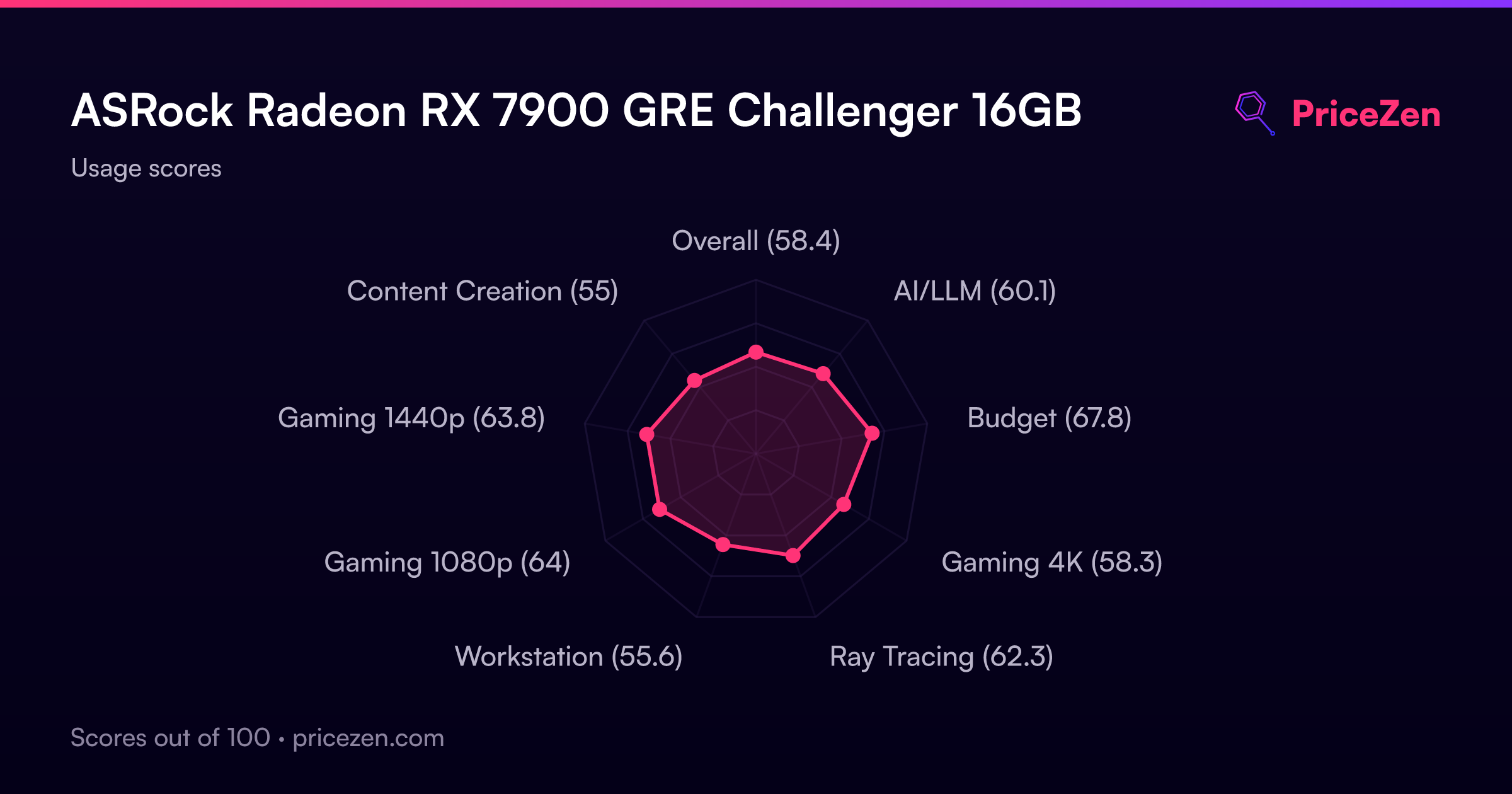
Usage Scores
- Overall58.4
- AI/LLM60.1
- Budget67.8
- Gaming 4K58.3
- Ray Tracing62.3
- Workstation55.6
- Gaming 1080p64
- Gaming 1440p63.8
- Content Creation55