Gigabyte GeForce GTX 1050 Ti 4GB GDDR5

Runs on 75W, no extra power cables needed verified Nov 22
21/100 overall score 4.5 average from 979 owner ratings
- GPU
- GeForce GTX 1050 Ti
- VRAM
- 4GB GDDR5
- Boost clock
- 1316 MHz
- TDP
- 75 W
- Memory bus
- 128 bit
- Class
- consumer
Compare prices at 1 store
Cheapest first. New, refurbished and bundled offers are kept apart, so you compare like with like.
| Store | Sold by | Colour and condition | Price | vs lowest | Last checked | Link |
|---|---|---|---|---|---|---|
| New1 offerSingle unit | ||||||
| Out of stock when last checked | ||||||
| Amazon | Not known | Not listed | No price | Out of stock | Nov 8 | Go to store |
 Source: PriceZen, checked Nov 8, 2026
A price counts as current when we checked it in the last 7 days. “Marketplace seller” means a third-party seller on that store, not the store itself.
Price history
No offers of this kind in this period.
Checked that dayNot checked that day, still on offer
Source: PriceZen, checked Aug 25, 2026










Snapshot
The 30-Second Version
The GTX 1050 Ti pulls a 6366 PassMark score, putting it in the 17th percentile for raster performance, yet owners rate it 4.5 out of 5 stars. It's quiet, easy to install, and sips power at 75W with no extra connector needed. But with 4GB of VRAM in the 14th percentile and compute in the 9th percentile, it's a 2016 card being sold at 2025 prices.
Pros & Cons
Pros
- 75W TDP runs entirely off the PCIe slot, no extra power cable needed 75th
- 4.5/5 customer rating across 979 reviews 71st
- Quiet operation with a single fan, owners consistently mention this
- Easy installation, a recurring highlight in buyer feedback
- Social proof in the 83rd percentile, people genuinely like this card
Cons
- Raster performance in the 17th percentile, PassMark score of 6366
- 4GB VRAM in the 14th percentile, limiting for modern titles
- Compute in the 9th percentile at 2.14 TFLOPS
- AI and LLM score of 7.8 out of 100, essentially unusable for that
- Thermal performance in the 26th percentile with only one fan
What owners think
The Word on the Street
- Multiple owners highlight how easy the card is to install and how quiet it runs, with several mentioning it works great for games like WoW and other lighter titles.
- Buyers appreciate that the 75W TDP means no extra power cable is needed, making it a drop-in upgrade for older systems and office PCs.
- A recurring complaint is that the card is overpriced for its age, with some buyers frustrated that it can't handle newer AAA titles or crypto mining efficiently.
How owner sentiment changed over time
ExclusiveBased on when customers actually wrote their reviews - so you can see whether early praise held up.
8 written reviews, Feb 2018 – Feb 2023: 6 happy, 1 mixed, 1 unhappy
Across all 979 store ratings: 4.5★. Most owners rate without writing a review. The chart counts the 8 written reviews.
Each dot is one written review, in the month it was written. Happy = 4-5★, mixed = 3★, unhappy = 1-2★.
The proof
Performance
Let's be real about the 6366 PassMark score. That's below average for a graphics card in our database, sitting in the 17th percentile for raster performance. For 1080p gaming, the picture is even rougher: a 25.7 out of 100 gaming score. This card was built for esports titles and older games at medium settings, not Cyberpunk or anything demanding. The 4GB of VRAM is also a limiting factor, landing in the 14th percentile. Modern titles want more, and the 112 GB/s bandwidth doesn't help when textures get heavy.
The 768 CUDA cores at 1316MHz boost translate to 2.14 TFLOPS of FP32 compute, which puts it in the 9th percentile for compute. That's near the bottom of what we track. AI workloads are even worse at 7.8 out of 100, so don't even think about local LLM inference. The single fan keeps the 75W TDP in check, but thermal performance is only in the 26th percentile. It runs cool enough for what it is, but there's no headroom for meaningful overclocking.
Specifications
Full Specifications
Chipset
| GPU Chipset | GeForce GTX 1050 Ti |
| Brand | NVIDIA |
| Architecture | Pascal |
| Class | consumer |
| Process | 14 |
Memory
| VRAM | 4 GB |
| Memory Type | GDDR5 |
| Memory Bus | 128 |
| Bandwidth | 112.1 |
Compute
| CUDA Cores | 768 |
| Base Clock | 1316 |
| Boost Clock | 1316 |
| FP32 TFLOPS | 2.14 |
Performance
| PassMark G3D | 6366 |
| GPU Compute | 2661 |
Power & Cooling
| TDP | 75 |
| Recommended PSU | 250 |
| Cooler | Single Fan |
| Fans | 1 |
Connectivity
| Interface | PCI Express 3.0 x16 |
| DisplayPort | 1 |
| HDMI | 1 |
| Max Resolution | 7680x4320 |
Physical
| Weight | 0.5 kg / 1.0 lbs |
Features
| DirectX | 12 |
vs Competition
Stacked against the current competition, this card is in a different universe. The ASUS PRIME RTX 5070 Ti, MSI Suprim RTX 5080, ZOTAC SOLID SFF OC 5070 Ti, PNY OC 5070 Ti, and Sapphire NITRO+ are all modern cards with vastly more VRAM, compute, and feature support. The 1050 Ti's 4GB of GDDR5 versus 16GB or 20GB on those cards isn't even a fair fight. Its 2.14 TFLOPS of compute is a rounding error next to what those cards push. The only place the 1050 Ti wins is power draw at 75W, but that's a consolation prize when you're giving up this much performance. If you're building a new system in 2025, none of those competitors should lose sleep over this card.
| Spec | Gigabyte GeForce GTX 1050 Ti | ASUS GeForce RTX 5090 TUF Gaming | MSI GeForce RTX 5070 Ti Ventus 3X OC | ZOTAC GeForce RTX 5080 APOCALYPSE | PNY GeForce RTX 5080 ARGB OC | Sapphire Radeon RX 7900 XTX NITRO+ |
|---|---|---|---|---|---|---|
| Chipset | GeForce GTX 1050 Ti | GeForce RTX 5090 | GeForce RTX 5070 Ti | GeForce RTX 5080 | GeForce RTX 5080 | Radeon RX 7900 XTX |
| Vram | 4GB GDDR5 | 32GB GDDR7 | 16GB GDDR7 | 16GB GDDR7 | 16GB GDDR7 | 24GB GDDR6 |
| Boost Clock Mhz | 1316 | 2407 | 2482 | 2730 | 2620 | 2680 |
| Tdp W | 75 | 575 | 300 | 360 | 360 | 339 |
| Memory Bus Bits | 128 | 512 | 256 | 256 | 256 | 384 |
| Ray Tracing | - | Yes | Yes | Yes | Yes | Yes |
| GPU Class | consumer | consumer | consumer | consumer | consumer | consumer |
| Compare | Compare | Compare | Compare | Compare |
| Product | AI | Rt | Vram | Raster | Compute | Feature | Thermal | User Sentiment | Efficiency | Connectivity | Social Proof | Affordability |
|---|---|---|---|---|---|---|---|---|---|---|---|---|
| Gigabyte GeForce GTX 1050 Ti | 13.8 | 15.9 | 13.2 | 16.2 | 9.4 | 10.5 | 24.7 | 16.3 | 39.2 | 19.8 | 75 | 71.3 |
| ASUS GeForce RTX 5090 TUF Gaming Compare | 97.2 | 90.5 | 97.8 | 98.8 | 97.8 | 95.7 | 71.8 | 85.1 | 23 | 99.3 | 98.7 | 2.2 |
| MSI GeForce RTX 5070 Ti Ventus 3X OC Compare | 78.9 | 92.4 | 85.9 | 88.9 | 87.8 | 95.7 | 91.8 | 85.1 | 71.6 | 94.2 | 83.9 | 21.1 |
| ZOTAC GeForce RTX 5080 APOCALYPSE Compare | 85.5 | 97.7 | 89.1 | 94.5 | 93.3 | 95.7 | 91.8 | 99.5 | 56.5 | 94.2 | 98.7 | 23.6 |
| PNY GeForce RTX 5080 ARGB OC Compare | 85.5 | 97.7 | 89.1 | 94.5 | 93.3 | 95.7 | 91.8 | 71.2 | 56.5 | 94.2 | 75 | 15.8 |
| Sapphire Radeon RX 7900 XTX NITRO+ Compare | 95.3 | 96.4 | 92 | 83.4 | 95.6 | 95.7 | 91.8 | 85.1 | 51.3 | 98.8 | 69.4 | 13.7 |
Price
Value & Pricing
The value story here is complicated. Affordability sits in the 73rd percentile, which sounds decent until you look at actual prices. The EUR listings range from EUR 659 to EUR 726 across DE and FR, a spread of EUR 67 for what is fundamentally a 2016-era budget card. The cheaper EUR 659 listing is the one to grab if you're in Europe and dead set on this model, but honestly, that's a lot of money for 17th percentile raster performance. The USD listing at 345 is similarly hard to justify when you look at what that budget gets you elsewhere. Owners themselves are split on this, with price_value showing up as a mixed sentiment theme. Some call it good value for money, others point out it's expensive for its age.
Read more
Overview
The Gigabyte GTX 1050 Ti 4GB pulls a PassMark G3D score of 6366, which lands it in the 17th percentile for raster performance in our database. That's a polite way of saying this card is firmly in budget territory, and it knows it. With 768 CUDA cores running at a 1316MHz boost and 4GB of GDDR5 on a 128-bit bus, you're getting 2.14 TFLOPS of FP32 compute and 112 GB/s of memory bandwidth. Those are 2016 numbers, and they haven't aged into anything more impressive.
What's interesting is the gap between specs and owner satisfaction. The customer rating sits at 4.5 out of 5 across 979 reviews, and our sentiment analysis puts social proof in the 83rd percentile. People who bought this card mostly knew what they were getting into: a quiet, easy-to-install GPU that handles older and lighter games without needing a power connector. The 75W TDP means it runs entirely off the PCIe slot, which is a genuine convenience for budget builds and office PCs getting a second life.
Common Questions
Q: Can the GTX 1050 Ti run modern AAA games at 1080p?
Not well. With a PassMark score of 6366 and a gaming score of 25.7 out of 100, this card is built for older titles and esports games at medium settings. The 4GB of VRAM in the 14th percentile will choke on newer AAA games that demand 6GB or more.
Q: Does this card need a separate power connector?
No. The 75W TDP is entirely within the PCIe slot's 75W power delivery spec, so it runs without any extra power cables. That's one of the main reasons owners like it for upgrading older prebuilt systems with weak power supplies.
Q: Is the GTX 1050 Ti good for crypto mining or AI work?
No on both counts. The compute score is 2.14 TFLOPS, which lands in the 9th percentile, and the AI/LLM score is 7.8 out of 100. One owner review specifically complained about how long it would take to recoup the cost through mining. This card is for light gaming, not compute workloads.
Who Should Skip This
Skip this card if you want to play anything released in the last few years at decent settings. The 25.7 out of 100 gaming score and 17th percentile raster performance mean modern titles will struggle, and the 4GB VRAM buffer in the 14th percentile is a hard ceiling. Also skip it if you're paying anywhere near the EUR 659 to EUR 726 prices we're seeing in Europe, or USD 345 in the US. That's modern mid-range GPU money for a card that was budget-tier in 2016. And if you're thinking about AI, LLMs, or any compute-heavy workload, the 7.8 out of 100 AI score should end that conversation immediately.
Verdict
The Gigabyte GTX 1050 Ti 4GB is a card with a split personality. The 4.5/5 rating and 83rd percentile social proof say owners are happy, and for good reason: it's quiet, easy to install, and runs without extra power. But the numbers tell a different story. A 6366 PassMark score, 17th percentile raster, 14th percentile VRAM, and 9th percentile compute mean this card is objectively weak by today's standards. If you're reviving an old office PC for light esports or older games, and you find one at a genuinely low price, it's a fine stopgap. But at the EUR 659 to EUR 726 prices we're seeing in Europe, or USD 345 in the US, you're paying modern money for ancient performance. The sentiment score of 68 out of 100 reflects that tension: people like the card, but they don't like what it costs in 2025.
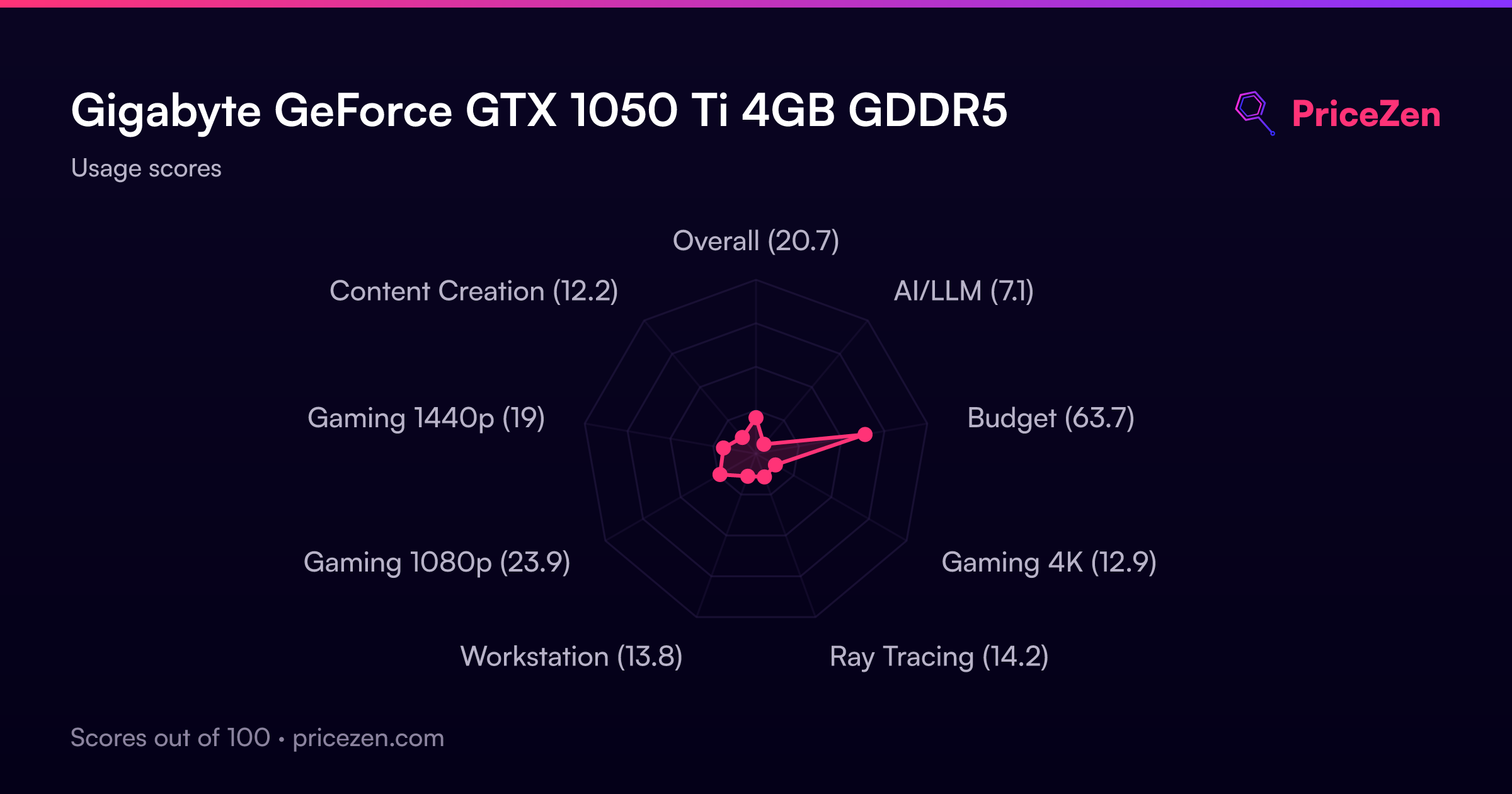
Usage Scores
- Overall20.7
- AI/LLM7.1
- Budget63.7
- Gaming 4K12.9
- Ray Tracing14.2
- Workstation13.8
- Gaming 1080p23.9
- Gaming 1440p19
- Content Creation12.2