Polaroid Flip009152 Black
A sonar autofocus system paired with a hyperfocal 4-lens design delivers sharp shots by automatically selecting from four distance-specific sweet spots, unaffected by lighting conditions. Its most powerful flash adapts output for subjects up to 4 meters away, while scene analysis warns of exposure issues before you shoot. This camera is best for beginners wanting reliably sharp, well-exposed instant prints without manual focus adjustments.












Snapshot
The 30-Second Version
The Polaroid Flip pairs clever sonar autofocus with a weak sensor and worse video, scoring 24.1/100 overall but a much friendlier 45.9/100 for beginners. Its best trick is picking the right lens in any light. Worth USD 180 if you want instant prints, not if you want a real camera.
Pros & Cons
Pros
- Sonar autofocus picks the right lens regardless of lighting conditions. 70th
- Four focal sweet spots mean sharper shots than two-lens instant rivals.
- Scene analysis warns you about bad exposure before you burn film.
- Adaptive flash reaches subjects up to 4 meters away.
Cons
- Tiny 1/2.3-inch sensor trails most of the category.
- No stabilization and weak 1080p video make it a poor vlogging pick.
- 649g is heavy for a point-and-shoot, and it's not weather sealed.
- Display and connectivity rank among the worst we've seen.
The proof
Performance
The interesting stuff is all in the focus system. Sonar doesn't care about lighting, so the lens selection works in the dark or in harsh sun, and the flash adapts its power out to 4 meters. That's the strongest pitch here. Everything else lags behind most cameras in our data: the 1/2.3-inch CMOS sensor sits in the bottom third, 1080p video with zero stabilization ranks near the bottom, and burst shooting and connectivity are weak spots too. At 649g it's chunky, and there's no weather sealing. This thing prints memories. It doesn't chase pixels.
Specifications
Full Specifications
Sensor
| Type | CMOS |
| Size | 1/2.3-inch" |
Autofocus
| Eye AF | No |
| Animal AF | No |
| Subject Detection | No |
Shooting
| Electronic Shutter | No |
Video
| Max Resolution | 1080p |
| 10-bit | No |
| Log Profile | No |
| RAW Video | No |
Display & EVF
| Touchscreen | No |
| Articulating | No |
Build
| Weight | 0.6 kg / 1.4 lbs |
Connectivity
| Wi-Fi | No |
| Bluetooth | Yes |
| Hot Shoe | No |
vs Competition
Here's the awkward part: our system compares it against the Nikon Z50, Canon EOS R50 V, Sony ZV-E10, Leica Q2 Monochrom and Olympus OM-D E-M5 Mark II, and the Flip loses on nearly every technical metric. If you care about image quality, video or autofocus speed, cross-shop the Canon EOS R50 V or Sony ZV-E10 instead. The Flip only wins if what you actually want is a physical print in your hand seconds after the shot. None of those competitors do that. Pick based on the output you want, not the spec sheet.
| Spec | Polaroid Flip009152 | Sony Alpha a7R VI | Fujifilm X-H2 | Nikon Z8 | Panasonic Lumix G9 II | OM System OM-1 Mark II |
|---|---|---|---|---|---|---|
| Type | instant | mirrorless | mirrorless | mirrorless | mirrorless | mirrorless |
| Sensor | ?MP 1/2.3-inch | 66.8MP full-frame | 40.2MP aps-c | 45.7MP full-frame | 25.2MP micro-four-thirds | 20.4MP micro-four-thirds |
| AF Points | - | 759 | 425 | 493 | 779 | 1053 |
| Burst FPS | - | 30 | 15 | 30 | 75 | 120 |
| Video | 1080p | 8K @120fps | 8K @60fps | 8K @120fps | 4K @120fps | 4K @60fps |
| IBIS | No | Yes | Yes | Yes | Yes | Yes |
| Weather Sealed | No | Yes | Yes | Yes | Yes | Yes |
| Weight (g) | 649 | 622 | 579 | 820 | 575 | 511 |
| Compare | Compare | Compare | Compare | Compare |
| Product | AF | EVF | Build | Burst | Video | Sensor | Battery | Display | Connectivity | Social Proof | Affordability | Stabilization |
|---|---|---|---|---|---|---|---|---|---|---|---|---|
| Polaroid Flip009152 | 36.9 | 37.4 | 52.6 | 31.7 | 21.9 | 31.5 | 46 | 27.3 | 29.1 | 55.4 | 69.7 | 32.9 |
| Sony Alpha a7R VI Compare | 96.5 | 98.9 | 94.3 | 88.1 | 98.9 | 80.7 | 96.3 | 97.4 | 95.4 | 97.4 | 12 | 99.6 |
| Fujifilm X-H2 Compare | 91.4 | 96.3 | 93.3 | 79.2 | 94.8 | 98.8 | 97.1 | 94.9 | 95.4 | 92.4 | 23.7 | 95.7 |
| Nikon Z8 Compare | 92.7 | 90.5 | 97.4 | 94.7 | 98.4 | 67.2 | 88.4 | 97.1 | 95.4 | 97.4 | 15.3 | 87.8 |
| Panasonic Lumix G9 II Compare | 97.6 | 90.2 | 93.2 | 95.9 | 97.4 | 59.2 | 89.8 | 96.4 | 95.4 | 86.4 | 37.3 | 87.8 |
| OM System OM-1 Mark II Compare | 98.6 | 99.8 | 92.7 | 99.4 | 83.6 | 46.2 | 95.1 | 94.9 | 95.4 | 86.4 | 24.8 | 99.6 |
Price
Value & Pricing
At USD 180 (both Amazon and Best Buy list it there), the Flip is reasonably priced for what it is, and affordability sits well above average in our rankings at the 70th percentile. EUR listings run 177-193 and CAD sits at 240. Just remember the real cost of any instant camera is the film, and the scene analysis warnings help you waste fewer sheets. As a gift or a party camera, the price makes sense. As your only camera, it doesn't.
Amazon 1 offer From MX$3,659
We started tracking prices for this product on Nov 25, 2026. The chart appears once we have more data.
Read more
Overview
The Polaroid Flip is an instant camera that tries to take the guesswork out of analog shooting. It uses sonar autofocus to pick from four lenses, each tuned to a different distance: 0.65m, 0.85m, 1.2m and 2.5m. A viewfinder LED warns you before you waste film on an overexposed or too-close shot. That's genuinely clever for a point-and-shoot.
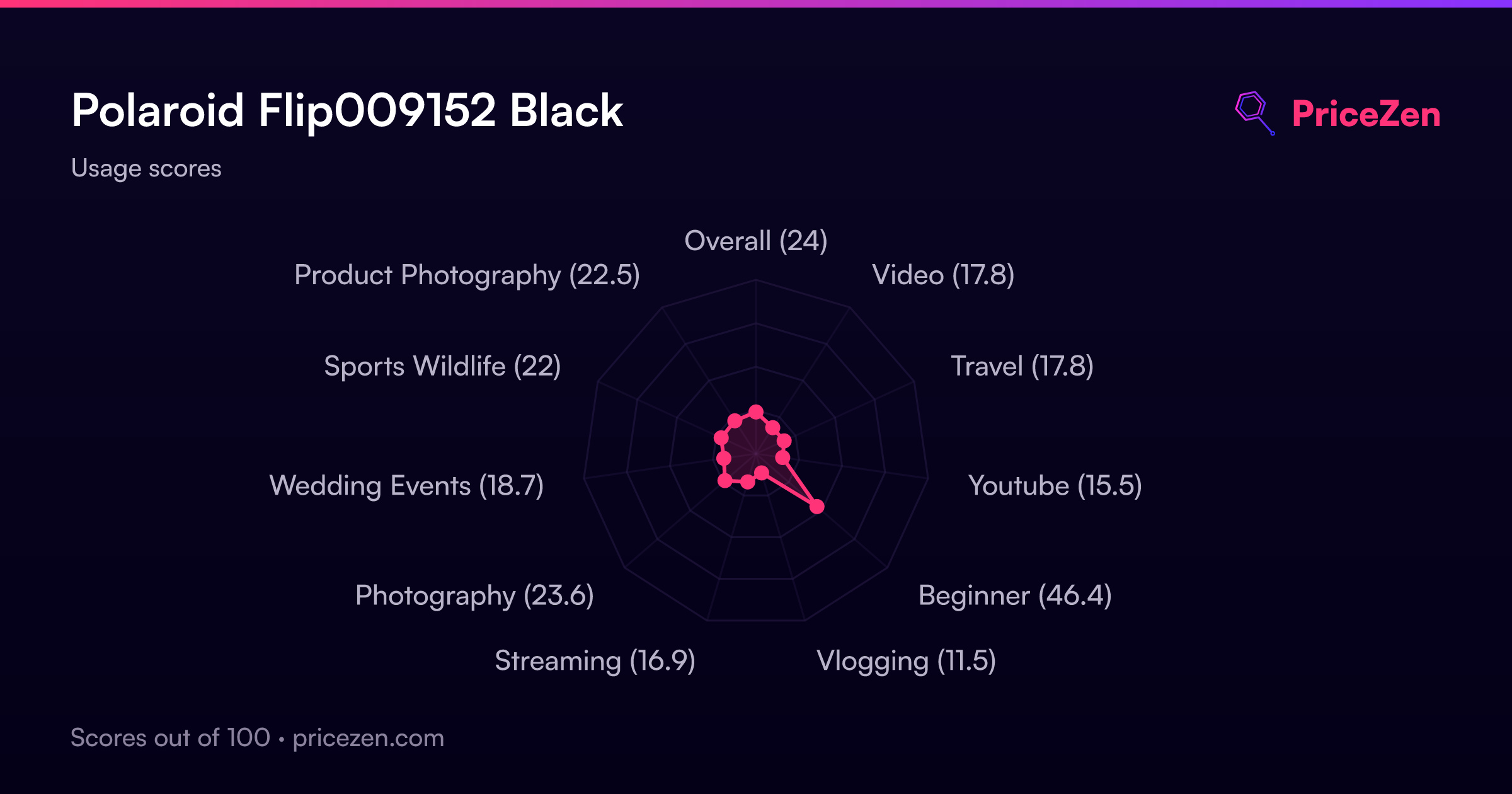
But our scoring model isn't kind to it overall. The Flip lands at 24.1/100 total and 23.6/100 for photography, dragged down by a small 1/2.3-inch sensor, no stabilization and weak video specs. It scores better for beginners at 45.9/100, which tells you exactly who this is for: people who want fun prints, not technical image quality.
Common Questions
Q: Does the sonar autofocus actually work in low light?
Yes, that's the whole point. Sonar uses sound waves rather than light to gauge distance, so lens selection works the same in darkness or bright sun, and the adaptive flash covers subjects up to 4 meters.
Q: Can I use the Polaroid Flip for vlogging or video?
We'd skip it. It shoots 1080p with no stabilization, and vlogging is its weakest area in our scoring at 11.5/100. Look at a dedicated video camera instead.
Q: Is it good for a total beginner?
It's one of the friendlier options we track. The viewfinder LED flags bad exposure and too-close subjects before you shoot, and its beginner score of 45.9/100 beats its overall score by a wide margin.
Who Should Skip This
If you need sharp digital files, decent video or fast burst shooting, look elsewhere, because the small sensor, lack of stabilization and bottom-tier video ranking will frustrate you within a week. And if you shoot outdoors in rough weather, the missing weather sealing is a dealbreaker. This is a fair-weather fun camera, and it knows it.
Verdict
Buy this if you want an instant camera that's smarter than the average one. The sonar focusing and exposure warnings take real friction out of film shooting, and the beginner score of 45.9/100 backs that up. Owners seem happy too, with a 4.5/5 rating across 46 reviews. Skip it if you're shopping for a serious digital camera, because our data says the sensor, video and stabilization just aren't there.
Usage Scores
- Overall24
- Video17.8
- Travel17.8
- Youtube15.5
- Beginner46.4
- Vlogging11.5
- Streaming16.9
- Photography23.6
- Wedding Events18.7
- Sports Wildlife22
- Product Photography22.5