Fujifilm X-T20 Black 2016
The 24.3MP X-Trans CMOS III sensor and X-Processor Pro engine deliver sharp, filter-free stills and 4K/30p video in a compact 383g body. Its retro design incorporates a 2.36m-dot EVF and a tilting touchscreen, paired with tactile exposure dials for intuitive manual control. This camera is best for product photographers and beginners seeking high image quality and classic handling without the bulk of a full-frame system.

No current retailer price











Snapshot
The 30-Second Version
The Fujifilm X-T20 is a compact mirrorless camera with a stellar 24.3MP APS-C sensor and Fuji's beloved film simulations, all in a lightweight retro body. Image quality is top-tier for the price, but the lack of stabilization and weather sealing holds it back for video and rough conditions. If you find a good used deal, it's an absolute steal for stills-focused shooters.
Pros & Cons
Pros
- Outstanding image quality and color from the 24.3MP X-Trans sensor 93rd
- Compact, lightweight body that's easy to carry all day 90th
- Film simulations produce gorgeous JPEGs with zero editing 88th
- Sharp and bright 2.36M-dot electronic viewfinder 86th
- Great value on the used market, especially with the 18-55mm kit lens
Cons
- No in-body image stabilization limits low-light handheld shooting
- Shallow grip makes handling awkward with larger lenses
- No weather sealing, so be careful in rain or dust
- Fujifilm's smartphone app is unreliable for transferring photos
- 4K video has noticeable rolling shutter and no headphone jack
What owners think
The Word on the Street
How owner sentiment changed over time
ExclusiveBased on when customers actually wrote their reviews - so you can see whether early praise held up.
15 written reviews, Mar 2017 – Jul 2020: 14 happy, 1 mixed
Across all 552 store ratings: 4.6★. Most owners rate without writing a review. The chart counts the 15 written reviews.
Each dot is one written review, in the month it was written. Happy = 4-5★, mixed = 3★, unhappy = 1-2★.
The proof
Performance
That 24.3MP APS-C sensor is the star of the show here. In our database, it sits in the 93rd percentile for sensor performance among mirrorless cameras, which is frankly ridiculous for a body at this price point. The X-Trans color array skips the optical low-pass filter, so you get noticeably crisp detail and Fuji's legendary color science. The film simulations, especially Classic Chrome and Acros, are a huge reason people buy into this system. You can basically skip RAW editing if you nail your exposure in-camera.
Autofocus lands in the 80th percentile with 91 AF points and continuous tracking that's been improved over earlier Fuji bodies. It's not going to embarrass a Sony a7 IV for fast action, but for portraits, street scenes, and casual wildlife, it's perfectly capable. The 14fps burst rate with the electronic shutter is in the 82nd percentile, which is quick enough to catch a kid's soccer game or a dog mid-zoom. Video sits at the 63rd percentile. The 4K footage looks good, but rolling shutter is noticeable, and the lack of stabilization means you'll want a tripod or a lens with OIS. The battery life is a pleasant surprise at 330 shots, landing in the 92nd percentile. You can get through a full day of light shooting without reaching for a spare.
Specifications
Full Specifications
Sensor
| Type | X-Trans CMOS III |
| Size | aps-c |
| Megapixels | 24.3 MP |
| ISO Range | 200 |
| Processor | X-Processor Pro |
Autofocus
| AF Points | 91 |
| AF Type | Phase Detection: 91 |
| Eye AF | No |
| Animal AF | No |
| Subject Detection | No |
Shooting
| Burst (Mechanical) | 14 |
| Burst (Electronic) | 14 |
| Max Shutter | 1/32000 |
| Electronic Shutter | Yes |
Video
| Max Resolution | 4K |
| 4K FPS | 30 |
| 1080p FPS | 60 |
| 10-bit | No |
| Log Profile | No |
| RAW Video | No |
| Codec | MPEG-4 AVC/H.264 |
Display & EVF
| Screen Size | 3" |
| Touchscreen | Yes |
| Articulating | Yes |
| EVF Resolution | 2.36 M dots |
Build
| Weather Sealed | No |
| Weight | 0.4 kg / 0.8 lbs |
| Battery Life | 330 |
Connectivity
| Wi-Fi | Yes |
| Bluetooth | Yes |
| USB | Micro-USB, USB 2.0 |
| HDMI | Micro HDMI |
| Hot Shoe | Yes |
vs Competition
Stacked against the Sony Alpha a7 IV, the X-T20 is a different beast entirely. The Sony is a full-frame, stabilized, weather-sealed hybrid monster that costs over $2,000. The Fuji can't touch it for video work or low-light performance, but it's also a third of the price and half the weight. If you're a hobbyist who doesn't need full-frame, the X-T20 makes a strong case for itself. The Nikon Zf is another retro-styled competitor with full-frame guts and better stabilization, but it's significantly heavier and pricier. The Panasonic LUMIX S5 II is a video-first full-frame option that outclasses the Fuji for hybrid shooters, but again, you're paying a premium.
Closer to its weight class, the Olympus OM-D E-M1 Mark III offers in-body stabilization and weather sealing in a similarly compact package, though the smaller micro four-thirds sensor can't match the Fuji's dynamic range. The OM System OM-1 is a newer, faster micro four-thirds body with computational photography tricks, but it's also more expensive. If you're cross-shopping these, ask yourself what matters more: the best possible image quality in a small package (get the Fuji) or ruggedness and stabilization (look at Olympus).
| Spec | Fujifilm X-T20 | Sony Alpha a7R VI | Nikon Z8 | Panasonic Lumix G9 II | OM System OM-1 Mark II | Canon EOS R6 Mark III |
|---|---|---|---|---|---|---|
| Type | mirrorless | mirrorless | mirrorless | mirrorless | mirrorless | mirrorless |
| Sensor | 24.3MP aps-c | 66.8MP full-frame | 45.7MP full-frame | 25.2MP micro-four-thirds | 20.4MP micro-four-thirds | 32.5MP full-frame |
| AF Points | 91 | 759 | 493 | 779 | 1053 | 1053 |
| Burst FPS | 14 | 30 | 30 | 75 | 120 | 40 |
| Video | 4K @30fps | 8K @120fps | 8K @120fps | 4K @120fps | 4K @60fps | 6K @120fps |
| IBIS | false | true | true | true | true | true |
| Weather Sealed | false | true | true | true | true | true |
| Weight (g) | 383 | 622 | 820 | 575 | 511 | 608 |
| Compare | Compare | Compare | Compare | Compare |
| Product | AF | EVF | Build | Burst | Video | Sensor | Battery | Display | User Sentiment | Connectivity | Social Proof | Affordability | Stabilization |
|---|---|---|---|---|---|---|---|---|---|---|---|---|---|
| Fujifilm X-T20 | 78.4 | 78.1 | 71 | 76.5 | 58 | 93.2 | 88.4 | 82.1 | 54.8 | 89.5 | 86.4 | 50.1 | 32.8 |
| Sony Alpha a7R VI Compare | 96.4 | 98.9 | 94.1 | 88 | 98.9 | 80.5 | 96.5 | 97.4 | 95.4 | 95.3 | 97.4 | 13.1 | 99.5 |
| Nikon Z8 Compare | 92.6 | 90.5 | 97.3 | 94.7 | 98.4 | 66.9 | 88.7 | 97.1 | 85.4 | 95.3 | 97.4 | 16.3 | 87.5 |
| Panasonic Lumix G9 II Compare | 97.6 | 90.3 | 93 | 95.9 | 97.4 | 58.8 | 90.1 | 96.4 | 95.4 | 95.3 | 86.4 | 38.2 | 87.5 |
| OM System OM-1 Mark II Compare | 98.6 | 99.8 | 92.4 | 99.5 | 83.6 | 45.6 | 95.3 | 94.8 | 85.4 | 95.3 | 86.4 | 26.4 | 99.5 |
| Canon EOS R6 Mark III Compare | 98.6 | 89.7 | 93.7 | 90.8 | 89.5 | 61.4 | 96.9 | 94.8 | 69.7 | 95.3 | 92.4 | 22.5 | 99.5 |
Price
Value & Pricing
Value is where the X-T20 gets really interesting. Since it's been discontinued, you're shopping the used market or leftover new stock, and prices are all over the place. We've seen a spread from $770 to over $36,000 (ignore that high end, it's nonsense). Realistically, a clean used body runs around $500 to $600, and a kit with the excellent 18-55mm f/2.8-4 lens can be found for $700 to $900. At that price, you're getting a sensor and processor that rival cameras costing twice as much. The main trade-off is the lack of stabilization and weather sealing. If those matter, a used Sony a6500 or a micro four-thirds body like the Olympus OM-D E-M1 Mark III might be a better fit. But for pure image quality per dollar, the X-T20 is hard to beat.
Read more
Overview
The Fujifilm X-T20 is one of those cameras that just feels right the moment you pick it up. It's a 24.3MP mirrorless shooter with Fuji's classic retro styling, physical dials for shutter speed and exposure compensation, and a sensor that punches well above its weight class. If you've been searching for a compact mirrorless camera that delivers film-like JPEGs straight out of the box, this little guy has been a cult favorite for years. The X-Trans CMOS III sensor and X-Processor Pro engine are the same guts you'd find in the pricier X-T2, which means you're getting serious image quality in a body that weighs just 383 grams.
Fujifilm aimed this at enthusiasts and beginners who want room to grow, and it mostly nails that balance. The 3-inch tilting touchscreen is handy for awkward angles, the 2.36M-dot EVF is bright and clear, and you get 4K video at 30fps if you need it. But it's not a do-everything workhorse. There's no in-body stabilization, no weather sealing, and the grip is shallow enough that bigger lenses feel front-heavy. Still, for street photography, travel (when you pack light), and everyday shooting, the X-T20 remains a compelling option even years after its release.
Pricing is all over the map since this is a discontinued model, but you can still find it floating around used or from third-party sellers. We've seen listings from around $770 for a body-only kit up to some absurd $36,351 outliers (probably a typo or a "collector's special"). If you're hunting for a deal, the sweet spot is usually a used body with the sharp 18-55mm f/2.8-4 kit lens for well under a grand. That's a lot of camera for the money.
Common Questions
Q: Is the Fujifilm X-T20 good for beginners?
Yes, the X-T20 is excellent for beginners who want to learn photography. The Auto mode handles everything for you, and the physical dials make it easy to understand exposure settings as you grow.
Q: Does the Fujifilm X-T20 have image stabilization?
No, the X-T20 body does not have in-body image stabilization. You'll need to use lenses with OIS or keep your shutter speed high to avoid blur in low light.
Q: Can the Fujifilm X-T20 shoot 4K video?
Yes, it can record UHD 4K video at up to 30fps. However, there's noticeable rolling shutter and no headphone jack, so it's better suited for casual video than professional work.
Q: What lenses work with the Fujifilm X-T20?
It uses Fujifilm's X-mount lenses, and the 18-55mm f/2.8-4 kit lens is a standout performer. You can also adapt vintage glass, but be mindful that larger lenses feel front-heavy on the small body.
Who Should Skip This
Skip the X-T20 if you shoot a lot of handheld video or work in rough weather. The missing stabilization and weather sealing are real dealbreakers for run-and-gun videographers and outdoor adventure shooters. If you have large hands or plan to use big telephoto lenses regularly, the cramped grip will drive you nuts. Look at a used Sony a6500 for stabilization in a similar size, or an Olympus OM-D E-M1 Mark III if you need something that can survive a rainstorm. Also, if you need reliable wireless transfer for quick social media posts, Fuji's app issues might push you toward a more modern body with better connectivity.
Verdict
The Fujifilm X-T20 is aging gracefully, and for a certain type of photographer, it's still a brilliant buy. If you care about image quality, color science, and having a camera that's actually fun to shoot with, this thing delivers. The physical dials and film simulations make it feel less like a computer and more like a creative tool. It's especially good for street photography, portraits, and travel when you pack light.
But it's not for everyone. The lack of stabilization means you'll need steady hands or a tripod for video and low-light work. The grip is small, so if you have larger hands or plan to use heavy telephoto lenses, you'll feel the strain. And without weather sealing, it's not the camera to take into a dust storm or a downpour. If those limitations don't bother you, the X-T20 is one of the best values in used mirrorless cameras right now.
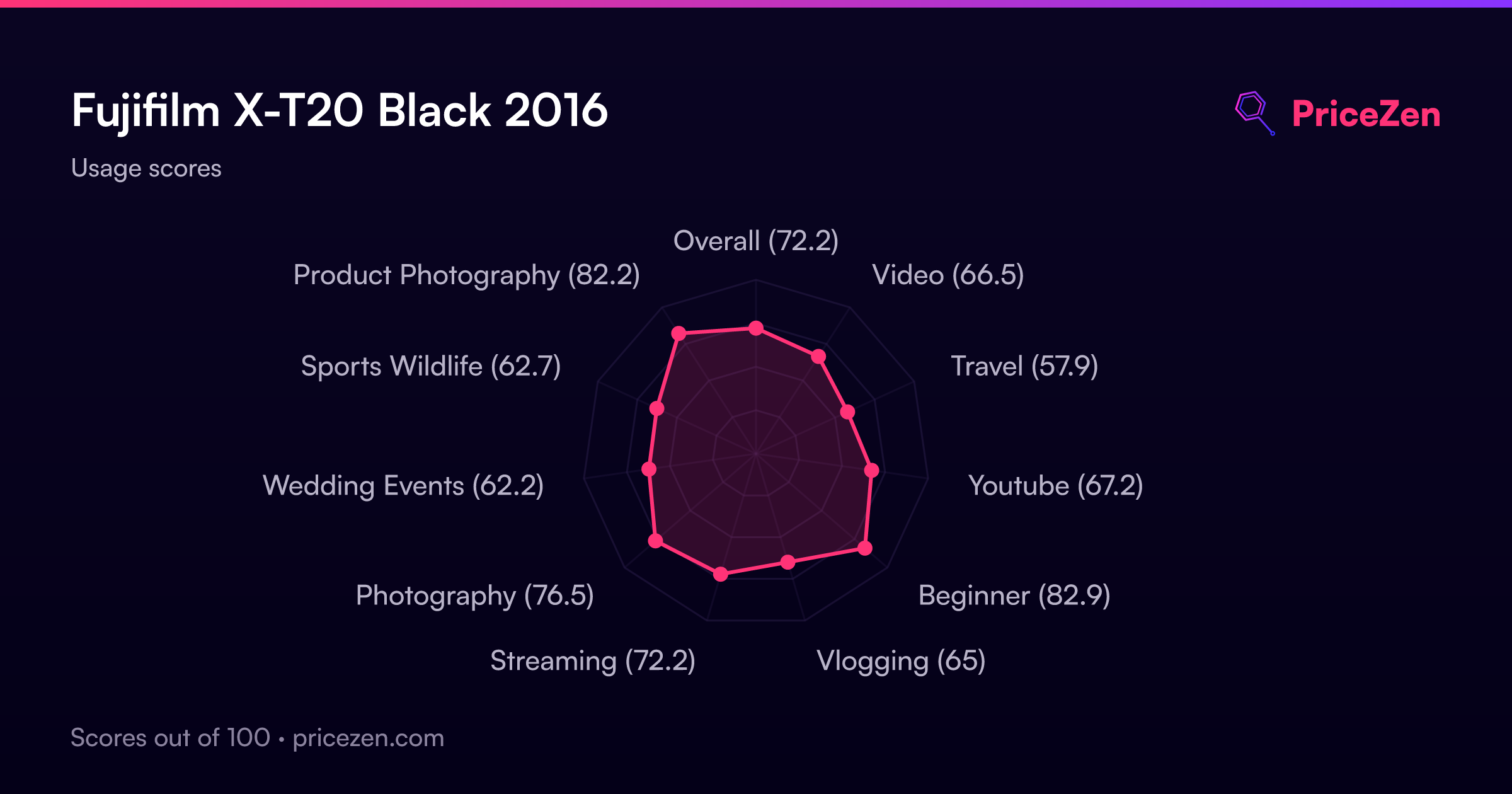
Usage Scores
- Overall72.2
- Video66.5
- Travel57.9
- Youtube67.2
- Beginner82.8
- Vlogging65
- Streaming72.2
- Photography76.5
- Wedding Events62.2
- Sports Wildlife62.7
- Product Photography82.2