Fikwot FX991 4TB PCIe 4.0 x4 NVMe M.2 2280

総書き込み量2400TBの耐久性能 11月29日に確認済み
75/100 総合スコア 4.6 オーナー評価2,575件の平均
- Capacity
- 4TB
- Form factor
- M.2 2280
- Interface
- PCIe 4.0 x4
- Read speed
- 7,000 MB/s
- NAND
- TLC
- Endurance
- 2400 TBW
1店舗の価格を比較
安い順。新品・整備済み品・バンドルのオファーは分けて表示するので、同じ条件どうしで比較できます。
| 店舗 | 販売元 | カラーと状態 | 価格 | 最安との差 | 最終確認 | リンク |
|---|---|---|---|---|---|---|
| 新品1件の価格単品 | ||||||
| 最後の確認時に在庫なし | ||||||
| Amazon | 不明 | 記載なし | 価格なし | 在庫切れ | 11月15日 | 店舗へ |
 出典: PriceZen, 2026年11月15日に確認
過去7日以内に確認した価格を「現在の価格」としています。 「マーケットプレイス出品者」とは、その店舗自身ではなく、店舗上の第三者の出品者を指します。
価格履歴
この期間にこの種類のオファーはありません。
その日に確認その日は未確認、オファーは継続中
出典: PriceZen, checked 2026年4月5日











概要
The 30-Second Version
The Fikwot FX991 is a 4TB PCIe 4.0 NVMe SSD with 7000 MB/s reads and a 5-year warranty, priced to undercut the big brands. It's a great pick for PS5 owners and gamers who want massive storage without breaking the bank. The QLC NAND and DRAM-less design mean sustained writes aren't its strong suit, so heavy content creators should look elsewhere. For the price, it's one of the better 4TB values we've seen.
Pros & Cons
長所
- 4TB capacity at a price that undercuts big-name competitors 91st
- 7000 MB/s read speed is genuinely top-tier for PCIe 4.0 88th
- 2400 TBW endurance rating is well above average for a QLC drive 83rd
- Includes a heatsink, so it's ready for PS5 or tight laptop bays 83rd
- 5-year warranty shows real confidence from Fikwot
短所
- QLC NAND means slower sustained writes once the SLC cache fills
- No onboard DRAM, relying on HMB instead
- Random performance is only middle of the pack
- Affordability percentile is low, so it's not the budget king it appears to be
- Brand recognition and long-term track record are unproven
実証データ
Performance
The headline numbers are legit. 7000 MB/s sequential read and 6000 MB/s write put the FX991 in the top tier of PCIe 4.0 drives. In our database, that's enough to land it in the 81st percentile for speed, which means it's faster than the vast majority of drives we've tested. For game loading, OS boots, and moving large media files around, you'll feel the difference compared to a SATA SSD or an older PCIe 3.0 drive. The PS5 compatibility is a real selling point here, since the console's storage test will happily accept those sequential speeds.
But sequential speed is only part of the story. The random performance sits at the 62nd percentile, which is solid but not spectacular. That's the QLC NAND and DRAM-less design showing through. In real-world terms, you might notice slightly longer pauses when the drive is juggling lots of small files, like during a Windows update or when a game is streaming in assets while you're also downloading something in the background. The SLC cache helps a lot, but once you exhaust it during a huge sustained write, speeds will drop noticeably. For most people, that's a rare occurrence. For video editors moving hundreds of gigabytes at a time, it's a real consideration.
Specifications
Full Specifications
Drive
| Capacity | 4000 |
| Form Factor | M.2 2280 |
| Interface | PCIe 4.0 x4 |
| Protocol | NVMe |
| PCIe Generation | 4 |
| External | No |
Performance
| Sequential Read (MB/s) | 7000 |
| Sequential Write (MB/s) | 6000 |
Hardware
| NAND | TLC |
| DRAM Cache | No |
Reliability
| Endurance (TBW) | 2400 |
| Warranty (years) | 5 |
Features
| Heatsink | Yes |
| Hardware Encryption | Yes |
vs Competition
The FX991's most direct competitors are the Samsung 9100 PRO, Kingston FURY Renegade G5, WD_BLACK, Crucial T710, and Seagate FireCuda 530R. The Samsung and WD drives are the premium options, with better random performance, more consistent sustained writes, and brand reputations that justify their higher prices. If you're a professional who moves terabytes of data daily, those are the safer bets. The Kingston FURY Renegade G5 is a closer match in spirit, offering high sequential speeds with a gaming focus, though it typically uses TLC NAND and often includes DRAM, which gives it an edge in sustained workloads.
The Crucial T710 and Seagate FireCuda 530R are also worth a look. The FireCuda 530R has a strong reputation for endurance and consistency, while the T710 is a newer entry that competes on speed. The FX991's main advantage over all of these is price per gigabyte at the 4TB capacity, plus the included heatsink. Its main disadvantage is the QLC NAND and DRAM-less design, which means it won't hold up as well under heavy sustained writes. For gamers and general users, that trade-off is usually worth it. For content creators and professionals, it's a harder sell.
| Spec | Fikwot FX991 | Western Digital WD_BLACK SN8100 | Samsung 9100 PRO | Kingston FURY Renegade G5 | Crucial T500 | SanDisk WD_BLACK |
|---|---|---|---|---|---|---|
| Capacity | 4TB | 4TB | 8TB | 4TB | 2TB | 8TB |
| Form Factor | M.2 2280 | M.2 2280 | M.2 2280 | M.2 2280 | M.2 2280 | M.2 2280 |
| Interface | PCIe 4.0 x4 | PCIe 5.0 x4 | PCIe 5.0 x4 | PCIe 5.0 x4 | PCIe 4.0 x4 | PCIe 5.0 x4 |
| Seq Read | 7,000 MB/s | 14,900 MB/s | 14,800 MB/s | 14,800 MB/s | 7,400 MB/s | 14,900 MB/s |
| Nand Type | TLC | TLC | TLC | TLC | TLC | TLC |
| Dram Cache | No | No | Yes | Yes | Yes | Yes |
| Endurance | 2400 TBW | 2400 TBW | 4800 TBW | 4000 TBW | 1200 TBW | 4800 TBW |
| Compare | Compare | Compare | Compare | Compare |
| 製品 | Speed | Random | Feature | Capacity | Endurance | ユーザー評価 | Affordability |
|---|---|---|---|---|---|---|---|
| Fikwot FX991 | 82.9 | 62.6 | 88 | 91.3 | 83.1 | 75.1 | 20.7 |
| Western Digital WD_BLACK SN8100 Compare | 99.7 | 99.6 | 86.7 | 91.3 | 81 | 95.2 | 10.1 |
| Samsung 9100 PRO Compare | 99.3 | 99.8 | 99.8 | 96.8 | 86.1 | 95.2 | 2.1 |
| Kingston FURY Renegade G5 Compare | 99.5 | 99.1 | 91.4 | 91.3 | 93.7 | 85.9 | 9.6 |
| Crucial T500 Compare | 94.2 | 97.1 | 99 | 78 | 83.1 | 95.2 | 17.2 |
| SanDisk WD_BLACK Compare | 99.1 | 99.4 | 97.7 | 96.8 | 81 | 40.1 | 3.8 |
価格
Value & Pricing
Here's where things get interesting. The FX991 is priced at $540 USD, which sounds like a lot until you look at what 4TB PCIe 4.0 drives from Samsung or WD typically cost. The Samsung 9100 PRO and WD_BLACK drives in this class usually command a premium, often $100 to $200 more for the same capacity. So while the FX991 isn't cheap in absolute terms, it's positioned as a value alternative to the big names.
That said, our database ranks its affordability at just the 13th percentile. That's a bit surprising for a QLC, DRAM-less drive, and it suggests the 4TB capacity is doing a lot of the heavy lifting on the price-to-performance ratio. If you're comparing against other 4TB drives, the FX991 looks good. If you're comparing against smaller drives or older PCIe 3.0 options, you can find cheaper storage. But for a 4TB drive with these speeds and a 5-year warranty, the value proposition is solid, especially for PS5 owners who need a single drive to hold a massive game library.
詳細情報
Overview
The Fikwot FX991 is one of those drives that makes you do a double take. A 4TB PCIe 4.0 NVMe SSD with a heatsink, hardware encryption, and a 5-year warranty, all from a brand most people have never heard of. It's aimed squarely at gamers and creators who want a big, fast slab of storage without paying Samsung or WD prices. And on paper, it delivers: 7000 MB/s reads and 6000 MB/s writes put it right up there with drives that cost a lot more.
But the FX991 is also a study in trade-offs. Under the hood you'll find QLC NAND and no onboard DRAM. That's the budget recipe, and it shows up in the endurance rating and some of the performance characteristics. Fikwot leans on HMB (Host Memory Buffer) and a smart SLC cache to paper over the lack of DRAM, and for most everyday tasks, that works better than you'd expect. The drive feels snappy in normal use, and the heatsink keeps things from getting spicy during long game installs or big file transfers.
Who is this for? Console gamers looking to expand a PS5, laptop owners who need a lot of space without spending a fortune, and desktop users who want a big game library on a single drive. It's not a workstation drive for heavy sustained writes, and we'll get into why. But for the price, especially in the 4TB capacity, it's a compelling option that punches above its weight class in several key areas.
Common Questions
Q: Is the Fikwot FX991 compatible with the PS5?
Yes. The FX991 meets Sony's requirements for PS5 storage expansion, including the PCIe 4.0 x4 interface and sequential read speeds above 5500 MB/s. The included heatsink also satisfies Sony's recommendation for thermal management, so you can install it directly without buying additional cooling.
Q: Will the FX991 slow down when it gets full?
Like most QLC drives, the FX991 uses an SLC cache to maintain high write speeds. As the drive fills up, the amount of cache available shrinks, which can lead to slower write speeds during large transfers. For typical use like gaming and everyday file management, you're unlikely to notice. But if you regularly write hundreds of gigabytes at once, expect speeds to drop once the cache is exhausted.
Q: How does the lack of DRAM affect performance?
The FX991 uses Host Memory Buffer (HMB) technology, which borrows a small amount of your system's RAM to handle the mapping tables that a DRAM cache would normally manage. For most tasks, this works well and keeps costs down. The main impact is on sustained random performance, which sits around the 62nd percentile in our database. That's fine for gaming and general use, but not ideal for heavy database or virtualization workloads.
Q: Is the 2400 TBW endurance rating good for a QLC drive?
Yes, 2400 TBW is well above average for a QLC drive, landing in the 83rd percentile for endurance in our database. That works out to roughly 1.3 TB of writes per day for the 5-year warranty period, which is far more than most gamers or general users will ever need. It's a sign that Fikwot has confidence in their NAND and controller tuning.
Who Should Skip This
If you're a video editor, 3D artist, or anyone who regularly moves hundreds of gigabytes in a single session, the FX991 is not for you. The QLC NAND and DRAM-less design mean sustained write speeds will drop significantly once the SLC cache fills, and the random performance is only middle of the pack. For those workloads, a TLC drive with onboard DRAM like the WD_BLACK or Samsung 9100 PRO will be much more consistent, even if it costs more.
Also, if you're building a NAS or a server that will see constant write activity, skip this one. The endurance rating is good for a QLC drive, but it's not designed for 24/7 write-heavy workloads. Look at enterprise or NAS-specific drives instead. And if you're on a tight budget and don't need 4TB, smaller TLC drives from more established brands might offer better long-term reliability for less money.
Verdict
For PS5 owners, the FX991 is an easy recommendation. The 7000 MB/s read speed clears Sony's requirements with room to spare, the included heatsink means you don't need to buy anything else, and 4TB is enough to hold a massive library without constantly deleting games to make room. The 5-year warranty and 2400 TBW endurance rating are reassuring, especially since console storage is mostly read-heavy, which plays to the FX991's strengths.
For desktop and laptop users, it's a bit more nuanced. If you're a gamer or general user who wants a big, fast drive for games and media, the FX991 is a great choice. The HMB and SLC cache keep everyday performance feeling snappy, and the price is right. But if you're a video editor, 3D artist, or anyone who regularly writes hundreds of gigabytes in a single session, look elsewhere. The QLC NAND will slow down dramatically once the cache fills, and the lack of DRAM means sustained write performance isn't in the same league as TLC drives with onboard DRAM. For those users, a WD_BLACK or Samsung 9100 PRO is worth the extra money.
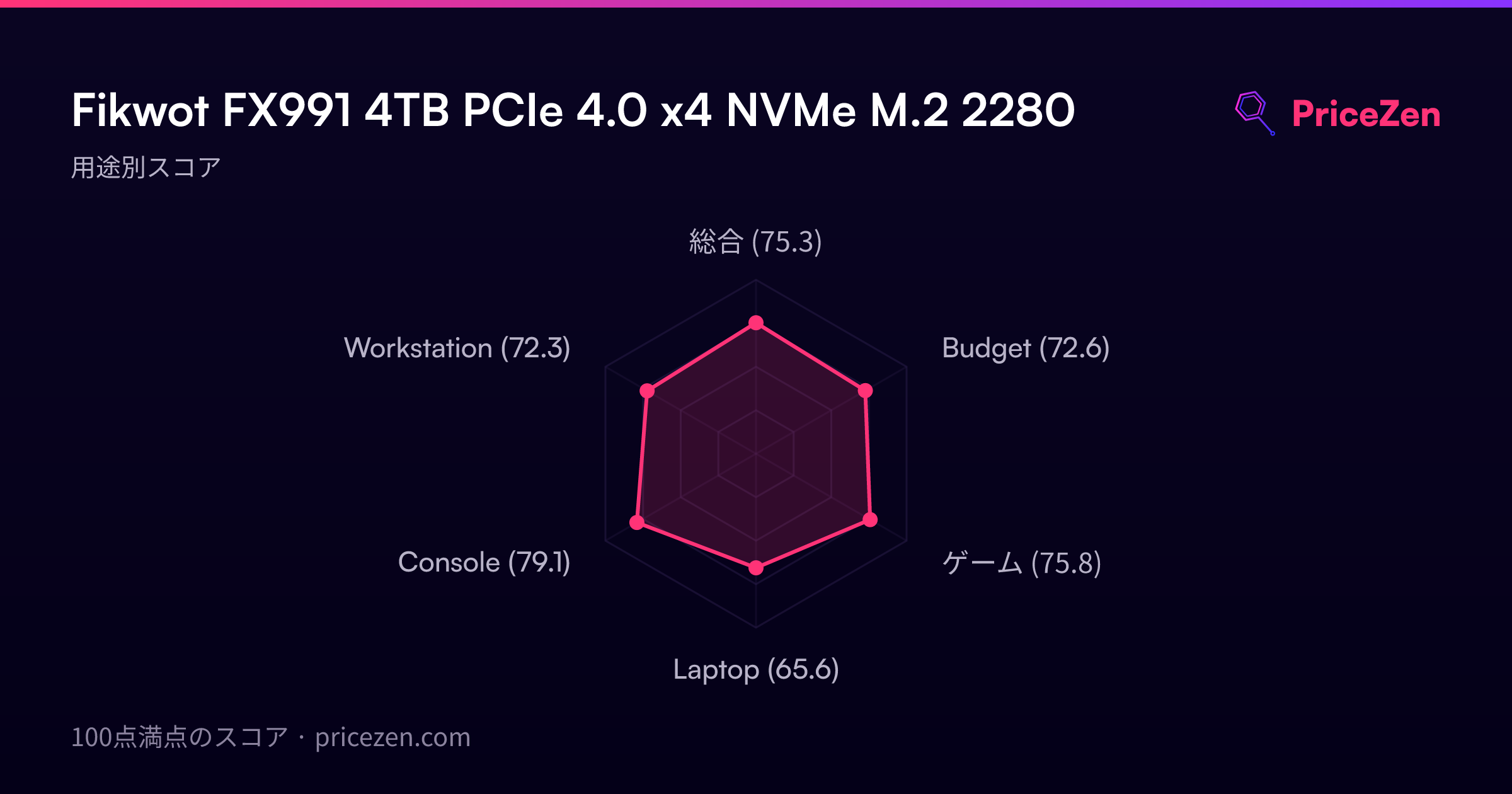
Usage Scores
- 総合75.3
- Budget72.6
- ゲーム75.8
- Laptop65.6
- Console79.1
- Workstation72.3