Western Digital WD Blue 2TB PCIe 3.0 x4 NVMe M.2 2280
The 2TB M.2 2280 PCIe 3.0 x4 NVMe drive delivers 2600 MB/s read and 1800 MB/s write speeds, over four times faster than SATA SSDs, with a 900 TBW endurance rating. Its DRAM-less design and Western Digital controller keep costs down, while the SSD Dashboard monitors drive health. Best for budget-conscious laptop and desktop users who need fast storage for everyday tasks and casual gaming.












概要
The 30-Second Version
The WD Blue WDS200T3B0C is a 2TB PCIe 3.0 NVMe drive that does the everyday stuff well: 2600 MB/s reads, 900 TBW endurance, and a 4.8/5 rating from 40119 owners. It's DRAM-less, so sustained writes and its middling speed ranking are the compromise. Pricing is the sticking point, with only Amazon JP listed at JPY 72,989 and affordability in the bottom quarter. Great laptop and budget-build drive if you catch it cheaper, skip it at full ask.
Pros & Cons
長所
- 2TB in a slim M.2 2280 card, capacity ranks in the top quarter 95th
- 2600 MB/s reads, around four times SATA SSD speed 79th
- 4.8/5 from 40119 reviews, social proof near the top
- 900 TBW endurance rating, above average for the category
- Strong fit for budget builds (70.4/100) and laptops (67.8/100)
短所
- DRAM-less design, sustained writes are the weak spot
- 1800 MB/s write vs 2600 MB/s read, a big gap
- Speed ranks in the middle of the pack
- Affordability sits in the bottom quarter in our pricing data
- Portable use score of 16.8/100, it's an internal drive only
オーナーの声
The Word on the Street
購入者の評価が時間とともにどう変化したか
独自顧客が実際にレビューを書いた時期に基づいています。発売当初の高評価が続いたかどうかがわかります。
書かれたレビュー 8件、2020/02~2025/05:満足 8件
ストア評価全40,119件:4.8★。 多くの購入者はレビューを書かずに評価だけを付けています。 グラフは書かれたレビュー8件を数えています。
各点は書かれたレビュー1件で、書かれた月に置いています。満足 = 4〜5★、普通 = 3★、不満 = 1〜2★。
実証データ
Performance
Let's translate those numbers. 2600 MB/s sequential read is roughly four times what a SATA SSD tops out at, which is exactly the claim WD makes, and it's the jump you feel when you move a boot drive off SATA. Copying a big folder, loading a level, unpacking an archive, all of that gets noticeably quicker. The 1800 MB/s write figure is the one to watch though. Writes trail reads by a wide margin here, and that's typical of a DRAM-less TLC design where part of the capacity acts as a faster pseudo-SLC buffer. Short bursts fly. Sustained multi-gigabyte writes, like dumping a full camera card or moving a huge video project, are where you'd expect it to slow down once that buffer fills. Random performance ranks solidly but unremarkably, and random IO is what makes an OS feel snappy day to day. So: quick, not quick-quick.
Endurance is rated at 900 TBW, which lands a bit above average in our data. For a normal desktop or laptop that's more headroom than you'll realistically burn through, and it's the number we'd point at if you're worried about a DRAM-less drive wearing out. Feature score is 53, dead average, and that tracks: you get WD's SSD Dashboard for health monitoring and firmware, and not much else beyond that. The trade-off worth naming is that this drive is tuned for everyday bursty work, not for hammering it with continuous large transfers. If your workflow is mostly opening apps and loading games, you'll never notice. If it's writing hundreds of gigabytes at a stretch, you will.
Specifications
Full Specifications
Drive
| Capacity | 2000 |
| Form Factor | M.2 2280 |
| Interface | PCIe 3.0 x4 |
| Protocol | NVMe |
| PCIe Generation | 3 |
| External | No |
Performance
| Sequential Read (MB/s) | 2600 |
| Sequential Write (MB/s) | 1800 |
Hardware
| NAND | TLC |
| DRAM Cache | No |
| Controller | Western Digital-designed controller |
Reliability
| Endurance (TBW) | 900 |
vs Competition
The competitor set in our data is a weird mix, and that tells you something. SanDisk Ultrastar DC SN655, Solidigm D5-P5336 and HP NVMe Mainstream Performance Mixed Use are enterprise-leaning names, and the WD Blue isn't playing in that bracket at all. It's a DRAM-less consumer PCIe 3.0 drive with a 900 TBW rating and a 53 feature score. If you're cross-shopping those, you're building something with very different demands, and this drive should come off your list early rather than late.
The more honest fight is against Team Group T-FORCE GC PRO and KLEVV CRAS C910, which are the consumer drives people actually put in gaming rigs. Against them, the Blue's argument is capacity per yen and proven reliability: 2TB at a high capacity ranking, and a review base of 40119 ratings averaging 4.8 that nothing else in this group can match for sheer volume of happy owners. Where it gives ground is raw speed, sitting in the middle of the pack, and the missing DRAM cache. If your priority is the fastest drive you can slot into a gaming build, cross-shop the T-FORCE and the KLEVV first. If your priority is a big, dependable, low-fuss boot-and-storage drive for a laptop, the Blue's 67.8/100 laptop score is the one to beat.
| Spec | Western Digital WD Blue | SanDisk Ultrastar DC SN655 | Team Group T-FORCE GC PRO | HP NVMe Mainstream Performance Mixed Use | Solidigm D5-P5336 | KLEVV CRAS C910 |
|---|---|---|---|---|---|---|
| Capacity | 2TB | 61.44TB | 2TB | 3.2TB | 61.44TB | 500GB |
| Form Factor | M.2 2280 | 2.5" | M.2 2280 | 2.5" | 2.5" | M.2 |
| Interface | PCIe 3.0 x4 | PCIe 4.0 x4 | PCIe 5.0 x4 | PCIe 4.0 x4 | PCIe 4.0 x4 | PCIe 4.0 x4 |
| Seq Read | 2,600 MB/s | - | 12,500 MB/s | - | - | 5,000 MB/s |
| Nand Type | TLC | TLC | TLC | - | QLC | TLC |
| Dram Cache | false | - | false | - | - | false |
| Endurance | 900 TBW | - | 1200 TBW | 17520 TBW | - | 350 TBW |
| Compare | Compare | Compare | Compare | Compare |
| 製品 | Speed | Random | Feature | Capacity | Endurance | ユーザー評価 | Affordability |
|---|---|---|---|---|---|---|---|
| Western Digital WD Blue | 56.4 | 62 | 53.3 | 78.7 | 62.8 | 94.9 | 24.7 |
| SanDisk Ultrastar DC SN655 Compare | 68.8 | 87.6 | 53.3 | 99.8 | 65.8 | 0 | 0.1 |
| Team Group T-FORCE GC PRO Compare | 96.5 | 62 | 86 | 78.7 | 87.1 | 25.3 | 17 |
| HP NVMe Mainstream Performance Mixed Use Compare | 68.8 | 89 | 14.8 | 87.4 | 99.3 | 0 | 0 |
| Solidigm D5-P5336 Compare | 68.8 | 62 | 14.8 | 99.8 | 57.2 | 0 | 0.1 |
| KLEVV CRAS C910 Compare | 71.8 | 87.3 | 87.4 | 27.8 | 71.9 | 64.6 | 63.9 |
価格
Value & Pricing
Here's where we have to be straight with you. We track this drive's price over time, partly through our community browser extension, and right now the only listing in our data is Amazon JP at JPY 72,989 for the 2TB unit. One store, one price, no cross-store competition to shop. Our affordability ranking puts it in the bottom quarter, which is a weak spot, and that's the number doing the talking rather than any gut feeling. This is a budget-oriented drive by design, but at the price we're currently seeing it isn't behaving like a bargain.
So the value case depends entirely on what you're comparing it against and when you buy. The specs justify a mainstream price: 2TB of TLC, 900 TBW, competent PCIe 3.0 speeds. They don't justify a premium. If you catch it lower, it's an easy recommendation for a laptop upgrade. At JPY 72,989 with no alternative retailer in our data, we'd wait or look elsewhere.
Amazon 1件の価格 最安 ¥72,989
2026年11月20日からこの製品の価格を追跡しています。データが増えるとチャートが表示されます。
詳細情報
Overview
The WD Blue WDS200T3B0C is the kind of drive that ends up in a lot of builds without anyone thinking too hard about it, and honestly that's a compliment. It's a 2TB M.2 2280 stick running PCIe 3.0 x4 with NVMe, rated at 2600 MB/s reads and 1800 MB/s writes, built on TLC NAND with a Western Digital-designed controller and firmware. No DRAM cache on board. That single design decision explains most of what's good and most of what's mediocre about this thing.
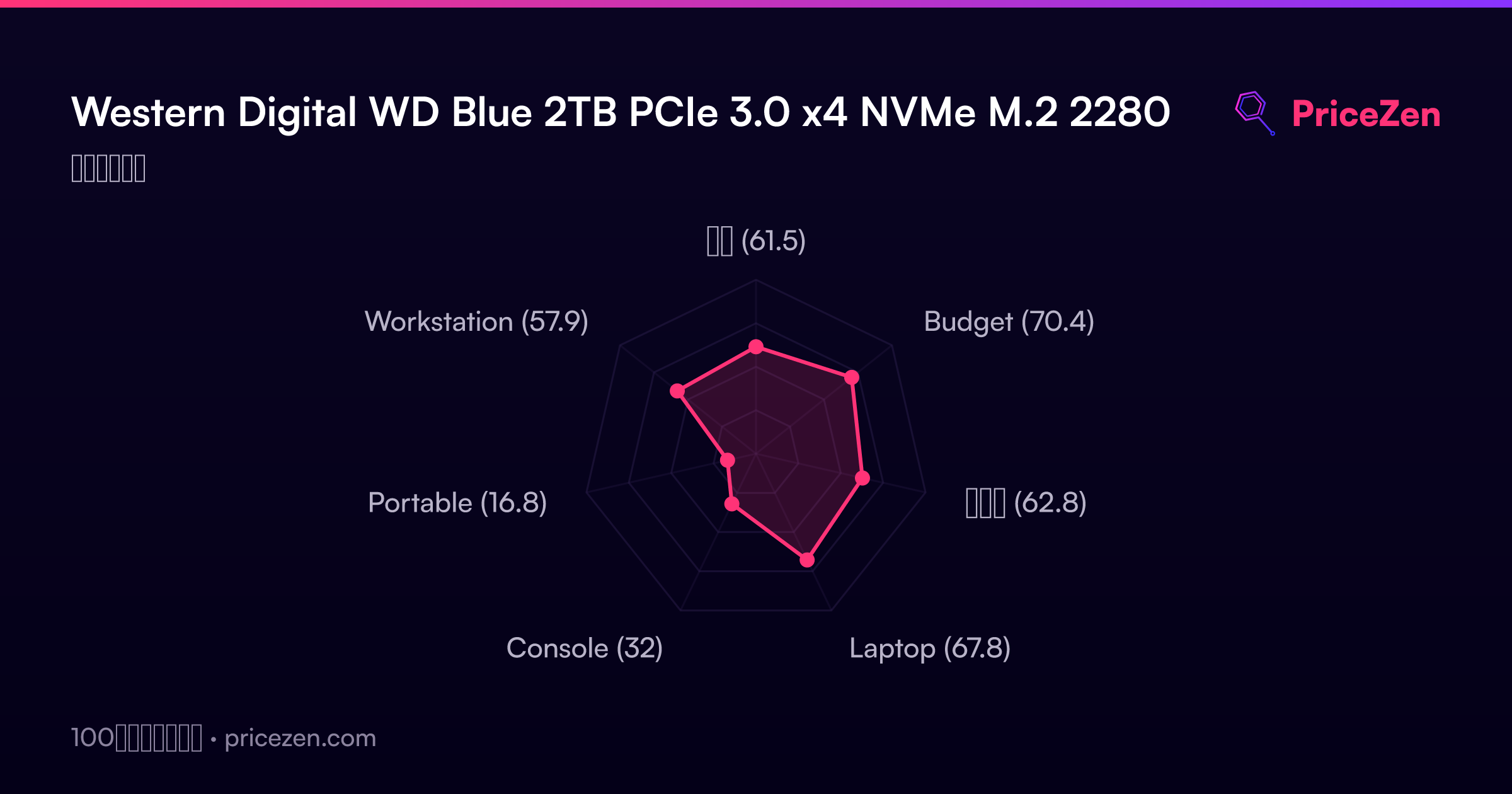
Who's it for? People upgrading a laptop or a budget desktop who want a big chunk of fast storage without paying flagship money. Our scoring model puts it at 70.4/100 for budget builds and 67.8/100 for laptops, which lines up with the spec sheet: a slim single-sided M.2 card that doesn't need a heatsink clearance conversation, and enough capacity to hold Windows plus a decent game library. Gaming scores 62.8/100, so it's fine there, not special.
What makes it interesting is the gap between how it benchmarks and how people actually feel about it. Speed lands in the middle of the pack in our rankings, basically average for an internal SSD right now. But social proof sits near the top of the charts, backed by a 4.8/5 average across 40119 reviews. That's an enormous sample. When a mid-tier drive gets loved that consistently, it usually means the boring stuff, reliability and compatibility and price, is doing the heavy lifting.
Common Questions
Q: Does the lack of a DRAM cache actually matter?
For everyday use, less than the spec sheet suggests. Random performance ranks solidly in our data, and that's the metric behind app launches and general OS responsiveness. Where DRAM-less designs hurt is long sustained writes, and with a 1800 MB/s write rating against 2600 MB/s reads, that's the scenario to keep in mind if you regularly move very large files.
Q: Will it fit and work in my laptop?
It's a standard M.2 2280 NVMe drive on PCIe 3.0 x4, so any laptop with an M.2 slot that supports NVMe should take it, and our laptop suitability score is 67.8/100. It also works in newer PCIe 4.0 slots, just at its own Gen3 speeds. Check that your slot is NVMe rather than SATA-only before ordering.
Q: Is 900 TBW enough for long-term use?
Yes for normal desktop and laptop workloads. 900 TBW sits a bit above average for internal SSDs, and reaching it would mean writing enormous amounts of data every day for years. WD's SSD Dashboard lets you keep an eye on drive health so you're not guessing.
Q: Is it fast enough for gaming?
It's adequate rather than exciting. Our gaming score is 62.8/100 and sequential reads of 2600 MB/s are far beyond what most game loading actually saturates, so load times will be fine. If you're chasing the shortest possible loads, faster consumer drives like the KLEVV CRAS C910 or Team Group T-FORCE GC PRO are worth cross-shopping.
Who Should Skip This
Skip this if you write large files for a living. Video editors dumping footage, anyone regularly moving huge archives, or people running write-heavy scratch disks will run into the DRAM-less ceiling, and the 1800 MB/s write rating already trails the read figure before sustained-load behaviour enters the picture. Same story if you're chasing maximum gaming performance: a middling speed ranking isn't the foundation for a performance build, and the Team Group T-FORCE GC PRO or KLEVV CRAS C910 are the ones to compare against there.
Also skip it if you need external storage. The portable score of 16.8/100 isn't a flaw, it's a category mismatch, this is a bare internal M.2 card. And if you're shopping the enterprise-leaning names in this set, SanDisk Ultrastar DC SN655 or Solidigm D5-P5336, you have requirements this consumer drive was never designed to meet. Finally, at JPY 72,989 with only one retailer in our data and affordability in the bottom quarter, bargain hunters should simply wait for a better price.
Verdict
For a laptop upgrade or a budget desktop refresh, we'd recommend it without much hesitation, provided the price cooperates. The M.2 2280 form factor drops into almost anything modern, 2TB solves the "my boot drive is always full" problem in one go, and 2600 MB/s reads make the machine feel genuinely quicker than any SATA setup. Owners upgrading from older SATA drives describe exactly that transformation. The 900 TBW rating means you're not gambling on longevity.
For a dedicated gaming rig or a content creation workstation, we'd hedge. Gaming scores 62.8/100, which is respectable but not a reason to pick this over a faster consumer drive, and the DRAM-less write behaviour is a real limitation for large-file work. And nobody should buy this expecting portability, that score is 16.8/100 because it's an internal component, full stop. Buy it as the sensible engine of an everyday PC. Don't buy it as the star of a performance build.
Usage Scores
- 総合61.5
- Budget70.4
- ゲーム62.8
- Laptop67.8
- Console32
- Portable16.8
- Workstation57.9