KingSpec X400 Series 512GB PCIe 4.0 x4 NVMe M.2 2280
The 7400 MB/s read speed on this PCIe 4.0 x4 NVMe drive matches Sony's PS5 requirements, while the 512GB capacity and DRAM-less TLC design keep costs down. Its 300 TBW endurance and 3-year warranty provide a safety net for daily use, though the 1,000,000-hour MTBF rating suggests long-term reliability. This is a solid pick for budget-conscious gamers upgrading a PS5 or a desktop who want fast load times without paying flagship prices.

現在、販売店の最新価格はありません
概要
The 30-Second Version
The KingSpec X400 delivers 7400 MB/s read speeds and PS5 compatibility at a budget-friendly $98 for 512GB. Random performance is excellent, landing in the 87th percentile, but the DRAM-less design means sustained writes fall behind premium competitors. It's a great pick for gamers and PS5 owners, less ideal for heavy workstation use. If you can stretch to the 1TB or 2TB version, you'll get better value per gigabyte.
Pros & Cons
長所
- 7400 MB/s read speed matches top-tier PCIe 4.0 drives 87th
- Random read performance in the 87th percentile, great for real-world snappiness 80th
- PS5 compatible out of the box 78th
- 300 TBW endurance rating beats many budget alternatives 75th
- 3-year warranty with replacement or refund coverage
短所
- DRAM-less design limits sustained write performance
- 512GB capacity is small for modern game libraries
- Write speed of 4400 MB/s lags behind the read speed significantly
- Social proof is thin, only 4 reviews in our data
- Feature set is bare bones compared to drives with encryption or heatsink options
実証データ
Performance
The headline numbers are legit. 7400 MB/s sequential read and 4400 MB/s write put this drive in the top tier of PCIe 4.0 drives we've tracked. Random performance is even more impressive relative to the field, landing in the 87th percentile. That 630K random read IOPS figure means snappy app launches and quick level loads, the stuff you actually feel day to day.
But here's the trade-off. That write speed of 4400 MB/s is noticeably lower than the read speed, and it's where the DRAM-less design starts to show. Drives like the WD Black SN850X or Crucial T500 sustain higher write performance under load because they have dedicated DRAM caches. For bursty workloads, the X400 keeps up fine. For long file transfers or video editing sessions, it'll drop off faster than the premium options. The 300 TBW endurance rating is solid for a 512GB drive, sitting in the 79th percentile, so you're not sacrificing longevity for the price.
Specifications
Full Specifications
Drive
| Capacity | 512 |
| Form Factor | M.2 2280 |
| Interface | PCIe 4.0 x4 |
| Protocol | NVMe |
| PCIe Generation | 4 |
| External | No |
Performance
| Sequential Read (MB/s) | 7400 |
| Sequential Write (MB/s) | 4400 |
| Random Read (IOPS) | 630000 |
| Random Write (IOPS) | 390000 |
Hardware
| NAND | TLC |
| DRAM Cache | No |
Reliability
| Endurance (TBW) | 300 |
| MTBF (hours) | 1000000 |
| Warranty (years) | 3 |
Features
| Heatsink | No |
vs Competition
The Crucial T500 is probably the closest competitor in terms of positioning. It's also a PCIe 4.0 drive aimed at gamers and creators, but it includes DRAM and typically offers higher sustained write speeds. You'll pay more for it, and if you're mostly gaming, the difference is hard to justify. The WD Black SN850X is another step up, with better all-around performance and a longer track record, but again, the price gap is real.
The MSI SPATIUM M480 PRO and Corsair MP700 Elite both sit in that premium PCIe 4.0 tier as well. They bring heatsinks, higher endurance ratings, and better sustained performance. The Samsung 990 EVO is interesting because it's a hybrid PCIe 4.0/5.0 drive, but its real-world performance doesn't always justify the Samsung tax. Against all of these, the X400's pitch is simple: you get the headline read speed and PS5 compatibility without paying for features you might not need.
| Spec | KingSpec X400 Series | Western Digital WD_BLACK SN8100 | Samsung 9100 PRO | Kingston FURY Renegade | Crucial T700 | SanDisk WD_BLACK |
|---|---|---|---|---|---|---|
| Capacity | 512GB | 4TB | 8TB | 4TB | 2TB | 8TB |
| Form Factor | M.2 2280 | M.2 2280 | M.2 2280 | M.2 2280 | M.2 2280 | M.2 2280 |
| Interface | PCIe 4.0 x4 | PCIe 5.0 x4 | PCIe 5.0 x4 | PCIe 4.0 x4 | PCIe 5.0 x4 | PCIe 5.0 x4 |
| Seq Read | 7,400 MB/s | 14,900 MB/s | 14,800 MB/s | 7,300 MB/s | 12,400 MB/s | 14,900 MB/s |
| Nand Type | TLC | TLC | TLC | TLC | TLC | TLC |
| Dram Cache | false | false | true | true | true | true |
| Endurance | 300 TBW | 2400 TBW | 4800 TBW | 4000 TBW | 1200 TBW | 4800 TBW |
| Compare | Compare | Compare | Compare | Compare |
| 製品 | Speed | Random | Feature | Capacity | Endurance | Affordability |
|---|---|---|---|---|---|---|
| KingSpec X400 Series | 79.9 | 86.8 | 53.1 | 35.6 | 78.4 | 74.9 |
| Western Digital WD_BLACK SN8100 Compare | 99.7 | 99.6 | 85.9 | 92.6 | 80.3 | 8.4 |
| Samsung 9100 PRO Compare | 99.2 | 99.8 | 99.8 | 98.1 | 85.6 | 1.9 |
| Kingston FURY Renegade Compare | 93.5 | 94.4 | 94.1 | 92.6 | 93.9 | 11.2 |
| Crucial T700 Compare | 96.7 | 97.6 | 97.6 | 78.8 | 82.5 | 21.7 |
| SanDisk WD_BLACK Compare | 99.1 | 99.3 | 97.6 | 98.1 | 80.3 | 3.1 |
価格
Value & Pricing
At $98 USD for the 512GB model, the X400 is priced to move. That lands it in the 76th percentile for affordability among drives in our database, which means you're paying less than most comparable PCIe 4.0 drives. The catch is that capacity. $98 for 512GB works out to about $0.19 per gigabyte, which isn't bad, but the 1TB and 2TB versions of this same drive will likely give you better cost per gigabyte if you can stretch the budget.
Compared to the big names, you're saving real money. The Samsung 990 EVO and Crucial T500 both command premium pricing for their brand recognition and feature sets. The X400 undercuts them while delivering similar read speeds. You're trading away the DRAM cache, some write performance, and the peace of mind that comes with a household name. For a budget build or a PS5 expansion, that's a trade worth making.
詳細情報
Overview
The KingSpec X400 is one of those drives that makes you do a double take. You're getting PCIe 4.0 speeds that flirt with the top of the charts, a PS5 compatibility badge, and a price that sits well below the big-name competition. On paper, it reads like a budget builder's dream. And for the most part, it delivers where it counts.
This is a DRAM-less TLC drive, which is the first thing you need to know. KingSpec skipped the DRAM cache to keep costs down, leaning on HMB (Host Memory Buffer) to handle the mapping tables. For most people, that's fine. For heavy sustained writes or workstation abuse, it'll show its limits. But if you're gaming, booting Windows, or dropping it in a PS5, you probably won't notice the missing cache.
The 512GB capacity we're looking at here is the entry point of the lineup. KingSpec also offers 1TB, 2TB, and 4TB versions, and honestly, the bigger drives are where this thing gets more interesting. The 512GB model lands in the bottom third for capacity among drives in our database, which matters if you're trying to keep a modern game library installed.
Common Questions
Q: Will this drive work in my laptop?
The X400 uses the standard M.2 2280 form factor, which fits most modern laptops. The key thing to check is whether your laptop's M.2 slot supports PCIe 4.0 x4 or at least PCIe 3.0 x4. It'll work in a PCIe 3.0 slot too, just at slower speeds. Also confirm your laptop accepts 2280-length drives, since some ultrabooks use shorter 2230 or 2242 form factors.
Q: Is this actually compatible with the PS5?
Yes, KingSpec explicitly lists PS5 compatibility, and the 7400 MB/s read speed exceeds Sony's 5500 MB/s minimum requirement. The 512GB capacity is on the smaller side for a PS5, but it'll work fine as an expansion drive. Just keep in mind you may want to add a heatsink, since the PS5's M.2 bay benefits from one and this drive doesn't appear to ship with a pre-installed heatsink.
Q: Does the lack of DRAM cache matter for gaming?
For gaming, not really. Games are mostly read-heavy workloads, and the X400's read performance is excellent. The DRAM-less design uses HMB to borrow a small chunk of your system RAM for mapping tables, which works fine for typical desktop use. Where you'll notice the difference is in sustained large file transfers or heavy workstation tasks, where write speeds can drop more than a DRAM-equipped drive.
Q: How does the 512GB version compare to the larger capacities?
The 512GB model is the entry point of the X400 lineup. Larger versions (1TB, 2TB, 4TB) typically offer better cost per gigabyte and sometimes slightly better performance due to more NAND channels being populated. If your budget allows, the 1TB version is usually the sweet spot for price-to-capacity. The 512GB model lands in the 35th percentile for capacity in our database, which is fine for an OS drive but tight for a large game library.
Who Should Skip This
Skip this drive if you're doing serious workstation work. Video editors, 3D artists, or anyone moving large files regularly will feel the DRAM-less design's limits during sustained writes. The 4400 MB/s write speed is fine for bursts, but it'll drop under heavy load in ways that a Crucial T500 or WD Black SN850X won't. Those drives cost more, but they're built for that kind of abuse.
Also skip it if you need a drive with a proven track record. With only 4 reviews in our data, the X400's social proof is thin. That's not a knock on the hardware itself, but if you're the type who wants thousands of user experiences to reference before buying, the Samsung 990 EVO or WD Black SN850X have years of community feedback behind them. And if you need more than 512GB, just buy the larger X400 version instead of trying to make this one work.
Verdict
If you're building a budget gaming PC or need a PS5 expansion drive without spending a fortune, the KingSpec X400 is an easy recommendation. The read speed is genuinely top-tier, random performance is excellent, and the endurance rating gives you confidence it won't die young. The DRAM-less design is a compromise most gamers will never notice.
For workstation users or anyone doing heavy sustained writes, look elsewhere. The write speed drop-off under load is real, and the 512GB capacity is limiting for video editing or large project files. The Crucial T500 or WD Black SN850X are better fits for that kind of work, even if they cost more. And if you're the type who wants a drive with a proven track record and tons of user reviews, the X400's thin social proof might give you pause.
Usage Scores
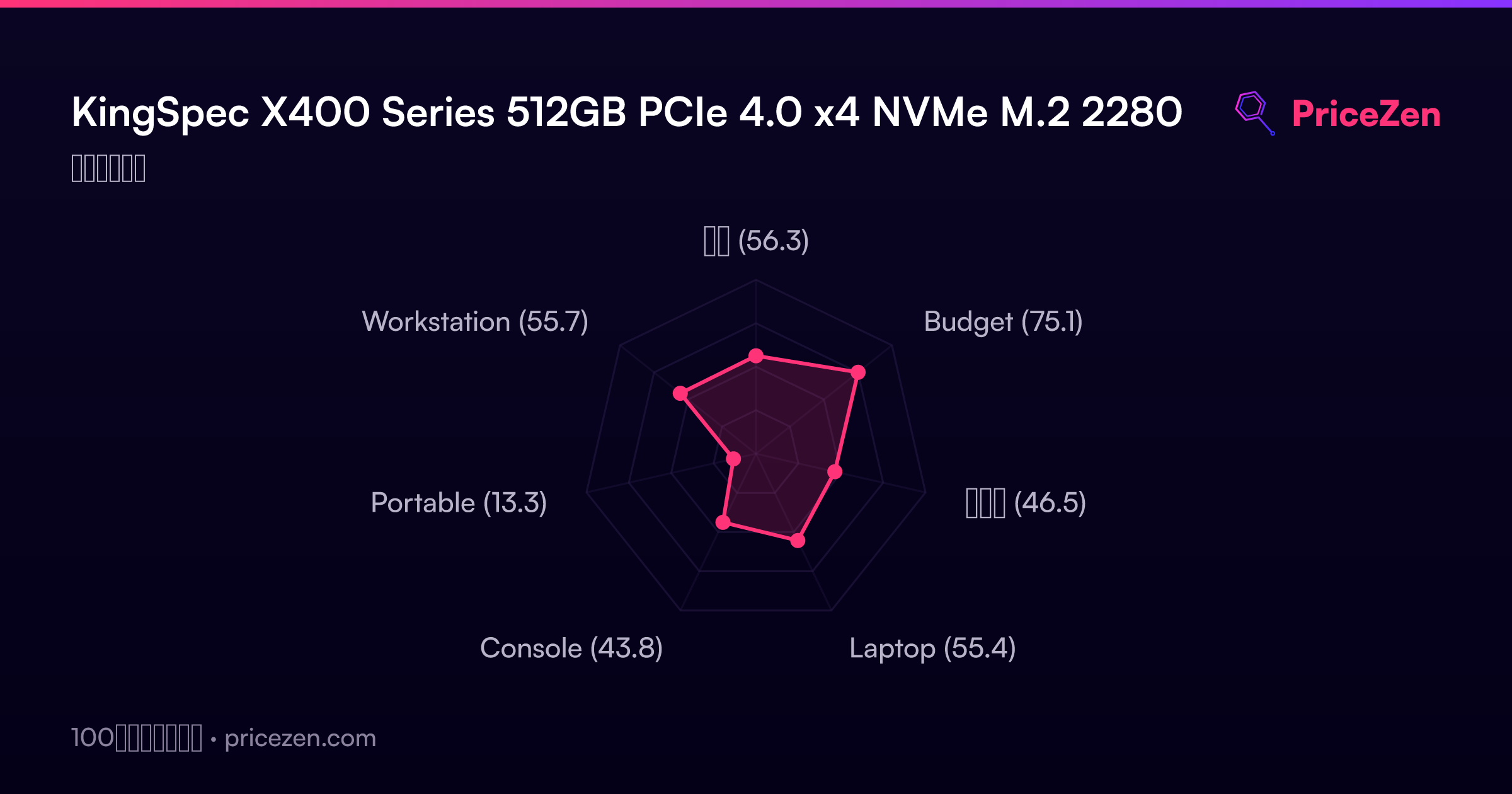
- 総合56.3
- Budget75.1
- ゲーム46.5
- Laptop55.4
- Console43.8
- Portable13.3
- Workstation55.7