Fujifilm GF 30mm f/5.6 T/S medium-format
Offering ±15mm shift and ±10° tilt with medium-format coverage, this 30mm prime delivers precise perspective control for architecture and product photography. Its 16-element optical design with three aspherical and three ED elements ensures edge-to-edge sharpness across the large GFX sensor, while the 0.21x magnification allows close-up detail work. This manual-focus lens is best for architectural photographers and studio professionals who require extensive movements to correct distortion and control depth of field.












概要
The 30-Second Version
The Fujifilm GF 30mm f/5.6 T/S is a native tilt-shift lens for GFX medium format that delivers excellent optical quality with ±8.5° tilt and ±15mm shift. At $4,500 USD it's a professional tool aimed at architectural and studio shooters who need precise perspective control. The trade-offs are real: manual focus only, no weather sealing, f/5.6 max aperture, and 1340g of weight. If you shoot architecture on GFX, this is the best native option available.
Pros & Cons
長所
- Excellent optical quality at the 88th percentile for tilt-shift lenses 90th
- Native GFX mount with full metadata communication for LCC workflow 78th
- ±15mm shift and ±8.5° tilt with ±90° rotation for flexible movements
- Tripod collar maintains optical axis during shift for clean stitching
- 30mm focal length is ideal for architecture and interior work on GFX
短所
- Manual focus only, no autofocus at all
- No weather sealing despite the professional price tag
- Heavy at 1340g, especially for field work
- f/5.6 maximum aperture limits low-light handheld use
- 105mm filter thread means buying a whole new filter set
実証データ
Performance
The optical performance is where this lens earns its keep. Our database puts it at the 88th percentile for optical quality among tilt-shift lenses, which translates to genuinely excellent sharpness across the frame, even when shifted. The 3 aspherical elements help keep distortion low, which matters a lot when you're photographing buildings with straight lines everywhere. The 3 ED elements handle chromatic aberration well, so you won't see ugly purple fringing on high-contrast edges like tree branches against a bright sky. At f/5.6 wide open, center sharpness is strong, and stopping down to f/8 or f/11 brings the corners into line nicely. For a lens that's going to spend most of its life on a tripod at f/8 to f/11, this is exactly what you want.
The minimum focus distance of 300mm gives you a 0.21x maximum magnification, which is decent for a wide angle. You can get close enough to emphasize foreground elements in landscape shots or capture detailed product shots with controlled focus falloff. The 9-blade diaphragm produces reasonably smooth out-of-focus areas, though the bokeh score sits at the 8th percentile, which tells you this isn't a lens for creamy background blur. At f/5.6 on medium format, you can get some subject separation, but the aperture ranking of 5th percentile confirms what the spec sheet says: this is not a fast lens. You're buying it for depth of field control through tilt, not for shallow depth of field through aperture.
Specifications
Full Specifications
Optics
| Type | Tilt-shift |
| Focal Length Min | 30 |
| Focal Length Max | 30 |
| Elements | 16 |
| Groups | 11 |
| Aspherical Elements | 3 |
| ED Elements | 3 |
| Coating | Nano GI coating |
Aperture
| Max Aperture | f/5.6 |
| Min Aperture | f/32 |
| Constant | Yes |
| Diaphragm Blades | 9 |
Build
| Mount | Fujifilm G |
| Format | medium-format |
| Weight | 1.3 kg / 3.0 lbs |
| Filter Thread | 105 |
AF & Stabilization
| AF Type | manual focus only |
| Stabilization | No |
Focus
| Min Focus Distance | 300 |
| Max Magnification | 0.21x |
vs Competition
The most obvious competitor is the Canon TS-E 24mm f/3.5L II, which has been the go-to tilt-shift lens for adapted use on GFX cameras. The Canon is faster at f/3.5, has weather sealing, and costs significantly less on the used market. But it's a 24mm full-frame lens, so on a GFX sensor you're getting a wider field of view and pushing the image circle harder when you shift. The Fujifilm's 30mm focal length is better matched to the GFX sensor's crop factor, and the native mount means no adapter wobble or electronic communication issues. The Canon also lacks the metadata integration that makes the Fujifilm's LCC workflow smoother.
Nikon's PC-E 24mm f/3.5D ED is another adapted option, but it's older, has a reputation for being fiddly with its tilt-shift mechanism, and requires a third-party adapter for GFX. The Sigma 16-300mm and Tamron 28-300mm that show up in our competitor list are completely different animals, superzoom travel lenses that happen to share a price bracket or category in our database. They're not real alternatives for tilt-shift work. If you need tilt-shift on GFX, the Fujifilm is really the only native game in town, and that's a big part of its appeal. You're not choosing between five options. You're choosing between this and a workaround.
| Spec | Fujifilm GF 30mm f/5.6 T/S | Sigma 12-24mm f/4 DG HSM Art | Canon RF 200-800mm f/6.3 IS USM | Nikon PC-E NIKKOR 24mm f/3.5D ED |
|---|---|---|---|---|
| Focal Length | 30mm | 12-24mm | 200-800mm | 24mm |
| Max Aperture | f/5.6 | f/4 | f/6.3 | f/3.5 |
| Mount | Fujifilm G | Nikon F | Canon RF | Nikon F |
| Format Coverage | medium-format | full-frame | full-frame | full-frame |
| Stabilization | No | No | Yes | Yes |
| Weather Sealed | No | Yes | No | No |
| Weight (g) | 1340 | 1148 | 3175 | 730 |
| AF Type | manual focus only | HSM | USM | Manual Focus |
| Lens Type | tilt-shift | zoom | telephoto | tilt-shift |
| Compare | Compare | Compare |
| 製品 | AF | Bokeh | Build | Macro | Reach | Video | Optical | Aperture | Wide Angle | Portability | Versatility | Affordability | Stabilization |
|---|---|---|---|---|---|---|---|---|---|---|---|---|---|
| Fujifilm GF 30mm f/5.6 T/S | 21.8 | 10.6 | 30.3 | 61.2 | 15.6 | 27.5 | 89.6 | 5.5 | 78.1 | 12.2 | 32.6 | 7.7 | 41.4 |
| Sigma 12-24mm f/4 DG HSM Art Compare | 83.5 | 12.8 | 77 | 57.9 | 15.6 | 57.5 | 98.1 | 16.1 | 95.3 | 16 | 70.5 | 27.9 | 41.4 |
| Canon RF 200-800mm f/6.3 IS USM Compare | 83.5 | 67 | 30.3 | 0 | 97.4 | 27.5 | 0 | 3.9 | 6.4 | 1.4 | 88.6 | 16.6 | 89.9 |
| Nikon PC-E NIKKOR 24mm f/3.5D ED Compare | 21.8 | 14.7 | 30.3 | 82.2 | 15.6 | 27.5 | 86.1 | 25.2 | 73.9 | 32.5 | 32.6 | 9.6 | 83.5 |
価格
Value & Pricing
At $4,500 USD, this lens is a serious investment. But context matters. The GFX system itself is expensive, and the people buying into it are typically professionals or serious enthusiasts who understand that medium format glass costs real money. Compared to adapting a Canon TS-E 24mm f/3.5L II, which runs around $2,000 USD used but requires an adapter and loses native metadata, the Fujifilm option starts to look more reasonable. You're paying for native integration, a larger image circle designed specifically for the GFX sensor, and the convenience of having tilt and shift data baked into your RAW files.
That said, the value proposition depends entirely on how often you'll use it. If you shoot architecture weekly, this lens pays for itself in saved post-production time and better stitched panoramas. If you're a landscape shooter who occasionally wants to try tilt-shift, renting might make more sense. The lack of weather sealing at this price point stings, especially since Fujifilm's own GFX bodies are weather sealed. You're getting a specialized tool with excellent optics, but the build quality ranking of 12th percentile suggests Fujifilm prioritized the optical design over ruggedness.
価格履歴
詳細情報
Overview
The Fujifilm GF 30mm f/5.6 T/S is a niche tool for a niche system, and it knows exactly what it is. This is a native tilt-shift lens for GFX medium format cameras, aimed at architectural shooters, landscape photographers who stitch panoramas, and studio product folks who need precise control over the plane of focus. At 30mm on a GFX sensor, you're getting roughly a 24mm full-frame equivalent field of view, which is the classic wide angle sweet spot for buildings and interiors. The headline features are ±8.5° of tilt and ±15mm of shift, with the whole tilt-shift assembly rotating ±90° so you can swing the movements in whatever direction the shot demands.
What makes this lens interesting is that it's one of very few native tilt-shift options for the GFX mount. Before this, GFX shooters had to adapt Canon TS-E glass or use third-party solutions, which always came with compromises in image circle coverage, metadata, or mechanical precision. Fujifilm built this from the ground up for the 44x33mm sensor, and the 16-element, 11-group optical design with 3 aspherical and 3 ED elements suggests they took the image circle requirements seriously. Shift movements eat up image circle fast, and a lens that can't cover the sensor when shifted is just an expensive paperweight.
But let's be real about the trade-offs up front. This is a manual focus only lens with no stabilization, no weather sealing, and a maximum aperture of f/5.6. It weighs 1340g, which is heavier than some GFX camera bodies. The filter thread is a massive 105mm, so your existing filter kit probably won't fit. And the price, around $4,500 USD, puts it firmly in the professional tool category. This isn't a lens you buy on a whim. It's a lens you buy because you shoot architecture for a living or you're deep enough into landscape work that tilt-shift stitching has become part of your workflow.
Common Questions
Q: Can I use this lens handheld?
Technically yes, but it's not really designed for that. At 1340g with no stabilization and an f/5.6 maximum aperture, you'll need fast shutter speeds and steady hands to get sharp results. The tilt and shift movements are also much easier to control precisely when the camera is locked down on a tripod. Most shooters will use this lens on a tripod for the vast majority of their work.
Q: Does the tilt and shift data get recorded in the image files?
Yes, that's one of the key advantages of this native lens. The GF30mm f/5.6 T/S communicates with GFX camera bodies and records the tilt and shift adjustments in the file metadata. This makes Lens Cast Calibration (LCC) corrections in post-production much more accurate, since the software knows exactly what movements were applied when the shot was taken.
Q: Is this lens weather sealed?
No, the GF30mm f/5.6 T/S does not have weather sealing. This is a notable omission for a lens at this price point, especially since many GFX camera bodies are weather sealed. If you shoot in rain, dust, or snow, you'll need to take extra precautions to protect the lens, particularly around the tilt-shift mechanism where there are more moving parts and potential entry points for moisture and debris.
Q: What filter size does this lens use?
The filter thread is 105mm, which is quite large. Most photographers won't already own filters in this size, so you'll likely need to budget for a new set of ND or polarizing filters if you plan to use them. Step-up rings from smaller filters won't work well here because the lens needs the full 105mm opening to avoid vignetting, especially when shifted.
Who Should Skip This
If you're not shooting architecture, interiors, or studio product work on a regular basis, this lens is probably overkill. The manual focus only design and f/5.6 aperture make it a poor choice for anything involving moving subjects, which is reflected in the wildlife and sports score of 14.9 out of 100. If you need a general-purpose wide angle for your GFX camera, the GF 30mm f/3.5 R WR is lighter, faster, has autofocus, and costs less than half as much. You lose the tilt-shift movements, but for most shooters that's a fair trade.
Landscape photographers who hike long distances should also think carefully. The 1340g weight plus the lack of weather sealing makes this a studio or urban lens more than a backcountry lens. If you're shooting in challenging conditions, a weather-sealed prime with focus stacking in post will often get you similar results with less hassle. And if you're on a budget, adapting a used Canon TS-E lens is still a viable path, just be prepared for the adapter quirks and missing metadata.
Verdict
For architectural photographers working on the GFX system, this lens is close to a no-brainer. The optical quality is excellent, the movements are precise, and the native integration saves real time in post. The 30mm focal length hits the sweet spot for building exteriors and interiors, and the tripod collar design that keeps the optical axis stable during shift is a thoughtful touch that makes stitched panoramas noticeably cleaner. If you're billing clients for architectural work, the $4,500 price tag is a business expense that pays for itself.
For landscape photographers, the calculus is a bit different. The tilt function is genuinely useful for keeping foreground and background sharp without focus stacking, and the shift function makes multi-shot panoramas much easier to stitch cleanly. But the weight and lack of weather sealing make it less appealing for backcountry work. If you're hiking miles to a location, 1340g of lens plus a GFX body plus a tripod is a lot to carry. In that case, you might be better off with a lighter prime and focus stacking in post. For studio product photographers, the tilt movements offer creative control you can't get any other way, but the f/5.6 aperture means you'll need good lighting.
Usage Scores
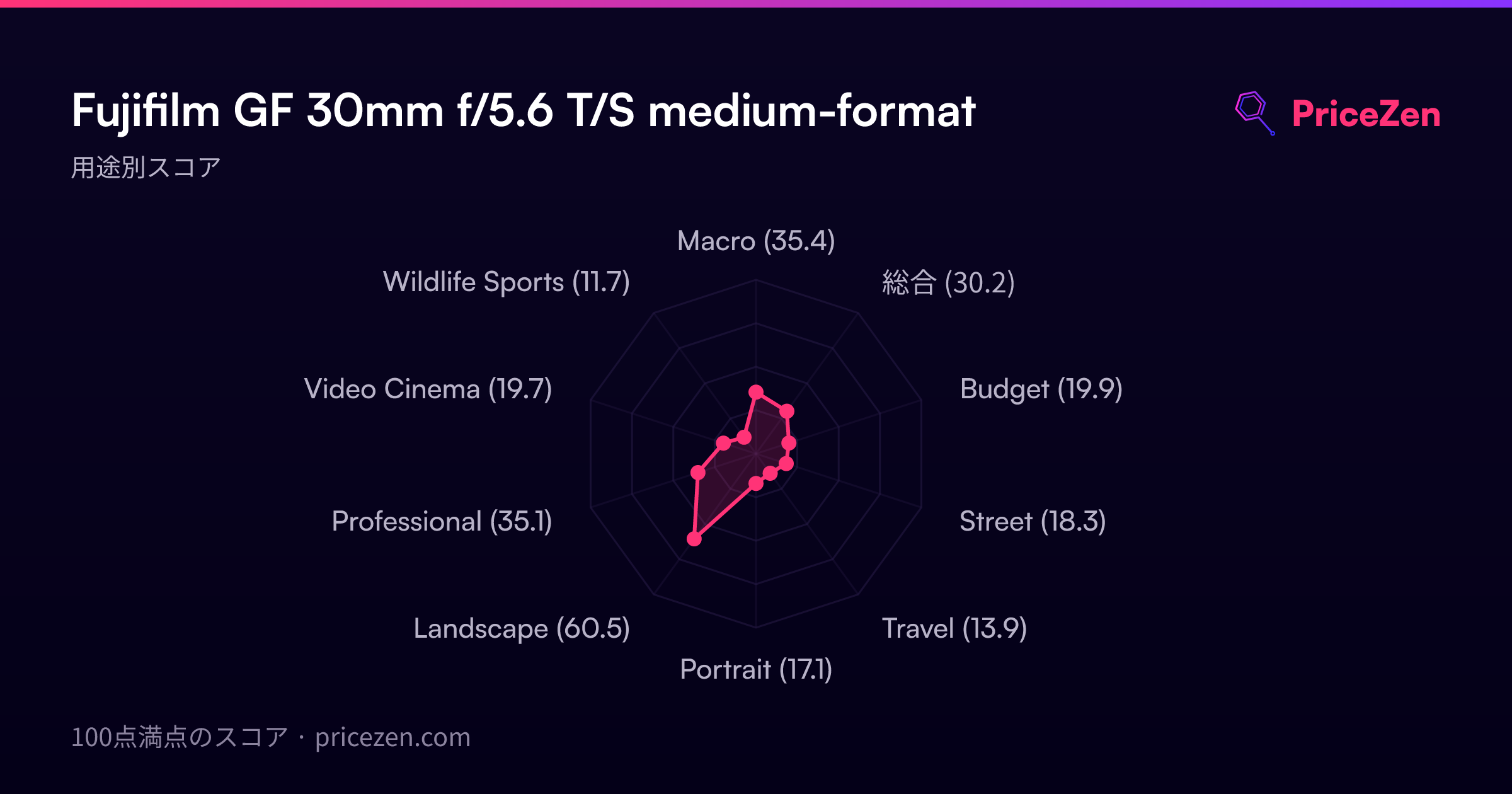
- Macro35.4
- 総合30.2
- Budget19.9
- Street18.3
- Travel13.9
- Portrait17.1
- Landscape60.5
- Professional35.1
- Video Cinema19.7
- Wildlife Sports11.7