ASUS GeForce RTX 5090 ROG Astral 32GB GDDR7
Harnessing the NVIDIA Blackwell architecture and 32GB of GDDR7 memory, this card pushes a 2760MHz boost clock and draws up to 800 watts for extreme 4K performance. Its quad-fan design and patented vapor chamber lower GPU temperatures by over 5%, while a curved AMOLED display and transparent glass backplate add functional, premium aesthetics. This GPU is best for enthusiasts running 4K gaming and ray tracing at maximum settings who demand top-tier thermal headroom and visual customization.












概要
The 30-Second Version
A 38,958 PassMark G3D score and a 96.4/100 ray tracing rating make this the top-ranked card in our data. It also costs USD 9,400 at Amazon and pulls 800W, landing it near the bottom for both affordability and efficiency. Brilliant silicon, brutal price.
Pros & Cons
長所
- 38,958 PassMark G3D score, top of our charts for both raster and compute 100th
- Ray tracing score of 96.4/100, the absolute best in our ranking 100th
- 32GB GDDR7 on a 512-bit bus, one of the biggest memory setups going 99th
- AI score of 95.2/100 with 680 Tensor cores, built for local LLM work 99th
- 3x DisplayPort 2.1 and 2x HDMI 2.1 on PCIe 5.0, near the top for connectivity
短所
- USD 9,400 at Amazon, affordability ranks essentially last in our data
- 800W TDP and a 1,200W PSU ask put efficiency in the bottom fifth
- 361mm long and 4.7 slots wide, this eats a full-size case
- Thermal ranking is only middle of the pack despite quad fans and liquid metal
- Just 2 owner ratings behind that 5/5, so social proof falls behind most cards
実証データ
Performance
The spec sheet does the talking here. 21,760 CUDA cores plus 680 Tensor and 170 RT cores feed a 38,958 PassMark G3D benchmark score, and our scoring model ranks it top of the class for raster, compute and ray tracing alike. The 32GB GDDR7 pool on a 512-bit interface sits in the 97th percentile for memory, which is why the AI score lands at 95.2/100 and content creation at 95.6/100. If you're loading large models locally or chewing through 8K timelines, that VRAM headroom is the whole point, and AV1 encode plus DLSS 4 support are baked in.
Cooling is where ASUS threw everything at the wall: four fans claimed to lift airflow and pressure by 20%, liquid metal on the die, and a patented vapor chamber with heat pipes that ASUS says drops GPU temps by over 5%. Our thermal ranking still lands it mid-pack, so treat that as competent rather than magical. The cost is physical and electrical: 361mm long, 4.7 slots thick, 800W TDP with a 1,200W PSU recommendation, fed by a single 16-pin connector or dual input via the detachable GC-HPWR adapter on BTF boards. Measure your case twice. Then measure it again.
Specifications
Full Specifications
Chipset
| GPU Chipset | GeForce RTX 5090 |
| Brand | NVIDIA |
| Architecture | Blackwell |
| Class | consumer |
Memory
| VRAM | 32 GB |
| Memory Type | GDDR7 |
| Memory Bus | 512 |
Compute
| CUDA Cores | 21760 |
| Tensor Cores | 680 |
| RT Cores | 170 |
| Base Clock | 2730 |
| Boost Clock | 2760 |
Performance
| PassMark G3D | 38958 |
| GPU Compute | 24458 |
Power & Cooling
| TDP | 800 |
| Recommended PSU | 1200 |
| Power Connectors | 1 x 16-pin |
| Cooler | Fan |
| Fans | 4 |
Connectivity
| Interface | PCI Express 5.0 |
| DisplayPort | 3 |
| HDMI | 2 |
| Max Displays | 4 |
| Max Resolution | 8K (4320p) |
Physical
| Length | 361 |
| Slot Width | 4.7 |
| Form Factor | Full Height |
| Weight | 3.3 kg / 7.3 lbs |
Features
| Ray Tracing | Yes |
| Upscaling | DLSS 4 |
| AV1 Encode | Yes |
| VR Ready | Yes |
| DirectX | 12 |
| RGB | Yes |
vs Competition
Against the MSI GeForce RTX 5090 Gaming Trio, this is the same chipset fight, and the Astral's argument is the extras: 32GB of GDDR7, the 96.4/100 ray tracing score, and a connectivity ranking in the 99th percentile thanks to those three DP 2.1 and two HDMI 2.1 outputs. If you just want Blackwell flagship performance, cross-shop the MSI hard before paying anniversary-edition money. The Gigabyte GeForce RTX 5080 AERO OC, ZOTAC GeForce RTX 5080 AMP Extreme Infinity and PNY GeForce RTX 5080 ARGB OC are the sensible-money options, but our top-of-the-charts compute and near-best VRAM rankings are exactly what you give up stepping down. And the ASRock Radeon RX 7900 XTX Phantom Gaming? Only worth a look if ray tracing and AI aren't on your list, because those are this card's two strongest scores.
価格
Value & Pricing
Let's not pretend: USD 6,000 to USD 9,400 across two US listings is a USD 3,400 spread, and the only in-stock store price we're tracking right now is Amazon at USD 9,400, the top of that range. In Europe it's EUR 14,222 to EUR 17,306 across four listings, a EUR 3,084 gap, with GBP 15,219 in the UK and JPY 2,505,993 in Japan. What you're buying is a limited 20th-anniversary edition with an AMOLED screen and a glass backplate on top of flagship silicon, and our budget score of 65.2/100 is the weakest thing about it. We track prices over time, partly through our community browser extension, and if you want this card, watching for the low end of that spread matters more than usual.
Amazon 1件の価格 最安 ¥2,505,993
2026年11月25日からこの製品の価格を追跡しています。データが増えるとチャートが表示されます。
詳細情報
Overview
38,958 in PassMark G3D, and our ranking puts this card at the very top of the charts for both ray tracing and compute. That's the headline: ASUS took NVIDIA's Blackwell flagship, gave it 21,760 CUDA cores, 32GB of GDDR7 on a 512-bit bus and a 2,760MHz boost clock, then wrapped it in a curved AMOLED display and a glass backplate for ROG's 20th anniversary. On paper it's about as much graphics card as you can currently bolt into a desktop.
And then there's the other number: USD 9,400 at Amazon, with US listings spanning USD 6,000 to USD 9,400. Our affordability score is 1 out of 100, which is as close to dead last as our model gets. So this is a two-sided story. Best-in-class silicon, collector-tier pricing, and an 800W power draw that makes the efficiency ranking (17th percentile) look exactly like you'd expect.
Common Questions
Q: What power supply do I need for this thing?
ASUS specs an 800W TDP and recommends a 1,200W PSU. There's a single 16-pin connector, or you can use dual power input via the detachable GC-HPWR adapter with a BTF motherboard plus a 12V-2x6 cable from the supply. Our efficiency ranking puts it in the bottom fifth of cards, so plan your build around that draw.
Q: Will it fit in my case?
Check carefully. It's 361mm long and occupies 4.7 slots, so most mid-towers and anything compact are out. The quad-fan cooler, vapor chamber and liquid metal are what earn that bulk, though our thermal ranking still only places it mid-pack.
Q: Is it actually good for running AI models locally?
Yes, that's one of its strongest cases. 32GB of GDDR7 on a 512-bit bus ranks among the very best for memory capacity, 680 Tensor cores push the AI score to 95.2/100, and compute sits at the top of our charts. Content creation scores 95.6/100 too, with AV1 encode on board.
Who Should Skip This
Gamers on any kind of budget should walk away. Affordability ranks 1st percentile, meaning basically last, and USD 9,400 buys you an AMOLED screen and a glass backplate, not extra frames over other RTX 5090 cards like the MSI Gaming Trio. Skip it too if your PSU is under the recommended 1,200W, your case can't clear 361mm and 4.7 slots, or you care about power bills, because the 800W TDP lands efficiency in the bottom fifth. And with only 2 owner reviews behind that 5/5, there's very little long-term owner data to lean on yet.
Verdict
If you need the fastest ray tracing and compute our model currently ranks, plus 32GB for local AI or heavy creation work, this delivers, and the 95-plus scores in all three of its best-use categories back that up. But nobody should buy this at USD 9,400 for gaming alone. It's a halo product for people who want the anniversary edition specifically, have a 1,200W PSU and a case that swallows 361mm and 4.7 slots. Everyone else: the performance is real, the premium is a choice.
Usage Scores
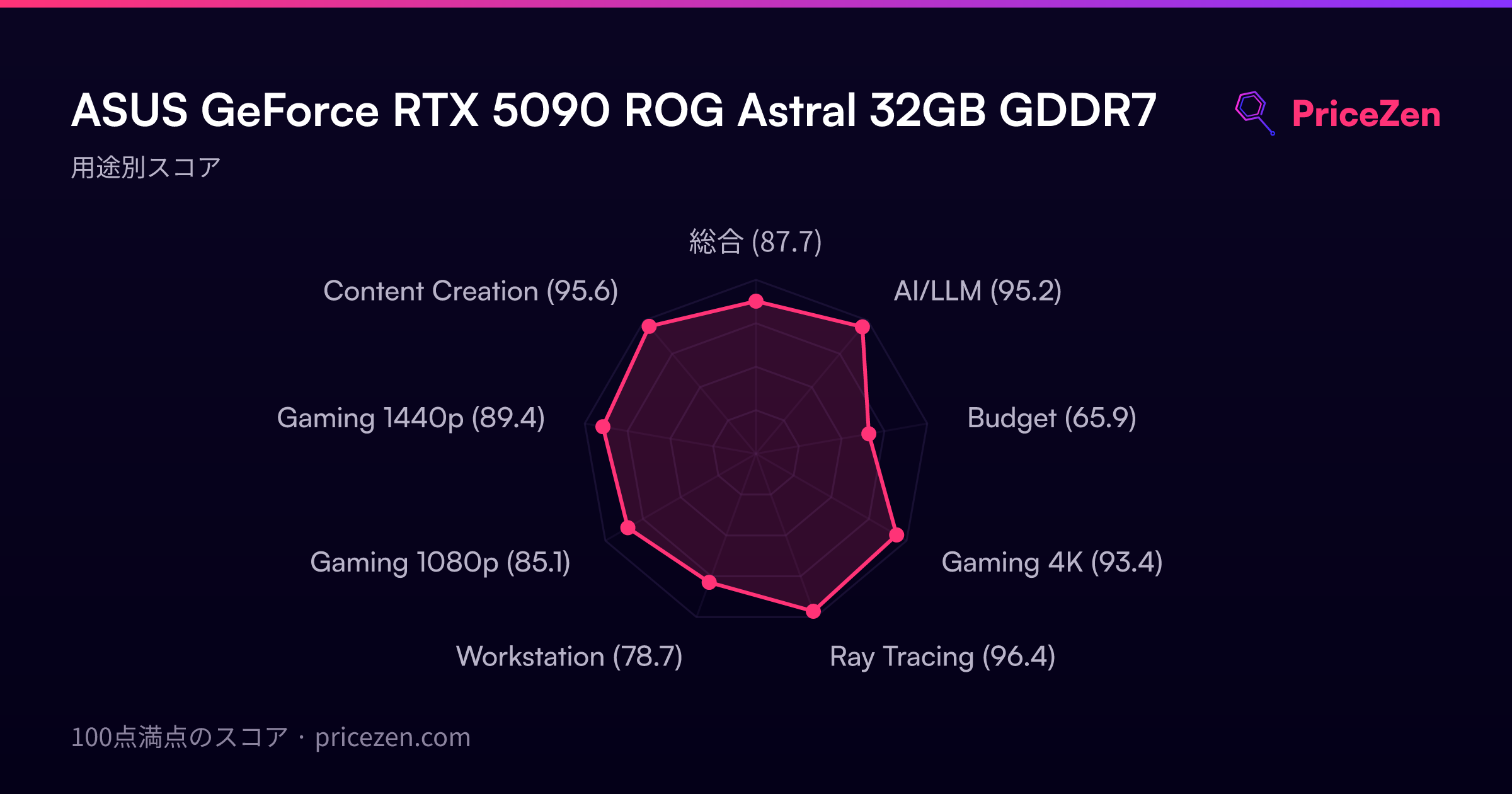
- 総合87.7
- AI/LLM95.2
- Budget65.9
- Gaming 4K93.4
- Ray Tracing96.4
- Workstation78.7
- Gaming 1080p85.1
- Gaming 1440p89.4
- Content Creation95.6