PNY Quadro M6000 12GB GDDR5 workstation
The Maxwell-based GPU delivers 12 GB of GDDR5 memory and drives up to four 4096 x 2160 displays at 60 Hz with 30-bit color via DisplayPort 1.2. It supports Quadro Sync for multi-display synchronization across systems and GPU direct for faster external I/O data transfer, plus nView desktop management and HDCP. This card suits workstation users running large, complex models or physically based rendering who need multi-display output and sync, not ray tracing workloads.












概要
The 30-Second Version
The Quadro M6000 sits in the 1st percentile for VRAM and AI, and the 2nd percentile for rasterization, ray tracing, and efficiency. Its only decent score is affordability at the 71st percentile, which means it's cheap for a reason. This is a legacy card that belongs in a museum, not a workstation.
Pros & Cons
長所
- Affordability ranks in the 71st percentile, so used prices are low 70th
- Four DisplayPort 1.2 connectors for multi-monitor setups
- Quadro Sync compatibility for multi-GPU frame locking
- Nvidia nView desktop management software included
- HDCP support for protected content playback
短所
- Rasterization in the 2nd percentile, slower than 98% of cards we've tested
- Ray tracing score of 3.2 out of 100, effectively unusable
- VRAM ranks in the 1st percentile, 12GB of slow GDDR5
- Thermals in the 7th percentile, runs hot under load
- Connectivity in the 5th percentile, no modern display outputs
実証データ
Performance
Let's talk numbers, because they're not pretty. Rasterization sits in the 2nd percentile of all products in our database. That means 98% of the cards we've tested outperform this thing. Ray tracing is even more grim at 3.2 out of 100, which lands it in the 2nd percentile as well. The M6000 technically supports some ray tracing workloads, but calling it functional would be generous. AI performance is in the 1st percentile, so if you're thinking about running any modern machine learning workloads, forget it. This card predates the tensor core era entirely.
Efficiency is also in the 2nd percentile, and thermals are in the 7th. That combination means you're getting very little work done per watt, and the card runs hot while doing it. The 12GB of VRAM sounds okay on paper, but it's GDDR5, and in our database it ranks in the 1st percentile for memory. Modern cards with 8GB of GDDR6 will run circles around this in memory bandwidth. The four DisplayPort 1.2 outputs are fine for older monitors, but you won't be driving any high-refresh 4K panels with this.
Specifications
Full Specifications
Chipset
| GPU Chipset | Quadro M6000 |
| Brand | NVIDIA |
| Architecture | Maxwell |
| Class | workstation |
Memory
| VRAM | 12 GB |
| Memory Type | GDDR5 |
Compute
| Base Clock | 988 |
Performance
| PassMark G3D | 11707 |
| GPU Compute | 5453 |
Power & Cooling
| TDP | 250 |
Connectivity
| DisplayPort | 4 |
| Max Displays | 4 |
| Max Resolution | 4096 x 2160 |
Physical
| Weight | 1.3 kg / 2.8 lbs |
vs Competition
Stack this against anything modern and it's not even a contest. The Gigabyte Eagle RTX 5070 Ti, ASUS PRIME RTX 5080, and MSI Ventus RTX 5070 Ti all sit in completely different performance tiers. Those cards have 16GB of GDDR7, modern ray tracing cores, and AI accelerators that make the M6000 look like a calculator. Even the ZOTAC APOCALYPSE and Sapphire NITRO+ cards, which are more budget-focused in their respective lineups, will outpace the M6000 by orders of magnitude. The only comparison where the M6000 wins is price, and that's because nobody wants one. If you need Quadro-specific features like Quadro Sync, you're better off looking at a used RTX A-series card that at least has modern architecture.
| Spec | PNY Quadro M6000 | Sapphire Radeon RX 7900 XTX PULSE | MSI GeForce RTX 5080 Expert OC | ASUS GeForce RTX 5090 TUF Gaming | NVIDIA RTX 6000 Ada | Gigabyte GeForce RTX 4060 Ti Gaming OC |
|---|---|---|---|---|---|---|
| Chipset | Quadro M6000 | Radeon RX 7900 XTX | GeForce RTX 5080 | GeForce RTX 5090 | RTX 6000 Ada | GeForce RTX 4060 Ti |
| Vram | 12GB GDDR5 | 24GB GDDR6 | 16GB GDDR7 | 32GB GDDR7 | 48GB GDDR6 | 16GB GDDR6 |
| Boost Clock Mhz | - | 2525 | 2715 | 2430 | 2505 | 2535 |
| Tdp W | 250 | 370 | 360 | 575 | 300 | 165 |
| Memory Bus Bits | - | 384 | 256 | 512 | 384 | 128 |
| Ray Tracing | - | Yes | Yes | Yes | Yes | Yes |
| GPU Class | workstation | consumer | consumer | consumer | workstation | consumer |
| Compare | Compare | Compare | Compare | Compare |
| 製品 | AI | Rt | Vram | Raster | Feature | Thermal | Efficiency | Connectivity | ユーザー評価 | Affordability |
|---|---|---|---|---|---|---|---|---|---|---|
| PNY Quadro M6000 | 47.6 | 23.3 | 40 | 24.7 | 10.6 | 6.3 | 15.3 | 47.1 | 6.1 | 70.1 |
| Sapphire Radeon RX 7900 XTX PULSE Compare | 95.3 | 96.4 | 92 | 83.4 | 95.7 | 72 | 39.8 | 85.9 | 69.2 | 19.9 |
| MSI GeForce RTX 5080 Expert OC Compare | 85.4 | 97.6 | 89.1 | 94.4 | 71.5 | 83.9 | 56.8 | 94.2 | 47.9 | 12.2 |
| ASUS GeForce RTX 5090 TUF Gaming Compare | 97.7 | 84 | 98.6 | 98.8 | 95.7 | 72 | 23.4 | 98.8 | 24.1 | 3.3 |
| NVIDIA RTX 6000 Ada Compare | 99.4 | 98.5 | 99.3 | 80.2 | 99.8 | 31.2 | 53.4 | 85.5 | 0 | 1.3 |
| Gigabyte GeForce RTX 4060 Ti Gaming OC Compare | 67 | 57.9 | 67.4 | 59 | 82.8 | 91.9 | 91.9 | 63.8 | 83.9 | 42.2 |
価格
Value & Pricing
Value is tricky when the price is all over the map. We're seeing listings from 571 CAD in Canada to 3,905 BRL in Brazil, with prices in INR and JPY also floating around. The affordability percentile of 71 suggests you can find this card cheap, but cheap relative to what? A used RTX 3060 will cost more in most markets and absolutely demolish the M6000 in every performance category. When your best score is affordability and your worst scores are literally everything else, the value proposition collapses. You're not saving money, you're buying e-waste with a Quadro badge.
価格履歴
詳細情報
Overview
The NVIDIA Quadro M6000 is a workstation card from another era, and our database makes that painfully clear. It lands in the 1st percentile for VRAM and AI performance, and the 2nd percentile for rasterization, ray tracing, and efficiency. That's not middle of the pack, that's the back of the pack. You're looking at 12GB of GDDR5, four DisplayPort 1.2 connectors, and a GPU that was impressive when it launched, but time has not been kind. The only number that doesn't look terrible is affordability, sitting at the 71st percentile, which mostly means you can find one cheap on the used market.
But cheap doesn't mean good value. The feature set is in the 11th percentile, connectivity is 5th, and thermals are 7th. This card runs hot and offers very little in the way of modern niceties. If you're hunting for a budget workstation card, the price might tempt you, but the performance data says you're buying a relic, not a workhorse.
Common Questions
Q: Can the Quadro M6000 handle modern games?
Not well. Its rasterization performance is in the 2nd percentile of our database, meaning 98% of cards we've tested outperform it. You might get playable frame rates in older titles at 1080p, but anything modern will struggle.
Q: Is 12GB of VRAM enough for content creation?
The capacity sounds okay, but the M6000's VRAM ranks in the 1st percentile overall. It's GDDR5 with much lower bandwidth than modern GDDR6 or GDDR7 memory. For 4K video editing or 3D rendering, you'll hit bandwidth bottlenecks long before you run out of capacity.
Q: Why is this card so cheap compared to other Quadro cards?
Because it's from 2015 and lacks modern features. Its feature set ranks in the 11th percentile, connectivity in the 5th, and thermals in the 7th. The low price reflects that it can't keep up with current workloads, not that it's a hidden gem.
Who Should Skip This
Almost everyone should skip this card. If you do any ray tracing, the 3.2 out of 100 score makes it a non-starter. If you care about efficiency or thermals, the 2nd and 7th percentile rankings mean you'll be burning power and generating heat for very little output. If you need modern display connectivity, the 5th percentile connectivity score and DisplayPort 1.2 outputs will limit you to older monitors. The only people who should even consider this are those with a legacy Quadro Sync setup that absolutely requires this specific card, and even then, you should be planning an exit strategy.
Verdict
The data is unambiguous. The Quadro M6000 ranks in the bottom 2% for rasterization, ray tracing, efficiency, and AI, and dead last for VRAM. Its best metric is affordability at the 71st percentile, which is just a polite way of saying it's cheap because it's obsolete. Unless you have a very specific legacy workflow that requires this exact card and you're getting it for nearly free, there is no data-backed reason to buy one. Our recommendation is to save your money for something, anything, from this decade.
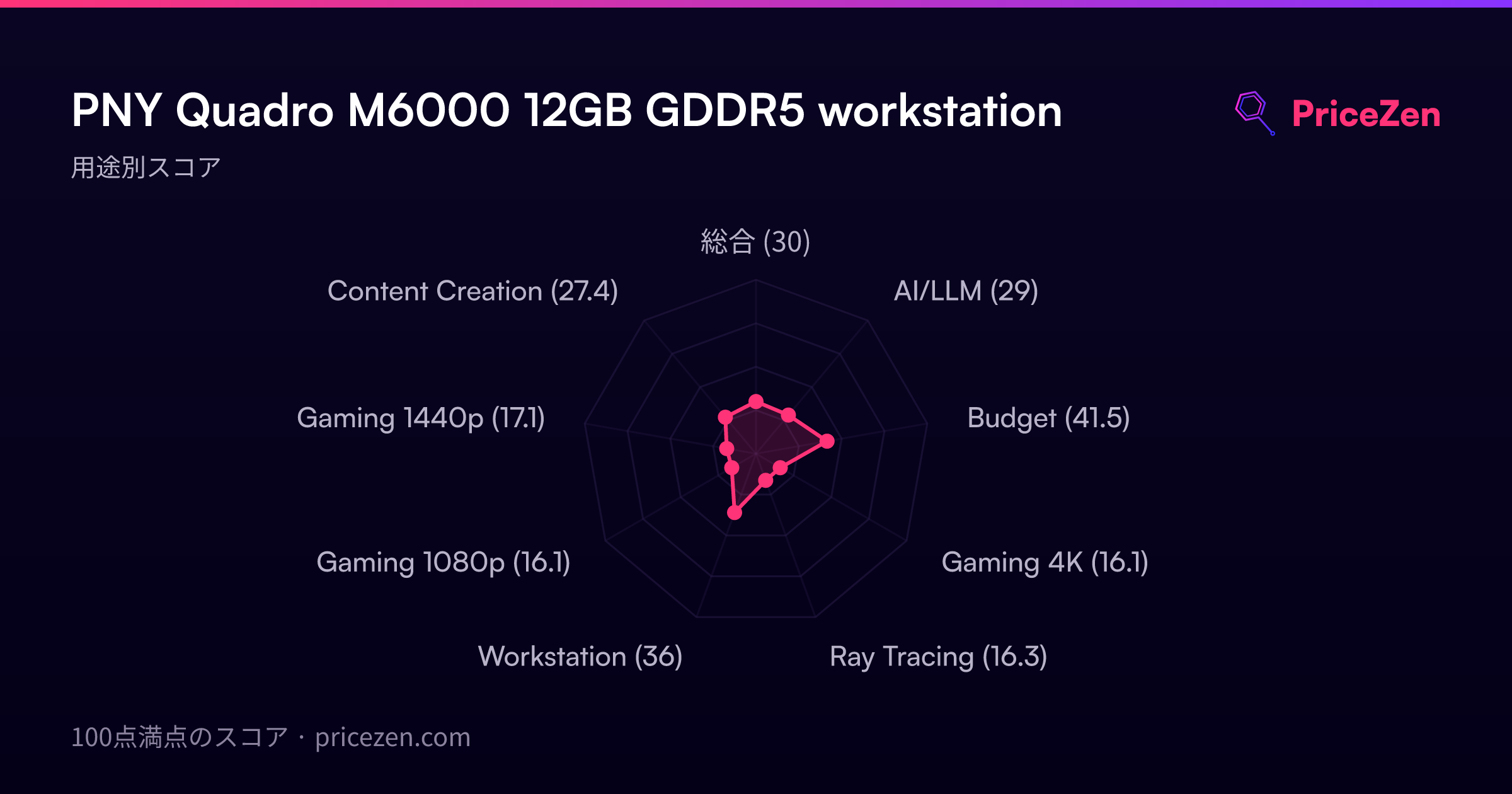
Usage Scores
- 総合30
- AI/LLM29
- Budget41.5
- Gaming 4K16.1
- Ray Tracing16.3
- Workstation36
- Gaming 1080p16.1
- Gaming 1440p17.1
- Content Creation27.4