Panasonic Lumix G DC-G9KBODY Black

60/100 総合スコア 4.8 オーナー評価261件の平均
- Type
- mirrorless
- Sensor
- 20.3MP micro-four-thirds
- Burst
- 60 fps
- Video
- 4K
- IBIS
- はい
- Weather sealed
- はい
- Weight
- 658 g
1店舗の価格を比較
安い順。新品・整備済み品・バンドルのオファーは分けて表示するので、同じ条件どうしで比較できます。
| 店舗 | 販売元 | カラーと状態 | 価格 | 最安との差 | 最終確認 | リンク |
|---|---|---|---|---|---|---|
| 新品1件の価格単品 | ||||||
| 過去7日間は確認していないため、これらの価格は変わっている可能性があります | ||||||
| Amazon | マーケットプレイス出品者 | 記載なし | ¥367,194 | 11月3日 | 店舗へ | |
 出典: PriceZen, 2026年11月3日に確認
過去7日以内に確認した価格を「現在の価格」としています。 「マーケットプレイス出品者」とは、その店舗自身ではなく、店舗上の第三者の出品者を指します。
価格履歴
その日に確認その日は未確認、オファーは継続中
出典: PriceZen, checked 2026年11月3日











概要
The 30-Second Version
The G9 is among the best for burst shooting and stabilization, making it a speed demon for stills. But autofocus is below average and the fixed display hurts for video. At $947, up about 82% from its previous low, it's a tough sell unless you specifically need the speed and the weather sealing.
Pros & Cons
長所
- 20fps mechanical and 60fps electronic burst shooting, 92nd percentile 98th
- 6.5-stop IBIS stabilization, 94th percentile 95th
- Weather-sealed magnesium alloy body, 96th percentile build quality 95th
- 3.7M-dot EVF, 93rd percentile 95th
- 4K 60p 10-bit video and RAW output
短所
- Autofocus ranks in the 36th percentile, DFD contrast-detect can hunt
- Fixed 3-inch display, 30th percentile
- 20.3MP Micro Four Thirds sensor, 47th percentile
- Battery life is average at best, 47th percentile
- Vlogging score of 37.5 out of 100
オーナーの声
購入者の評価が時間とともにどう変化したか
独自顧客が実際にレビューを書いた時期に基づいています。発売当初の高評価が続いたかどうかがわかります。
書かれたレビュー 3件、2024/03~2026/02:満足 3件
ストア評価全261件:4.8★。 多くの購入者はレビューを書かずに評価だけを付けています。 グラフは書かれたレビュー3件を数えています。
各点は書かれたレビュー1件で、書かれた月に置いています。満足 = 4〜5★、普通 = 3★、不満 = 1〜2★。
実証データ
Performance
The burst numbers are the headline here. 20fps with the mechanical shutter and 60fps with the electronic shutter put the G9 in the 92nd percentile for burst shooting. That's genuinely fast, the kind of speed that makes a difference when you're tracking a bird in flight or a runner crossing the finish line. The 20.3MP Live MOS sensor is middle of the pack at the 47th percentile, so you're trading some resolution and low-light headroom for that speed. ISO tops out at 25600, which is fine but not class-leading.
The stabilization is where this camera really earns its keep. The 5-axis Dual I.S. 2.0 system with 6.5 stops of compensation ranks in the 94th percentile. Handheld shots at slow shutter speeds feel almost unfair. The 3.7M-dot EVF is also a standout, sitting in the 93rd percentile. It's big, sharp, and usable in direct sunlight. Video is solid at the 75th percentile with 4K 60p 8-bit and 4K 30p 10-bit internal recording, plus RAW video output. But the autofocus is the weak link, ranking in the 36th percentile. Panasonic's DFD contrast-detect system is fast in good light but can hunt in low light or with fast-moving subjects.
Specifications
Full Specifications
Sensor
| Type | CMOS |
| Size | micro-four-thirds |
| Megapixels | 20.3 MP |
Shooting
| Burst (Mechanical) | 60 |
| Burst (Electronic) | 60 |
| Electronic Shutter | Yes |
Video
| Max Resolution | 4K |
| 10-bit | Yes |
| RAW Video | Yes |
Display & EVF
| Screen Size | 3" |
| EVF Resolution | 3.68 M dots |
Build
| Weather Sealed | Yes |
| Weight | 0.7 kg / 1.5 lbs |
Connectivity
| Wi-Fi | Yes |
vs Competition
The current top five in our ranking are the Sony FX30, Fujifilm X-H2, Nikon Z6 III, OM System OM-1 Mark II and Canon EOS R6 Mark III, and the G9 has to fight for its place against all of them. Where it holds ground is physical: build quality is among the best, with a weather-sealed magnesium alloy body at 658g, stabilization is also among the best with 6.5 stops, and burst speed is near the top with 20fps mechanical or 60fps electronic bursts. Its 3.7M-dot EVF also ranks near the top, so the viewfinder experience is not the compromise here.
The gaps are elsewhere. The 20.3MP Micro Four Thirds sensor is about average, and autofocus is below average, which is the number that decides most of these matchups. Video ranks above average with 4K 60p 8-bit and 4K 30p 10-bit internal recording plus RAW output, respectable but not the reason to pick it over the video-leaning bodies in this group. At $947, the G9 needs speed and durability to be your top priorities, because on sensor and autofocus it gives ground to the rest of the field.
| Spec | Panasonic Lumix G DC-G9KBODY | Fujifilm X-S20 | Canon EOS R7084C002_EDIP_1 | Nikon Z2043_EDIG_1 | OM System OM-5 Mark II V210070SU000-AG2-2 | Olympus OM-D E-M1 |
|---|---|---|---|---|---|---|
| Type | mirrorless | mirrorless | mirrorless | mirrorless | mirrorless | mirrorless |
| Sensor | 20.3MP micro-four-thirds | 26.1MP aps-c | 32MP full-frame | - | 20.4MP micro-four-thirds | 16.3MP micro-four-thirds |
| AF Points | - | - | - | - | 121 | 81 |
| Burst FPS | 60 | 30 | 40 | - | - | 10 |
| Video | 4K | 6K @60fps | 4K @120fps | 6K @120fps | 4K @30fps | 1080p |
| IBIS | Yes | Yes | Yes | Yes | Yes | Yes |
| Weather Sealed | Yes | Yes | Yes | No | Yes | Yes |
| Weight (g) | 658 | 1901 | 907 | 907 | 2304 | 443 |
| Compare | Compare | Compare | Compare | Compare |
| 製品 | AF | EVF | Build | Burst | Video | Sensor | Battery | Display | Connectivity | ユーザー評価 | Affordability | Stabilization |
|---|---|---|---|---|---|---|---|---|---|---|---|---|
| Panasonic Lumix G DC-G9KBODY | 37.1 | 92.1 | 95.1 | 94.6 | 71.7 | 46.4 | 45.9 | 27.6 | 51.9 | 97.5 | 43.9 | 94.5 |
| Fujifilm X-S20 Compare | 80.4 | 85.7 | 99.3 | 82.8 | 88.4 | 95.7 | 45.9 | 82.4 | 95.6 | 0 | 35 | 95.7 |
| Canon EOS R7084C002_EDIP_1 Compare | 80.4 | 93.9 | 98 | 90.5 | 89.5 | 62 | 45.9 | 82.4 | 54.6 | 6.3 | 22.3 | 99.6 |
| Nikon Z2043_EDIG_1 Compare | 80.4 | 37.5 | 56.7 | 32.1 | 93.5 | 50 | 99.8 | 82.4 | 85.6 | 0 | 23.8 | 97 |
| OM System OM-5 Mark II V210070SU000-AG2-2 Compare | 84.4 | 85.7 | 88.6 | 32.1 | 70.5 | 47.5 | 45.9 | 82.4 | 85.6 | 21.5 | 34.2 | 94.5 |
| Olympus OM-D E-M1 Compare | 82.4 | 85.7 | 91.5 | 68.4 | 22.1 | 18.8 | 45.9 | 82.4 | 65.3 | 72.2 | 64.1 | 87.9 |
価格
Value & Pricing
Pricing has moved sharply in the wrong direction. We track this camera's price over time, partly through our community browser extension, and the US listing now sits at $947 where it used to start at $521, roughly an 82% climb. That changes the math completely. The G9's build quality, stabilization and burst speed are still genuinely strong, but they were easy to love at the old low end. At $947 you're paying a premium for a specialist tool with a sensor and autofocus that are about average, and that's a much harder sell. If you want one, watching for the price to come back down is the sensible play.
詳細情報
Overview
The Panasonic LUMIX G9 lands in our database with a 61.7 out of 100 overall score, which sounds modest until you look at where it shines. Build quality sits in the 96th percentile, stabilization in the 94th, and burst shooting in the 92nd. This is a camera built like a tank and tuned for speed, with a 20.3MP Micro Four Thirds sensor, 20fps mechanical burst, and 60fps electronic burst. It's also weather sealed and weighs 658g, so it's ready for rough conditions without being a brick.
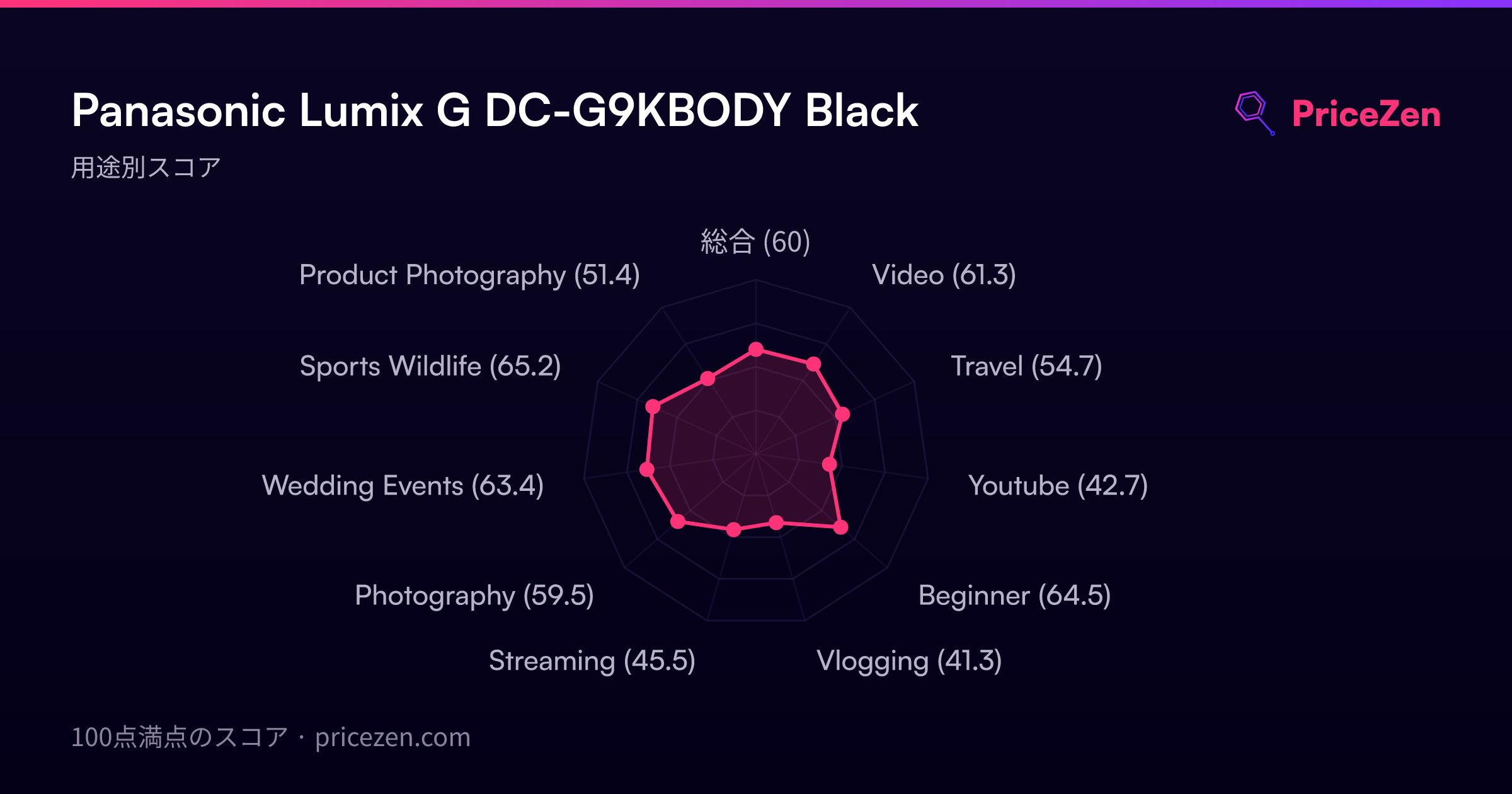
But the G9 is a specialist, not an all-rounder. It scores 64.3 for sports and wildlife and 62.3 for weddings and events, while vlogging bottoms out at 37.5. The fixed 3-inch display and mediocre autofocus ranking (36th percentile) hold it back for video-centric work. If you need a rugged, fast stills camera and don't mind the Micro Four Thirds sensor size, this thing has serious chops.
Common Questions
Q: Is the LUMIX G9 good for sports and wildlife photography?
Yes, it's one of the better options for the price. The 20fps mechanical burst and 60fps electronic burst put it in the 92nd percentile for speed, and the 6.5-stop stabilization helps with handheld telephoto shots. The main limitation is autofocus, which ranks in the 36th percentile and can struggle with erratic subject movement.
Q: How does the G9's video quality compare to newer cameras?
Video is solid but not class-leading. It records 4K 60p in 8-bit and 4K 30p in 10-bit internally, plus RAW video output over HDMI. That puts it in the 75th percentile for video. The fixed 3-inch display and contrast-detect autofocus make it less ideal for vlogging or run-and-gun work, which is reflected in its 37.5 vlogging score.
Q: Is the Micro Four Thirds sensor a dealbreaker?
It depends on what you shoot. The 20.3MP sensor ranks in the 47th percentile, so it's average for this class. You get less low-light performance and shallower depth of field control than APS-C or full-frame rivals. But the smaller sensor enables the fast burst speeds and compact lens system. For daylight sports and wildlife, it's a fair trade.
Who Should Skip This
Skip the G9 if you shoot a lot of video or need dependable autofocus. The AF ranking is the biggest red flag, and the fixed 3-inch display is near the bottom, making vlogging and low-angle work awkward. Battery life is also just average, so long shooting days will require spares. At $947, the contrast-detect AF and average sensor are a lot to accept for the money.
Verdict
The Panasonic LUMIX G9 is a specialist's camera, and the price no longer does it any favors. If you shoot sports, wildlife, or anything that demands fast bursts and rock-solid stabilization, the burst speed and stabilization still make a strong case. But if you need reliable autofocus for video or fast-moving subjects, the AF ranking will frustrate you. At $947, up roughly 82% from where we last tracked it, this is a buy only if the rugged body and burst speed are exactly what you need. Everyone else should wait for the price to settle.
Usage Scores
- 総合60
- Video61.3
- Travel54.7
- Youtube42.7
- Beginner64.5
- Vlogging41.3
- Streaming45.5
- Photography59.5
- Wedding Events63.4
- Sports Wildlife65.2
- Product Photography51.4