Titanium Micro TH7175 2TB PCIe 4.0 NVMe M.2 2280

7175 MB/s reads for quick game loads verified Nov 28
60/100 overall score
Prices checked on 1 days so far, too few to say what is usual.
- Capacity
- 2TB
- Form factor
- M.2 2280
- Interface
- PCIe 4.0
- Read speed
- 7,175 MB/s
Compare prices at 1 store
Cheapest first. New, refurbished and bundled offers are kept apart, so you compare like with like.
| Store | Sold by | Colour and condition | Price | vs lowest | Last checked | Link |
|---|---|---|---|---|---|---|
| New1 offerSingle unit | ||||||
| Amazon | Not known | Not listed | ¥88,034 | Lowest price | 3 days ago | Go to store |
 Source: PriceZen, checked Nov 25, 2026
A price counts as current when we checked it in the last 7 days. “Marketplace seller” means a third-party seller on that store, not the store itself.











Snapshot
The 30-Second Version
The Titanium Micro TH7175 is a 2TB PCIe 4.0 SSD with a blazing 7150 MB/s read speed, but it uses QLC memory that slows down when full. Pricing is inconsistent, ranging from USD 460 to USD 586 in the US, with Best Buy offering the best deal. It's a decent budget option for everyday use, but heavy users should look at TLC drives from Samsung or Kingston instead.
Pros & Cons
Pros
- Blazing 7150 MB/s sequential read speed 90th
- 2TB capacity is a great sweet spot 78th
- 7-year warranty is longer than most competitors 68th
- Works with PC, Mac, Linux, and consoles
- Phison E18 controller is proven and reliable
Cons
- QLC memory means slower writes when the drive fills up
- Random read performance is just average
- Feature set is bare bones compared to rivals
- Price varies wildly between retailers
- Unknown brand with no track record or reviews
The proof
Performance
Let's talk about that headline number first. 7150 MB/s sequential read is fast. Like, really fast. That puts it in the 89th percentile of all drives in our database, which means it's beating most PCIe 4.0 drives on the market. The write speed is a bit more modest at 5600 MB/s, but that's still plenty for moving large files around. For context, this drive will load games and boot Windows noticeably faster than any SATA SSD, and it's right up there with drives that cost a lot more.
But here's the catch: those numbers are for the drive when it's mostly empty. The TH7175 uses QLC NAND, which is cheaper to make but has a smaller SLC cache. Once you fill the drive past a certain point, write speeds can drop off a cliff. The random read performance is also just okay, sitting in the 62nd percentile. That means everyday tasks like opening apps and browsing files will feel snappy, but heavy multitasking or sustained writes might expose the drive's limits. The 700TB TBW endurance rating is decent for a QLC drive, but it's not going to win any longevity awards.
Specifications
Full Specifications
Drive
| Capacity | 2000 |
| Form Factor | M.2 2280 |
| Interface | PCIe 4.0 |
| Protocol | NVMe |
| PCIe Generation | 4 |
| External | No |
Performance
| Sequential Read (MB/s) | 7175 |
| Sequential Write (MB/s) | 6800 |
Reliability
| Warranty (years) | 7 |
vs Competition
The obvious comparison here is the Samsung 9100 PRO. Samsung's drive is faster, has a better feature set, and comes from a brand with a proven track record. But it also costs more. The Titanium Micro TH7175 undercuts it on price, at least when you find a deal. The trade-off is that you're giving up Samsung's software suite, better random performance, and the peace of mind that comes with a known quantity.
The Kingston FURY Renegade G5 is another interesting alternative. It's aimed at gamers and has a similar PCIe 4.0 interface, but with TLC memory instead of QLC. That means more consistent performance under sustained loads. The Western Digital WD_BLACK and Crucial T500 are also worth a look if you want a drive that's been tested by thousands of users. The Micron T710 is a solid enterprise-leaning option with better endurance. Honestly, the TH7175's main advantage is that it's cheap when it's on sale. If it's not on sale, there's no reason to pick it over any of these.
| Spec | Titanium Micro TH7175 | Inland Performance Plus | MSI SPATIUM M480 PRO | SanDisk Ultrastar DC SN655 | Nextorage NEM-PAC Series NEM-PAC2TB/N SYM | Team Group T-FORCE GC PRO |
|---|---|---|---|---|---|---|
| Capacity | 2TB | 8TB | 4TB | 61.44TB | 2TB | 2TB |
| Form Factor | M.2 2280 | M.2 2280 | M.2 2280 | 2.5" | M.2 2280 | M.2 2280 |
| Interface | PCIe 4.0 | PCIe 4.0 | PCIe 4.0 x4 | PCIe 4.0 x4 | PCIe 4.0 x4 | PCIe 5.0 x4 |
| Seq Read | 7,175 MB/s | 7,100 MB/s | 7,400 MB/s | - | 7,400 MB/s | 12,500 MB/s |
| Nand Type | - | TLC | TLC | TLC | TLC | TLC |
| Dram Cache | - | Yes | Yes | - | Yes | No |
| Endurance | - | 6000 TBW | 3300 TBW | - | - | 1200 TBW |
| Compare | Compare | Compare | Compare | Compare |
| Product | Speed | Random | Feature | Capacity | Endurance | Affordability |
|---|---|---|---|---|---|---|
| Titanium Micro TH7175 | 89.9 | 62.3 | 15.6 | 78.2 | 67.9 | 17.1 |
| Inland Performance Plus Compare | 87.8 | 81.7 | 89.7 | 97.1 | 93.3 | 5.3 |
| MSI SPATIUM M480 PRO Compare | 94.2 | 81.7 | 94.3 | 91.5 | 92.4 | 9.7 |
| SanDisk Ultrastar DC SN655 Compare | 69.3 | 88.1 | 54.3 | 99.2 | 66.6 | 0 |
| Nextorage NEM-PAC Series NEM-PAC2TB/N SYM Compare | 89.1 | 94.7 | 94.3 | 78.2 | 64.1 | 30.8 |
| Team Group T-FORCE GC PRO Compare | 96.6 | 62.3 | 86.5 | 78.2 | 87.3 | 17.4 |
Price
Value & Pricing
Pricing on this drive is a bit of a rollercoaster. In the US, we're seeing listings from USD 460 to USD 586 for the same 2TB drive. That's a USD 126 spread, which is huge. If you can snag it at the lower end, you're getting a fast 2TB drive for a reasonable price. At the top end, you're paying Samsung 9100 PRO money for a drive from a brand nobody's heard of. That's a tough sell.
The best deal in our data comes from Best Buy, which makes sense given the retailer notes. They're listing it at the lower end of that range and they offer price matching. If you're in Canada, the CAD 1,252 price is the only option we're seeing, and that's not exactly a bargain. The affordability percentile is just 14th, which means this drive is priced higher than 86% of comparable products. That's not a great look for a value-oriented brand.
We started tracking prices for this product on Nov 25, 2026. The chart appears once we have more data.
Read more
Overview
The Titanium Micro TH7175 is one of those drives that makes you do a double take. It's a 2TB PCIe 4.0 NVMe SSD with a Phison E18 controller, 3D QLC memory, and a claimed 7150 MB/s read speed. That's a serious spec sheet for a brand most people have never heard of. And that's kind of the whole story here: big numbers, small reputation.
This drive is aimed at everyday users who want a fast boot drive or a big game library without spending Samsung money. The 2TB capacity is a sweet spot for laptops and desktops alike. It's compatible with PC, Mac, Linux, and even consoles, which is a nice touch. But the real question is whether the performance holds up when the drive gets full, because QLC memory has a habit of getting sluggish under load.
We pulled the numbers from our database and the picture is mixed. The sequential speed is genuinely impressive, landing in the top 11% of all drives we've tested. But the feature set is thin, and the price is all over the place depending on where you shop. If you're patient and find a deal, this could be a hidden gem. If you pay full retail, you're probably better off with a name brand.
Common Questions
Q: Is the Titanium Micro TH7175 good for gaming?
For most gamers, yes. The 7150 MB/s sequential read speed means games will load fast, and the 2TB capacity gives you room for a big library. Just keep in mind that the random read performance is only average, so games with lots of small file accesses might not feel as snappy as they would on a higher-end drive. If you're a competitive gamer who wants every millisecond, look at the Kingston FURY Renegade G5 or Samsung 9100 PRO instead.
Q: Will this drive work in my laptop?
It should, as long as your laptop has an M.2 2280 slot that supports PCIe 4.0 NVMe drives. The TH7175 is compatible with PC, Mac, and Linux systems. If your laptop only supports PCIe 3.0, the drive will still work but at reduced speeds. Check your laptop's specs before buying to make sure you have the right slot and enough clearance for the drive.
Q: How does QLC memory affect real-world performance?
QLC memory stores four bits per cell, which makes it cheaper but slower than TLC or MLC. The main impact is on write speeds when the drive is more than about 70% full. At that point, the SLC cache shrinks and write speeds can drop significantly. For everyday tasks like booting Windows, loading games, and opening apps, you probably won't notice a difference. But if you regularly write hundreds of gigabytes at once, you'll see the slowdown.
Q: Is the 7-year warranty actually reliable?
The warranty is generous on paper, but it's only as good as the company behind it. Titanium Micro is a relatively unknown brand, so there's some risk that they won't be around in seven years to honor the warranty. The drive does have a 700TB TBW endurance rating, which is decent for QLC, but not exceptional. If warranty support is a top priority, you might feel safer with a bigger brand like Samsung or Western Digital.
Who Should Skip This
If you're a content creator who regularly edits 4K video, runs virtual machines, or does anything that involves sustained writes, skip this drive. The QLC memory will slow down significantly once the drive fills up, and the random write performance isn't great. You'll be much happier with a TLC drive like the Crucial T500 or the Samsung 9100 PRO, even if it costs a bit more.
Also skip this if you're the type who likes to set it and forget it. The price volatility means you could easily overpay by USD 126 if you're not careful. And with no customer reviews available and a brand that's still building its reputation, there's some risk involved. If you want a drive that's been tested by thousands of users and has a proven track record, stick with the established players.
Verdict
If you're building a budget gaming PC or upgrading an older laptop, the Titanium Micro TH7175 is worth considering, but only if you find it at the lower end of that USD 460 to USD 586 range. The sequential read speed is genuinely impressive, and the 2TB capacity means you won't have to worry about running out of space for a while. The 7-year warranty is also a nice safety net, assuming the company is still around to honor it.
For anyone who does heavy video editing, runs virtual machines, or constantly moves large files, this drive is a pass. The QLC memory and mediocre random performance will frustrate you. Spend a bit more on a TLC drive from Samsung, Kingston, or Crucial. You'll get more consistent performance and a better overall experience. The TH7175 is a good drive for light to moderate use, but it's not a workhorse.
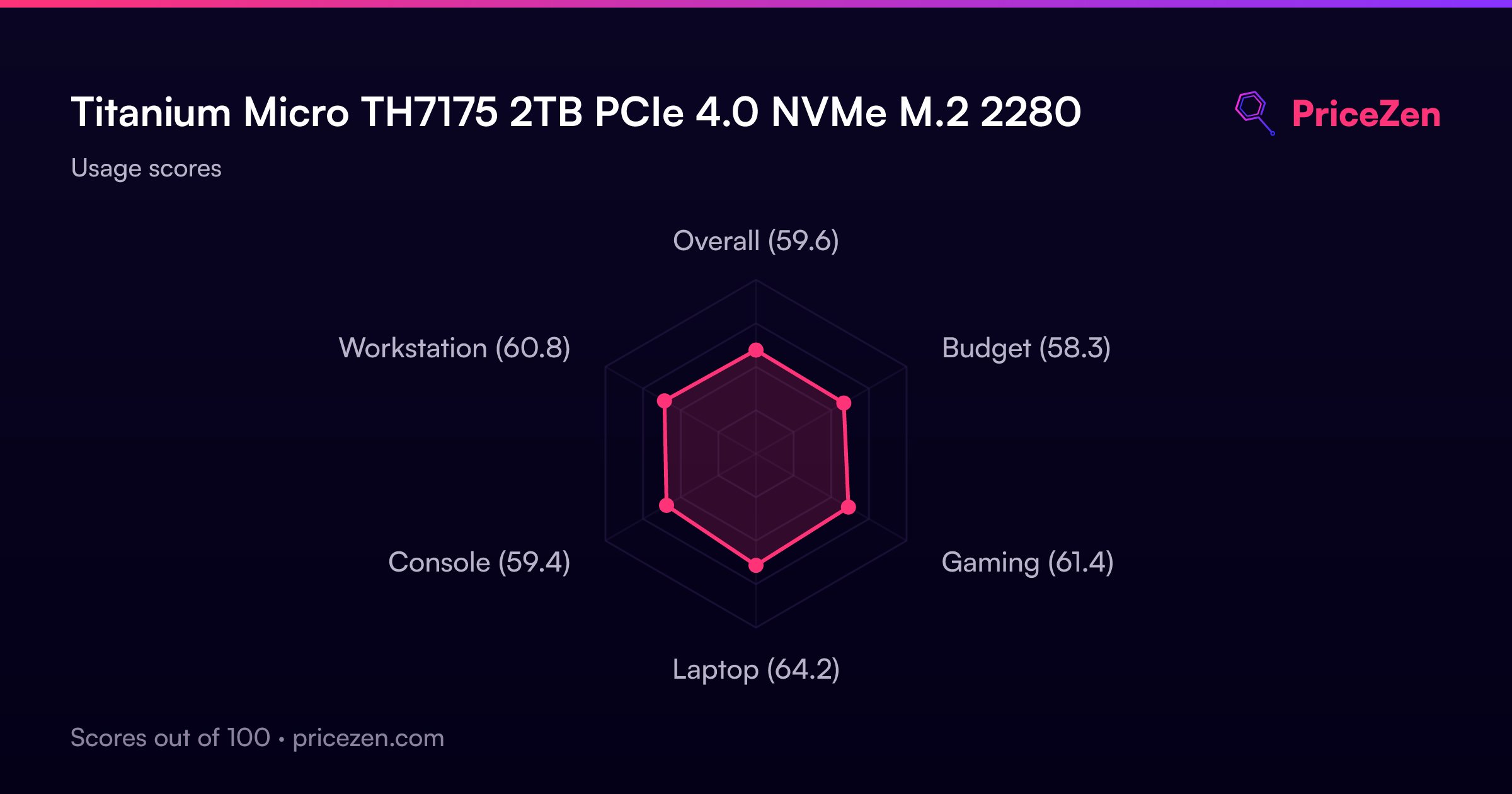
Usage Scores
- Overall59.6
- Budget58.3
- Gaming61.4
- Laptop64.2
- Console59.4
- Workstation60.8