OM System M.Zuiko Digital ED 8-25mm f/4 PRO micro-four-thirds

Sealed ultra-wide zoom for wet days verified Nov 29
48/100 overall score 4.8 average from 2 owner ratings
- Focal length
- 8-25mm
- Aperture
- f/4
- Mount
- Micro Four Thirds
- Format coverage
- micro-four-thirds
- Weather sealed
- Yes
- Weight
- 411 g
- Af type
- Autofocus
- Lens type
- wide-angle
Compare prices at 1 store
Cheapest first. New, refurbished and bundled offers are kept apart, so you compare like with like.
| Store | Sold by | Colour and condition | Price | vs lowest | Last checked | Link |
|---|---|---|---|---|---|---|
| New1 offerSingle unit | ||||||
| Not checked in the last 7 days, so these prices may have changed | ||||||
| Amazon | Marketplace seller | Not listed | ¥194,176 | Nov 3 | Go to store | |
 Source: PriceZen, checked Nov 3, 2026
A price counts as current when we checked it in the last 7 days. “Marketplace seller” means a third-party seller on that store, not the store itself.
Price history
Checked that dayNot checked that day, still on offer
Source: PriceZen, checked Nov 3, 2026











Snapshot
The 30-Second Version
The Olympus M.Zuiko Digital ED 8-25mm F4 PRO is a weather-sealed wide zoom for Micro Four Thirds that delivers excellent image quality and a flexible 16-50mm equivalent range. It's a top choice for landscape and travel shooters, but the f/4 aperture limits low light performance and bokeh. Prices range from USD 900 to USD 1,300, so shop around before buying.
Pros & Cons
Pros
- Excellent wide angle performance, 88th percentile in our database 88th
- Useful 8-25mm range covers ultra-wide to standard 84th
- Weather sealed for outdoor shooting 82nd
- Constant f/4 aperture throughout the zoom range 77th
- Compact and light at 411g for a PRO lens
Cons
- f/4 max aperture limits low light and bokeh
- No optical stabilization built in
- Pricey compared to other Micro Four Thirds zooms
- Portrait performance is weak at 29.2/100
- 72mm filter thread means pricier filters
What owners think
The Word on the Street
- Buyers consistently praise the lens for its excellent wide angle performance and compact, lightweight design.
- Owners using it on OM System bodies report the f/4 aperture is perfectly fine for tripod-based low light work.
- Some users note the lens is essentially identical to the older Olympus-branded version, which makes the rebrand feel like a minor update.
How owner sentiment changed over time
ExclusiveBased on when customers actually wrote their reviews - so you can see whether early praise held up.
2 written reviews, Nov 2025: 2 without stars
Across all 2 store ratings: 4.8★. The chart counts the 2 written reviews.
Each dot is one written review, in the month it was written. Happy = 4-5★, mixed = 3★, unhappy = 1-2★.
The proof
Performance
Optically, this lens is a standout. It ranks in the 88th percentile for wide angle performance and 84th percentile for overall optical quality, which puts it among the best Micro Four Thirds zooms we've tracked. The 16-element design includes 2 aspherical ED elements and 1 Super ED element, and that glass does real work keeping distortion and chromatic aberration in check at 8mm. Sharpness holds up well across the frame, even wide open at f/4.
Autofocus uses Olympus's MSC system, which is quick and nearly silent. It's not the fastest focusing lens in our database, sitting around the 70th percentile, but for landscape, street, and general walkaround use, it's more than adequate. The minimum focus distance of 230mm gives you a 1:4.76 magnification ratio, so you can get surprisingly close for a wide zoom. It's not a true macro lens, but you can pull off some fun close-up wide-angle shots with dramatic foregrounds.
One thing to know: there's no optical stabilization built in. That's not a dealbreaker since most modern Olympus and OM System bodies have excellent in-body stabilization, but if you're adapting this to a Panasonic body without IBIS, you'll want to keep your shutter speeds up. The f/4 max aperture also means low light handheld shooting isn't this lens's comfort zone.
Specifications
Full Specifications
Optics
| Type | Wide-angle |
| Focal Length Min | 8 |
| Focal Length Max | 25 |
| Elements | 16 |
| Groups | 10 |
| Aspherical Elements | 2 |
| ED Elements | 3 |
| Coating | fluorine coating |
Aperture
| Max Aperture | f/4 |
| Min Aperture | f/22 |
| Constant | Yes |
| Diaphragm Blades | 7 |
Build
| Mount | Micro Four Thirds |
| Format | micro-four-thirds |
| Weather Sealed | Yes |
| Weight | 0.4 kg / 0.9 lbs |
| Filter Thread | 72 |
AF & Stabilization
| AF Type | Autofocus |
| Stabilization | No |
Focus
| Min Focus Distance | 230 |
| Max Magnification | 0.21x |
vs Competition
Compared to the Viltrox LAB AF 35mm f/1.2 LAB FE, this Olympus is a completely different animal. The Viltrox is a full-frame portrait prime with a massive aperture, while the Olympus is a compact wide zoom for a smaller sensor. If you want bokeh and subject isolation, the Viltrox wins easily. But if you want to capture a mountain range or a cramped interior, the Olympus is the obvious choice. The Sigma Art 17-40mm f/1.8 DC Art is another interesting comparison. It's faster at f/1.8 but designed for APS-C, and it doesn't go nearly as wide as 8mm on Micro Four Thirds. The Olympus gives you a true ultra-wide perspective that neither of those lenses can match.
The Tamron 70-180mm f/2.8 and Canon RF 135mm f/1.8 are telephoto options that serve entirely different purposes. If you're shooting wildlife, portraits, or sports, those are better tools. But for landscape, architecture, and travel, the Olympus 8-25mm covers ground those lenses simply can't. The trade-off is aperture. Every competitor mentioned here is faster than f/4, and that's the Olympus's biggest compromise. You're trading light gathering and shallow depth of field for range and portability.
| Spec | OM System M.Zuiko Digital ED 8-25mm f/4 PRO | Canon L-series EF 85mm f/1.4L IS USM | Olympus M.Zuiko 25mm f/1.2 PRO | Zeiss Milvus 35mm f/1.4 ZE | ARRI Signature 3-Lens 25-75mm f/1.8 | Tamron 18-300mm f/3.5-6.3 6. Di III-A VC VXD |
|---|---|---|---|---|---|---|
| Focal Length | 8-25mm | 85mm | 25mm | 35mm | 25-75mm | 18-300mm |
| Max Aperture | f/4 | f/1.4 | f/1.2 | f/1.4 | f/1.8 | f/3.5-6.3 |
| Mount | Micro Four Thirds | Canon EF | Olympus OM | Canon EF | ARRI LPL | Canon RF |
| Format Coverage | micro-four-thirds | full-frame | micro-four-thirds | full-frame | full-frame | APS-C |
| Stabilization | No | Yes | No | No | No | Yes |
| Weather Sealed | Yes | Yes | Yes | Yes | No | No |
| Weight (g) | 411 | 950 | - | 1174 | 1900 | - |
| AF Type | Autofocus | USM | - | Manual Focus | - | VXD (Voice-coil eXtreme-torque Drive) linear motor |
| Lens Type | wide-angle | prime | prime | prime | prime | zoom |
| Compare | Compare | Compare | Compare | Compare |
| Product | AF | Bokeh | Build | Macro | Reach | Video | Optical | Aperture | Wide Angle | Portability | Versatility | Social Proof | Affordability | Stabilization |
|---|---|---|---|---|---|---|---|---|---|---|---|---|---|---|
| OM System M.Zuiko Digital ED 8-25mm f/4 PRO | 54.8 | 12.7 | 77.1 | 61.2 | 43.2 | 57 | 82.3 | 16 | 88 | 63.6 | 84.1 | 16.4 | 28.3 | 41.5 |
| Canon L-series EF 85mm f/1.4L IS USM Compare | 83.6 | 93.2 | 77.1 | 29.9 | 65.4 | 27.2 | 40.7 | 89.3 | 19.2 | 22.3 | 32.5 | 95.8 | 0.3 | 89.9 |
| Olympus M.Zuiko 25mm f/1.2 PRO Compare | 0 | 46.6 | 77.1 | 14.3 | 43.2 | 27.2 | 92.6 | 96.4 | 39.4 | 0 | 32.5 | 11.1 | 45.2 | 41.5 |
| Zeiss Milvus 35mm f/1.4 ZE Compare | 21.9 | 56.3 | 77.1 | 63.6 | 28.9 | 27.2 | 83.3 | 89.3 | 52.7 | 15.9 | 32.5 | 31.6 | 17.9 | 41.5 |
| ARRI Signature 3-Lens 25-75mm f/1.8 Compare | 0 | 81.3 | 30.4 | 37.7 | 58.6 | 27.2 | 0 | 74.7 | 69.1 | 6.2 | 81.9 | 0 | 0.1 | 41.5 |
| Tamron 18-300mm f/3.5-6.3 6. Di III-A VC VXD Compare | 95.4 | 47.8 | 30.4 | 93.2 | 93.2 | 69.6 | 0 | 25.1 | 66.1 | 0 | 98.9 | 9.3 | 46.5 | 89.9 |
Price
Value & Pricing
Value is where this lens gets a little tricky. The affordability ranking sits at the 31st percentile, which means it's more expensive than most lenses in its category. We're seeing a USD 400 spread across US listings, from USD 900 to USD 1,300, so shopping around matters. The best deal in our database is at the lower end of that range, and if you can find it closer to USD 900, the value proposition improves significantly. Canadian buyers face a similar spread, from CAD 999 to CAD 1,400. For what you get, the build quality and optical performance justify the price if you shoot wide often. But if you only occasionally need the 8mm end, a cheaper prime or a used Olympus 9-18mm might make more sense.
Read more
Overview
The Olympus M.Zuiko Digital ED 8-25mm F4 PRO is a wide-to-standard zoom for Micro Four Thirds that covers a 16-50mm full-frame equivalent range. It sits in the premium PRO lineup, so you're getting weather sealing, constant f/4 aperture, and a build that feels like it belongs on an OM-1 or OM-3. Price-wise, we're seeing it listed between USD 900 and USD 1,300 depending on the vendor, so it's not a casual impulse buy, but it's also not in the stratosphere like some full-frame glass.
What makes this lens interesting is the range. An 8mm starting point on Micro Four Thirds is genuinely wide, and being able to zoom all the way to 25mm means you can go from sweeping vistas to a normal-ish walkaround focal length without swapping glass. That's the kind of flexibility that makes this a strong candidate for travel and outdoor shooters who don't want to carry a bag full of primes.
Is the Olympus 8-25mm F4 PRO good for landscape photography? Based on our database, it's one of the better options out there, scoring 71.8 out of 100 for landscape work. The wide end is where it shines, and the constant aperture means you don't lose light as you zoom. Just don't expect shallow depth of field magic from an f/4 lens on a smaller sensor.
Common Questions
Q: Is the Olympus 8-25mm F4 PRO good for landscape photography?
Yes, it's one of the best landscape lenses for Micro Four Thirds, scoring 71.8 out of 100 in our database. The 8mm wide end gives you a 16mm full-frame equivalent field of view, which is ideal for sweeping vistas.
Q: Does the Olympus 8-25mm F4 PRO have image stabilization?
No, this lens does not have built-in optical stabilization. It relies on the in-body stabilization found in most Olympus and OM System cameras, so pairing it with a body that has IBIS is recommended.
Q: What is the difference between the Olympus and OM System 8-25mm F4 PRO?
There is no functional difference. The OM SYSTEM version is the same lens with updated branding after Olympus sold its camera division. The optical design, build, and performance are identical.
Q: Can the Olympus 8-25mm F4 PRO be used for macro photography?
It's not a true macro lens, but it can focus as close as 230mm for a 1:4.76 magnification ratio. That's enough for close-up wide angle shots with dramatic foregrounds, but dedicated macro lenses offer much higher magnification.
Who Should Skip This
Skip this lens if you shoot portraits, events, or anything that needs shallow depth of field. The f/4 aperture and 7-blade diaphragm produce busy bokeh, and the portrait score of 29.2/100 in our database tells the story. You'd be better served by a fast prime like the Olympus 45mm f/1.2 PRO or even a cheaper 25mm f/1.8. Also skip it if you're on a tight budget. The affordability ranking is low, and there are cheaper wide options for Micro Four Thirds that cover 80% of what this lens does. And if you shoot a lot of handheld video without a stabilized body, the lack of optical stabilization will be a constant annoyance.
Verdict
Should you buy the Olympus M.Zuiko Digital ED 8-25mm F4 PRO? If you shoot Micro Four Thirds and spend a lot of time at wide angles, yes. This is one of the best wide zooms available for the system, and the 8-25mm range is genuinely useful for landscape, architecture, and travel. The weather sealing and PRO build quality mean it'll survive real outdoor use, and the optical performance is top-tier for the format.
But if you're a portrait shooter or someone who loves creamy bokeh, this lens will frustrate you. The f/4 aperture and 7-blade diaphragm produce busy backgrounds, and the portrait score of 29.2/100 in our database reflects that. This is a lens for people who want to capture scenes, not isolate subjects. For the right photographer, it's a fantastic tool. For the wrong one, it's an expensive mismatch.
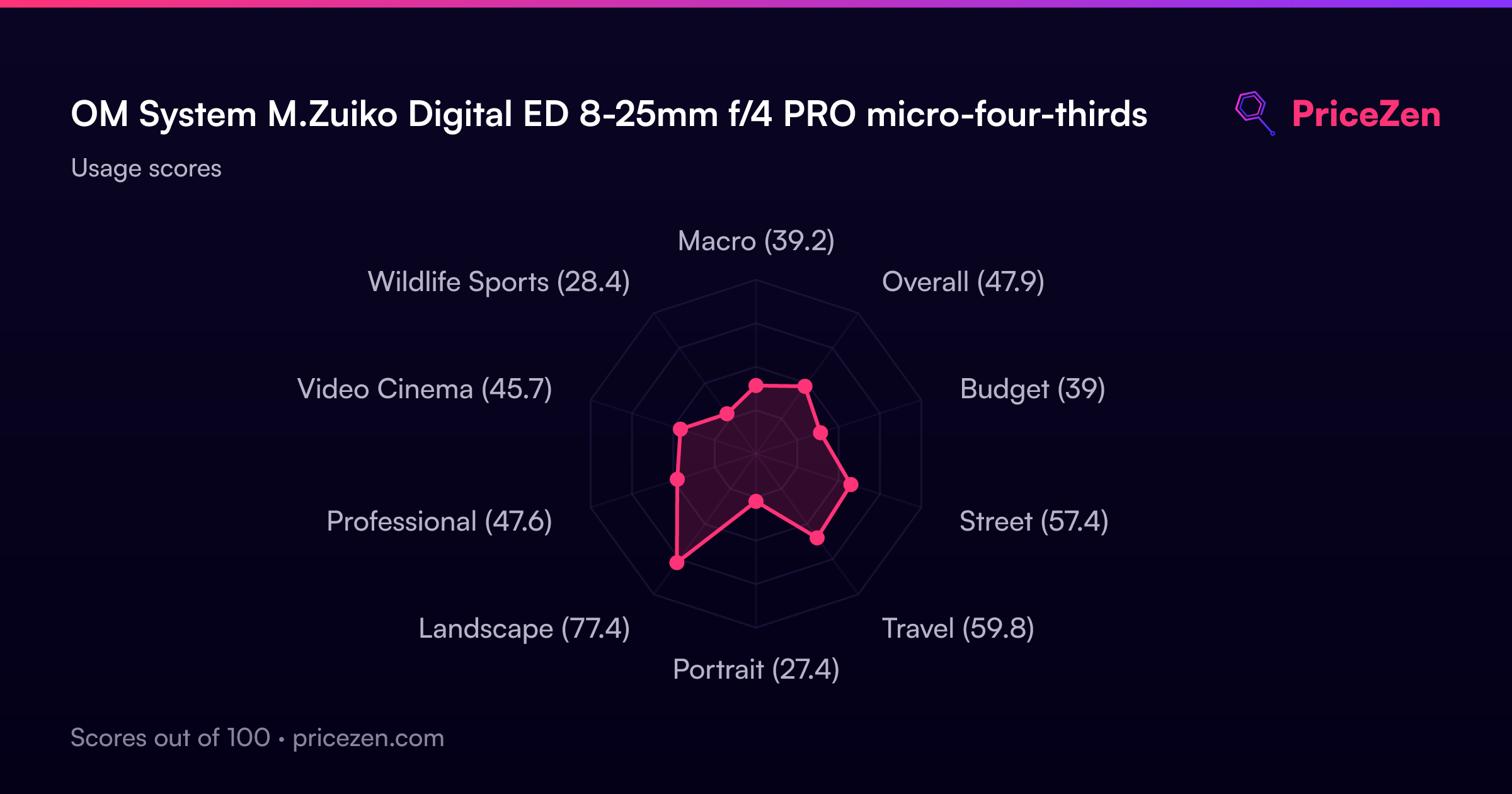
Usage Scores
- Macro39.2
- Overall47.9
- Budget39
- Street57.4
- Travel59.8
- Portrait27.4
- Landscape77.4
- Professional47.6
- Video Cinema45.7
- Wildlife Sports28.4