HP OmniBook 7 2026, Core Ultra X7 358H, 32GB, 2TB SSD, Soft Gray
Combining a 16-inch 2560x1440 OLED 120Hz display with 620 nits brightness and an Intel Core Ultra X7 358H processor with integrated Arc B390 graphics, this laptop delivers AI-accelerated productivity via its 50 TOPS NPU. Its military-grade-tested chassis withstands drops and shocks, while Wi-Fi 7 and Thunderbolt ports ensure fast, flexible connectivity. It's an ideal choice for developers and media enthusiasts seeking a vivid OLED screen and AI-enhanced productivity, rather than gaming.

No current retailer price
Snapshot
The 30-Second Version
A gorgeous OLED productivity beast with a killer CPU and tons of storage. Just don't expect to play games on it, and maybe buy the extended warranty.
Pros & Cons
Pros
- Gorgeous 16-inch OLED touchscreen with 120Hz refresh rate 94th
- Massive 2TB SSD and 32GB RAM, both near the top of our charts 93rd
- That Core Ultra X7 358H CPU is a productivity monster 92nd
- Wi-Fi 7 and Thunderbolt support for future-proof connectivity 89th
Cons
- Gaming performance is basically a non-starter
- Reliability and social proof scores are mediocre at best
- At 1.95kg, it's not exactly a featherweight
- No discrete GPU means creative pros will feel the pinch
What owners think
The Word on the Street
The proof
Performance
The CPU is a standout. That 16-core Core Ultra X7 358H sits in the 87th percentile, which means it's one of the better laptop chips we've tested for raw productivity. The 32GB of LPDDR5X and 2TB NVMe SSD are both top-tier, landing in the 93rd and 94th percentiles respectively. That's a lot of fast storage and memory for the price. The integrated Intel Arc B390 GPU is fine for everyday tasks and light creative work, but it's the reason gaming scores a dismal 21.3 out of 100. Don't expect to run Cyberpunk on this thing. The OLED display is a real treat though, 620 nits of brightness and 120Hz refresh rate make everything look smooth and vibrant.
Specifications
Full Specifications
Processor
| CPU | Intel Core Ultra X7 358H |
| Cores | 16 |
| Frequency | 1.9 GHz |
| L3 Cache | 18 MB |
Graphics
| GPU | Intel Arc B390 GPU |
| Type | Integrated |
| VRAM | 16 GB |
| VRAM Type | Shared |
Memory & Storage
| RAM | 32 GB |
| RAM Generation | LPDDR5X |
| Storage | 2 TB |
| Storage Type | NVMe SSD |
Display
| Size | 16" |
| Resolution | 2560x1440 (QHD) |
| Panel | OLED |
| Refresh Rate | 120 Hz |
| Brightness | 620 nits |
| Color Gamut | 100% DCI-P3 |
Connectivity
| USB-C Ports | 2 |
| USB Ports | 2 |
| Thunderbolt | Thunderbolt 4 |
| HDMI | HDMI 2.1 |
| Wi-Fi | Wi-Fi 7 |
| Bluetooth | Bluetooth 6.0 |
Physical
| Weight | 1.9 kg / 4.3 lbs |
| Battery | 70 Wh |
| OS | Windows 11 Home |
vs Competition
The obvious comparison is the Samsung Galaxy Book5 Pro, which offers a similar OLED experience but with a lighter chassis and better brand recognition. The Apple MacBook Pro M4 Max absolutely destroys this thing in GPU performance and build quality, but you'll pay significantly more. The ASUS ROG Zephyrus G14 is the pick if you want any gaming capability at all, though you'll sacrifice the big 16-inch OLED. For pure productivity value, the OmniBook 7 holds its own against all of them, especially with that 2TB SSD included.
| Spec | HP OmniBook 7 | Apple MacBook Pro 14.2" M4 Max | ASUS ROG Zephyrus 14" GA403WW-G14.R95080 | Lenovo Legion Pro 7i Gen 10 16" | Samsung Galaxy Book5 Pro 14" NP944XHA-KG3US | Dell Premium 14.5" LDA14250-7667SLV-PUS |
|---|---|---|---|---|---|---|
| CPU | Intel Core Ultra X7 358H | Apple M4 Max | AMD Ryzen AI 9 HX 370 | Intel Core Ultra 9 275HX | Intel Core Ultra 7 258V | Intel Core Ultra 7 255H |
| RAM (GB) | 32 | 64 | 32 | 32 | 32 | 32 |
| Storage (GB) | 2048 | 4096 | 2048 | 1024 | 1024 | 1024 |
| Screen | 16" 2560x1440 | 14.2" 3024x1964 | 14" 2880x1800 | 16" 2560x1600 | 14" 2880x1800 | 14.5" 3200x2000 |
| GPU | Intel Arc B390 GPU | Apple (40-Core) | NVIDIA GeForce RTX 5080 | NVIDIA GeForce RTX 5070 Ti | Intel Arc Graphics 140V | Intel Arc Graphics |
| OS | Windows 11 Home | macOS | Windows 11 Home | Windows 11 Home | Windows 11 Pro | Windows 11 Home |
| Weight (kg) | 2 | 1.6 | 1.6 | 2.7 | 1.2 | 1.7 |
| Battery (Wh) | 70 | 72 | - | 99 | 63 | 62 |
| Compare | Compare | Compare | Compare | Compare |
| Product | CPU | GPU | RAM | Ports | Screen | Portability | Storage | Reliability | Affordability |
|---|---|---|---|---|---|---|---|---|---|
| HP OmniBook 7 | 88.8 | 77.5 | 92.1 | 77.2 | 92.8 | 21.5 | 93.9 | 33.6 | 0 |
| Apple MacBook Pro 14.2" M4 Max Compare | 93.7 | 91.6 | 95.7 | 73.2 | 99.3 | 68.9 | 98.5 | 98.3 | 1.7 |
| ASUS ROG Zephyrus 14" GA403WW-G14.R95080 Compare | 91.2 | 98.3 | 90.9 | 89.2 | 96.5 | 73.6 | 89.7 | 60.6 | 5.7 |
| Lenovo Legion Pro 7i Gen 10 16" Compare | 97.2 | 96.6 | 89 | 97.2 | 95.6 | 9.6 | 79.2 | 82.1 | 5.5 |
| Samsung Galaxy Book5 Pro 14" NP944XHA-KG3US Compare | 65.7 | 69.6 | 79.4 | 83.1 | 91.5 | 89.5 | 79.2 | 82.1 | 20.1 |
| Dell Premium 14.5" LDA14250-7667SLV-PUS Compare | 87 | 69.6 | 89 | 65.9 | 97.2 | 61.2 | 65.1 | 33.6 | 14 |
Price
Value & Pricing
At $1,879 USD, you're getting a lot of hardware for the money. The screen, storage, and RAM alone would cost a fortune to upgrade on a lesser machine. But you're also paying for that AI-focused CPU and the Copilot+ branding, which may or may not matter to you. For a developer or productivity user, this is a solid deal. For anyone else, it's a lot of cash for a laptop that can't game and has questionable long-term reliability scores.
Read more
Overview
The HP OmniBook 7 16 is a weirdly compelling machine. It's got a gorgeous OLED touchscreen, a massive 2TB SSD, and 32GB of RAM, all wrapped in a chassis that HP claims can survive a drop or two. But the real story here is the Intel Core Ultra X7 358H with that 50 TOPS NPU. This is a Copilot+ PC through and through, built for AI workloads and productivity, not for fragging noobs in the latest shooter. If you're a developer or someone who lives in spreadsheets and code editors, this thing is a serious contender. If you want to game, keep walking.
Common Questions
Q: Can this laptop handle gaming?
Nope. The integrated Intel Arc B390 GPU scores a 21.3 out of 100 for gaming in our database. It'll run older or indie titles at low settings, but anything modern will chug. Get a laptop with a discrete GPU if gaming matters.
Q: Is the OLED screen worth it?
Absolutely. It's a 16-inch 2K OLED with 120Hz refresh rate and 620 nits of brightness. That's one of the best displays we've seen on a productivity laptop. Colors pop, blacks are deep, and the touchscreen is responsive.
Q: How's the battery life?
The 70Wh battery is decent but not class-leading. Expect a full workday of moderate use, but that bright OLED screen will drain it faster if you crank the brightness. Keep the charger handy for heavy AI workloads.
Who Should Skip This
If you're looking for a gaming laptop or something that can handle serious GPU work like video editing or 3D rendering, this isn't it. Go get an ASUS ROG Zephyrus G14 or a MacBook Pro with an M4 Max instead. Also, if you need a laptop you can toss in a bag without worrying about reliability, the OmniBook's mediocre scores in that department might give you pause.
Verdict
The HP OmniBook 7 16 is a purpose-built machine for people who live in code, spreadsheets, and AI tools. The display is stunning, the storage is generous, and the CPU chews through productivity tasks. But the weak gaming performance and mediocre reliability scores mean this isn't a laptop for everyone. If you're a developer or a productivity-focused professional, buy it. If you want to game or need rock-solid dependability, look elsewhere.
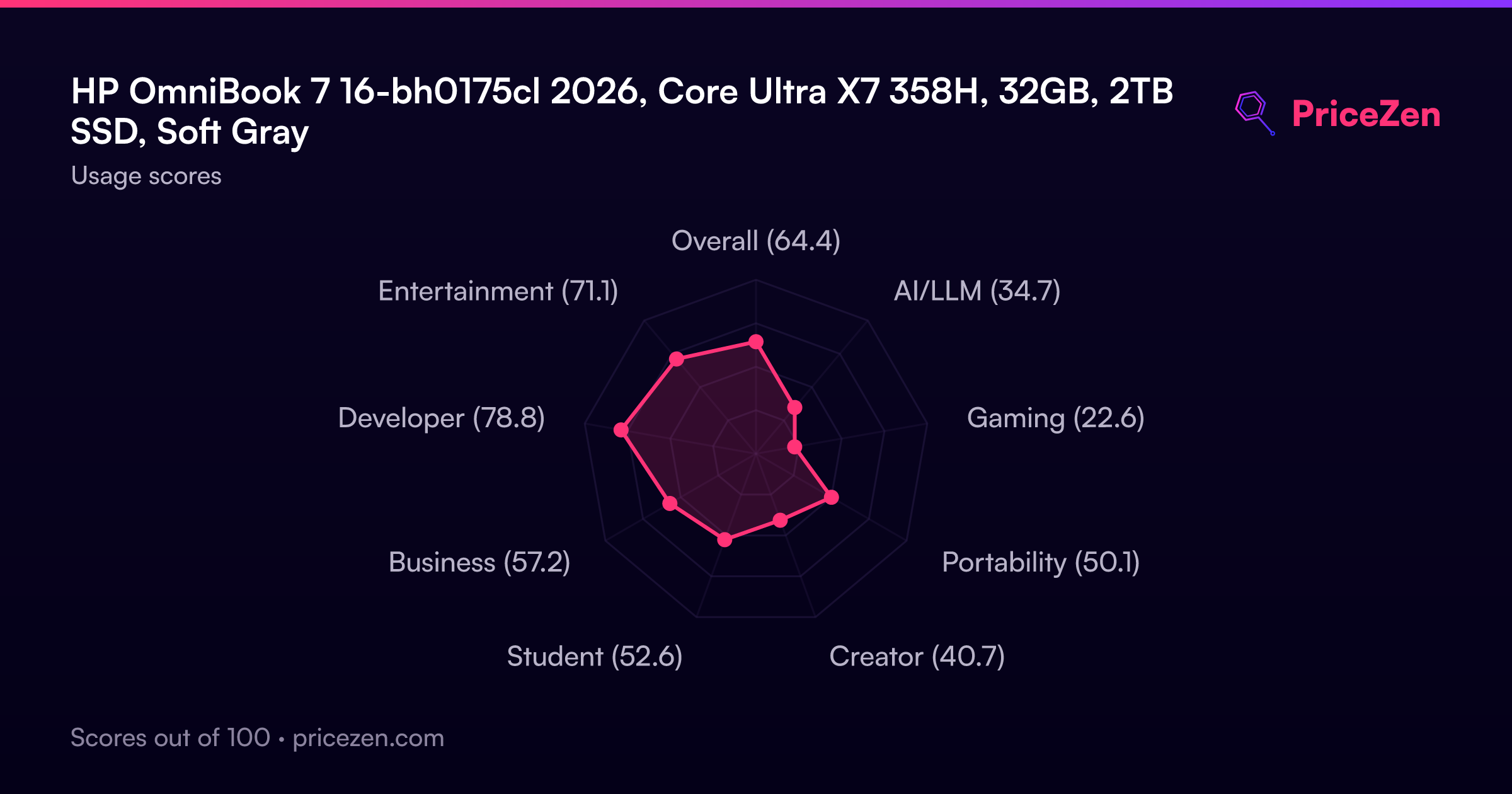
Usage Scores
- Overall64.4
- AI/LLM34.7
- Gaming22.6
- Portability50.1
- Creator40.7
- Student52.6
- Business57.2
- Developer78.8
- Entertainment71.1