ASUS TUF Gaming 16" FX607VU-ES51 2024, Core 5 210H, 8GB, 512GB SSD, RTX 4050, Mecha Gray
The Intel Core 5 210H and RTX 4050 with 115W Max TGP deliver solid 1080p gaming, backed by a 144Hz IPS panel and 90Wh battery for long sessions. Its MIL-STD-810H durability and efficient Arc Flow cooling make it a dependable choice for travel or daily use, while the 16:10 display adds extra vertical workspace. Best for budget-conscious gamers who prioritize build toughness and smooth esports performance over high-end specs.

No current retailer price



Snapshot
The 30-Second Version
The RTX 4050 at 115W TGP is the star here, ranking in the 79th percentile of our database. But the 8GB of DDR5 RAM sits in the 23rd percentile and will need an immediate upgrade. At USD 899 it's a decent deal; at USD 1,099 it's a harder sell.
Pros & Cons
Pros
- RTX 4050 with 115W TGP ranks in the 79th percentile for GPU performance 89th
- Port selection is top-tier at the 90th percentile, including Thunderbolt and HDMI 2.1 84th
- 144Hz 1920x1200 display lands in the 76th percentile for screens 74th
- 90Wh battery is genuinely large for a gaming laptop 73rd
- MIL-STD-810H durability rating and solid cooling design with 5 heat pipes
Cons
- 8GB of DDR5 RAM sits in the 23rd percentile, a serious bottleneck
- Core 5 210H CPU only manages the 61st percentile
- 512GB SSD is average at the 52nd percentile
- 45% NTSC color coverage limits the display for creative work
- 2.20kg weight puts it in the 16th percentile for compactness
What owners think
The Word on the Street
How owner sentiment changed over time
ExclusiveBased on when customers actually wrote their reviews - so you can see whether early praise held up.
9 written reviews, Sep 2025 – Jan 2026: 7 happy, 2 unhappy
Across all 57 store ratings: 4.2★. Most owners rate without writing a review. The chart counts the 9 written reviews.
Each dot is one written review, in the month it was written. Happy = 4-5★, mixed = 3★, unhappy = 1-2★.
The proof
Performance
The RTX 4050 here is the real story. With a 115W max TGP and NVIDIA Advanced Optimus, this GPU ranks in the 79th percentile of our database. That's well above average for this class, and it means you can actually push modern games at 1080p without dialing everything to potato mode. The 6GB of VRAM is the standard ceiling for this tier, so don't expect 1440p ultra, but 1080p medium-to-high on most titles is realistic.
The Core 5 210H is an 8-core chip at 2.2GHz, and it lands in the 61st percentile. Solid, but not exciting. The real problem is the 8GB of DDR5 RAM. That's a 23rd percentile showing, and it's going to choke multitasking and memory-hungry games. One owner flat out said the RAM needs an immediate upgrade. The 512GB NVMe SSD is middle of the pack at the 52nd percentile, which is fine but not generous. The 144Hz IPS display with Adaptive-Sync hits the 76th percentile, so motion clarity is good, though the 45% NTSC color coverage means it's not a creator's dream.
Specifications
Full Specifications
Processor
| CPU | Intel Core 5 210H |
| Cores | 8 |
| Frequency | 2.2 GHz |
| L3 Cache | 12 MB |
Graphics
| GPU | NVIDIA GeForce RTX 4050 |
| Type | Discrete |
| VRAM | 6 GB |
| VRAM Type | GDDR6 |
Memory & Storage
| RAM | 8 GB |
| RAM Generation | DDR5 |
| Storage | 512 GB |
| Storage Type | NVMe SSD |
Display
| Size | 16" |
| Resolution | 1920x1200 (Full HD) |
| Panel | IPS |
| Refresh Rate | 144 Hz |
| Brightness | 300 nits |
| Color Gamut | 45% NTSC |
Connectivity
| USB-C Ports | 2 |
| USB Ports | 2 |
| Thunderbolt | Thunderbolt 4 |
| HDMI | HDMI 2.1 |
| Wi-Fi | Wi-Fi 6 |
| Bluetooth | Bluetooth 5.3 |
| Ethernet | Gigabit Ethernet |
Physical
| Weight | 2.2 kg / 4.9 lbs |
| Battery | 56 Wh |
| OS | Windows 11 Home |
vs Competition
Against the Lenovo Legion 5i 83F00008US, the TUF F16 wins on port selection and battery size, but the Legion typically ships with more RAM and a stronger CPU, which matters for anything beyond pure GPU-bound gaming. The HP OMEN Transcend 14-fb1023dx is more compact and offers better color coverage, though you'll pay for that privilege. The MSI Prestige PRE13EVOA2088 isn't really a gaming machine, so it's not a direct fight, but it shows what you give up in GPU power for portability. The Apple MacBook Pro M4 Pro and Microsoft Surface Laptop 7th Edition are in a completely different price bracket and performance class, so they're only relevant if you're cross-shopping gaming and productivity. The TUF F16's 79th percentile GPU is its strongest card, but the 23rd percentile RAM is a glaring weakness none of these competitors share.
| Spec | ASUS TUF Gaming 16" FX607VU-ES51 | Apple MacBook Pro 14.2" M4 Max | Lenovo Legion Pro 7i Gen 10 16" | HP OMEN Transcend | Samsung Galaxy Book5 Pro 14" NP944XHA-KG3US | Dell Premium 14.5" LDA14250-7667SLV-PUS |
|---|---|---|---|---|---|---|
| CPU | Intel Core 5 210H | Apple M4 Max | Intel Core Ultra 9 275HX | Intel Core Ultra 9 285H | Intel Core Ultra 7 258V | Intel Core Ultra 7 255H |
| RAM (GB) | 8 | 64 | 32 | 32 | 32 | 32 |
| Storage (GB) | 512 | 4096 | 1024 | 1024 | 1024 | 1024 |
| Screen | 16" 1920x1200 | 14.2" 3024x1964 | 16" 2560x1600 | 14" 2880x1800 | 14" 2880x1800 | 14.5" 3200x2000 |
| GPU | NVIDIA GeForce RTX 4050 | Apple (40-Core) | NVIDIA GeForce RTX 5070 Ti | NVIDIA GeForce RTX 5070 | Intel Arc Graphics 140V | Intel Arc Graphics |
| OS | Windows 11 Home | macOS | Windows 11 Home | Windows 11 Home | Windows 11 Pro | Windows 11 Home |
| Weight (kg) | 2.2 | 1.6 | 2.7 | 1.6 | 1.2 | 1.7 |
| Battery (Wh) | 56 | 72 | 99 | 71 | 63 | 62 |
| Compare | Compare | Compare | Compare | Compare |
| Product | CPU | GPU | RAM | Ports | Screen | Portability | Storage | Reliability | Social Proof | Affordability |
|---|---|---|---|---|---|---|---|---|---|---|
| ASUS TUF Gaming 16" FX607VU-ES51 | 62.1 | 83.9 | 22.2 | 89.4 | 74.1 | 16 | 50.8 | 60.7 | 72.9 | 50.5 |
| Apple MacBook Pro 14.2" M4 Max Compare | 93.7 | 91.5 | 95.6 | 73.8 | 99.1 | 68.9 | 98.4 | 98.3 | 73.4 | 1.7 |
| Lenovo Legion Pro 7i Gen 10 16" Compare | 97.2 | 96.7 | 88.9 | 97.3 | 94.9 | 9.5 | 79.1 | 82.1 | 99.7 | 5.7 |
| HP OMEN Transcend Compare | 90.1 | 93.5 | 89.6 | 89.4 | 96 | 72.3 | 65.1 | 33.7 | 94.2 | 8.9 |
| Samsung Galaxy Book5 Pro 14" NP944XHA-KG3US Compare | 65.7 | 69.5 | 79.4 | 83.4 | 90.3 | 89.5 | 79.1 | 82.1 | 96.6 | 21 |
| Dell Premium 14.5" LDA14250-7667SLV-PUS Compare | 87 | 69.5 | 88.9 | 66.6 | 96.8 | 61.2 | 65.1 | 33.7 | 96.6 | 14.4 |
Price
Value & Pricing
The price spread here is worth paying attention to. US listings range from USD 899 to USD 1,099 across 4 vendors, and that USD 200 gap changes the math significantly. At USD 899, this is a reasonable entry-level gaming laptop with a genuinely strong GPU. At USD 1,099, you're creeping into territory where competitors offer more RAM and better CPUs out of the box. The 8GB RAM situation means you should factor in an upgrade cost immediately, which eats into the value proposition. If you can snag the lower end of that price range, the RTX 4050 at 115W makes this a decent deal. At the top end, it's harder to justify.
Read more
Overview
The ASUS TUF Gaming F16 FX607VU-ES51 lands in a weird spot. You get an RTX 4050 with a 115W max TGP, which puts the GPU in the 79th percentile of our database. That's genuinely strong for a budget gaming laptop. But then ASUS paired it with 8GB of DDR5 RAM, which sits way down in the 23rd percentile. That's a bottleneck waiting to happen, and multiple owners are already calling it out.
The 16-inch 1920x1200 display runs at 144Hz and hits the 76th percentile for screens. Port selection is a genuine highlight at the 90th percentile, with Thunderbolt, dual USB-C, dual USB-A, HDMI 2.1, and Ethernet. The 90Wh battery is beefy too. But the Core 5 210H processor only manages the 61st percentile, and the 512GB SSD is dead average at the 52nd percentile. You're getting a mixed bag here, and the price spread from USD 899 to USD 1,099 across vendors makes the value proposition trickier than it should be.
Common Questions
Q: What processor does this laptop have?
It runs an Intel Core 5 210H, an 8-core chip clocked at 2.2GHz. In our database it lands in the 61st percentile for CPU performance, so it's solid but not a standout.
Q: What's the screen size and resolution?
You get a 16-inch IPS panel at 1920x1200 with a 144Hz refresh rate. The screen ranks in the 76th percentile overall, though the 45% NTSC color coverage means it's better for gaming than color-critical work.
Q: Is 8GB of RAM enough for gaming?
Honestly, no. The 8GB of DDR5 sits in the 23rd percentile of our database, and multiple owners report it needs an immediate upgrade. Budget for adding more RAM if you plan to play anything beyond lighter titles.
Who Should Skip This
If you're not comfortable opening up a laptop to upgrade RAM, skip this one. The 8GB of DDR5 in the 23rd percentile will frustrate you from day one, and the Core 5 210H at the 61st percentile won't bail you out. Creative professionals should also look elsewhere, since the 45% NTSC color coverage on the display is a weak spot for color work. And if portability matters, the 2.20kg weight puts this in the 16th percentile for compactness, so it's not a great travel companion. Anyone expecting a plug-and-play gaming experience at the USD 1,099 end of the price range should probably look at competitors with more RAM out of the box.
Verdict
The ASUS TUF Gaming F16 FX607VU-ES51 is a frustrating product. The RTX 4050 at 115W is genuinely good, the port selection is excellent, and the 90Wh battery is a nice surprise. But the 8GB of RAM in the 23rd percentile undermines the whole experience, and the Core 5 210H at the 61st percentile doesn't help. If you're willing to upgrade the RAM yourself and you can find this at the USD 899 end of the price range, it's a solid budget gaming laptop. If you're paying USD 1,099 and expecting it to work great out of the box, you'll be disappointed. The bones are good, but ASUS cut the wrong corner.
Usage Scores
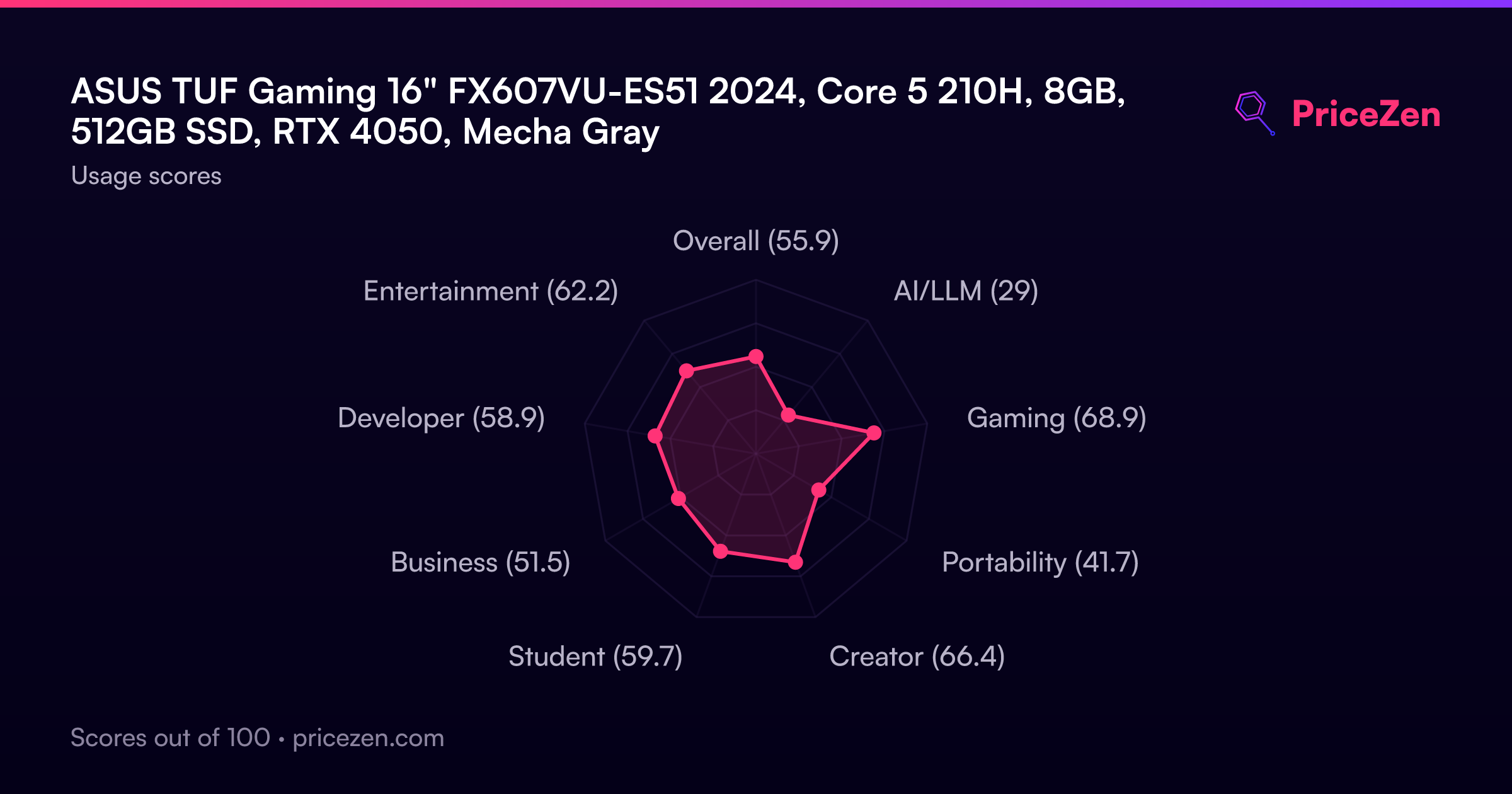
- Overall55.9
- AI/LLM29
- Gaming68.9
- Portability41.7
- Creator66.4
- Student59.8
- Business51.5
- Developer58.9
- Entertainment62.2