ASUS TUF Gaming 14" FA401EA-DS96, Ryzen AI Max+ 392, 32GB, 1TB SSD, Jaegar Gray
The AMD Ryzen AI Max+ 392 processor with Radeon 8060S integrated graphics delivers gaming performance close to a dedicated GPU while drawing less power, paired with 32GB of quad-channel LPDDR5X memory that dynamically allocates between system RAM and VRAM. The 14-inch 2560x1600 165Hz display with a 3ms response time and a redesigned keyboard with 97-blade fans keep things cool and responsive. This laptop suits gamers and creative professionals who want a compact 1.52kg machine for both gaming and demanding productivity tasks, though its gaming score is weak at 25.1/100.

No current retailer price











Snapshot
The 30-Second Version
The ASUS TUF Gaming FA401 (TUF Gaming A14) is a 14-inch gaming laptop with a 12-core Ryzen AI Max+ 392, Radeon 8060S integrated graphics, 32GB LPDDR5X and a 2560x1600 165Hz display for USD 2,099. Its CPU and GPU rank near the top of the category, but gaming scores only 25.1/100 against discrete-GPU rivals. It's a superb compact work-and-play machine, not a pure gaming buy.
Pros & Cons
Pros
- Ryzen AI Max+ 392 CPU ranks near the very top of the category 94th
- Radeon 8060S is a standout integrated GPU, no discrete card needed 92nd
- 32GB LPDDR5X 8000 quad-channel unified memory, flexibly allocated 91st
- Sharp 2560x1600 165Hz panel with 3ms response 82nd
- Only 1.52kg with a 1TB PCIe Gen 4 SSD
Cons
- USD 2,099 is steep, affordability ranks in the bottom fifth
- Gaming scores just 25.1/100 against discrete-GPU rivals
- Port selection is a weak spot, lagging behind most laptops here
- Only 11 owner reviews so far, so social proof is thin
- Memory is soldered LPDDR5X, so 32GB is what you get forever
The proof
Performance
The numbers back up the pitch. In our rankings against every traditional laptop we track, the CPU is among the best (94th percentile) and the GPU is close behind (92nd), which is remarkable for integrated graphics. RAM sits near the top, storage is above average. Translation: the Ryzen AI Max+ 392's 12 cores chew through compile jobs, VMs and heavy multitasking, and the 32GB of quad-channel LPDDR5X at 8000 means the iGPU isn't starved for bandwidth the way most integrated setups are. The 1TB Gen 4 SSD keeps load times short.
The display is well above average rather than class-leading: 2560x1600 at 165Hz with a 3ms response time is a sharp, fast 16:10 panel that works as nicely for spreadsheets as it does for shooters. ASUS also redesigned the keyboard deck to pull more air through and paired it with two 97-blade fans, which matters when you're pushing a high core count chip in a 14-inch chassis. Our reliability score lands mid-pack at 61, so nothing alarming, nothing exceptional. And no, we haven't had this thing on a desk. These are spec and benchmark-derived rankings plus what owners report, not our stopwatch.
Specifications
Full Specifications
Processor
| CPU | AMD Ryzen AI Max+ 392 |
| Cores | 12 |
| Frequency | 3.2 GHz |
| L3 Cache | 64 MB |
Graphics
| GPU | AMD Radeon 8060S |
| Type | Integrated |
Memory & Storage
| RAM | 32 GB |
| RAM Generation | LPDDR5X |
| Storage | 1 TB |
| Storage Type | NVMe SSD |
Display
| Size | 14" |
| Resolution | 2560x1600 (QHD) |
| Refresh Rate | 165 Hz |
Connectivity
| Wi-Fi | Wi-Fi 6E |
Physical
| Weight | 2.8 kg / 6.1 lbs |
| OS | Windows 11 Home |
vs Competition
Cross-shop the HP OMEN Transcend 14-fb1023dx first if you want a 14-inch gaming laptop but care more about gaming scores than CPU headroom. The FA401's gaming rating of 25.1 is its soft spot, and a compact rival aimed squarely at gaming is worth a look before you commit. The Lenovo Legion Pro 7i Gen 10 16" is the opposite direction entirely: if you don't need 1.52kg portability and want maximum gaming performance, our model rewards that class of machine far more than this one.
On the productivity side, the Apple MacBook Pro 14.2" M4 Max is the obvious cross-shop for anyone whose day is creative work rather than Windows gaming, and the Samsung Galaxy Book5 Pro 14" NP944XHA-KG3US and Dell Premium 14.5" LDA14250-7667SLV-PUS are the ones to weigh if you want a thin premium Windows machine and don't need this much GPU. The FA401's argument against all of them is the same: a top-tier CPU and near-top graphics in a 14-inch body, with 32GB of memory that shifts between system and VRAM as you need it. Just know the port situation trails most of the field.
| Spec | ASUS TUF Gaming 14" FA401EA-DS96 | Apple MacBook Pro 14.2" M4 Max | Lenovo Legion Pro 7i Gen 10 16" | HP OMEN Transcend | Samsung Galaxy Book5 Pro 14" NP944XHA-KG3US | Dell Premium 14.5" LDA14250-7667SLV-PUS |
|---|---|---|---|---|---|---|
| CPU | AMD Ryzen AI Max+ 392 | Apple M4 Max | Intel Core Ultra 9 275HX | Intel Core Ultra 9 285H | Intel Core Ultra 7 258V | Intel Core Ultra 7 255H |
| RAM (GB) | 32 | 64 | 32 | 32 | 32 | 32 |
| Storage (GB) | 1024 | 4096 | 1024 | 1024 | 1024 | 1024 |
| Screen | 14" 2560x1600 | 14.2" 3024x1964 | 16" 2560x1600 | 14" 2880x1800 | 14" 2880x1800 | 14.5" 3200x2000 |
| GPU | AMD Radeon 8060S | Apple (40-Core) | NVIDIA GeForce RTX 5070 Ti | NVIDIA GeForce RTX 5070 | Intel Arc Graphics 140V | Intel Arc Graphics |
| OS | Windows 11 Home | macOS | Windows 11 Home | Windows 11 Home | Windows 11 Pro | Windows 11 Home |
| Weight (kg) | 2.8 | 1.6 | 2.7 | 1.6 | 1.2 | 1.7 |
| Battery (Wh) | - | 72 | 99 | 71 | 63 | 62 |
| Compare | Compare | Compare | Compare | Compare |
| Product | CPU | GPU | RAM | Ports | Screen | Portability | Storage | Reliability | Social Proof | Affordability |
|---|---|---|---|---|---|---|---|---|---|---|
| ASUS TUF Gaming 14" FA401EA-DS96 | 93.9 | 91.7 | 90.8 | 9.9 | 82.2 | 61.2 | 79.3 | 60.6 | 20.2 | 20.8 |
| Apple MacBook Pro 14.2" M4 Max Compare | 93.7 | 91.5 | 95.6 | 73.9 | 99.1 | 68.8 | 98.4 | 98.2 | 72.7 | 1.8 |
| Lenovo Legion Pro 7i Gen 10 16" Compare | 97.2 | 96.7 | 89 | 97.3 | 95 | 9.5 | 79.3 | 81.9 | 99.7 | 5.8 |
| HP OMEN Transcend Compare | 90.1 | 93.5 | 89.6 | 89.4 | 96 | 72.2 | 65.3 | 33.7 | 93.1 | 8.9 |
| Samsung Galaxy Book5 Pro 14" NP944XHA-KG3US Compare | 65.9 | 69.6 | 79.5 | 83.5 | 90.4 | 89.4 | 79.3 | 81.9 | 95.6 | 21 |
| Dell Premium 14.5" LDA14250-7667SLV-PUS Compare | 87 | 69.6 | 89 | 66.7 | 96.8 | 61.2 | 65.3 | 33.7 | 95.6 | 14.6 |
Price
Value & Pricing
At USD 2,099 from Amazon, this is not a value play, and our affordability ranking (in the bottom fifth) says so plainly. You're paying for density: top-tier CPU and GPU rankings, 32GB of fast unified memory and a 1TB Gen 4 drive inside 1.52kg. If your work is code, containers, photo and video edits with gaming on the side, that combination is hard to match at this size. If your priority is frames per second per dollar, the same money buys more raw gaming grunt elsewhere. We track its price over time, partly through our community browser extension, and right now there's a single US listing, so there's not much shopping around to do.
Read more
Overview
The ASUS TUF Gaming FA401, sold as the TUF Gaming A14, is a 14-inch gaming laptop sitting at USD 2,099 on Amazon right now. That's premium money for a compact machine, and ASUS is betting you'll pay it for an unusual chip: the AMD Ryzen AI Max+ 392, a 12-core part running at 3.2GHz with Radeon 8060S integrated graphics instead of a separate GPU. Add 32GB of LPDDR5X 8000 quad-channel memory, a 1TB PCIe Gen 4 SSD and a 2560x1600 165Hz panel, and you've got a spec sheet that reads more like a creator workstation than a budget TUF.
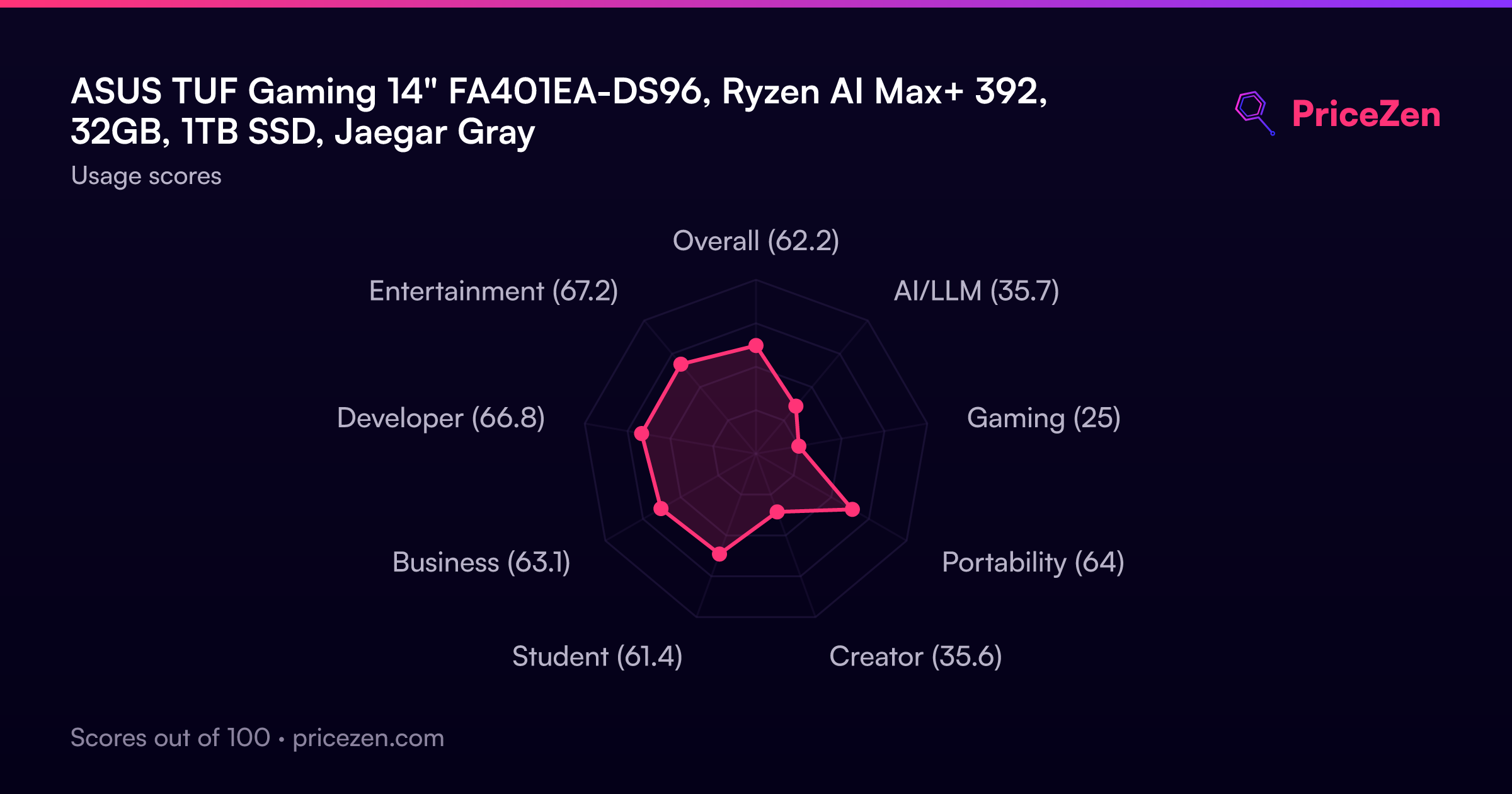
So is the ASUS TUF Gaming A14 good for gaming? Sort of, and that's the interesting part. The Radeon 8060S is one of the strongest integrated GPUs we track, sitting near the top of our rankings for graphics in this category. But our scoring model still puts gaming as its weakest area at 25.1 out of 100, because it's competing against laptops with real discrete cards. Where it shines is everywhere else: compact at 69.2, entertainment at 67, developer work at 66.6.
The unified memory design is the trick here. That 32GB pool gets split dynamically between system RAM and VRAM, so you can lean it toward graphics when you're playing something or toward memory when you're compiling or editing. At 1.52kg with Wi-Fi 6E and Windows 11 Home, this is a genuinely portable machine that happens to game, not a gaming brick you can technically carry.
Common Questions
Q: Is the ASUS TUF Gaming A14 good for gaming?
It handles games fine thanks to the Radeon 8060S, which ranks near the top for graphics among traditional laptops, and the 165Hz 2560x1600 panel is a great match. But our gaming score is only 25.1/100 because rivals with dedicated GPUs push far more frames.
Q: Can you upgrade the RAM on the ASUS TUF Gaming FA401?
No. The 32GB of LPDDR5X 8000 is soldered unified memory shared between the CPU and Radeon 8060S graphics, so buy the capacity you'll need up front. The 1TB PCIe Gen 4 SSD is the storage you get out of the box.
Q: Is the TUF Gaming A14 good for programming and development?
Yes, it's one of its stronger use cases at 66.6/100 in our scoring. The 12-core Ryzen AI Max+ 392 ranks among the best for CPU and 32GB of quad-channel memory gives containers and VMs plenty of room.
Q: How much does the ASUS TUF Gaming FA401 cost?
We currently track it at USD 2,099 on Amazon in the US. Affordability is a weak point, ranking in the bottom fifth of the category, so you're paying for the compact size and the unusual chip.
Who Should Skip This
Skip this if gaming is the whole point. At 25.1/100 for gaming and USD 2,099, a Lenovo Legion Pro 7i Gen 10 16" or an HP OMEN Transcend 14-fb1023dx makes more sense if you want frames first and portability second. Skip it too if you live on dongle-free connectivity, since ports rank near the bottom here, or if you need more than 32GB of RAM down the road, because that memory is soldered. And if your day is entirely creative work with no Windows gaming, the Apple MacBook Pro 14.2" M4 Max deserves a serious look before you spend this kind of money.
Verdict
Buy it if you want one small Windows laptop that does serious work and respectable gaming without a discrete GPU's bulk. Developers, students who also game, and anyone living out of a backpack get a lot here: elite CPU rankings, 32GB of fast unified memory, a 1TB Gen 4 SSD and a genuinely good 165Hz screen at 1.52kg.
Don't buy it purely as a gaming machine. Our model rates gaming at 25.1/100, and at USD 2,099 you can do better on frames alone. Also go in with eyes open on the review count: 3.9 out of 5 across 11 reviews is a small sample, and our social proof score reflects that. This is an early-adopter purchase of a very clever chip, not a proven crowd favorite.
Usage Scores
- Overall62.2
- AI/LLM35.7
- Gaming25
- Portability64
- Creator35.6
- Student61.4
- Business63.1
- Developer66.8
- Entertainment67.2