ASUS GeForce GTX 1060 Dual OC 3GB
The 1809 MHz boost clock and 3GB GDDR5 memory deliver solid 1080p gaming performance, while the dual-fan cooling provides doubled airflow for quieter operation. This certified refurbished card is tested to work like new, comes with a 90-day warranty, and includes dual HDMI 2.0 ports for VR headset and monitor connectivity. It is best for budget-conscious gamers seeking a reliable, VR-ready graphics card for 1080p gaming without breaking the bank.

No current retailer price











Snapshot
The 30-Second Version
The ASUS GeForce GTX 1060 Dual 3GB is a budget graphics card that still handles esports titles at 1080p, but its 3GB of VRAM makes it a poor choice for modern games. At around $100 USD renewed, it's cheap but hard to recommend over used cards with more memory.
Pros & Cons
Pros
- Very affordable at around $100 USD renewed 93rd
- Handles esports titles like CS:GO and Siege well
- Low 120W TDP won't tax your power supply
- Dual fan cooler keeps noise reasonable
- Compact 242mm length fits most cases
Cons
- 3GB VRAM is a serious limitation in 2025
- Bottom-tier compute and AI performance
- Only one HDMI output
- No modern features like ray tracing or DLSS
- Renewed units can be a gamble on reliability
What owners think
The Word on the Street
How owner sentiment changed over time
ExclusiveBased on when customers actually wrote their reviews - so you can see whether early praise held up.
6 written reviews, Dec 2018 – Jun 2025: 5 happy, 1 unhappy
Across all 27 store ratings: 4.1★. Most owners rate without writing a review. The chart counts the 6 written reviews.
Each dot is one written review, in the month it was written. Happy = 4-5★, mixed = 3★, unhappy = 1-2★.
The proof
Performance
The GTX 1060 3GB puts up a PassMark G3D score of 10058, which lands it in the bottom quarter of all graphics cards we track. That's not surprising for a card this old, but it does tell you exactly where this thing sits in 2025. For context, that score is roughly a third of what you'd get from a mid-range card from the last couple generations. The 1809MHz boost clock is fine for Pascal, and the 4.375 TFLOPS of FP32 compute was respectable back in the day, but it's firmly in the bottom 11th percentile for compute now.
In practice, the 3GB of VRAM is the real bottleneck. The 192-bit memory bus and 192 GB/s of bandwidth are adequate for the GPU itself, but modern games at 1080p routinely want 6GB or more. You'll be turning textures down to low or medium in anything released after 2020. The card is VR Ready on paper, and it does have HDMI output, but don't expect a great VR experience with 3GB of memory. This is a 1080p esports card, nothing more.
Specifications
Full Specifications
Chipset
| GPU Chipset | GeForce GTX 1060 |
| Brand | NVIDIA |
| Architecture | Pascal |
| Class | consumer |
| Process | 16 |
Memory
| VRAM | 3 GB |
| Memory Type | GDDR5 |
| Memory Bus | 192 |
| Bandwidth | 192.2 |
Compute
| Base Clock | 1506 |
| Boost Clock | 1809 |
| FP32 TFLOPS | 4.375 |
Performance
| PassMark G3D | 10058 |
| GPU Compute | 4264 |
Power & Cooling
| TDP | 120 |
| Recommended PSU | 300 |
| Cooler | Dual Fan |
| Fans | 2 |
Connectivity
| HDMI | 1 |
Physical
| Length | 242 |
| Weight | 0.9 kg / 2.1 lbs |
Features
| Ray Tracing | No |
| VR Ready | Yes |
vs Competition
Compared to the MSI GTX 1080 Ti GAMING X, this card is in a completely different league. The 1080 Ti has 11GB of VRAM and roughly triple the raw performance, though it also costs significantly more even used. The ASRock Challenger B570 CL 10G and XFX SPEEDSTER SWFT309 RX-67XLKWFDV are both modern cards with 10GB or more of memory, and they absolutely demolish the 1060 3GB in every metric we track. The Sapphire PULSE 11324-01-20G is another 20GB card that makes the 1060 look like a relic.
The Gigabyte Windforce GV-N2080WF3-8GC is probably the closest comparison in spirit, an older card that's still kicking around on the used market. But even that has 8GB of VRAM and RTX features. If you're shopping in this price range, the honest advice is to look at used RX 580 8GB or GTX 1070 cards instead. They cost a bit more but won't leave you stranded the first time a game demands more than 3GB of memory.
| Spec | ASUS GeForce GTX 1060 Dual OC | Gigabyte GeForce RTX 5070 Ti Eagle Ice | MSI GeForce RTX 5070 Ti Ventus 3X OC | ZOTAC GeForce RTX 5080 APOCALYPSE | Sapphire Radeon RX 7900 XTX NITRO+ | PNY GeForce RTX 5080 ARGB OC |
|---|---|---|---|---|---|---|
| Chipset | GeForce GTX 1060 | GeForce RTX 5070 Ti | GeForce RTX 5070 Ti | GeForce RTX 5080 | Radeon RX 7900 XTX | GeForce RTX 5080 |
| Vram | 3GB GDDR5 | 16GB GDDR7 | 16GB GDDR7 | 16GB GDDR7 | 24GB GDDR6 | 16GB GDDR7 |
| Boost Clock Mhz | 1809 | 2542 | 2482 | 2730 | 2680 | 2620 |
| Tdp W | 120 | 300 | 300 | 360 | 339 | 360 |
| Memory Bus Bits | 192 | 256 | 256 | 256 | 384 | 256 |
| Ray Tracing | false | true | true | true | true | true |
| GPU Class | consumer | consumer | consumer | consumer | consumer | consumer |
| Compare | Compare | Compare | Compare | Compare |
| Product | AI | Rt | Vram | Raster | Compute | Feature | Thermal | Efficiency | Connectivity | Social Proof | Affordability |
|---|---|---|---|---|---|---|---|---|---|---|---|
| ASUS GeForce GTX 1060 Dual OC | 11 | 22.3 | 10.4 | 24 | 11.8 | 25.1 | 42.6 | 37.4 | 12.6 | 39.6 | 92.7 |
| Gigabyte GeForce RTX 5070 Ti Eagle Ice Compare | 79.5 | 88.7 | 86 | 89 | 88.1 | 95.9 | 91.8 | 72 | 94.1 | 93.3 | 26.9 |
| MSI GeForce RTX 5070 Ti Ventus 3X OC Compare | 79.5 | 92.5 | 86 | 89 | 88.1 | 95.9 | 91.8 | 72 | 94.1 | 83.9 | 23.4 |
| ZOTAC GeForce RTX 5080 APOCALYPSE Compare | 85.6 | 97.5 | 89 | 94.5 | 93.4 | 95.9 | 91.8 | 57 | 94.1 | 98.7 | 20.5 |
| Sapphire Radeon RX 7900 XTX NITRO+ Compare | 95.1 | 96.3 | 91.9 | 83.5 | 95.6 | 95.9 | 91.8 | 52 | 98.8 | 69.1 | 19 |
| PNY GeForce RTX 5080 ARGB OC Compare | 85.6 | 97.5 | 89 | 94.5 | 93.4 | 95.9 | 91.8 | 57 | 94.1 | 74.9 | 14.7 |
Price
Value & Pricing
At around $100 USD for a renewed unit, the GTX 1060 3GB is cheap, but cheap doesn't always mean good value. You're getting a card that's nearly a decade old, with 3GB of VRAM and no support for modern features. For not much more money, you can often find used GTX 1070 or RX 580 8GB cards that will age far better. The affordability score is high because the price is low, but the total score of 20.5 out of 100 tells the real story. This is a card you buy because it's what you can afford right now, not because it's a smart long-term purchase.
Read more
Overview
The ASUS GeForce GTX 1060 Dual DUAL-GTX1060-O3G is a budget graphics card from the Pascal era, now mostly showing up as a certified refurbished unit on Amazon for around $100 USD. It's aimed at people who want a cheap way to get playable frame rates in older or esports titles without spending real money on a modern GPU. The 3GB of GDDR5 memory is the big asterisk here, and it's the main reason this card sits near the bottom of our database for VRAM capacity.
If you're searching for a used GTX 1060 3GB, you're probably wondering if it can still handle 1080p gaming in 2025. The short answer is yes, but only for lighter games. CS:GO, Rainbow Six Siege, Valorant, and similar competitive shooters will run fine. Anything modern and memory-hungry will choke on that 3GB frame buffer. This is a card for a very specific buyer: someone on a tight budget who plays older or esports titles and doesn't mind turning settings down.
We've seen a lot of renewed GTX 1060 cards come through our database, and this ASUS Dual model is one of the more common ones. The dual fan cooler is decent, the card is reasonably compact at 242mm, and the 120W TDP means it won't stress most power supplies. But make no mistake, this is old hardware. The 16nm Pascal architecture launched in 2016, and it shows in everything from feature support to raw performance.
Common Questions
Q: Is the GTX 1060 3GB good for gaming in 2025?
It's fine for esports and older games at 1080p, but the 3GB of VRAM will struggle with modern AAA titles. Expect to run newer games at low settings or not at all.
Q: Can the GTX 1060 3GB run VR?
Technically it's VR Ready, but 3GB of VRAM is below what most VR headsets want these days. You might get basic VR working, but don't expect a smooth experience.
Q: How much VRAM does the ASUS Dual GTX 1060 have?
This model has 3GB of GDDR5 memory on a 192-bit bus. That's the main limitation of this card compared to the 6GB version of the GTX 1060.
Q: Is a renewed GTX 1060 worth buying?
At around $100 USD, it can be worth it if you only play older or esports games. But renewed units carry reliability risks, and used cards with more VRAM are often a better value.
Who Should Skip This
Skip this card if you play modern AAA games, do any kind of content creation, or want to keep your GPU for more than a year or two. The 3GB of VRAM is already below minimum requirements for many 2024 and 2025 releases. If you're interested in ray tracing, DLSS, or AI workloads, this card is completely out of the question with its bottom-tier feature and AI scores. Instead, look at a used GTX 1070, RX 580 8GB, or save up for something like the ASRock Challenger B570 CL 10G. Anyone who wants to play at 1440p or higher should also look elsewhere, this card is strictly a 1080p low-to-medium settings performer.
Verdict
Should you buy the ASUS GTX 1060 3GB in 2025? Only if you're on an extremely tight budget and you know exactly what you're getting into. If you play CS:GO, Valorant, League of Legends, or older titles, this card will serve you fine at 1080p. The dual fan cooler is decent, the power draw is low, and the price is hard to argue with.
But if you have any interest in modern games, even at 1080p, the 3GB of VRAM will frustrate you constantly. You'll be fighting texture settings, dealing with stutters, and watching games refuse to launch because they don't meet minimum requirements. Save up a little more and get something with at least 8GB of VRAM. Your future self will thank you.
Usage Scores
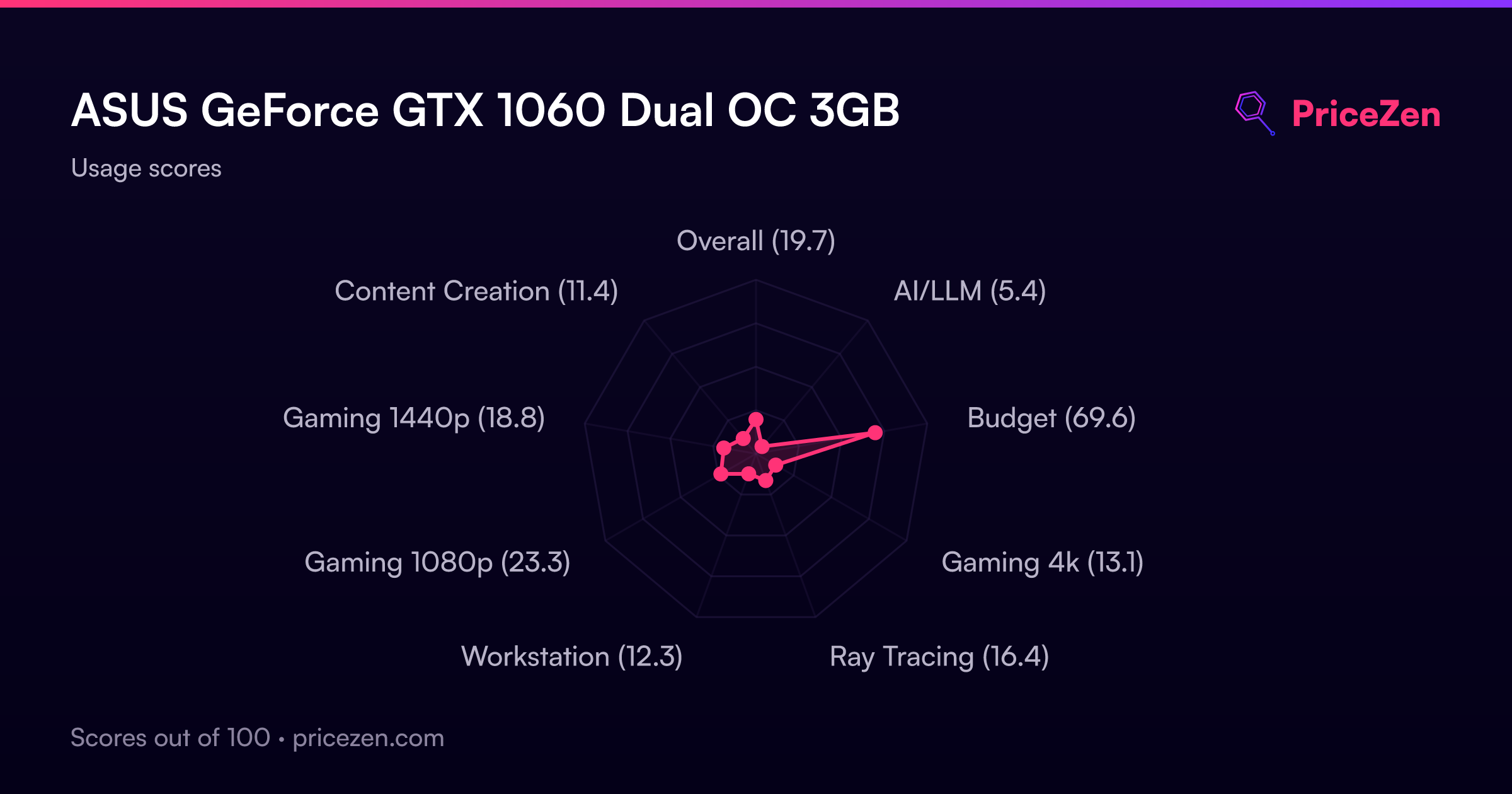
- Overall19.7
- AI/LLM5.4
- Budget69.6
- Gaming 4k13.1
- Ray Tracing16.4
- Workstation12.3
- Gaming 1080p23.3
- Gaming 1440p18.8
- Content Creation11.4