NVIDIA 900-5G132-2540-000
The RTX 5000 Ada Generation pairs 12,800 CUDA cores, 100 third-gen RT Cores, and 400 fourth-gen Tensor Cores with 32 GB of memory for AI graphics and petaFLOPS inferencing. Its GPUDirect RDMA, Quadro Sync II, and Mosaic support make multi-GPU and multi-display setups straightforward. Best for professionals running rendering, AI, or compute workloads on workstations, though ray tracing performance scores low.

No current retailer price










Snapshot
The 30-Second Version
A pro card with a consumer-hostile price tag and benchmark rankings to match. Unless your job literally requires Quadro Sync II, this isn't your GPU.
Pros & Cons
Pros
- Pro-only features you can't get elsewhere: GPUDirect RDMA, Quadro Sync II, Mosaic and 3D stereo
- 32GB of graphics memory for big scenes and datasets
- 12,800 CUDA cores and 400 Tensor cores still chew through compute work
- Purpose-built for certified professional workstation pipelines
Cons
- EUR 5,108 is brutal, affordability ranks in the 4th percentile
- Ray tracing scores 3.5/100, a real letdown for a card with 100 RT cores
- Raster, AI and efficiency all sit near dead last in our rankings
- Thermal and connectivity scores lag behind most of the category
The proof
Performance
Here's what surprised us digging through the data: despite 100 third-gen RT cores, ray tracing scores just 3.5 out of 100 in our model, landing near the bottom (2nd percentile). AI and VRAM rankings sit at the very bottom of the charts too, which stings when the marketing pitch leans so hard on AI inferencing. Against the current crop of cards we rank, this Ada-generation silicon simply falls behind on raster, efficiency and thermals. The feature score (11th percentile) is its best showing, and honestly that tracks: the value here is the pro feature set, not the benchmark numbers.
Specifications
Full Specifications
Physical
| Weight | 0.6 kg / 1.3 lbs |
vs Competition
Cross-shop this against the ASUS GeForce RTX 5090 TUF Gaming and the Gigabyte GeForce RTX 5080 AERO OC before you even think about clicking buy. Our rankings put this RTX 5000 Ada near the floor on raster, ray tracing and AI, so if raw speed is what you're after, those GeForce cards are the smarter cross-shop. The MSI GeForce RTX 5080 Gaming Trio belongs on the same shortlist. The RTX 5000 Ada only wins this fight on one battlefield: its pro feature stack. GPUDirect RDMA, Quadro Sync II and Mosaic are the reason this card still exists in a catalog. Need them? Fine. Don't? One of those GeForce options is your answer.
| Spec | NVIDIA 900-5G132-2540-000 | MSI GeForce RTX 4070 Ti SUPER GAMING SLIM Gaming X | Gigabyte GeForce RTX 4080 SUPER AERO OC | ASUS GeForce RTX 4070 Prime OC | ZOTAC GeForce RTX 3080 GAMING | XFX Radeon RX 9070 XT Quicksilver |
|---|---|---|---|---|---|---|
| Chipset | - | GeForce RTX 4070 Ti SUPER | GeForce RTX 4080 SUPER | GeForce RTX 4070 | GeForce RTX 3080 | Radeon RX 9070 XT |
| Vram | - | 16GB GDDR6X | 16GB GDDR6X | 12GB GDDR6X | 10GB GDDR6X | 16GB GDDR6 |
| Boost Clock Mhz | - | 2685 | 2595 | 2550 | 1740 | 2970 |
| Tdp W | - | 285 | 320 | 200 | 320 | 304 |
| Memory Bus Bits | - | 256 | 256 | 128 | 320 | 256 |
| Ray Tracing | - | true | true | true | true | true |
| GPU Class | - | consumer | consumer | consumer | consumer | consumer |
| Compare | Compare | Compare | Compare | Compare |
| Product | AI | Rt | Vram | Raster | Feature | Thermal | Efficiency | Connectivity | Affordability |
|---|---|---|---|---|---|---|---|---|---|
| NVIDIA 900-5G132-2540-000 | 0.7 | 2.1 | 0.7 | 2.2 | 10.7 | 6.3 | 2.2 | 5.1 | 3.8 |
| MSI GeForce RTX 4070 Ti SUPER GAMING SLIM Gaming X Compare | 77.1 | 86.6 | 79.1 | 86.3 | 52.4 | 91.8 | 76.1 | 39.7 | 21.5 |
| Gigabyte GeForce RTX 4080 SUPER AERO OC Compare | 71.3 | 93.6 | 77.3 | 91.2 | 77.9 | 72.1 | 67.8 | 55.3 | 11.7 |
| ASUS GeForce RTX 4070 Prime OC Compare | 54.5 | 67.2 | 58.3 | 72.6 | 88.7 | 91.8 | 89.6 | 31.3 | 20.2 |
| ZOTAC GeForce RTX 3080 GAMING Compare | 52.1 | 74.6 | 55 | 65.2 | 95.8 | 91.8 | 31.2 | 69.1 | 37.9 |
| XFX Radeon RX 9070 XT Quicksilver Compare | 88.2 | 46.7 | 73.5 | 74.9 | 33 | 72.1 | 44.9 | 37.3 | 35.9 |
Price
Value & Pricing
Not worth it for most people, full stop. Our budget score is 10.2 out of 100 and the workstation score is 9 out of 100, so even judged as a pro tool it struggles against what's available right now. The only scenario where EUR 5,108 makes sense is when your software demands Quadro Sync II or GPUDirect and there's no workaround. Everyone else should keep walking.
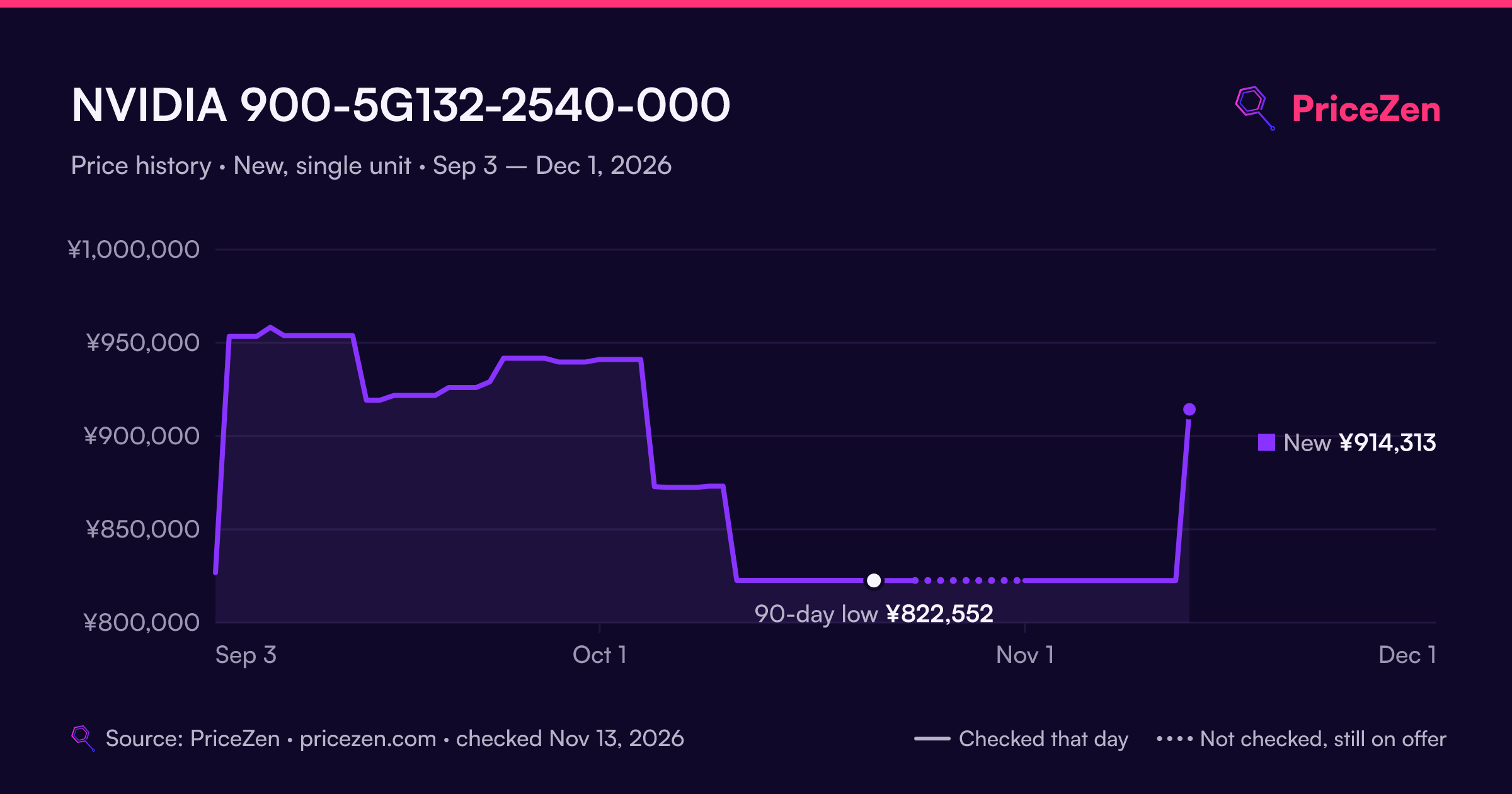
Price history
Read more
Overview
Let's not dance around this one. The NVIDIA RTX 5000 Ada Generation (900-5G132-2540-000) is a serious professional card with a serious problem: our scoring model puts it at 9.6 out of 100 overall, and its affordability is among the worst (4th percentile) against everything else we track in this category. At EUR 5,108 on Amazon right now, you're paying enterprise money for a card that ranks near the bottom on raw performance metrics.
The one thing to know? This card exists for very specific pro workflows, not general horsepower. You get 32GB of graphics memory, 12,800 CUDA cores, 100 RT cores and 400 Tensor cores on the Ada Lovelace architecture, plus the pro-only stuff: GPUDirect RDMA, Quadro Sync II compatibility, Mosaic multi-display tech and 3D stereo with a dedicated connector. If your pipeline needs those features, nothing on a gaming card replaces them. If it doesn't, you're lighting money on fire.
Common Questions
Q: Is 32GB of VRAM enough for professional work?
For most rendering and compute jobs, yes, 32GB handles large scenes comfortably. Just know that our VRAM ranking puts it at the bottom against the current field, so if memory capacity is your top priority, compare carefully before committing.
Q: Can I use this for gaming instead of buying a GeForce card?
Don't. Raster performance ranks near the bottom (2nd percentile) and ray tracing scores 3.5 out of 100 in our model. At EUR 5,108 you'd be paying a fortune for worse gaming performance than the GeForce alternatives we rank above it.
Q: What actually justifies the price?
The pro feature set: GPUDirect RDMA, GPUDirect for Video, Quadro Sync II compatibility, Mosaic and 3D stereo support. If your studio's pipeline depends on those, they're the whole point. If you had to ask, you probably don't need them.
Who Should Skip This
If you're looking for gaming performance, AI horsepower or anything resembling value, this isn't it. Go get the ASUS GeForce RTX 5090 TUF Gaming or one of the RTX 5080 options like the Gigabyte AERO OC instead. And if you're a pro who doesn't specifically need Quadro Sync II or GPUDirect, skip this too. You'd be paying a premium for features you'll never switch on.
Verdict
Skip it unless your workflow explicitly requires the pro features. The specs read fine on paper, but our scoring model is blunt: 9.6 overall, bottom-tier performance rankings, and a price in the stratosphere. This is a niche tool priced like a necessity, and for the vast majority of buyers it's neither. If Quadro Sync II or GPUDirect is a hard requirement in your pipeline, buy it and move on. Otherwise, put that EUR 5,108 toward a GeForce card and pocket the difference.
Usage Scores
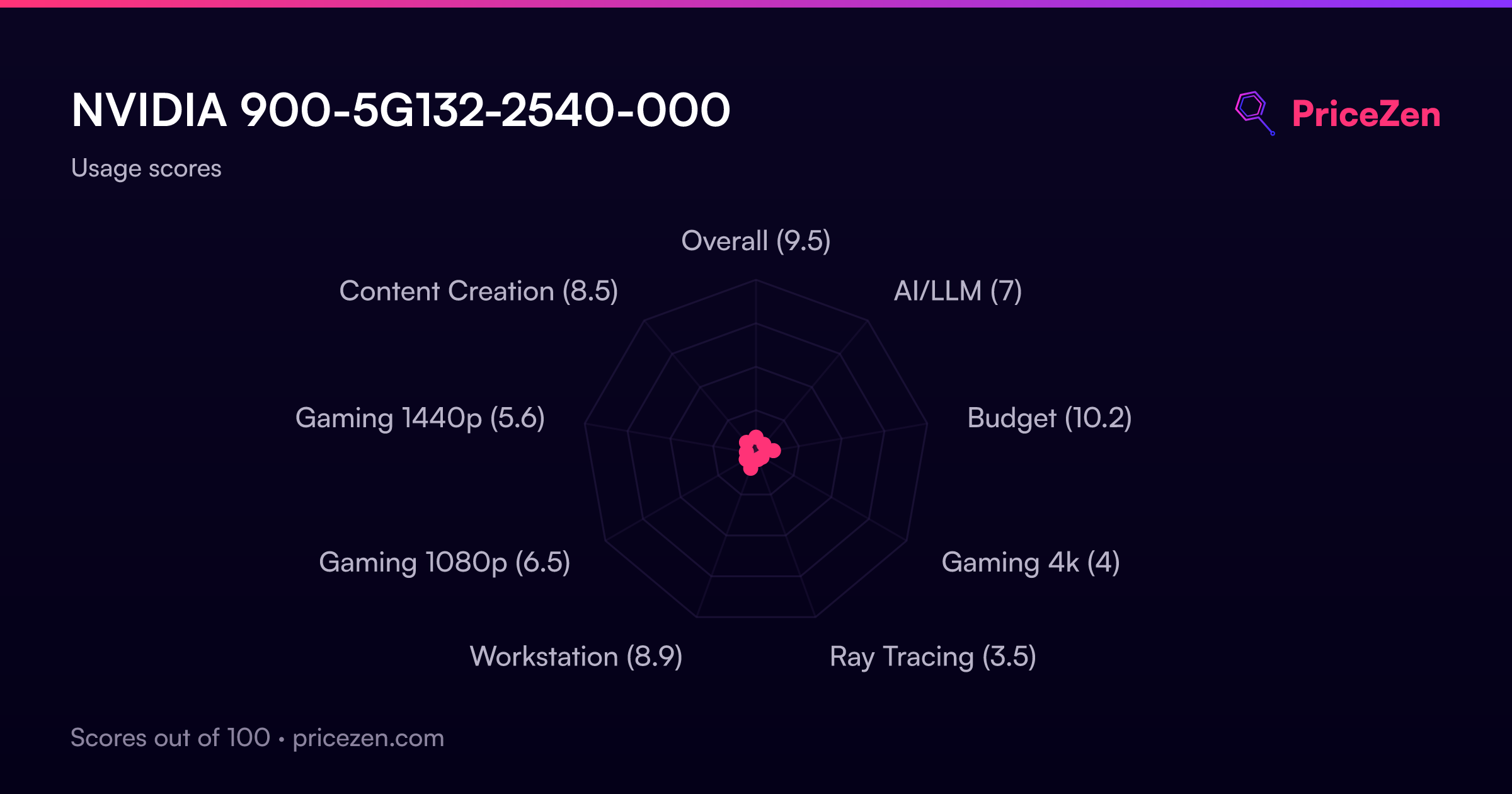
- Overall9.5
- AI/LLM7
- Budget10.2
- Gaming 4k4
- Ray Tracing3.5
- Workstation8.9
- Gaming 1080p6.5
- Gaming 1440p5.6
- Content Creation8.5