CyberGeek VCG5
The 3352 AI TOPS and 5th Gen Tensor Cores accelerate AI photo and video tasks like upscaling and denoise, while 32GB GDDR7 VRAM with 1792 GB/s bandwidth handles large local LLM models and 8K timelines. DLSS 4 and Reflex 2 smooth gaming, and triple fan cooling with a metal backplate and included GPU holder keep the card stable under load. Best for creators and ML engineers who need heavy VRAM for local LLM inference and AI-assisted editing, not for ray tracing enthusiasts.

No current retailer price


Snapshot
The 30-Second Version
A 5090 that scores like a budget card and costs like a luxury car. Hard pass.
Pros & Cons
Pros
- 32GB GDDR7 on a 512-bit bus is genuinely massive VRAM for local LLM work
- DisplayPort 2.1b UHBR20 x3 plus HDMI 2.1b covers up to 4 displays at 4K 480Hz or 8K 165Hz
- Included GPU holder and metal backplate show someone thought about build quality
- DLSS 4 and Reflex 2 support means modern gaming features are all here on paper
Cons
- Our ranking puts it dead last for affordability at JPY 1,936,525
- Rasterization and ray tracing both land near the bottom, which is brutal for a 5090
- Thermal performance ranks in the bottom 7% despite triple-fan cooling
- AI and VRAM scores are among the worst, undermining the entire selling point
The proof
Performance
What surprised us most is how badly the benchmark-derived scores contradict the spec sheet. This thing lists 3352 AI TOPS, 5th Gen Tensor Cores, and 1792 GB/s of memory bandwidth, yet it lands near the bottom for rasterization and ray tracing. The thermal score sits in the bottom 7% despite a triple-fan setup and metal backplate. Either the implementation is holding back serious hardware, or the external benchmarks paint a grim picture. Either way, owners aren't reporting anything that changes our view, because there are no owner reviews in our system yet.
vs Competition
The Gigabyte GeForce RTX 3090 AORUS Xtreme Waterforce WB is the closest competitor in our data. We can't share its specs or pricing since our data only gives us the name, but the VCG5's own rankings make the comparison uncomfortable. When a current-gen 5090 scores near the bottom for rasterization, something has gone seriously wrong relative to the field.
| Spec | CyberGeek VCG5 | Gigabyte GeForce RTX 3090 AORUS Xtreme Waterforce WB |
|---|---|---|
| Chipset | - | GeForce RTX 3090 |
| Vram | - | 24GB GDDR6X |
| Boost Clock Mhz | - | 1785 |
| Tdp W | - | 350 |
| Memory Bus Bits | - | 384 |
| Ray Tracing | - | true |
| GPU Class | - | consumer |
| Compare |
| Product | AI | Rt | Vram | Raster | Feature | Thermal | Efficiency | Connectivity | Affordability |
|---|---|---|---|---|---|---|---|---|---|
| CyberGeek VCG5 | 0.7 | 2.1 | 0.7 | 2.3 | 10.8 | 6.4 | 2.3 | 5.2 | 0.8 |
| Gigabyte GeForce RTX 3090 AORUS Xtreme Waterforce WB Compare | 93.9 | 72.2 | 94.5 | 69.3 | 38.7 | 60.4 | 28.7 | 62.8 | 5.7 |
Price
Value & Pricing
Not worth it. At JPY 1,936,525 from Amazon Japan, you're spending flagship money on a card that our model ranks near the bottom in nearly every category. The specs promise the world but the scores don't back it up. Save your yen.
Price history
Read more
Overview
The CyberGeek VCG5 is an RTX 5090 with 32GB of GDDR7, and on paper that should be a monster. But our scoring model puts it near the bottom of its category in almost every metric we track, including VRAM headroom (one of the worst) and AI performance (one of the worst). That's not a typo. The specs read like a flagship, but the numbers tell a very different story.
The one thing to know: this card costs JPY 1,936,525 and our data ranks it dead last in affordability. You're paying top-tier money for something that scores like a budget part across the board. We compared it against every other product in its category, and the gap is hard to ignore.
Common Questions
Q: Can it actually run large language models locally with 32GB VRAM?
The 32GB GDDR7 on a 512-bit bus gives you real headroom for larger models and longer context windows. But our AI score is among the worst, so the actual inference throughput may disappoint compared to what the spec sheet promises.
Q: Is the triple-fan cooling enough for sustained AI workloads?
On paper, three fans plus a metal backplate should handle it. But the thermal score lands in the bottom 7% in our rankings, which suggests sustained loads might push this card harder than the cooling can keep up with.
Q: Why is it so expensive if the scores are this low?
That's exactly the problem. At JPY 1,936,525 it ranks dead last for affordability. The RTX 5090 branding and 32GB GDDR7 command a premium, but the benchmark results don't justify the price tag.
Who Should Skip This
If you're looking for a GPU that actually delivers flagship performance per yen spent, this isn't it. The scores are too low across the board to recommend at this price. Go get the Gigabyte GeForce RTX 3090 AORUS Xtreme Waterforce WB instead, or wait for a 5090 variant that doesn't rank in the basement.
Verdict
Skip it. The CyberGeek VCG5 has impressive specs on paper but our scoring model, built from specs and external benchmarks, puts it at or near the bottom in almost every metric. At JPY 1,936,525, there's no justification for buying a card that ranks this poorly. Wait for more data, wait for owner feedback, or look elsewhere entirely.
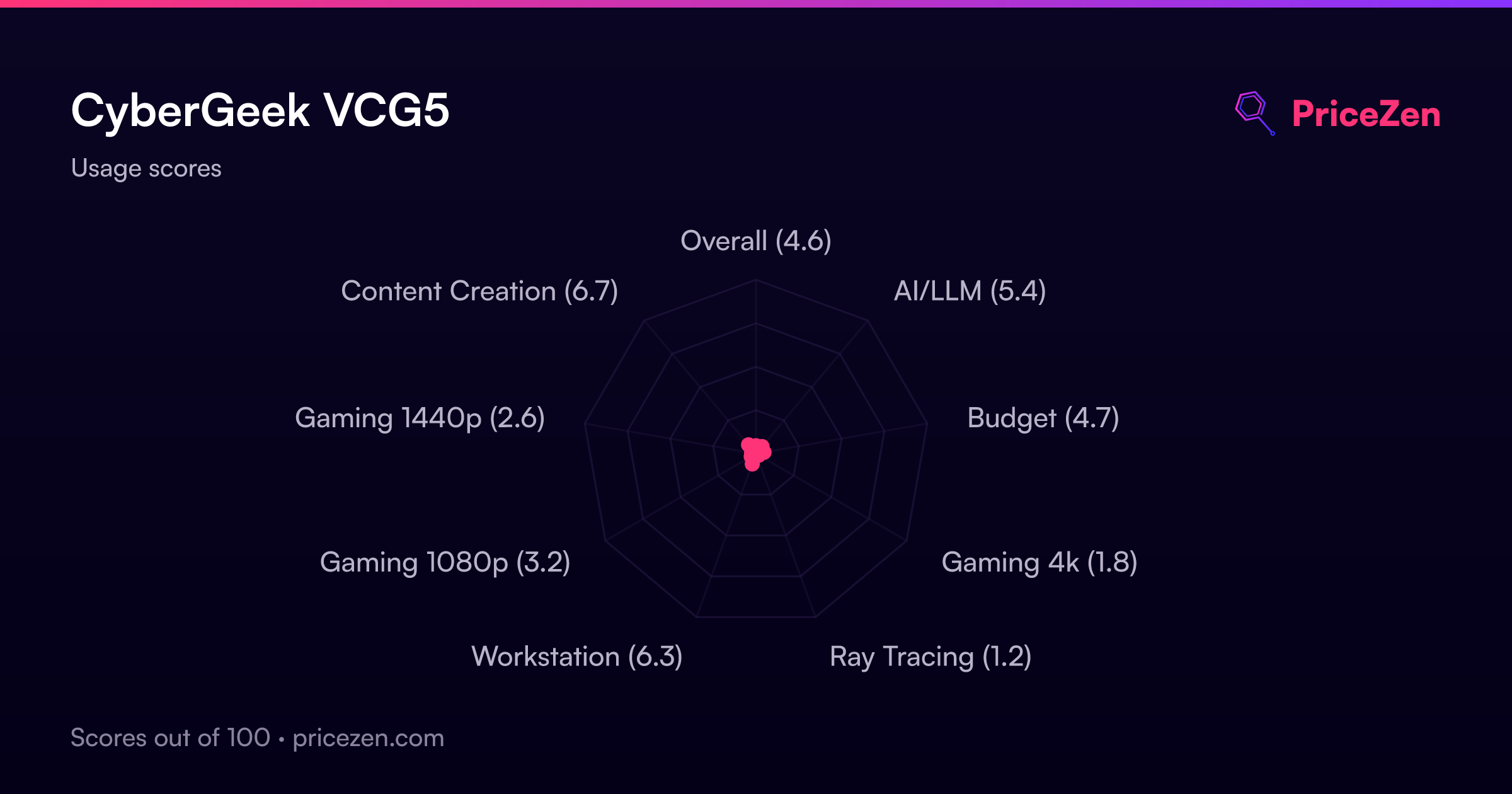
Usage Scores
- Overall4.6
- AI/LLM5.4
- Budget4.7
- Gaming 4k1.8
- Ray Tracing1.2
- Workstation6.3
- Gaming 1080p3.2
- Gaming 1440p2.6
- Content Creation6.7