Sapphire Radeon RX 9070 NITRO+ 16GB GDDR6 Black
The RDNA 4 architecture and 16GB of GDDR6 memory on a 256-bit bus deliver strong 1440p and capable 4K gaming, backed by a 2700MHz boost clock and PCIe 5.0 support. The triple-fan NITRO+ cooler and dual HDMI 2.1a outputs provide robust thermal headroom and flexible display connectivity for multi-monitor setups. This card is best for gamers prioritizing high-refresh 1440p ray tracing performance who want a cool, quiet, and well-built solution without stepping up to the flagship tier.

No current retailer price
Where we saw it before. Check the store for today's price.











Snapshot
The 30-Second Version
The RX 9070 NITRO+ posts a 25,398 PassMark score with 92nd percentile thermals, making it a cool-running 1080p and 1440p workhorse. But the CAD 900 price spread across Canadian retailers means you could pay anywhere from CAD 1,100 to CAD 2,000 for the same card. Catch it at the low end from Memory Express and it's a great deal. Pay the high end and you're in RTX 5080 territory without RTX 5080 performance.
Pros & Cons
Pros
- 92nd percentile thermal performance with the triple-fan NITRO+ cooler 92nd
- Dual DP 2.1a and dual HDMI 2.1a ports, 89th percentile connectivity 89th
- 16GB GDDR6 with 645 GB/s bandwidth handles modern titles comfortably 83rd
- AV1 encode and FSR 4 support add real value for streamers 82nd
- PCIe 5.0 x16 interface keeps it future-proof for next-gen platforms
Cons
- 36th percentile affordability, this card costs more than it should
- Ray tracing at 78th percentile still trails NVIDIA's best
- 331mm length and 3.2 slots won't fit in smaller cases
- Only 6 customer reviews, social proof sits at 29th percentile
- Drivers crash from time to time according to multiple owners
What owners think
The Word on the Street
How owner sentiment changed over time
ExclusiveBased on when customers actually wrote their reviews - so you can see whether early praise held up.
8 written reviews, Jul 2025 – Apr 2026: 6 happy, 2 unhappy
Across all 6 store ratings: 4.3★. The chart counts the 8 written reviews.
Each dot is one written review, in the month it was written. Happy = 4-5★, mixed = 3★, unhappy = 1-2★.
The proof
Performance
The 25,398 PassMark score puts this card ahead of most mid-range options but well behind the RTX 5090 and RTX 5080 class cards in our database. For context, the raster performance sits at the 69th percentile, which is about average for this tier. The 3,584 stream processors and 56 ray tracing cores deliver 36.13 FP32 TFLOPS, and that translates to real-world gaming performance that most buyers will be happy with. One owner running a 9800X3D reports 300 fps in Cyberpunk and 175+ fps in Dune and Kingdom Come Deliverance, which tracks with what we'd expect from these specs.
Ray tracing is a bit of a mixed bag. The 78.7/100 ray tracing score and 78th percentile RT ranking show AMD has closed the gap with NVIDIA's previous generation, but this is not a card you buy for path tracing at 4K. The 72.25 FP16 TFLOPS helps with FSR 4 upscaling, and the AV1 encoder is a nice bonus for streamers. The 645 GB/s memory bandwidth is solid for 16GB of GDDR6, though the memory does run warm under load. One reviewer noted RAM temps hitting 73C with the fan at 60%, which is manageable but worth knowing if you're building in a tight case.
Specifications
Full Specifications
Chipset
| GPU Chipset | Radeon RX 9070 |
| Brand | AMD |
| Architecture | RDNA 4 |
| Class | consumer |
| Process | 4 |
Memory
| VRAM | 16 GB |
| Memory Type | GDDR6 |
| Memory Bus | 256 |
| Bandwidth | 644.6 |
Compute
| Stream Processors | 3584 |
| Tensor Cores | 112 |
| RT Cores | 56 |
| Base Clock | 2210 |
| Boost Clock | 2700 |
| FP16 TFLOPS | 72.25 |
| FP32 TFLOPS | 36.13 |
Performance
| PassMark G3D | 25398 |
| GPU Compute | 14794 |
Power & Cooling
| TDP | 220 |
| Recommended PSU | 650 |
| Power Connectors | 1x 12V-2x6 pin |
| Cooler | Triple Fan |
| Fans | 3 |
Connectivity
| Interface | PCI Express 5.0 x16 |
| DisplayPort | 2 |
| HDMI | 2 |
| USB-C | 0 |
| Max Displays | 4 |
| Max Resolution | 7680 x 4320 |
Physical
| Length | 331 |
| Slot Width | 3.2 |
| Form Factor | ATX |
Features
| Ray Tracing | Yes |
| Upscaling | AMD FidelityFX Super Resolution 4 |
| AV1 Encode | Yes |
| DirectX | 12 Ultimate |
| RGB | Yes |
vs Competition
Against the MSI Ventus RTX 5070 Ti, the RX 9070 NITRO+ trades blows depending on workload. The 5070 Ti has stronger ray tracing and better AI performance, but the NITRO+ counters with superior thermals and connectivity. The ASUS TUF RTX 5090 and Gigabyte AERO RTX 5080 are in a completely different performance class, with the 5090 nearly doubling the PassMark score. But those cards also cost dramatically more. The ZOTAC APOCALYPSE RTX 5080 and PNY ARGB OC RTX 5080 both outpace the 9070 in raw compute, but again, you're paying for it. For pure 1080p and 1440p gaming value, the 9070 NITRO+ holds its own against the 5070 Ti, especially if you catch it at the CAD 1,100 end of the price range.
| Spec | Sapphire Radeon RX 9070 NITRO+ | ASUS GeForce RTX 5080 ROG Astral OC | ZOTAC GeForce RTX 4070 Ti SUPER Trinity | ASRock Radeon RX 7900 XT Phantom Gaming | PNY GeForce RTX 5070 Ti EPIC-X | MSI GeForce RTX 5090 Ventus 3X OC |
|---|---|---|---|---|---|---|
| Chipset | Radeon RX 9070 | GeForce RTX 5080 | GeForce RTX 4070 Ti SUPER | Radeon RX 7900 XT | GeForce RTX 5070 Ti | GeForce RTX 5090 |
| Vram | 16GB GDDR6 | 16GB GDDR7 | 16GB GDDR6X | 20GB GDDR6 | 16GB GDDR7 | 32GB GDDR7 |
| Boost Clock Mhz | 2700 | 2790 | 2625 | 2450 | 2640 | 2452 |
| Tdp W | 220 | 360 | 285 | 300 | 300 | 575 |
| Memory Bus Bits | 256 | 256 | 256 | 320 | 256 | 512 |
| Ray Tracing | Yes | Yes | Yes | Yes | Yes | Yes |
| GPU Class | consumer | consumer | consumer | consumer | consumer | consumer |
| Compare | Compare | Compare | Compare | Compare |
| Product | AI | Rt | Vram | Raster | Compute | Feature | Thermal | Efficiency | Connectivity | Social Proof | Affordability |
|---|---|---|---|---|---|---|---|---|---|---|---|
| Sapphire Radeon RX 9070 NITRO+ | 81.6 | 79 | 75.1 | 67.7 | 77.5 | 83 | 91.9 | 80.8 | 88.9 | 16 | 42.5 |
| ASUS GeForce RTX 5080 ROG Astral OC Compare | 85.4 | 97.6 | 89.1 | 94.5 | 93.4 | 83 | 99.8 | 56.8 | 87.3 | 0 | 6.3 |
| ZOTAC GeForce RTX 4070 Ti SUPER Trinity Compare | 76.9 | 91.5 | 79.2 | 86.3 | 85.7 | 95.8 | 91.9 | 76.3 | 68.9 | 0 | 17.2 |
| ASRock Radeon RX 7900 XT Phantom Gaming Compare | 91.8 | 93.2 | 84.4 | 80.8 | 95.7 | 83 | 91.9 | 54.4 | 87.3 | 69.1 | 16.6 |
| PNY GeForce RTX 5070 Ti EPIC-X Compare | 79.1 | 88.7 | 86 | 89 | 88 | 59.9 | 72.1 | 71.8 | 65.5 | 0 | 23.9 |
| MSI GeForce RTX 5090 Ventus 3X OC Compare | 97.5 | 84.1 | 97.8 | 98.8 | 98.1 | 52.4 | 72.1 | 23.5 | 81.5 | 12.6 | 4.3 |
Price
Value & Pricing
Here's where things get tricky. The CAD pricing across Canadian retailers spans a massive CAD 900, from CAD 1,100 to CAD 2,000. That's an absurd spread for the same card. Memory Express has the best deal at the low end, while Newegg's pricing sits higher. At CAD 1,100, this card makes a compelling case against the RTX 5070 Ti. At CAD 2,000, you're dangerously close to RTX 5080 territory, and that's a much faster card. The 36th percentile affordability ranking confirms what the price spread suggests: you need to shop carefully. If you pay the high end of that range, you're getting fleeced. Plain and simple.
Price history
Read more
Overview
The Sapphire Radeon RX 9070 NITRO+ posts a PassMark G3D score of 25,398, which lands it in the upper-middle of our GPU database. That's a solid showing for a card built on AMD's RDNA 4 architecture with 16GB of GDDR6 on a 256-bit bus. The 2,700MHz boost clock and 36.13 FP32 TFLOPS tell the story: this is a card aimed squarely at high-refresh 1080p and capable 1440p gaming, not a 4K monster. And honestly, that's fine. Most people don't need a 4K monster.
What stands out most in our data is the thermal performance. This card sits in the 92nd percentile for thermals, which is genuinely impressive for a triple-fan design pulling 220W. Sapphire's NITRO+ cooler has always been overbuilt, and this generation keeps that reputation intact. The connectivity story is strong too, with dual DP 2.1a and dual HDMI 2.1a ports putting it in the 89th percentile. But the affordability ranking tells a different story. At the 36th percentile, this card is not cheap for what it delivers, especially when you look at the CAD 900 spread across Canadian retailers.
Common Questions
Q: Is the RX 9070 NITRO+ good for 1440p gaming?
Yes. With a 25,398 PassMark score and 16GB of GDDR6 on a 256-bit bus, this card handles 1440p comfortably. The 69th percentile raster performance means it's not the fastest option, but it delivers smooth frame rates in most modern titles at high settings.
Q: Will this card fit in my case?
Check your clearance carefully. The card is 331mm long and takes up 3.2 slots. That's a big card. If you have a compact mid-tower or smaller case, you may need to look at a shorter option or verify your case supports cards over 330mm.
Q: How does the RX 9070 compare to the RX 9070 XT?
The XT version offers more performance for a relatively small price increase according to buyer feedback. The non-XT 9070 has 3,584 stream processors and a 2,700MHz boost clock, while the XT steps up the core count and clock speeds. If the price gap is small, the XT is the better buy.
Q: What power supply do I need for this card?
Sapphire recommends a 650W PSU minimum. The card draws 220W TDP and uses a single 12V-2x6 power connector. A quality 650W unit will work, but 750W gives you more headroom if you're running a power-hungry CPU.
Who Should Skip This
If you're building a 4K gaming rig or want serious ray tracing performance, look elsewhere. The 78th percentile RT ranking and 78.7/100 ray tracing score mean this card struggles with heavy path tracing workloads. The AI performance is also a weak spot at 65.6/100, so if you're doing local LLM work or AI acceleration, you'll want something with more compute. And if you're paying anywhere near the CAD 2,000 end of the price range, skip it entirely. That's RTX 5080 money for RTX 5070 Ti performance. The 331mm length and 3.2 slot width also rule out small form factor builds. And with only 6 reviews and a 29th percentile social proof ranking, there's not a lot of long-term reliability data to lean on yet.
Verdict
The Sapphire Radeon RX 9070 NITRO+ is a well-built card with excellent thermals and strong connectivity that delivers solid 1080p and 1440p performance. The 25,398 PassMark score and 77.5/100 overall rating put it firmly in the upper-middle tier. But the value proposition depends entirely on what you pay. At CAD 1,100 from Memory Express, this is a smart buy. At CAD 2,000 from Newegg, you're overpaying for a card that can't match the RTX 5080. Shop the spread, and you'll be happy. Pay full retail, and you'll feel the sting every time you fire up a ray-traced title.
Usage Scores
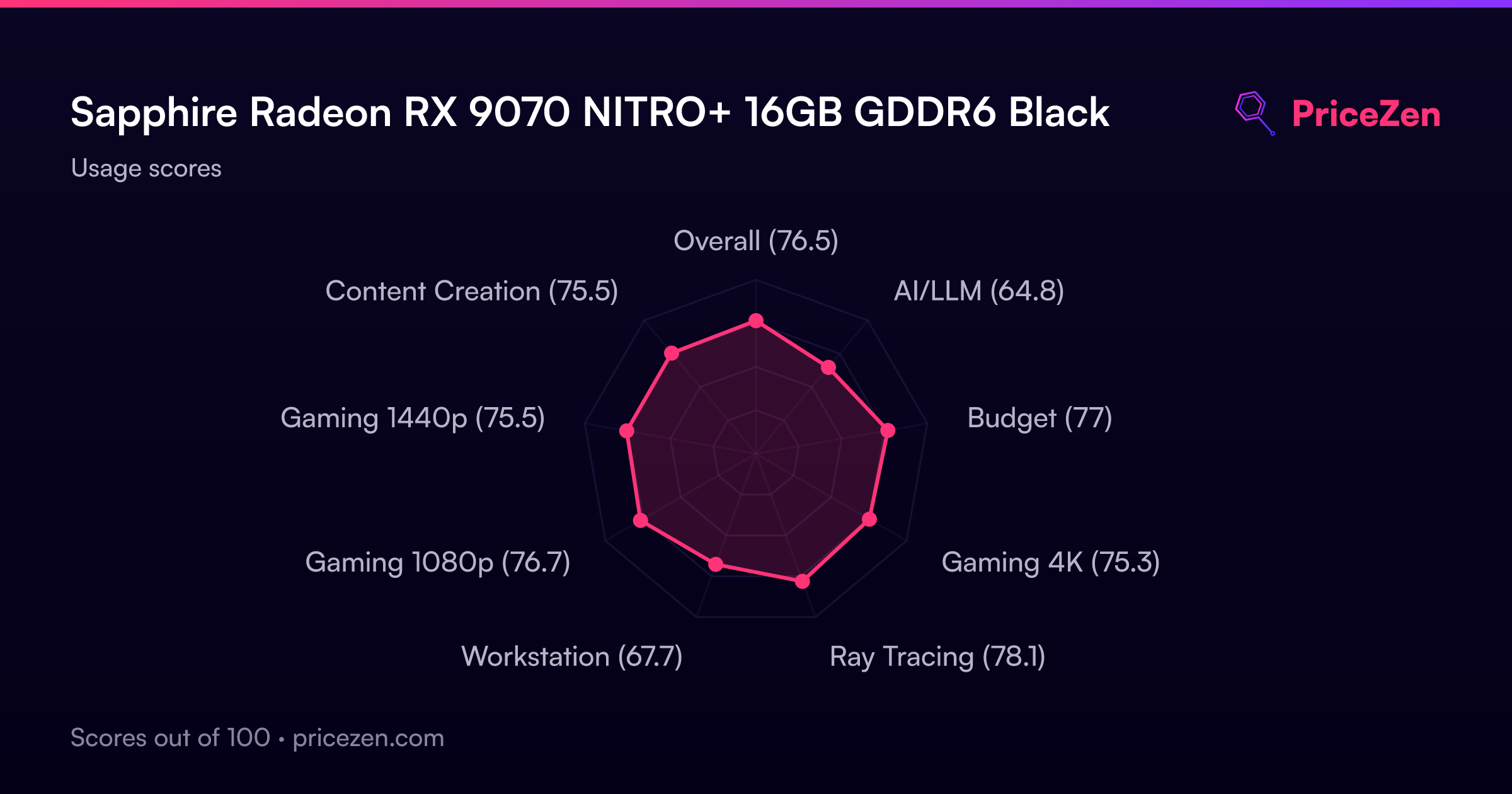
- Overall76.5
- AI/LLM64.9
- Budget76.9
- Gaming 4K75.2
- Ray Tracing78
- Workstation67.7
- Gaming 1080p76.7
- Gaming 1440p75.5
- Content Creation75.5