Panasonic LUMIX FZ80D Black
Its 60x optical zoom lens paired with a 20MP CMOS sensor provides extreme telephoto reach in a fixed-lens body, making distant subjects accessible without interchangeable lenses. The Post-Focus feature and included accessory bundle add creative flexibility and out-of-box value for beginners. This camera is best for hobbyist wildlife observers and casual sports spectators who prioritize zoom range over 4K video or low-light performance.












Snapshot
The 30-Second Version
A 20-1200mm equivalent zoom with 5-stop stabilization that ranks among the best in its class, wrapped around a 20MP 1/2.3-inch sensor that falls behind most of the field. Great reach, strong EVF, weak video at 4K@30fps. USD 450 to USD 550 with a 64GB card in the box.
Pros & Cons
Pros
- 20-1200mm equivalent zoom range, plus 1cm minimum focus for close-ups 88th
- 5-stop stabilization ranks among the best on the market 86th
- 2360K-dot glare-resistant EVF is one of the better ones we track 79th
- 49 AF points with Eye AF and Animal AF, well above average for the category 74th
- Bundle includes a 64GB Extreme Pro card rated up to 200MB/s read and 90MB/s write
Cons
- 20MP 1/2.3-inch sensor falls behind most of the field
- Video capped at 4K@30fps, a weak spot at the 22nd percentile
- Fixed 3-inch touchscreen, no flip-out for self-facing shooting
- No weather sealing, and 1179g is heavy for a compact
- Battery ranks about average at 46, so plan on charging via USB-C mid-day
The proof
Performance
The stabilization spec is the headline. Panasonic rates the POWER O.I.S. system at 5 stops, and our ranking puts it among the best on the market. That matters more than usual here, because at 1200mm equivalent every heartbeat looks like an earthquake. Pair it with the 2360K-dot glare-resistant viewfinder (one of the better ones we track) and you've got a setup built for handholding a very long lens in bright daylight. Autofocus is well above average with 49 AF points plus Eye AF, Animal AF and subject detection, which is a genuinely useful feature set for the birds-and-backyard-wildlife crowd. Burst is 10fps mechanical and 10fps electronic, landing at the 74th percentile, so solid rather than special.
Then the ceiling. A 20MP 1/2.3-inch CMOS is a small sensor, and our sensor ranking of 32 reflects that: it falls behind most of the field. Video tops out at 4K@30fps and 1080p@60fps in MP4, which puts it at the 22nd percentile, a weak spot. Battery ranks 46, basically middle of the pack, though USB Type-C charging helps. The 3-inch touchscreen is fixed, not articulating, and ranks 59. And at 1179g this isn't a pocket camera despite the point-and-shoot label. No weather sealing either, so keep it dry.
Specifications
Full Specifications
Sensor
| Type | CMOS |
| Size | 1/2.3-inch" |
| Megapixels | 20 MP |
| ISO Range | 80 |
| Processor | Venus Engine |
Autofocus
| AF Points | 49 |
| Eye AF | Yes |
| Animal AF | Yes |
| Subject Detection | Yes |
Shooting
| Burst (Mechanical) | 10 |
| Burst (Electronic) | 10 |
| Electronic Shutter | Yes |
Video
| Max Resolution | 1080p |
| 4K FPS | 30 |
| 1080p FPS | 60 |
| 10-bit | No |
| Log Profile | No |
| RAW Video | No |
| Codec | MP4 |
Display & EVF
| Screen Size | 3" |
| Touchscreen | Yes |
| Articulating | No |
| EVF Resolution | 2.36 M dots |
Build
| Weight | 1.2 kg / 2.6 lbs |
Connectivity
| Wi-Fi | Yes |
| Bluetooth | Yes |
| USB | USB-C |
vs Competition
Our system compares this against the Sony Alpha a7R VI, Fujifilm GFX100S II, Canon EOS R1, Leica SL2 and Kolari Vision X-T5, and honestly that's a rough room for a 1/2.3-inch sensor. The FZ80D's sensor score of 32 and video score of 22 tell you exactly how that fight goes. But look at where it holds its own: stabilization at 88 and EVF at 85 are leading numbers regardless of who it's stacked against, and autofocus at 79 is strong. Cross-shop the Canon EOS R1 if you're chasing action and want the burst and AF headroom this 10fps body can't match. Look at the Sony Alpha a7R VI or Fujifilm GFX100S II if resolution and file quality are the point. The Leica SL2 and Kolari Vision X-T5 are different propositions entirely. None of them are trying to hand you 1200mm equivalent in one sealed unit at USD 450.
| Spec | Panasonic LUMIX FZ80D | Fujifilm X-T30 II | Sony Alpha ILCE-6700L_EDIAV_1 | Blackmagic Design URSA Cine17K 65 | ARRI ALEXA 35 XTREME | Olympus OM-D E-M1 |
|---|---|---|---|---|---|---|
| Type | mirrorless | mirrorless | mirrorless | cinema | cinema | mirrorless |
| Sensor | 20MP 1/2.3-inch | 26.1MP aps-c | 24.2MP aps-c | 140.8MP full-frame | 14.6MP aps-c | 16.3MP micro-four-thirds |
| AF Points | 49 | 425 | 759 | - | - | 81 |
| Burst FPS | 10 | 30 | 11 | 60 | 35 | 10 |
| Video | 1080p @30fps | 4K @30fps | 4K @120fps | 8K @60fps | 4K @240fps | 1080p |
| IBIS | Yes | No | Yes | No | No | Yes |
| Weather Sealed | No | No | No | No | No | Yes |
| Weight (g) | 1179 | 329 | 409 | - | 2900 | 443 |
| Compare | Compare | Compare | Compare | Compare |
| Product | AF | EVF | Build | Burst | Video | Sensor | Battery | Display | Connectivity | Affordability | Stabilization |
|---|---|---|---|---|---|---|---|---|---|---|---|
| Panasonic LUMIX FZ80D | 78.9 | 85.6 | 63.2 | 74.1 | 22 | 32.1 | 46 | 59.1 | 67.3 | 60.8 | 87.8 |
| Fujifilm X-T30 II Compare | 89.7 | 85.6 | 14.3 | 87.9 | 75.5 | 95.7 | 90.9 | 95 | 90 | 45.4 | 33.2 |
| Sony Alpha ILCE-6700L_EDIAV_1 Compare | 96.5 | 85.6 | 18.2 | 71.2 | 87.5 | 91.2 | 46 | 91.6 | 90 | 32.5 | 87.8 |
| Blackmagic Design URSA Cine17K 65 Compare | 37 | 98.7 | 73.6 | 98.3 | 99.7 | 98.2 | 46 | 82.3 | 81 | 2.7 | 33.2 |
| ARRI ALEXA 35 XTREME Compare | 37 | 81.2 | 78.4 | 96 | 97.8 | 72.8 | 46 | 27.5 | 83.2 | 1.3 | 33.2 |
| Olympus OM-D E-M1 Compare | 82.1 | 85.6 | 91.5 | 68.5 | 22 | 18.7 | 46 | 82.3 | 65 | 64.1 | 87.8 |
Price
Value & Pricing
In the US we're tracking two listings between USD 450 and USD 550, a USD 100 spread worth shopping around for since it's the same bundle. Elsewhere it's CAD 1,501 in Canada, JPY 109,775 in Japan and MXN 11,611 in Mexico. Affordability ranks 55 in our model, so about average against everything else in this category, which makes sense given the company it keeps. What you're buying is reach and stabilization plus a fast 64GB U3 card in the box, not sensor size. If your priority is focal length per dollar, the math works. If it's image quality per dollar, it doesn't.
Amazon 1 offer From ¥109,775
We started tracking prices for this product on Nov 25, 2026. The chart appears once we have more data.
Read more
Overview
A 20-1200mm equivalent zoom on a 20MP 1/2.3-inch sensor, sold as a bundle with a 64GB Extreme Pro SDXC card for USD 450 to USD 550. That reach is the whole pitch, and our scoring backs up where it lands: stabilization is among the best on the market, the 2.4M-dot EVF is one of the better ones we track, and autofocus is well above average. Those are strong numbers for a point-and-shoot. The flip side shows up just as clearly in the data: the sensor ranks 32nd out of 100 against the field and video sits at 22.
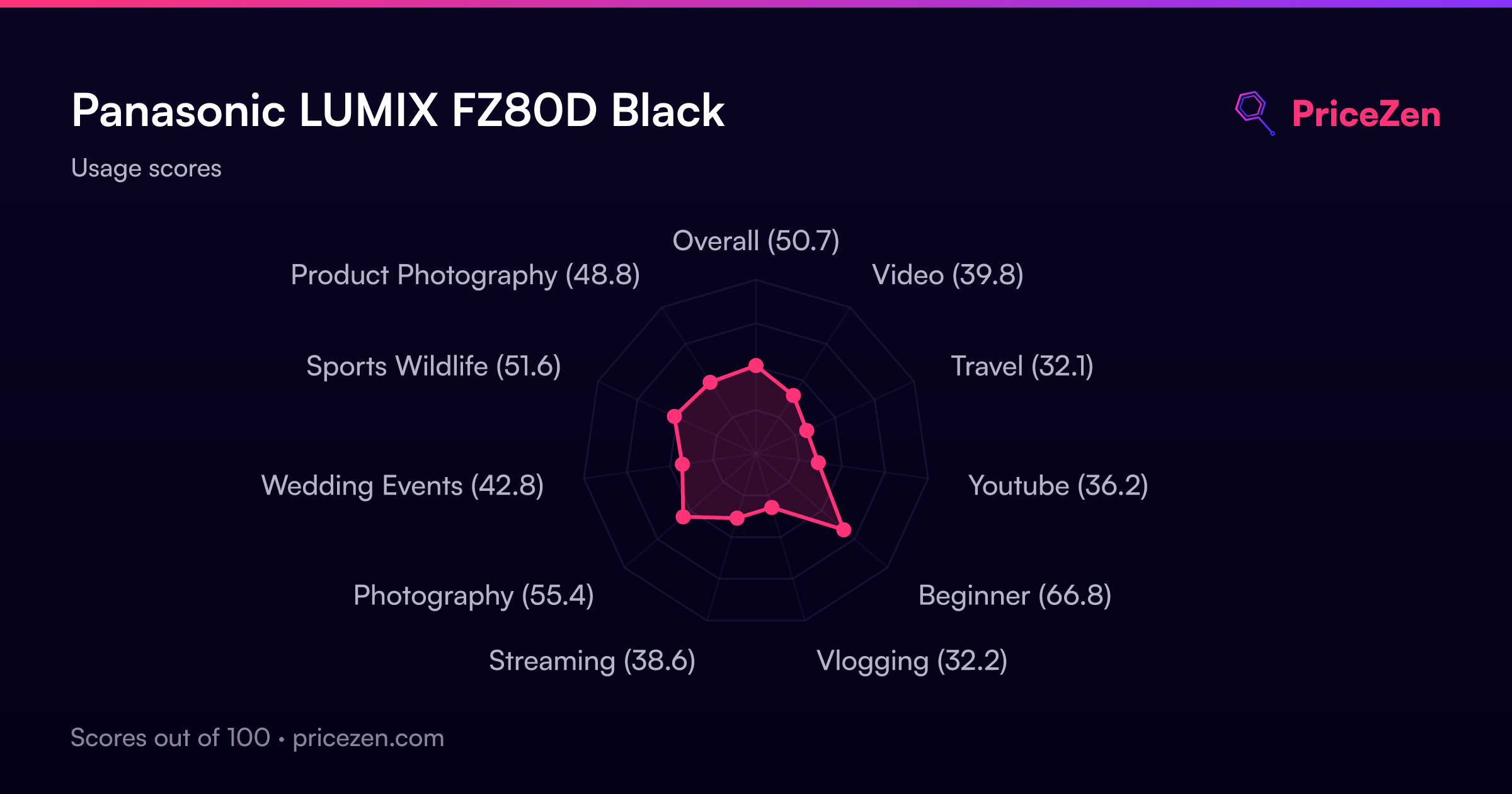
So this is a long-zoom travel camera that happens to be filed under mirrorless at Best Buy, not a competitor to the big-sensor bodies it gets grouped with. Our category scores put it at 64.1 for beginners, 55.2 for general photography and 51.5 for sports and wildlife, with vlogging its weakest area at 32.1. Read those numbers together and the shape is obvious: easy to pick up, enormous reach, modest image quality ceiling.
Common Questions
Q: How good is the zoom really, and can you handhold it at full reach?
The lens covers 20-1200mm equivalent, and Panasonic rates the POWER O.I.S. at 5 stops. Our stabilization ranking puts it among the best in the category, which is what makes 1200mm handheld plausible at all. Minimum focusing distance is 1cm for close-up work. It'll still weigh you down at 1179g.
Q: Is it any good for video or vlogging?
Not really. It shoots 4K@30fps and 1080p@60fps in MP4, and our video score puts it at the 22nd percentile, a weak spot. Vlogging is its lowest use-case score at 32.1, helped along by a fixed 3-inch screen that doesn't flip forward. You can pull 8-megapixel stills from 4K footage, which is a nice trick, but video isn't the reason to buy this.
Q: What's actually in the bundle, and is the card fast enough for 4K?
Camera, a 64GB Extreme Pro SDXC UHS-I card and accessories. The card is rated up to 200MB/s read and 90MB/s write with U3 speed class, which comfortably covers the 4K@30fps this camera records. US listings run USD 450 to USD 550 for the kit, so check both before you commit.
Who Should Skip This
If you shoot video seriously, skip it. A 22nd-percentile video score and a 4K@30fps ceiling aren't going to cut it, and the fixed screen kills self-facing recording, which is why vlogging scores just 32.1. Same story if you print big or crop hard: the 20MP 1/2.3-inch sensor ranks 32 and falls behind most of what we track. Sports shooters who need serious burst depth will find 10fps only solid at the 74th percentile. And with no weather sealing plus 1179g of body, it's a poor fit for wet-weather field work or anyone hoping for a jacket-pocket camera.
Verdict
Buy it for the zoom, not the sensor. Our beginner score of 64.1 is its strongest use case, and the combination of 5-stop stabilization, a top-tier EVF and animal-detect AF makes a lot of sense for someone who wants to photograph birds, planes and their kid's soccer game without buying three lenses. The 32 sensor score and 22 video score are real limits, not nitpicks, so go in knowing files won't hold up like a larger-sensor body. At USD 450 with a 64GB card included, it's a fair deal for what it does. Just don't ask it to be a cinema camera.
Usage Scores
- Overall50.7
- Video39.8
- Travel32.1
- Youtube36.2
- Beginner66.7
- Vlogging32.2
- Streaming38.6
- Photography55.4
- Wedding Events42.8
- Sports Wildlife51.6
- Product Photography48.8