Transcend MTS825 2TB SATA III M.2 2280
The 2TB M.2 2280 SATA III drive delivers 550 MB/s read and 460 MB/s write speeds, with SLC caching and LDPC ECC for stable transfers. Its compact form factor fits Ultrabooks and slim devices, backed by a 720 TBW endurance and a 3-year warranty. Best for budget-conscious laptop owners upgrading storage for everyday tasks and light workloads.


Snapshot
The 30-Second Version
The Transcend MTS825 TS2TMTS825S is a 2TB M.2 2280 SATA III internal SSD built for older laptops that can't take NVMe. Owners love the boot-speed jump over an HDD, but sustained writes disappoint and the price is steep for SATA. Only worth it if your slot leaves you no choice.
Pros & Cons
Pros
- 2TB in a single M.2 2280 stick, capacity ranks well above average 79th
- Owners consistently report much faster boots and response versus an HDD 78th
- Easy install and cloning, works in older ultrabooks and laptops 75th
- 720 TBW endurance rating with LDPC error correction 71st
- Strong owner rating of 4.6/5 across 500 reviews
Cons
- SATA III ceiling means speed lags behind most current internal SSDs
- DRAM-less controller, owners report poor sustained write performance
- A handful of early failure reports sour the reliability picture
- Affordability ranks near the bottom of the category at current prices
- Only a 3-year warranty
What owners think
The Word on the Street
How owner sentiment changed over time
ExclusiveBased on when customers actually wrote their reviews - so you can see whether early praise held up.
10 written reviews, Dec 2019 – Apr 2026: 8 happy, 1 mixed, 1 unhappy
Across all 500 store ratings: 4.6★. Most owners rate without writing a review. The chart counts the 10 written reviews.
Each dot is one written review, in the month it was written. Happy = 4-5★, mixed = 3★, unhappy = 1-2★.
The proof
Performance
Transcend quotes up to 550 MB/s read and 460 MB/s write, with marketing highlights stretching that to 560/500 MB/s. Random performance is rated at 55K read IOPS and 80K write IOPS. Those are normal SATA numbers, and against everything else in our internal SSD database the speed ranking is one of the weakest, which is a weak spot. That's not a knock on the drive so much as a knock on the interface: SATA III simply runs out of road long before modern flash does. Random performance sits about average, so day-to-day responsiveness is fine even if big sequential transfers aren't thrilling.
The DRAM-less design plus SLC caching is where owners get grumpy. Several report write speeds falling off during large sustained jobs, one buyer benchmarked a full system restore and found writes disappointing enough to complain publicly. Short bursts and boot duties are where this thing shines; filling 2TB in one go is not. Endurance at 720 TBW ranks solidly (one of the better), so it's not fragile on paper, but early failures do show up in owner reports.
Specifications
Full Specifications
Drive
| Capacity | 2000 |
| Form Factor | M.2 2280 |
| Interface | SATA III |
| Protocol | SATA |
| External | No |
Performance
| Sequential Read (MB/s) | 550 |
| Sequential Write (MB/s) | 460 |
| Random Read (IOPS) | 55000 |
| Random Write (IOPS) | 80000 |
Hardware
| NAND | SLC |
| DRAM Cache | No |
Reliability
| Endurance (TBW) | 720 |
| MTBF (hours) | 2000000 |
| Warranty (years) | 3 |
Features
| Hardware Encryption | No |
vs Competition
Cross-shop the Western Digital WD_BLACK SN8100, Samsung 9100 PRO and Kingston FURY Renegade before you commit, and the Crucial T700 and Seagate FireCuda 530R are in the same conversation. Our ranking places all of them ahead of the MTS825 overall, and the gap comes down to this drive's SATA III interface and its weak speed standing. Any of those alternatives is the better pick if your motherboard has an NVMe-capable M.2 slot, full stop.
The only scenario where the Transcend wins is compatibility. Its B+M key and SATA signalling make it a fit for older ultrabooks and slim laptops that physically can't take those faster drives. So check your slot first. If it's SATA-only, the MTS825 is a legitimate 2TB answer. If it isn't, you're paying a premium for a limitation.
| Spec | Transcend MTS825 | Western Digital WD_BLACK SN8100 | Samsung 9100 PRO | Kingston FURY Renegade | Crucial T700 | Seagate FireCuda 530R |
|---|---|---|---|---|---|---|
| Capacity | 2TB | 4TB | 4TB | 4TB | 2TB | 4TB |
| Form Factor | M.2 2280 | M.2 2280 | M.2 2280 | M.2 2280 | M.2 2280 | M.2 2280 |
| Interface | SATA III | PCIe 5.0 x4 | PCIe 5.0 x4 | PCIe 4.0 x4 | PCIe 5.0 x4 | PCIe 4.0 x4 |
| Seq Read | 550 MB/s | 14,900 MB/s | 14,800 MB/s | 7,300 MB/s | 12,400 MB/s | 7,400 MB/s |
| Nand Type | SLC | TLC | TLC | TLC | TLC | TLC |
| Dram Cache | false | false | true | true | true | false |
| Endurance | 720 TBW | 2400 TBW | 2400 TBW | 4000 TBW | 1200 TBW | 5050 TBW |
| Compare | Compare | Compare | Compare | Compare |
| Product | Speed | Random | Feature | Capacity | User Sentiment | Endurance | Social Proof | Affordability |
|---|---|---|---|---|---|---|---|---|
| Transcend MTS825 | 23.2 | 40.7 | 77.7 | 78.5 | 27.7 | 71.2 | 75.1 | 21.8 |
| Western Digital WD_BLACK SN8100 Compare | 99.7 | 99.6 | 85.3 | 92.5 | 95 | 80.5 | 94.9 | 8.4 |
| Samsung 9100 PRO Compare | 99.3 | 99.8 | 99.7 | 92.5 | 0 | 85.6 | 99.6 | 5 |
| Kingston FURY Renegade Compare | 93.4 | 94.4 | 93.9 | 92.5 | 79.1 | 94 | 94.9 | 10.6 |
| Crucial T700 Compare | 96.7 | 97.7 | 97.5 | 78.5 | 79.1 | 82.5 | 75.1 | 22 |
| Seagate FireCuda 530R Compare | 92.9 | 96.8 | 52.1 | 92.5 | 65.7 | 95.6 | 85.8 | 7.5 |
Price
Value & Pricing
Here's the problem. We track this drive at USD 506 at Amazon in the US, and EUR 400 to EUR 460 across four European listings, a EUR 60 spread that's worth shopping around for. Our affordability ranking puts it near the bottom, meaning most drives in this category cost less for what they deliver. Owners who caught it discounted are happy; owners paying full freight are getting SATA throughput at a price where the rest of the market has moved on. If you need M.2 SATA specifically, your options are thin and that's the whole argument for it. If you don't, this is a lot of money for a slow interface.
Amazon 1 offer From €460
We started tracking prices for this product on Nov 20, 2026. The chart appears once we have more data.
Read more
Overview
The Transcend MTS825 TS2TMTS825S is a 2TB internal SSD in the M.2 2280 form factor, and the important bit is that it runs on SATA III at 6Gb/s, not NVMe. It's aimed squarely at people reviving an older ultrabook or laptop whose only M.2 slot speaks SATA. In our price tracking it sits around USD 506 in the US and EUR 400 to EUR 460 across European listings, which puts it well above impulse-buy territory for a SATA drive.
On paper it's a straightforward upgrade part: 3D TLC NAND with SLC caching, LDPC error correction, a B+M key, and a DRAM-less controller. Transcend rates it for 720 TBW with a 3-year warranty and a 2,000,000 hour MTBF figure. Owners mostly agree it does the job it was bought for, boot times drop, machines feel snappier, and installation is painless. But our scoring model puts it at 56.8/100 overall, and the reasons why are worth reading before you click buy.
Common Questions
Q: Is the Transcend MTS825 good for gaming?
It'll load games far faster than a hard drive, but its SATA III speeds of up to 550 MB/s read rank near the bottom of our internal SSD category. If your board supports NVMe, a faster drive is the better gaming pick.
Q: Does the Transcend MTS825 work in any M.2 slot?
No, it's a SATA III M.2 2280 drive with a B+M key, so it needs a slot that supports SATA signalling. Many newer NVMe-only M.2 slots won't recognise it, so check your laptop or motherboard manual first.
Q: How does the Transcend MTS825 compare to the Samsung 9100 PRO?
Our ranking puts the Samsung 9100 PRO ahead, mainly because the MTS825 is capped by SATA III while its speed is one of the weakest in our data. The Transcend only makes sense if your machine can't take an NVMe drive.
Q: Is 2TB enough for Windows 11 and everyday use?
Yes, 2TB gives plenty of room for Windows 11 plus apps and files, and capacity is one of this drive's stronger points in our rankings. Some owner complaints about tight headroom relate to smaller capacities, not this 2TB model.
Who Should Skip This
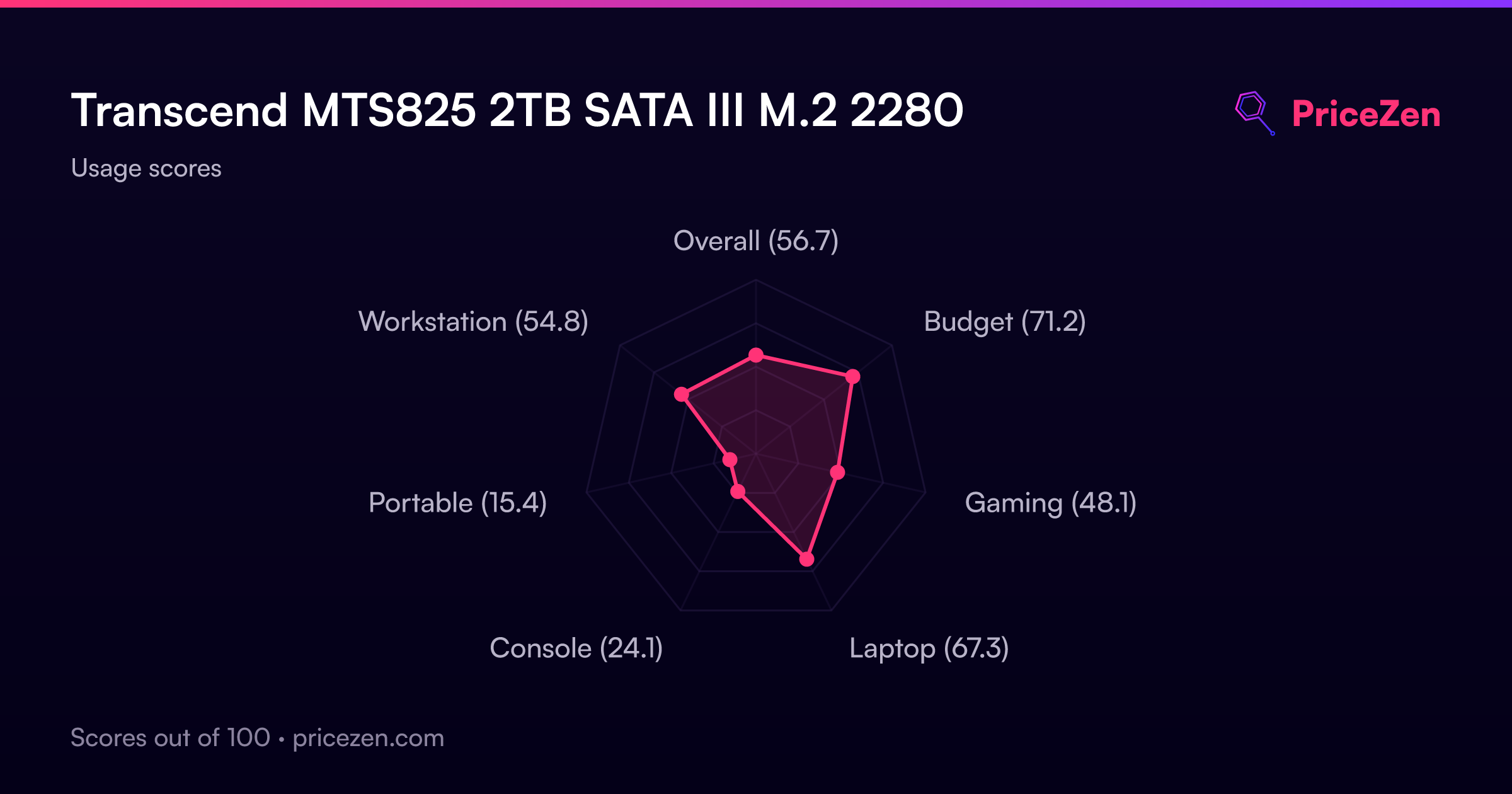
Skip this if your desktop or laptop has an NVMe-capable M.2 slot, if you edit video or move huge files regularly, or if you want a portable-style fast scratch drive (our model scores it just 15.4/100 for portable use). Sustained writes are its sore point and the price doesn't help. The Western Digital WD_BLACK SN8100, Samsung 9100 PRO, Kingston FURY Renegade, Crucial T700 and Seagate FireCuda 530R all rank higher in our data and are the smarter buys for anyone with a modern slot.
Verdict
Buy it only if your laptop's M.2 slot is SATA-only and you genuinely want 2TB in one drive. For that narrow case it does exactly what owners say it does: turns a sluggish old machine into something pleasant, with easy installation and no drama. The 4.6/5 rating from 500 reviews backs that up.
For everyone else, we'd pass. Our model scores it 56.8/100, sentiment among owners is one of the lower despite the high star average, and the recurring complaints about write performance and early failures aren't nothing. At USD 506 or EUR 400 to EUR 460, you're spending real money on last-generation throughput. Check your slot, then check the alternatives.
Usage Scores
- Overall56.7
- Budget71.2
- Gaming48.1
- Laptop67.3
- Console24.1
- Portable15.4
- Workstation54.8