G.Skill Ripjaws 64GB DDR5-5600 CL46 SODIMM Black

DDR5 SODIMM for laptops and mini PCs verified Nov 29
59/100 overall score
- Capacity
- 64GB
- Kit
- 1 x 64GB
- Memory
- DDR5
- Speed
- 5600 MT/s
- CAS latency
- CL46
- Form factor
- SODIMM







Snapshot
The 30-Second Version
A 64GB single-stick DDR5 SODIMM at 5600 MT/s that nails capacity (top 10%) but stumbles on latency (bottom quarter) and price (bottom 4%). The lone US listing sits at USD 2,000 on Amazon, which makes it one of the worst values in our laptop memory category. Great density for single-slot laptops, terrible deal at the current price. Watch the tracker, don't buy yet.
Pros & Cons
Pros
- 64GB in a single SODIMM, capacity in the top 10% of our laptop memory rankings 89th
- 5600 MT/s transfer rate sits well above average, in the top quarter 78th
- Low 1.1V operating voltage keeps power draw and heat modest for a notebook
- JEDEC default profile means it boots at stock speeds without BIOS fiddling on compatible hardware
- Heat spreader included, unusual for a laptop module
Cons
- CL46 latency is a weak spot, ranking in the bottom quarter against the category
- Single-channel configuration leaves dual-channel bandwidth unused on two-slot laptops
- Affordability ranks in the bottom 4%, one of the worst price-to-value positions we track
- Non-ECC and unbuffered rules out any server or mission-critical use, reflected in the 30.1 server score
- Feature set ranks below average, in the lower third, no extras beyond the heat spreader
The proof
Performance
Let's talk about what 5600 MT/s CL46 actually means for you. The transfer rate is strong, well above the middle of the pack in our data, so bulk throughput tasks like moving large datasets around or feeding a hungry integrated GPU will feel fine. But CL46 is loose. Really loose. Our latency ranking puts it in the bottom quarter, which means most laptop memory we track responds faster than this. In practice that shows up in latency-sensitive work: certain games, some compile workloads, anything where the CPU is waiting on memory rather than streaming through it. You get a big bucket, but the tap isn't especially quick.
The single-module design is the other half of the story. One 64GB stick means one channel populated. On a laptop with two SODIMM slots, running a single module leaves bandwidth on the table compared to a matched pair, and G.Skill explicitly warns against mixing kits to fill that second slot later. Their guidance is blunt: mixing kits causes stability issues or system failure. So if you're planning to add a second stick down the road, you'd want to buy a matched kit from the start instead. Also worth flagging: the spec sheet notes that hitting maximum speed may require BIOS adjustments and depends on your motherboard and CPU. The JEDEC default profile gets you booting, but the full 5600 MT/s isn't guaranteed on every machine. Check G.Skill's QVL or RAM Configurator before you commit.
Specifications
Full Specifications
Memory
| Type | DDR5 |
| Form Factor | SODIMM |
| Total Capacity | 65536 |
| Modules | 1 |
| Per Module | 65536 |
| Pins | 262 |
Performance
| Speed | 5600 |
| CAS Latency | 46 |
| Timings | 46-45-45-89 |
| Voltage | 1.1 |
Class
| ECC | No |
| Registered | No |
Features
| Heat Spreader | Yes |
vs Competition
The competitors in our data read like a who's-who of performance memory: Kingston FURY Beast, Corsair VENGEANCE RGB, KLEVV CRAS V RGB, Crucial Pro OC Gaming, and V-Color TUF GAMING ALLIANCE. Most of those names lean toward tighter timings and gaming-oriented profiles, which is precisely where this Ripjaws module gives ground. With CL46 in the bottom quarter for latency, anything from that list tuned for lower CAS latency will respond quicker in the workloads that care. If you're chasing frame rates or snappy compile times, cross-shop Crucial Pro OC Gaming and Kingston FURY Beast first.
Where the Ripjaws wins is raw single-slot density. Very few modules in our category match 64GB in one stick, and that top-10% capacity ranking is genuine. If your laptop has exactly one accessible SODIMM slot and you need maximum RAM, this form factor solves a problem the others may not. But you're solving that problem at a steep price with loose timings, so make sure the single-slot constraint is real before you pay for it. For anyone with two slots available, a matched kit from any of those competitors will likely serve you better on both bandwidth and cost.
| Spec | G.Skill Ripjaws | Kingston FURY Beast | Corsair VENGEANCE RGB | Team Group T-CREATE EXPERT | Crucial Pro Overclocking | XPG Lancer Blade RGB |
|---|---|---|---|---|---|---|
| Capacity | 64GB | 64GB | 64GB | 64GB | 32GB | 32GB |
| Kit | 1 x 64GB | 2 x 32GB | 2 x 32GB | 2 x 32GB | 2 x 16GB | 2 x 16GB |
| Memory Type | DDR5 | DDR5 | DDR5 | DDR5 | DDR5 | DDR5 |
| Speed Mts | 5600 | 6400 | 6400 | 6000 | 6400 | 6000 |
| Cas Latency | CL46 | CL32 | CL32 | CL34 | CL32 | CL30 |
| Form Factor | SODIMM | UDIMM | UDIMM | UDIMM | UDIMM | UDIMM |
| Ecc | No | No | No | No | No | No |
| Compare | Compare | Compare | Compare | Compare |
| Product | Speed | Feature | Latency | Capacity | Affordability |
|---|---|---|---|---|---|
| G.Skill Ripjaws | 77.6 | 36.7 | 22.3 | 89.4 | 4.2 |
| Kingston FURY Beast Compare | 94.8 | 89.6 | 87.6 | 89.4 | 7.7 |
| Corsair VENGEANCE RGB Compare | 94.8 | 89.6 | 87.6 | 89.4 | 6.8 |
| Team Group T-CREATE EXPERT Compare | 87.6 | 74.8 | 77.1 | 89.4 | 10.7 |
| Crucial Pro Overclocking Compare | 94.8 | 74.8 | 87.6 | 70.4 | 27 |
| XPG Lancer Blade RGB Compare | 87.6 | 89.6 | 87.6 | 70.4 | 16.6 |
Price
Value & Pricing
Here's where we have to be straight with you. The only US listing in our system right now is Amazon at USD 2,000, and the Canadian listing sits at CAD 3,000. Those are the prices our automated tracking picked up, and they land this module in the bottom 4% for affordability. That's not "a bit pricey." That's near the bottom of the entire category. We track prices over time through our community browser extension, and there's only one US listing here, so there's no store competition pulling the number down.
At USD 2,000 for a single laptop SODIMM, the price-to-performance math doesn't work for almost anyone. You're paying an enormous premium for 64GB of capacity with loose timings and single-channel operation. Our budget score of 59.6 reflects the product's positioning, but the actual street price makes that look generous. Unless this listing corrects dramatically, we'd hold off and watch the price tracker.
Read more
Overview
G.Skill's Ripjaws F5-5600S4645A64GX1-RS is a single 64GB DDR5 SODIMM, the kind of stick you buy when your laptop has one free slot and you want to stop watching Chrome eat your RAM for breakfast. It runs at 5600 MT/s with CL46 timings (46-45-45-89) at 1.1V, uses the standard 262-pin notebook form factor, and ships with a heat spreader plus a JEDEC default profile so it boots at stock SPD speeds on compatible hardware without you touching anything.
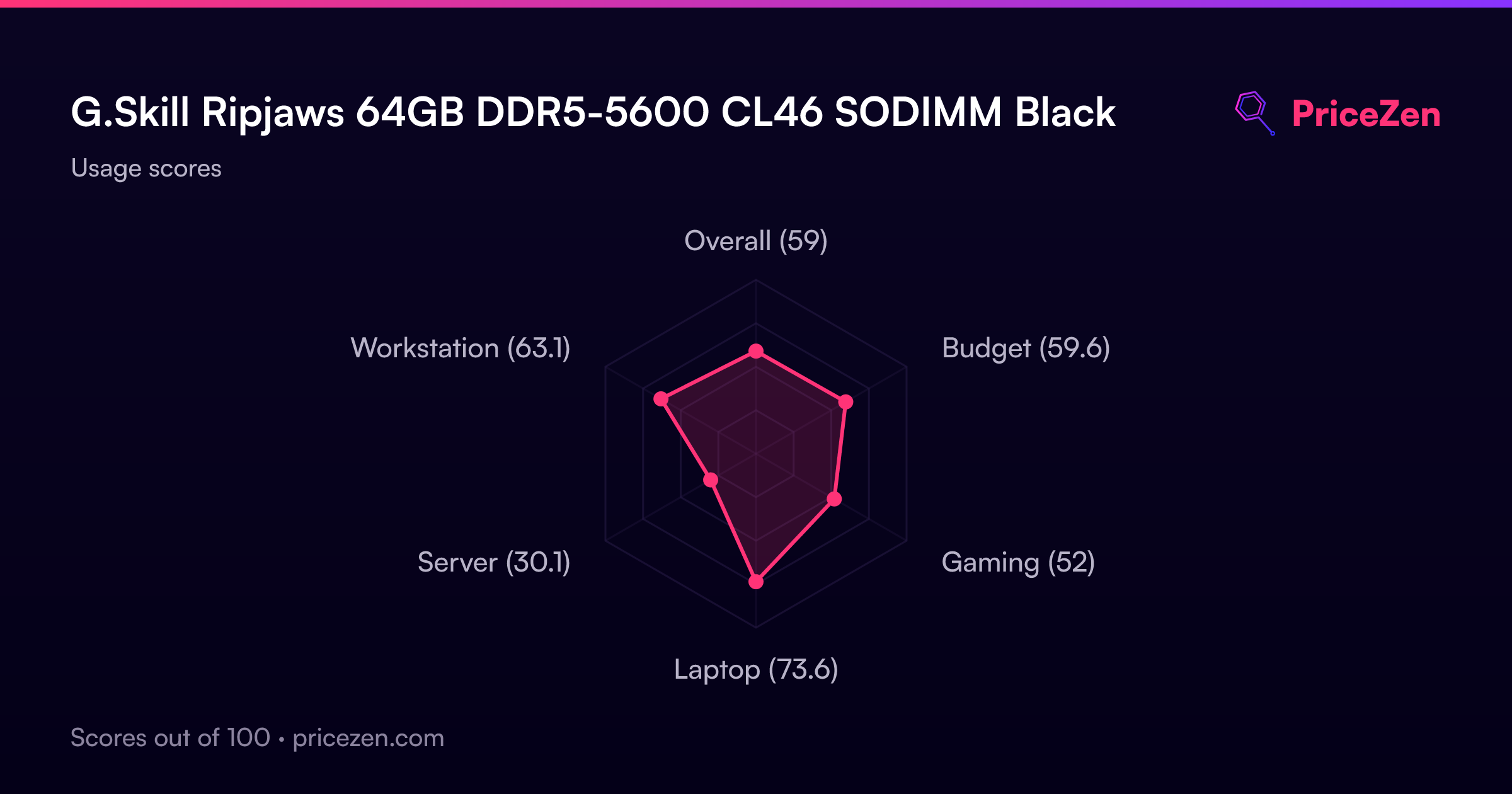
Our scoring model puts this squarely in laptop territory: 73.6 out of 100 for laptop use, which is its strongest showing by a wide margin. Workstation duty lands at 63.1, budget value at 59.6, and server use bottoms out at 30.1. That last number isn't a mystery. This is non-ECC, unbuffered memory, which is exactly what notebooks want and exactly what servers don't. If you're building anything that needs error correction, you're in the wrong aisle.
What makes it interesting is the density. Capacity ranks in the top 10% against everything else in our laptop memory category, meaning very few single modules give you this much room in one slot. Speed sits in the top quarter, comfortably above average. But latency ranks in the bottom quarter and features in the lower third, so this is a capacity-first product with some real compromises baked in. And then there's the price, which we'll get to, because it's the elephant sitting on the coffee table.
Common Questions
Q: Will this run at 5600 MT/s in my laptop without any BIOS changes?
Not necessarily. G.Skill includes a JEDEC default profile so the module boots at stock SPD speeds on compatible hardware, but reaching the full 5600 MT/s may require BIOS adjustments and depends on your specific CPU and motherboard. Check G.Skill's QVL or RAM Configurator tool to confirm your laptop is validated before buying.
Q: Can I add a second stick later to get dual-channel performance?
G.Skill explicitly warns against mixing memory kits, stating it will cause stability issues or system failure. If you want dual-channel operation, buy a matched kit designed to run together from the start. Adding a separately purchased module, even the same model number, isn't supported.
Q: Is this suitable for a home server or NAS build?
No. This is non-ECC, unbuffered memory, and our scoring model gives it just 30.1 out of 100 for server use, its weakest category by far. Servers and NAS builds that need data integrity should use ECC memory. This module is designed for laptops and notebooks, period.
Q: Why is the latency ranking so low if the speed is decent?
Speed and latency measure different things. The 5600 MT/s transfer rate is strong (top quarter), but CL46 timings are loose, putting latency in the bottom quarter. That means high throughput for streaming data but slower response for tasks where the CPU waits on individual memory accesses, like certain games or latency-sensitive applications.
Who Should Skip This
Skip this if you have two SODIMM slots available. A matched dual-channel kit will give you more bandwidth, and G.Skill's own warnings mean you can't safely add a second stick later anyway. Also skip it if you care about latency-sensitive performance. CL46 in the bottom quarter means most of the category responds faster, and competitors like Crucial Pro OC Gaming or Kingston FURY Beast are worth cross-shopping for tighter timings.
And honestly, skip it at the current price regardless of your use case. USD 2,000 for a single laptop SODIMM with loose timings and single-channel operation is a rough deal no matter how you slice it. Server builders should look elsewhere entirely given the non-ECC design and 30.1 server score. Budget-conscious buyers have essentially every other option in the category ahead of this one on value right now.
Verdict
If you own a laptop with a single SODIMM slot, you genuinely need 64GB, and you find this module at a sane price, it does the job. The capacity is real, the voltage is low, and the JEDEC profile means plug-and-play on validated hardware. Our laptop score of 73.6 reflects a product that fits its intended niche well. For mobile workstations running VMs, large datasets, or heavy multitasking where capacity matters more than latency, the specs line up.
But at the current USD 2,000 asking price, we can't recommend buying it. The affordability ranking is brutal, the latency is loose, and single-channel operation caps your bandwidth. Wait for the price to normalize, or look at matched kits from the competitor list that give you dual-channel operation and tighter timings. This is a good spec sheet attached to a bad price tag right now, and no amount of capacity makes that math work.
Usage Scores
- Overall59
- Budget59.6
- Gaming52
- Laptop73.6
- Server30.1
- Workstation63.1