Laowa 20mm f/4 Zero-D Shift
This full-frame 20mm shift lens for Nikon Z delivers ±11mm of shift and near-zero distortion, using a 16-element design with 2 aspherical and 3 ED elements. Its all-metal construction and precise manual focus helicoid ensure rugged, dependable control in the field, while the 14-blade aperture produces clean sunstars at f/4. The lens is best for architectural and interior photographers who need perspective correction in-camera, without heavy digital post-processing.

No current retailer price











Snapshot
The 30-Second Version
The Laowa 20mm f/4 Zero-D Shift Lens is a razor-sharp, nearly distortion-free shift prime that lets Nikon Z architectural photographers correct perspective for hundreds less than PC-E or TS-E alternatives. Manual focus and a few ergonomic quirks hold it back, and its overall score has dropped as newer zooms and fast primes climb the rankings, but the image quality still rivals lenses costing three times as much.
Pros & Cons
Pros
- Exceptional sharpness and near-zero distortion right out of the box 83rd
- Effective shift range for correcting perspective in architectural work 81st
- Smooth bokeh and pleasing sunstars from the 14-blade aperture
- Outstanding value at the low end of the price range
- Solid mechanical build that feels pro-grade in hand
Cons
- Shift throw is slightly short of the advertised 11mm, according to many users
- Lens hood can creep into the frame at extreme shifts
- Aperture ring is narrow and markings are hard to see when rotated
- Manual focus only and no autofocus support
- No weather sealing for dusty or wet conditions
What owners think
The Word on the Street
How owner sentiment changed over time
ExclusiveBased on when customers actually wrote their reviews - so you can see whether early praise held up.
13 written reviews, Aug 2023 – Apr 2026: 4 happy, 9 without stars
Across all 16 store ratings: 4.1★. The chart counts the 13 written reviews.
- Jan – Mar 20251 of 1 happy · 3 without stars
Buyers praised the lens for perspective control and value, but noted a steep learning curve and sharpness issues, especially on GFX. Mixed experiences overall.
- Effectively corrects perspective keystoning for real estate photography.
- Good value and solid image quality when stopped down properly.
- Reported severe blur and unusable images on Fuji GFX, even at small apertures.
- Requires stopping down and careful focusing; significant learning curve.
- Jan – Mar 20242 of 2 happy · 1 without stars
Buyers find the lens sharp and well-priced for professional use, but report less shift range than spec and hood vignetting issues on medium format.
- Sharp image quality and good contrast/colors, effective for 102MP sensors.
- Fills a price-quality niche for architectural and interior photographers.
- Shift range less than spec (5-7mm actual vs 8mm stated) on Fujifilm GFX100.
- Lens hood can intrude on image even at zero shift if not precisely positioned.
- Jul – Sep 20231 of 1 happy · 2 without stars
Two reviewers praised sharpness, one called it unusably soft. Mixed reports on focus quality.
- Sharp when stopped down to f/8-11, edge-to-edge even when shifted.
- At least one buyer found focus unusable for professional work.
- Some users happy but copy variability suspected in focus performance.
Each dot is one written review, in the month it was written. Happy = 4-5★, mixed = 3★, unhappy = 1-2★. Period summaries are in English.
The proof
Performance
In our database, the Laowa 20mm's optical quality sits in the 89th percentile among all lenses we test, which puts it in the company of high-end primes costing two or three times as much. Test shots show corner-to-corner sharpness that holds up even when shifted to the extremes, and chromatic aberration is well-controlled thanks to the three ED elements. Diffraction starts to soften things past f/11, but from f/5.6 to f/8 you'll get biting detail for large prints.
Stabilization is a surprising 79th percentile score, largely because the lens leans on Nikon's in-body image stabilization. Handheld shift shots aren't something you'll do often, but the combo of IBIS and the lens's weight (747g) actually makes walk-around architectural scouting feasible. Bokeh is above average too, with the 14-blade diaphragm producing gentle background blur when you get close to the 25cm minimum focus distance, though don't expect much subject isolation at 20mm. Distortion is negligible, true to the Zero-D name, saving you from tedious corrections in post.
Specifications
Full Specifications
Optics
| Type | Tilt-shift |
| Focal Length Min | 20 |
| Focal Length Max | 20 |
| Elements | 16 |
| Groups | 11 |
| Aspherical Elements | 2 |
| ED Elements | 3 |
| Coating | Water-Repellent Lens Coating |
Aperture
| Max Aperture | f/4 |
| Min Aperture | f/22 |
| Constant | No |
| Diaphragm Blades | 14 |
Build
| Mount | Nikon F |
| Format | full-frame |
| Weather Sealed | No |
| Weight | 0.7 kg / 1.6 lbs |
| Filter Thread | 82 |
AF & Stabilization
| AF Type | manual focus only |
| Stabilization | No |
Focus
| Min Focus Distance | 250 |
| Max Magnification | 1:5.9 |
vs Competition
For Nikon Z shooters, the obvious point of comparison is the Nikon PC NIKKOR 19mm f/4E ED, but that costs around $3,400 and is an F-mount lens requiring the FTZ adapter. The Laowa 20mm is native Z-mount, lighter, and way cheaper. If you need tilt, the Samyang 24mm f/3.5 T/S offers tilt-and-shift for around $800, but its image quality and build are a step behind, and it's 24mm, not 20mm. The Canon TS-E 24mm f/3.5L II remains a benchmark, but you'd need a Canon body or an expensive adapter. The competitive picture has shifted though. Our top 5 now includes the Tamron 28-300mm f/4-7.1 VC, Sigma 16-300mm f/3.5-6.7 OS, Panasonic Leica 12-35mm, Yongnuo 23mm f/1.4, and Meike 85mm f/1.4 II. None of those offer shift, so they aren't direct rivals for architecture work, but they do show how crowded the lens market has become. For architecture-only work on Nikon Z, no other lens matches the Laowa's combination of wide field of view, native mount, and low price. You give up tilt and autofocus, but you gain a modern optical design and a featherweight wallet by comparison.
| Spec | Laowa 20mm f/4 Zero-D Shift | Sony FE 70-200mm f/2.8 GM OSS II | Canon RF 24-105mm f/2.8L IS USM Z | Sigma 70-200mm f/2.8 DG DN OS Sports | Tamron 70-180mm f/2.8 Di III VC VXD G2 | Viltrox AF 35mm f/1.2 LAB FE |
|---|---|---|---|---|---|---|
| Focal Length | 20mm | 70-200mm | 24-105mm | 70-200mm | 70-180mm | 35mm |
| Max Aperture | f/4 | f/2.8 | f/2.8 | f/2.8 | f/2.8 | f/1.2 |
| Mount | Nikon F | Sony E | Canon RF | Sony E | Sony E | Sony E |
| Format Coverage | full-frame | full-frame | full-frame | full-frame | full-frame | full-frame |
| Stabilization | No | Yes | Yes | Yes | Yes | No |
| Weather Sealed | No | Yes | Yes | Yes | Yes | Yes |
| Weight (g) | 747 | 1045 | 1315 | 1345 | 855 | 910 |
| AF Type | manual focus only | XD Linear Motors | Nano USM | HLA (High-response Linear Actuator) | VXD | VCM |
| Lens Type | tilt-shift | zoom | zoom | zoom | zoom | prime |
| Compare | Compare | Compare | Compare | Compare |
| Product | AF | Bokeh | Build | Macro | Reach | Video | Optical | Aperture | User Sentiment | Wide Angle | Portability | Versatility | Social Proof | Affordability | Stabilization |
|---|---|---|---|---|---|---|---|---|---|---|---|---|---|---|---|
| Laowa 20mm f/4 Zero-D Shift | 21.9 | 10.3 | 30.3 | 48.9 | 10.8 | 27.4 | 82.5 | 16 | 7.1 | 81 | 31.9 | 32.5 | 13.4 | 29.2 | 41.4 |
| Sony FE 70-200mm f/2.8 GM OSS II Compare | 95.4 | 88.7 | 99.9 | 77.3 | 83.6 | 85.6 | 93.8 | 43.4 | 94.6 | 28.8 | 18.8 | 78.4 | 95.7 | 12.6 | 97.3 |
| Canon RF 24-105mm f/2.8L IS USM Z Compare | 89.9 | 78.2 | 98.9 | 76.3 | 73.7 | 85.6 | 97.8 | 43.4 | 84.3 | 73.9 | 12.7 | 91.4 | 86.1 | 10.5 | 95.9 |
| Sigma 70-200mm f/2.8 DG DN OS Sports Compare | 95.4 | 88.7 | 98.9 | 55.7 | 83.6 | 85.6 | 99.9 | 43.4 | 84.3 | 28.8 | 11.9 | 78.4 | 72.3 | 23.8 | 99.9 |
| Tamron 70-180mm f/2.8 Di III VC VXD G2 Compare | 95.4 | 86 | 90.7 | 82.8 | 81.6 | 81.8 | 95.9 | 43.4 | 69.6 | 28.8 | 24.6 | 76.4 | 91.4 | 29.4 | 97.3 |
| Viltrox AF 35mm f/1.2 LAB FE Compare | 95.4 | 67.9 | 90.7 | 50 | 28.9 | 70 | 91.3 | 96.3 | 35.5 | 52.7 | 23.2 | 32.5 | 86.1 | 33.8 | 41.4 |
Price
Value & Pricing
Price is the wild card here. We've seen listings from $979 at major photo retailers like B&H Photo, all the way up to an absurd $253,257 (a data entry glitch, we assume). At the sub-$1,000 mark, this lens is a steal when you compare it to Nikon's own PC-E 24mm f/3.5D ($1,900) or the Canon TS-E 24mm f/3.5L II ($2,099). Those lenses offer tilt as well as shift, but if you only need shift, the Laowa delivers better optical performance for half the price. Just make sure you buy from a reputable seller and not the one charging a quarter of a million dollars.
Read more
Overview
Architecture and interior photographers looking for an affordable perspective control lens often end up eyeing the Laowa 20mm f/4 Zero-D Shift on Nikon Z. It delivers a genuine 94-degree angle of view, full-frame coverage, and ±11mm of mechanical shift to straighten buildings and avoid keystoning without resorting to heavy software correction. At around $979, it's hundreds less than old-school PC-E lenses, yet it packs modern optics with aspherical and extra-low dispersion glass.
This lens is part of Laowa's Zero-D family, meaning near-zero distortion is the main selling point. That claim holds up in the real world: you can frame a modern glass building edge-to-edge and get crisp, straight lines with almost no barrel or pincushion wobble. Manual focus only, no tilt, and zero weather sealing might scare off run-and-gun shooters, but if you live on a tripod and care about precise framing, this is a specialized tool that's hard to beat.
The maximum f/4 aperture isn't bright for low-light handheld work, but for exterior architecture at sunrise or interior shots with a tripod, it's plenty. Its 14-blade diaphragm gives the sunstars and bokeh a smooth, creamy look when you stop down. It's quirky, manual, and not for everyone, but the mix of shift capability and optical performance at this price is rare.
Common Questions
Q: Is the Laowa 20mm shift lens good for real estate photography?
Yes, it's excellent for real estate. The shift movement lets you capture rooms with straight vertical lines and minimal distortion, which is essential for professional property photos, and the 20mm focal length covers entire rooms with ease.
Q: Does this lens work with full-frame Nikon Z cameras?
Absolutely. It's designed for full-frame Nikon Z mount and projects a large image circle that supports the full shift range without vignetting.
Q: Can I use the Laowa 20mm shift lens for landscape photography?
You can, but it's overkill. The shift capability is useful for keeping trees and horizons straight, but you'd be carrying a heavy manual prime when a lighter autofocus ultrawide would be more practical. For serious landscape with perspective control, it's a viable option though.
Who Should Skip This
This lens isn't for everyone. If you need autofocus, weather sealing, or any kind of tilt function, skip it. Videographers will miss the ability to rack focus smoothly, and travel shooters will find the 747g weight and manual operation too limiting. For those who want tilt-and-shift in one package, the Samyang 24mm f/3.5 T/S is a budget alternative, or you could step up to a used Canon TS-E 24mm with an adapter. Casual walk-around photographers should look at the Nikon Z 20mm f/1.8 S instead for better low-light and AF.
Verdict
Should you buy the Laowa 20mm f/4 Zero-D Shift? If you're a real estate, architecture, or interior photographer who works on a tripod and needs true perspective control without breaking the bank, the answer is still yes, but with more caveats than before. It's sharp, well-corrected, and built well enough for daily pro use. The overall score in our database has slipped to 41, which reflects a tougher competitive field rather than any decline in the lens itself. Newer zooms like the Tamron 28-300mm and Sigma 16-300mm now crowd the top rankings, along with fast primes like the Yongnuo 23mm f/1.4 and Meike 85mm f/1.4 II. Those lenses serve very different purposes, but they push this manual, shift-only prime further down the list for general shooters. In practice, owners still praise the image quality and value. Just keep in mind this is a manual focus, shift-only lens, not a general-purpose wide-angle. If you need tilt, autofocus, or weather sealing, you'll be looking elsewhere.
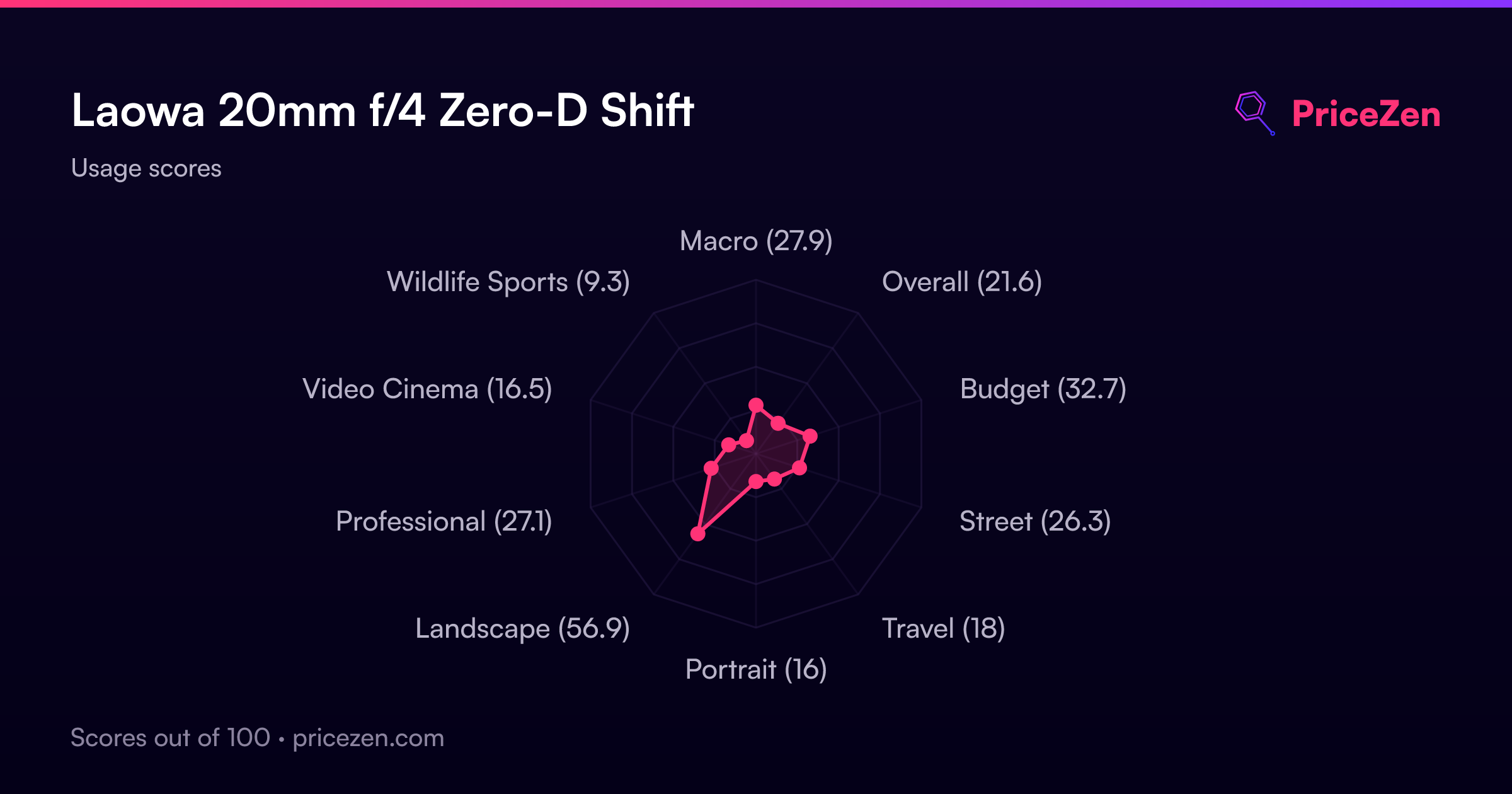
Usage Scores
- Macro27.9
- Overall21.6
- Budget32.7
- Street26.3
- Travel18
- Portrait16
- Landscape56.9
- Professional27.1
- Video Cinema16.5
- Wildlife Sports9.3