Tamron 16-30mm f/2.8 Di III VXD G2
The VXD linear motor delivers fast, quiet autofocus, while the constant f/2.8 aperture and 107° field of view suit low-light and wide-angle shooting. Weighing 440g with a 67mm filter thread and weather sealing, it pairs well with full-frame Sony E-mount bodies. Best for landscape and street photographers who need a lightweight, sharp zoom for travel and architecture.

No current retailer price











Snapshot
The 30-Second Version
The Tamron 16-30mm f/2.8 Di III VXD G2 is a lightweight full-frame wide-angle zoom for Sony E-mount that delivers excellent sharpness, fast autofocus, and solid build quality at a price that undercuts first-party options. It's a standout choice for landscape and astrophotography, though the lack of stabilization and mediocre bokeh hold it back for some use cases. At CAD 1,150 from Camera Canada, it's hard to beat for the money.
Pros & Cons
Pros
- Excellent sharpness for landscape and astro 95th
- Fast, quiet VXD autofocus 95th
- Lightweight at 440g for a full-frame f/2.8 zoom 90th
- Weather sealed with fluorine coating 88th
- 67mm filter thread keeps costs down
- Infinity lock is great for astrophotography
Cons
- No optical stabilization built in
- Rendering change at 30mm f/2.8
- Distortion at 16mm for people photos
- Bokeh quality is mediocre
- Macro performance is weak
- Firmware updates needed on some Nikon Z bodies
What owners think
The Word on the Street
How owner sentiment changed over time
ExclusiveBased on when customers actually wrote their reviews - so you can see whether early praise held up.
Happy owners: 100% lately, 94% in Jul 2025 – Mar 2026
Too few reviews to call that a change.
Across all 40 store ratings: 5.0★. The chart counts the 30 written reviews with stars and their own date.
7 written reviews without stars are left out of the trend.
Show the numbers
| Period | Reviews | Happy | Mixed | Unhappy | Happy share |
|---|---|---|---|---|---|
| Jul 2025 – Mar 2026 | 17 | 16 | 1 | 0 | 94% |
| Apr – Nov 2026 | 13 | 13 | 0 | 0 | 100% |
- Jul – Sep 20263 of 3 happy
Buyers praise the lens for sharpness and versatility in astro, concert, and video work. One notes a rendering shift at 30mm f/2.8, seen as a feature if managed.
- Sharpness and overall image quality praised across astrophotography, concerts, and video.
- Rendering changes at 30mm f/2.8; consistent when stopped down to f/4, seen as a feature.
- Excellent for vertical video and versatile in various shooting conditions.
- Solid addition to kit, enjoyable to use, and reliable performance.
- Apr – Jun 20266 of 6 happy
Buyers praised this lens for astrophotography, landscape, and indoor events, highlighting its sharpness, lightweight build, and useful features like the infinity lock and programmable controls. One noted distortion at 16mm for people shots.
- Excellent sharpness and build quality, especially for astro and landscape photography.
- Lightweight and well-built, ideal for travel and extended use.
- Infinity lock and programmable controls are game-changers for night and event shooting.
- At 16mm, people appear distorted; users should avoid that focal length for portraits.
- Oct – Dec 20257 of 7 happy · 5 without stars
Buyers in Q4 2025 praised the lens for sharpness, compactness, and value, especially for Nikon Z and Sony E mounts. One noted a firmware requirement for Nikon Z, but overall satisfaction was high.
- Sharpness and optical quality praised across multiple reviews, with one calling it 'tack sharp' and another 'outstanding.'
- Compact and lightweight design appreciated, especially for travel and gimbal use, compared to alternatives.
- Value for money highlighted, with one reviewer noting it's better than a Canon EF 16-35mm and cheaper than native options.
- Firmware requirement for Nikon Z cameras noted as a setup hurdle, but not a dealbreaker; overall setup manageable.
Each column joins calendar quarters until it holds at least 10 reviews with stars and their own date. Happy = 4-5★, mixed = 3★, unhappy = 1-2★. Period summaries are in English.
The proof
Performance
Autofocus is where this lens really shines. The VXD linear motor puts it in the 95th percentile for AF speed among wide-angle zooms in our database. It's fast, quiet, and accurate, which matters whether you're tracking a moving subject or locking focus on a star field. Build quality is also top-tier, landing in the 95th percentile. The lens feels solid without being heavy, and the weather sealing gives you confidence in rough conditions.
Optically, it's solid but not class-leading. The 73rd percentile optical score means it's good, just not the absolute sharpest wide zoom we've tested. Users consistently praise sharpness for landscape and astro work, though there's a noted rendering change at 30mm wide open that some owners mention. The wide-angle performance sits at the 88th percentile, which translates to excellent coverage for architecture and interiors. Video shooters will appreciate the 87th percentile video score, helped by that quiet AF motor and minimal focus breathing.
Specifications
Full Specifications
Optics
| Type | Zoom |
| Focal Length Min | 16 |
| Focal Length Max | 30 |
| Elements | 16 |
| Groups | 12 |
| Aspherical Elements | 3 |
| ED Elements | 3 |
| Coating | Fluorine coating |
Aperture
| Max Aperture | f/2.8 |
| Min Aperture | f/16 |
| Constant | Yes |
| Diaphragm Blades | 9 |
Build
| Mount | Nikon Z |
| Format | full-frame |
| Weather Sealed | Yes |
| Weight | 0.4 kg / 1.0 lbs |
| Filter Thread | 67 |
AF & Stabilization
| AF Type | VXD |
| Stabilization | No |
Focus
| Min Focus Distance | 190 |
| Max Magnification | 1:5.4 |
vs Competition
The obvious comparison is against Sony's own wide-angle zooms, and that's where Tamron's value proposition gets interesting. Sony's first-party f/2.8 wide zooms cost considerably more, and while they may edge out the Tamron in corner sharpness, the gap isn't as wide as the price difference suggests. The Tamron holds its own in AF speed and build quality, which are the two things you'll notice most in daily use.
Against the Sigma Sports 70-200mm f/2.8 DG DN OS, it's a different tool entirely. The Sigma has optical stabilization and longer reach, but it's also heavier and more expensive. If you need the 70-200mm range, get the Sigma. If you need ultra-wide coverage for landscapes, astro, or architecture, the Tamron is the smarter buy. The Zeiss Batis 85mm f/1.8 is a prime with better bokeh and a faster aperture, but it can't match the Tamron's flexibility at the wide end.
| Spec | Tamron 16-30mm f/2.8 Di III VXD G2 | Sony FE 70-200mm f/2.8 GM OSS II | Canon RF 24-105mm f/2.8L IS USM Z | Sigma 70-200mm f/2.8 DG DN OS Sports | Viltrox AF 35mm f/1.2 LAB FE | Nikon NIKKOR Z 70-200mm f/2.8 VR S II |
|---|---|---|---|---|---|---|
| Focal Length | 16-30mm | 70-200mm | 24-105mm | 70-200mm | 35mm | 70-200mm |
| Max Aperture | f/2.8 | f/2.8 | f/2.8 | f/2.8 | f/1.2 | f/2.8 |
| Mount | Nikon Z | Sony E | Canon RF | Sony E | Sony E | Nikon Z |
| Format Coverage | full-frame | full-frame | full-frame | full-frame | full-frame | full-frame |
| Stabilization | false | true | true | true | false | true |
| Weather Sealed | true | true | true | true | true | true |
| Weight (g) | 440 | 1045 | 1315 | 1345 | 910 | 998 |
| AF Type | VXD | XD Linear Motors | Nano USM | HLA (High-response Linear Actuator) | VCM | VCM Multi-Focus AF System |
| Lens Type | zoom | zoom | zoom | zoom | prime | telephoto |
| Compare | Compare | Compare | Compare | Compare |
| Product | AF | Bokeh | Build | Macro | Reach | Video | Optical | Aperture | User Sentiment | Wide Angle | Portability | Versatility | Social Proof | Affordability | Stabilization |
|---|---|---|---|---|---|---|---|---|---|---|---|---|---|---|---|
| Tamron 16-30mm f/2.8 Di III VXD G2 | 95.3 | 24.5 | 95.4 | 53.3 | 23.5 | 85.6 | 89.7 | 43.4 | 69.5 | 88 | 60.5 | 67.7 | 50.2 | 36.9 | 41.4 |
| Sony FE 70-200mm f/2.8 GM OSS II Compare | 95.3 | 88.7 | 99.9 | 77.4 | 83.6 | 85.6 | 89.4 | 43.4 | 94.5 | 28.9 | 18.9 | 78.5 | 95.7 | 12.5 | 97.3 |
| Canon RF 24-105mm f/2.8L IS USM Z Compare | 89.9 | 78.2 | 98.9 | 76.4 | 73.8 | 85.6 | 97.8 | 43.4 | 84.5 | 73.9 | 12.7 | 91.5 | 86.1 | 10.4 | 95.9 |
| Sigma 70-200mm f/2.8 DG DN OS Sports Compare | 95.3 | 88.7 | 98.9 | 55.7 | 83.6 | 85.6 | 99.9 | 43.4 | 76.9 | 28.9 | 11.9 | 78.5 | 72.3 | 23.6 | 99.9 |
| Viltrox AF 35mm f/1.2 LAB FE Compare | 95.3 | 67.9 | 90.6 | 50 | 28.9 | 69.9 | 91.4 | 96.4 | 35.2 | 52.8 | 23.3 | 32.5 | 86.1 | 33.7 | 41.4 |
| Nikon NIKKOR Z 70-200mm f/2.8 VR S II Compare | 95.3 | 88.7 | 98.9 | 77.4 | 83.6 | 85.6 | 87.7 | 43.4 | 84.5 | 28.9 | 19.8 | 78.5 | 55.5 | 14.2 | 99.3 |
Price
Value & Pricing
For a constant f/2.8 full-frame wide zoom, the Tamron 16-30mm G2 undercuts first-party options by a significant margin. Canadian buyers should note the CAD 137 spread across vendors, with Camera Canada at CAD 1,150 being the best deal we found. US pricing runs USD 879 to USD 965. The affordability percentile sits at 35th, which sounds low, but that's because this category includes a lot of cheap manual primes. For what you get, a fast ultra-wide zoom with this build quality and AF performance, it's genuinely good value. The 4.9 out of 5 customer rating across 41 reviews backs that up.
Price history
Read more
Overview
The Tamron 16-30mm f/2.8 Di III VXD G2 is a full-frame wide-angle zoom for Sony E-mount that sits in that sweet spot between "I need something serious" and "I don't want to sell a kidney." At 440g with a constant f/2.8 aperture, it's aimed squarely at landscape shooters, astrophotographers, and anyone who wants a fast ultra-wide without lugging around a brick. The G2 update brings an expanded field of view, a VXD linear motor for autofocus, and full weather sealing.
People searching for a lightweight f/2.8 wide-angle zoom for Sony will find this lens checks a lot of boxes. It takes 67mm filters, which is a nice touch for a lens this wide, and the close focus distance of 7.5 inches means you can get creative with foreground elements. The fluorine coating on the front element helps keep dust and moisture off, which matters when you're shooting in the field at 2am.
We've seen this lens sell between CAD 1,150 and CAD 1,287 across Canadian retailers, with Camera Canada offering the best price at CAD 1,150. In the US it runs USD 879 to USD 965. For a constant f/2.8 full-frame wide zoom, that's aggressive pricing compared to first-party options.
Common Questions
Q: Is the Tamron 16-30mm f/2.8 good for astrophotography?
Yes, it's one of the best budget-friendly options for astro work. The constant f/2.8 aperture, 16mm wide end, and infinity lock make it ideal for capturing night skies, and owners specifically praise its sharpness for star fields.
Q: Does the Tamron 16-30mm f/2.8 have image stabilization?
No, this lens does not have built-in optical stabilization. If you're shooting on a Sony body with IBIS, you'll still get stabilization from the camera, but handheld video shooters may want to consider a stabilized alternative.
Q: How does the Tamron 16-30mm f/2.8 compare to Sony's wide-angle zooms?
The Tamron undercuts Sony's first-party f/2.8 wide zooms on price while delivering comparable autofocus speed and build quality. Sony's lenses may have a slight edge in corner sharpness, but the Tamron is the better value for most shooters.
Q: Is the Tamron 16-30mm f/2.8 weather sealed?
Yes, it has moisture-resistant construction and a fluorine coating on the front element to repel water and dust. It's built to handle rough outdoor conditions.
Who Should Skip This
Skip this lens if you shoot a lot of handheld video and need optical stabilization, since the Tamron relies on your camera body's IBIS. Macro photographers should also look elsewhere, the 37.5 out of 100 macro score in our database tells the story. If you regularly photograph people at the wide end, the distortion at 16mm will frustrate you, and you'd be better served by a 24mm or 35mm prime. Portrait shooters who want creamy bokeh should consider the Zeiss Batis 85mm f/1.8 or a fast prime instead.
Verdict
Should you buy the Tamron 16-30mm f/2.8 Di III VXD G2? If you shoot landscapes, astrophotography, architecture, or interiors on a Sony full-frame body, the answer is probably yes. It's sharp, fast to focus, well built, and light enough to carry all day. The constant f/2.8 aperture means you can shoot in low light without pushing ISO too hard, and the 16mm end gives you that dramatic ultra-wide perspective that primes can't match.
The main reasons to look elsewhere are if you need optical stabilization for handheld video work, or if you shoot a lot of people at 16mm where the distortion becomes noticeable. Macro shooters should also steer clear. But for the core use cases this lens targets, it's one of the best values in the full-frame wide zoom category right now.
Usage Scores
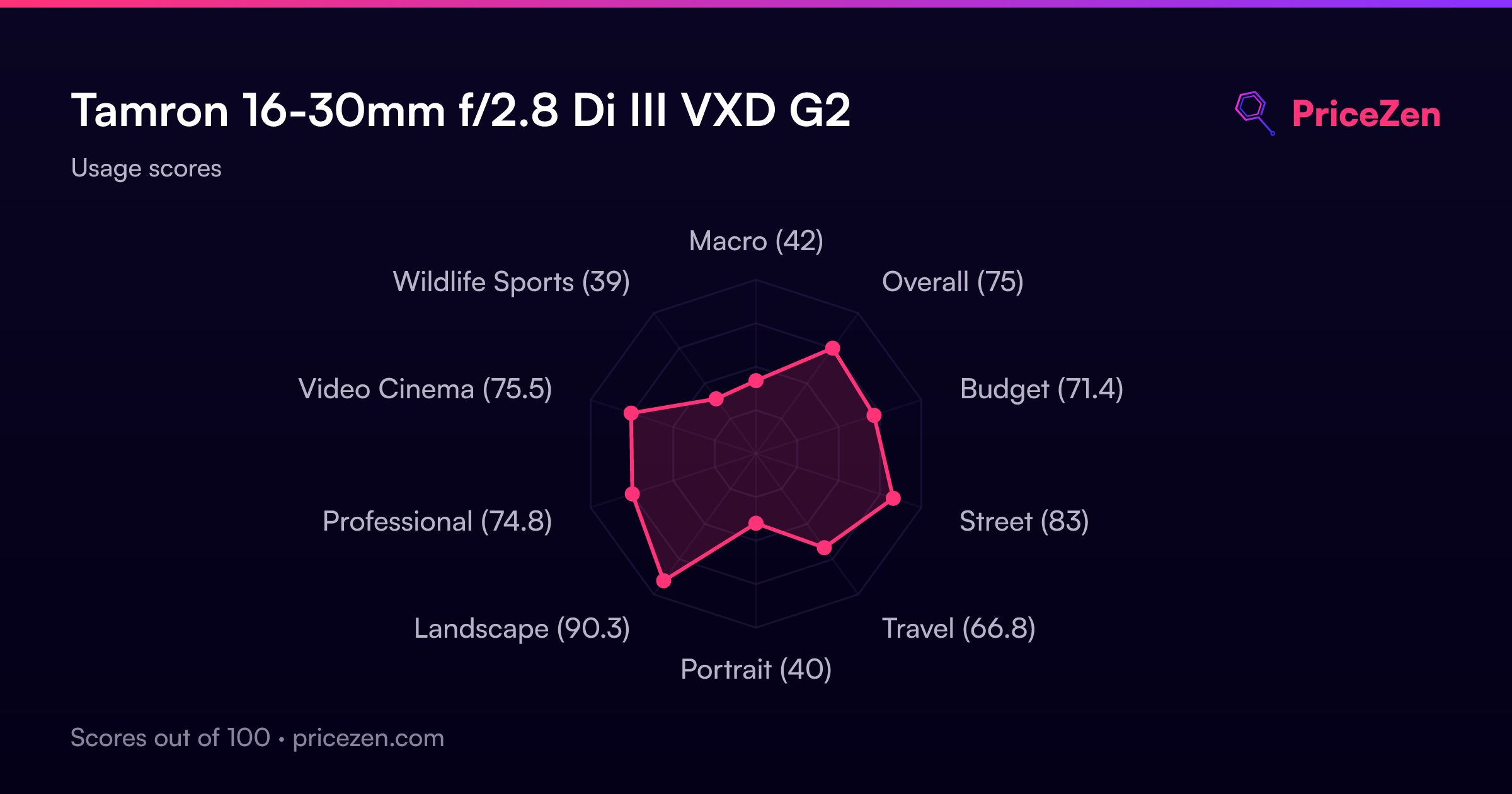
- Macro42
- Overall76
- Budget70.6
- Street83.1
- Travel66.8
- Portrait40.2
- Landscape90.4
- Professional74.9
- Video Cinema75.7
- Wildlife Sports39