DZOFILM Pictor 12-25mm T2.8 APS-C

12-25mm zoom at a constant f/2.8 verified Nov 29
48/100 overall score
Prices checked on 1 days so far, too few to say what is usual.
- Focal length
- 12-25mm
- Aperture
- f/2.8
- Mount
- ARRI PL
- Format coverage
- APS-C
- Weight
- 1600 g
- Lens type
- zoom
Compare prices at 1 store
Cheapest first. New, refurbished and bundled offers are kept apart, so you compare like with like.
| Store | Sold by | Colour and condition | Price | vs lowest | Last checked | Link |
|---|---|---|---|---|---|---|
| New1 offerSingle unit | ||||||
| Amazon | Not known | Not listed | €3,533.11 | Lowest price | 4 days ago | Go to store |
 Source: PriceZen, checked Nov 25, 2026
A price counts as current when we checked it in the last 7 days. “Marketplace seller” means a third-party seller on that store, not the store itself.











Snapshot
The 30-Second Version
The Pictor 12-25mm T2.8 is a dedicated Super35 cine zoom with top-tier optics, parfocal focus and a 16-blade iris. It's also 1600g, unsealed, unstabilized and priced from USD 1,699, with Canadian listings ranging from CAD 2,362 to CAD 3,786. Buy it for controlled wide-angle film work on PL or EF cameras. Skip it for handheld, low-light or shallow-depth-of-field shooting.
Pros & Cons
Pros
- Optical quality among the best in this category 96th
- Parfocal design holds focus from 12mm through 25mm 84th
- 16-blade iris for round highlights and clean stops to T22 79th
- 0.8 MOD cine gears plus swappable PL mount with EF included 73rd
- Strong wide coverage, well above average, 400mm close focus
Cons
- 1600g puts portability near the bottom
- Affordability ranks near the bottom, this is expensive glass
- No stabilization and no weather sealing
- Bokeh scores 21/100, T2.8 won't isolate subjects much
- Macro is the weakest area at 24.2/100 despite 400mm close focus
The proof
Performance
The headline number is that top-tier optical ranking, and it's backed by a genuinely complex design: 21 elements in 15 groups is a lot of glass to throw at distortion control on an ultra-wide zoom. Pair that with the 16-blade iris and you get round, clean out-of-focus highlights and smooth stops down to T22 instead of the polygonal look cheaper irises give you. The near-zero breathing claim matters more than it sounds on paper. On a zoom that holds focus from 12mm to 25mm, low breathing means a rack focus doesn't subtly resize your frame, which is the difference between a shot that reads as intentional and one that reads as amateur.
The trade-offs are real and they cluster around light and distance. A constant T2.8 puts aperture at about average, middle of the pack, so this isn't a low-light monster and it won't melt backgrounds. Bokeh scores just 21 out of 100 in our rankings, a genuine weak spot, and reach sits at 34 since 25mm is where the party ends. Close focus is 400mm, which sounds handy until you see the macro score of 24.2/100 and the near-bottom macro ranking. You can get close enough for tight faces in a cramped room, but you're not shooting product details or insert work with this thing. And with stabilization at about average (read: none), every handheld frame is on you or your rig.
Specifications
Full Specifications
Optics
| Type | Zoom |
| Focal Length Min | 12 |
| Focal Length Max | 25 |
| Elements | 21 |
| Groups | 15 |
| Coating | none |
Aperture
| Max Aperture | f/2.8 |
| Min Aperture | f/22 |
| Constant | Yes |
| Diaphragm Blades | 16 |
Build
| Mount | ARRI PL |
| Format | APS-C |
| Weight | 1.6 kg / 3.5 lbs |
| Filter Thread | 86 |
AF & Stabilization
| Stabilization | No |
Focus
| Min Focus Distance | 400 |
vs Competition
The competitor set in our data is mostly fast telephoto zooms, and that contrast is instructive. The Sony FE 70-200mm f/2.8 GM OSS II, Sigma 70-200mm f/2.8 DG DN OS Sports and Tamron 70-180mm f/2.8 Di III VC VXD G2 all live at the opposite end of the focal range from this lens. Against them, the Pictor gives ground on reach (34th percentile), subject isolation (bokeh at 21/100) and weight (near-bottom portability). What it wins is everything cine-specific: parfocal zooming, geared rings, a 16-blade iris and PL mounting. If your work is compressed portraits, events or sports, cross-shop those three first. If your work is wide, controlled, scripted frames, they're not really substitutes.
The Canon RF 24-105mm f/2.8L IS USM Z is the closer philosophical rival, a zoom built with video crews in mind, and the Viltrox AF 35mm f/1.2 LAB FE is the option for people who mainly want speed and separation from a single focal length. Here the Pictor's argument is its well-above-average wide-angle coverage and its top-tier optics on Super35, plus the near-zero breathing that makes zooms and focus pulls usable on camera. But be honest with yourself about the about-average aperture ranking: if shallow depth of field or dim interiors drive your work, this lens is the wrong tool no matter how good the glass is.
| Spec | DZOFILM Pictor 12-25mm T2.8 | Sony FE 70-200mm f/2.8 GM OSS II | Sigma 70-200mm f/2.8 DG DN OS Sports | Canon RF 24-105mm f/2.8L IS USM Z | Nikon NIKKOR Z 70-200mm f/2.8 VR S | Tamron 35-150mm f/2-2.8 Di III VXD |
|---|---|---|---|---|---|---|
| Focal Length | 12-25mm | 70-200mm | 70-200mm | 24-105mm | 70-200mm | 35-150mm |
| Max Aperture | f/2.8 | f/2.8 | f/2.8 | f/2.8 | f/2.8 | f/2-2.8 |
| Mount | ARRI PL | Sony E | Sony E | Canon RF | Nikon Z | Sony E |
| Format Coverage | APS-C | full-frame | full-frame | full-frame | full-frame | full-frame |
| Stabilization | No | Yes | Yes | Yes | Yes | No |
| Weather Sealed | No | Yes | Yes | Yes | Yes | Yes |
| Weight (g) | 1600 | 1045 | 1345 | 1300 | 1440 | 1165 |
| AF Type | - | XD Linear Motors | HLA (High-response Linear Actuator) | Nano USM | STM (stepping motor) | VXD linear motor |
| Lens Type | zoom | zoom | zoom | zoom | zoom | zoom |
| Compare | Compare | Compare | Compare | Compare |
| Product | Bokeh | Build | Macro | Reach | Video | Optical | Aperture | Wide Angle | Portability | Versatility | Affordability | Stabilization |
|---|---|---|---|---|---|---|---|---|---|---|---|---|
| DZOFILM Pictor 12-25mm T2.8 | 20.6 | 64.2 | 7.2 | 34.4 | 78.8 | 96.2 | 43.1 | 84 | 8.7 | 72.5 | 15.7 | 41.5 |
| Sony FE 70-200mm f/2.8 GM OSS II Compare | 88.6 | 99.9 | 77.3 | 83.6 | 85.2 | 89.3 | 43.1 | 28.9 | 19.2 | 78.5 | 12.7 | 97.2 |
| Sigma 70-200mm f/2.8 DG DN OS Sports Compare | 88.6 | 98.9 | 55.9 | 83.6 | 85.2 | 99.9 | 43.1 | 28.9 | 12.1 | 78.5 | 24.2 | 99.9 |
| Canon RF 24-105mm f/2.8L IS USM Z Compare | 78.1 | 98.9 | 76.2 | 73.8 | 85.2 | 97.8 | 43.1 | 73.9 | 13.3 | 91.5 | 10.7 | 95.9 |
| Nikon NIKKOR Z 70-200mm f/2.8 VR S Compare | 85.9 | 98.9 | 58.1 | 83.6 | 85.2 | 98 | 43.1 | 28.9 | 10.3 | 78.5 | 14.5 | 98.6 |
| Tamron 35-150mm f/2-2.8 Di III VXD Compare | 88.4 | 77.2 | 51.5 | 80.3 | 69.7 | 96.6 | 64.1 | 52.8 | 16.2 | 90.8 | 24 | 41.5 |
Price
Value & Pricing
At USD 1,699 from Amazon, this is a serious chunk of change for a lens that only covers Super35 and only spans 12-25mm. Our affordability ranking near the bottom isn't a judgment on build quality, it's just math: most products in this category cost less. What you're paying for is that top-tier optical performance and the cine mechanics, and if you're billing clients for wide-angle work, those things earn their keep. If you're a hobbyist, the value argument gets thin fast.
Pricing gets messy depending on where you shop. In Canada we're tracking three listings spread from CAD 2,362 to CAD 3,786, a gap of CAD 1,424 for the same lens. That's not a rounding error, that's a follow focus unit's worth of difference, so compare Canadian retailers before you click buy. European listings run EUR 3,310 to EUR 3,533 across four stores, and Brazil sits at BRL 19,082. We track these prices over time, partly through our community browser extension, and the Canadian spread alone is reason enough to slow down and shop around.
We started tracking prices for this product on Nov 25, 2026. The chart appears once we have more data.
Read more
Overview
The DZOFILM Pictor 12-25mm T2.8 is a proper cine zoom, not a photo lens with a video mode bolted on. It covers Super35/APS-C sensors through an ARRI PL mount (with a Canon EF mount included in the box), holds focus across the whole zoom range, and puts 0.8 MOD cine gears on the focus, iris and zoom rings so it plays nicely with follow focus units and motors. The optical recipe is 21 elements in 15 groups, and the iris uses 16 blades. If you shoot narrative or commercial work on a Super35 camera and you want wide establishing shots that can push in without a focus pull mid-move, this is aimed squarely at you.
What makes it interesting is where it lands in our rankings. Optical quality is among the best in this category, about as good as it gets in our data. Wide-angle coverage is strong too, well above average, and video suitability is solidly above average. So the glass and the geometry are the story here. This is a lens you buy because of how it draws a wide frame, not because it's convenient.
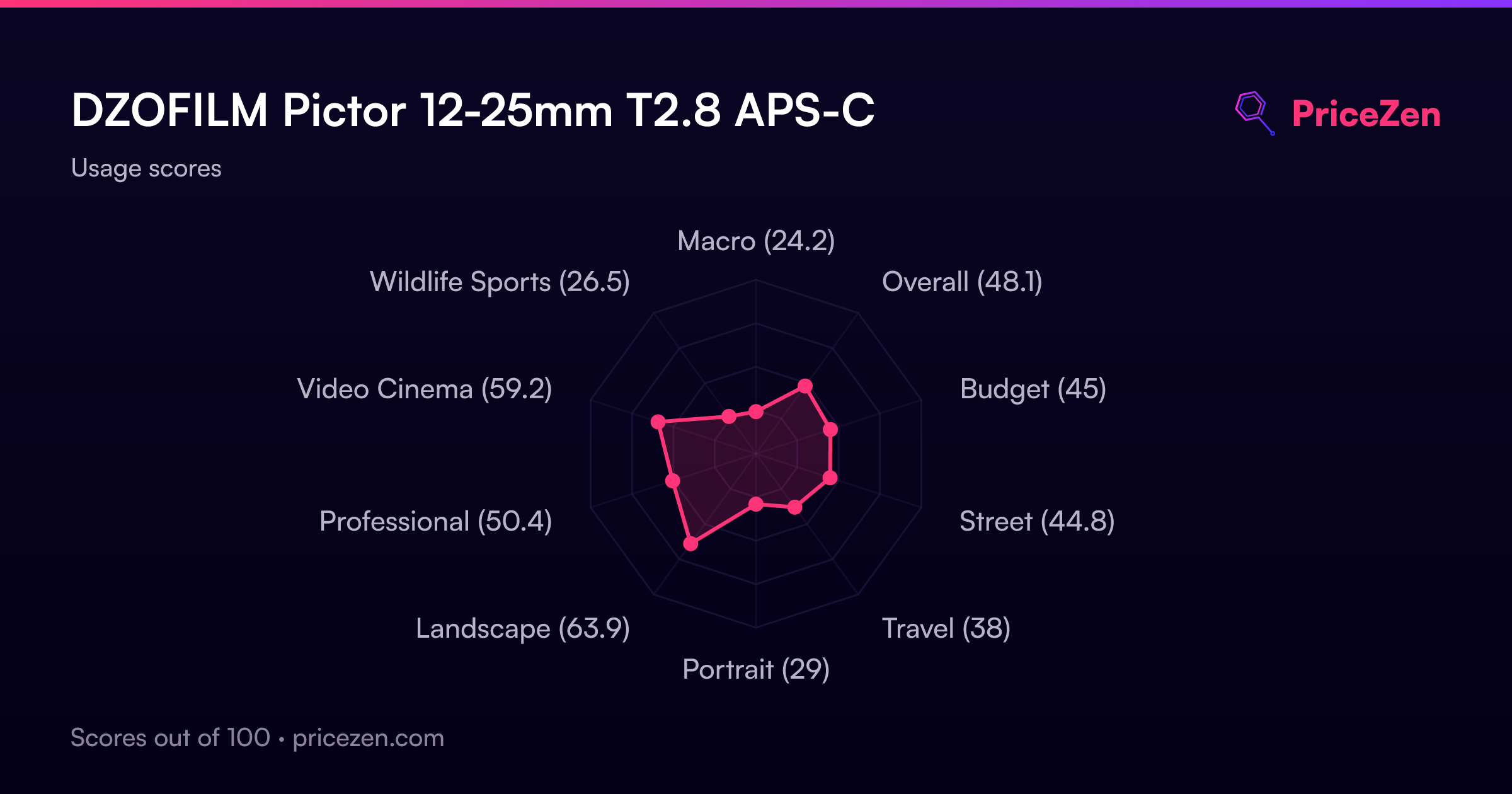
And convenience is exactly what you give up. There's no stabilization, no weather sealing, and at 1600g it lands near the bottom for portability, one of the weakest showings we track in this category. Affordability is barely better, also near the bottom. Our scoring puts its best use case at landscape (64.2/100), then video cinema (59.2/100) and professional work (50.4/100). That ordering tells you a lot: it's a specialist tool for controlled shoots, not a run-and-gun companion.
Common Questions
Q: Will this cover my full-frame camera?
No, it's designed for Super35/APS-C coverage, so on a full-frame sensor you'd need to shoot in a crop mode. That's normal for cine zooms in this class, and the 12-25mm range is meant to be read against a Super35 field of view. If you need native full-frame coverage, this isn't the lens.
Q: Does it really hold focus while zooming?
Yes, that's the point of a parfocal design, and it's listed as maintaining focus throughout the zoom range. Combined with the near-zero breathing spec, you can push in from 12mm to 25mm during a take without your focus mark drifting or your framing subtly resizing. For scripted work, that's the feature you're paying for.
Q: Can I use it on a Canon EF camera, or is it PL only?
It ships with a swappable PL mount and a Canon EF mount included, so you can run it on EF-mount cinema cameras without buying anything extra. Just note there's no stabilization and autofocus isn't part of the cine design, so plan on manual focus with the 0.8 MOD gears, ideally with a follow focus.
Q: Is T2.8 enough for low-light shooting?
It's workable but not a strength. A constant T2.8 puts this lens at about average for aperture in our data, right in the middle of the pack, and its bokeh score of 21/100 confirms it won't give you heavy subject separation. For dim interiors or creamy backgrounds, a faster lens is the better call.
Who Should Skip This
Handheld and run-and-gun shooters should walk away. With no stabilization (about average), no weather sealing and 1600g of front-end weight (near-bottom portability), this lens demands a tripod, gimbal or shoulder rig and dry conditions. Event videographers and travel shooters will be happier with a stabilized zoom like the Tamron 70-180mm f/2.8 Di III VC VXD G2 or the Sony FE 70-200mm f/2.8 GM OSS II, assuming the longer focal range suits their work.
Portrait shooters chasing background blur and macro shooters chasing detail should skip it too. Bokeh at 21/100 and a macro score of 24.2/100 (near-bottom) are hard limits, not quirks you can work around, and 25mm of reach won't flatter a face the way a telephoto does. If shallow depth of field is your signature, look at something like the Viltrox AF 35mm f/1.2 LAB FE instead.
Verdict
For indie filmmakers and small crews shooting Super35 narrative, documentary interviews in tight rooms, or wide commercial setups, this is a strong buy. The combination of top-tier optics, parfocal behavior, geared rings and both PL and EF mounts in the box is exactly what a working cine zoom should deliver, and our video score of 79 backs that up. Budget for support though, because 1600g on the front of a camera is a rig decision, not an accessory decision.
For photographers, hybrid shooters and anyone who works handheld or outdoors in bad weather, we'd pass. No stabilization, no sealing, weak bokeh and a macro score of 24.2/100 mean this lens fights you in exactly the situations those shooters live in. And if USD 1,699 (or up to CAD 3,786 depending on the listing) is a stretch, remember you're buying a specialist. Specialists are wonderful when they match your job and expensive paperweights when they don't.
Usage Scores
- Macro24.2
- Overall48.1
- Budget45
- Street44.8
- Travel38
- Portrait29
- Landscape63.9
- Professional50.4
- Video Cinema59.2
- Wildlife Sports26.5